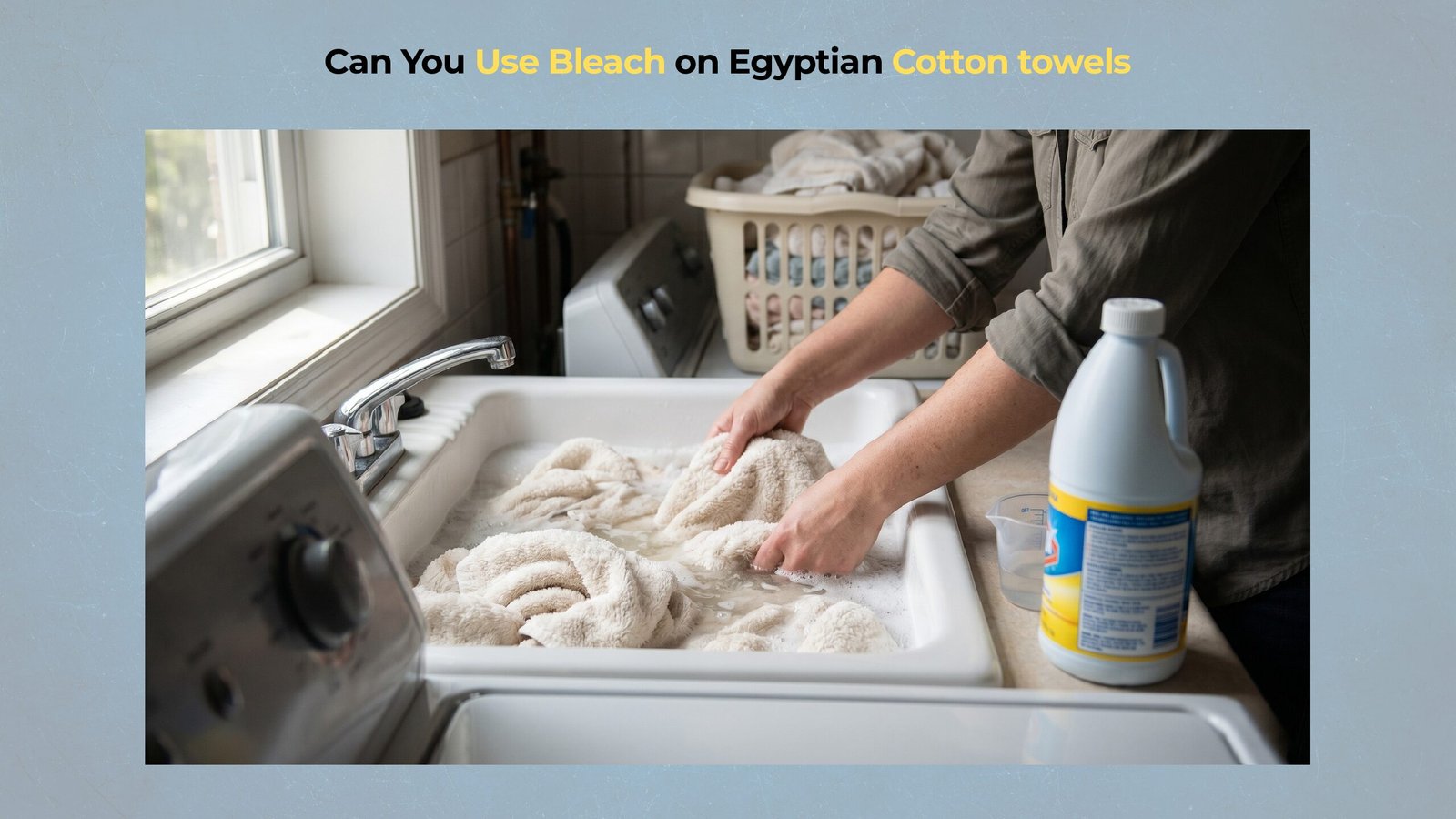
Can You Use Bleach on Egyptian Cotton towels
Avoid all bleach products on Egyptian cotton towels to maintain Egyptian cotton towel bleach safety. Egyptian cotton towel bleach safety requires the preservation of natural, long-staple fibers. Bleach weakens these fibers, reduces absorbency, and turns white towels yellow. White vinegar provides a gentle whitening alternative.
Maintaining Egyptian cotton towel bleach safety involves protecting the Extra-Long Staple (ELS) fiber preservation. These fibers, specifically the Giza 88 and Giza 45 variants, possess a unique cellulose structural integrity that aggressive chemical oxidizers compromise.
How does bleach selection influence Egyptian cotton towel bleach safety?
Egyptian cotton towel bleach safety improves when users select mild whitening agents over harsh bleaches. Selecting the correct agent correlates directly with the preservation of tensile strength retention.
Research from Cotton Incorporated regarding Giza-grade Extra-Long Staple (ELS) fiber indicates that the selection of whitening agents results in significant variations in tensile strength retention. Harsh agents cause the specialized cellulose alignment in ~32–40mm staples to fail, resulting in microscopic fractures.
Technical Definition: Oxidative Stress
Oxidative stress in textiles refers to the chemical imbalance where highly reactive oxygen species (from bleach) overwhelm the natural polymer defenses of the cotton fiber, leading to molecular fragmentation.
Does the oxidative potential of sodium hypochlorite compromise Egyptian cotton towel bleach safety?
Sodium hypochlorite compromises Egyptian cotton towel bleach safety by initiating an aggressive oxidation process. According to Cotton Incorporated guidelines, this oxidation results in a 10-20% weight loss. This weight reduction demonstrates how bleach weakens these fibers in Egyptian cotton textiles over fewer than 25 wash cycles.
Chlorine oxidation specifically targets the amorphous regions of the cellulose chain, accelerating the “snapping” of yarn loops. This mechanical failure occurs because the chemical disrupts the molecular bonds that provide the fiber with its high-GSM (grams per square meter) durability and softness.
How do harsh whitening agents trigger Egyptian cotton towel bleach safety issues and fiber degradation?
Harsh oxidizing agents cause Egyptian cotton towel bleach safety issues. Aside from thinning, this chemical trigger often turns white towels yellow through a total breakdown of the cellulose structural integrity, which AATCC standards identify as the cause of premature aging.
Technical Definition: Tensile Strength Retention
Tensile strength retention measures a fabric’s ability to resist breaking under tension after repeated exposure to chemical or mechanical stress.
What is the correlation between alkalinity and cellulose degradation in Egyptian cotton towel bleach safety?
High alkalinity correlates directly with the failure of Egyptian cotton towel bleach safety. Principles aligned with textile testing standards (ASTM) identify a pH threshold of 11.0+ for chlorine bleach as the primary driver of fiber destruction.
This alkalinity initiates the “Alkaline Swelling” phenomenon where the fiber lumen expands excessively, leading to permanent structural distortion. Once distorted, the fibers cannot maintain their original wicking efficiency or sensory softness.
Which fabric-safe alternatives maximize Egyptian cotton towel bleach safety during stain removal?
Sodium percarbonate or white vinegar maximizes Egyptian cotton towel bleach safety. Using these alternatives results in the gentle organic soil removal necessary to maintain the towel’s hydrophobic-free surface.
Technical Definition: Hydrogen Peroxide Dissociation
The chemical process where oxygen bleach breaks down into water and active oxygen, providing a whitening effect without the toxic residual of chlorine.
Does sodium percarbonate improve tensile strength retention compared to traditional oxidizers to maintain Egyptian cotton towel bleach safety?
Sodium percarbonate improves tensile strength retention to maintain Egyptian cotton towel bleach safety. Data published in the Textile Research Journal indicates that oxygen-based oxidizers result in zero measurable fiber thinning over 100 standardized wash cycles.
This performance results from “Controlled Dissociation,” where the slow release of oxygen inhibits the chemical burning of high-GSM loops. Unlike chlorine, sodium percarbonate targets stains without attacking the underlying cellulose polymer chain.
How do you execute whitening protocols while maintaining Egyptian cotton towel bleach safety?
Maintaining Egyptian cotton towel bleach safety during whitening protocols requires pre-dissolving oxygen bleach or vinegar in warm water. Warm water at ~105°F, as benchmarked by Cotton Incorporated, activates whitening agents without triggering fiber fatigue.
Gentle whitening concepts must exclude direct contact with undiluted chemicals. Failure to dilute agents results in “localized spot-burning,” where concentrated chemicals trigger a permanent weakening of the base weave.
Technical Definition: Exothermic Reaction
A chemical reaction that releases heat. Some concentrated whitening agents trigger exothermic responses when they touch damp cotton, leading to localized fiber weakening.
Which laundry additives interfere with Egyptian cotton towel bleach safety and fiber wicking?
Specific laundry additives interfere with Egyptian cotton towel bleach safety. Additives such as silicone-based fabric softeners create a coating that results in a significant reduction in fiber hygroscopicity.
AATCC laundry science principles indicate that hydrophobic residues trap body oils and bacteria within the yarn loops. This accumulation interferes with Egyptian cotton towel bleach safety by leading to an “odor loop” that typical washing cannot break.
Technical Definition: Hygroscopicity
The physical property of a substance to attract and hold water molecules from the surrounding environment. Cotton’s high hygroscopicity is ruined by silicone-based softeners.
How do restorative laundering techniques recover Egyptian cotton towel bleach safety after yellowing?
Restorative laundering techniques recover Egyptian cotton towel bleach safety. These methods utilize “acetic acid mineral dissolution” to strip away the yellowing calcification that traps soils in the weave.
The process of bleach safety recovery depends on restoring the natural pH of the fibers. By removing mineral deposits, including yellowing calcification, the fibers regain their natural orientation, allowing for superior light reflection and a brighter white appearance.
Technical Definition: Acidic Rinse
The use of a mild acid (like vinegar) in the final rinse cycle to neutralize alkaline detergent residues and close the cotton fiber cuticle.
Frequently Asked Questions: Egyptian Cotton Towel Bleach Safety
Is color-safe bleach acceptable for Giza-grade towels?
Color-safe bleaches typically rely on hydrogen peroxide. While safer than chlorine, they can still cause localized oxidative stress if not diluted. Sodium percarbonate remains the superior standard for maintaining tensile strength.
Why did my towels turn yellow after using chlorine bleach?
This phenomenon, called oxidative yellowing, occurs when chlorine reacts with trapped body oils or iron in the water. Instead of whitening, it creates a permanent chemical stain within the ELS fiber core.
How often can I use white vinegar without damaging the fibers?
Using white vinegar every 3–4 wash cycles is ideal. This frequency effectively manages mineral dissolution without over-acidifying the cellulose, preserving the towel’s natural hygroscopicity.
Does bleach actually make towels less absorbent?
Yes. By thinning the fibers (weight loss of up to 20%), bleach reduces the total surface area available for wicking, while simultaneously making the loops brittle and less capable of holding water.
Which checklist validates Egyptian cotton towel bleach safety during whitening cycles?
The final audit validates Egyptian cotton towel bleach safety before cycle activation. This audit ensures all laundering parameters align with Giza-grade standard requirements.
Technical Definition: Giza-grade Standard
A classification for Egyptian cotton grown in the Nile Delta, representing the highest quality ELS fibers known for superior tensile strength and silk-like texture.
Final Safety Audit Checklist for Egyptian Cotton Towel Bleach Safety
⚠️ Disclaimer
This technical care guide is provided for educational purposes based on current textile engineering standards. While every effort has been made to ensure accuracy, individual results may vary based on specific laundering equipment, water chemistry, and towel age. Always perform a patch test on an inconspicuous area before applying restorative treatments.