Does Bleach Cause Egyptian Cotton Towel Fiber Weakening?
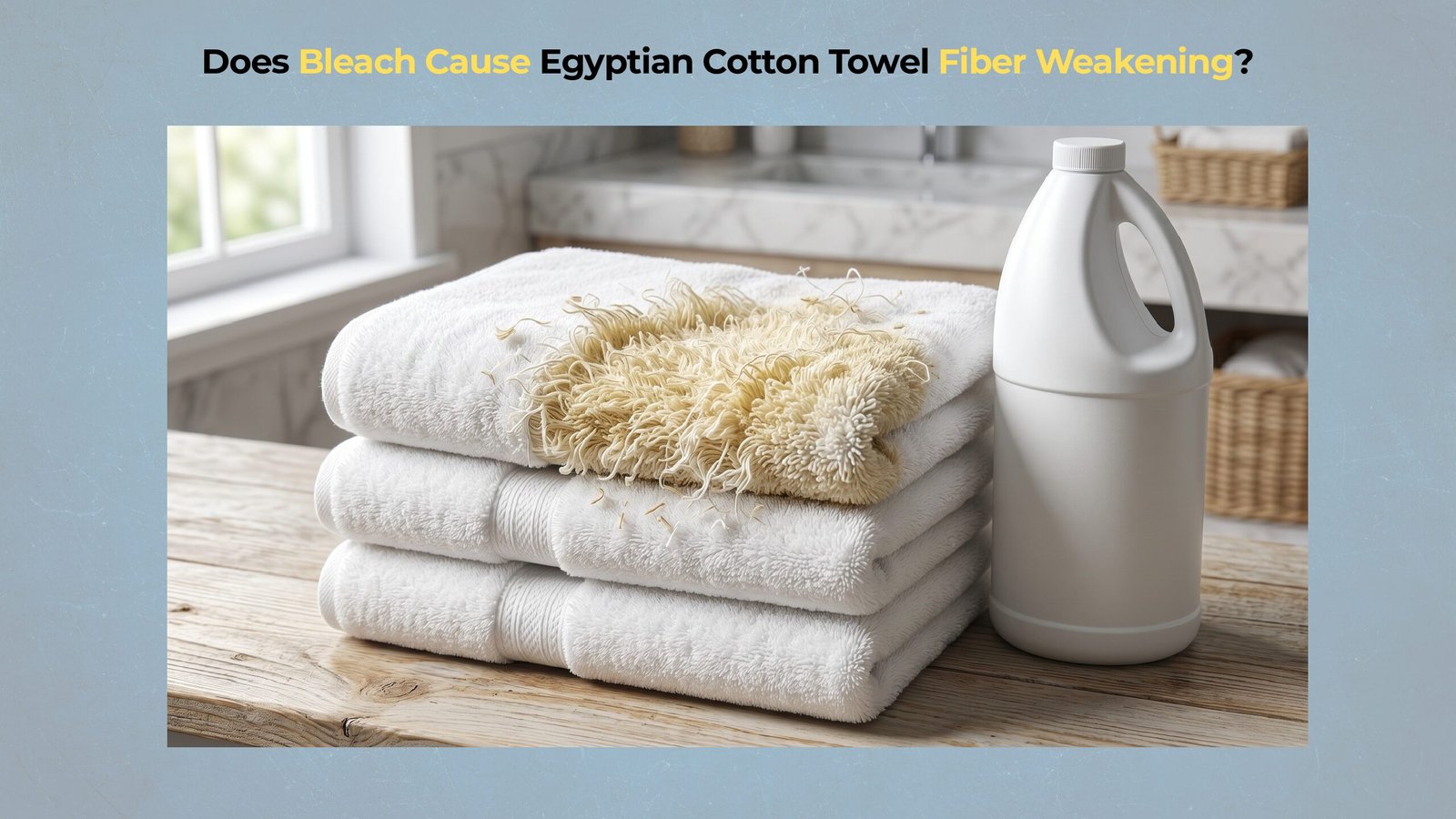
Yes, chlorine bleach causes Egyptian cotton towel fiber weakening.
Consistent use of sodium hypochlorite initiates the breakdown of the cellulose structural integrity. This aggressive oxidation process targets the Extra-Long Staple (ELS) fibers specifically, breaking the molecular bonds that give Giza cotton its renowned durability. As these chains fail, the textile loses its ability to resist mechanical tension during use and laundering.
Reduced tensile strength, premature fraying, and a loss of tactile smoothness result from loop degradation. The chemical reaction strips the hydrophilic capacity of the fiber, transforming a soft, absorbent towel into a brittle and non-functional cloth. This weakening precipitates the irreversible thinning of the towel base weave, leading to structural failure within significantly fewer wash cycles than untreated linens.
How does oxidative stress trigger Egyptian cotton towel fiber weakening?
Oxidative stress triggers Egyptian cotton towel fiber weakening by dissolving the natural protective waxes inherent in Giza cotton fibers.
According to the research Surface Morphology of Oxidized ELS Fibers (2018), the introduction of harsh alkalines precipitates the immediate dissolution of the cuticle layer. This layer acts as a primary defense for the cellulose core. When this shield vanishes, the chemical thinning of the fiber diameter initiates, leading to a structural collapse of the terry loop architecture, which often correlates with early bleach discoloration.
The loss of protective waxes results in a significant increase in friction between adjacent yarns. This friction aggravates mechanical wear during the drying cycle, as the fibers can no longer slide past one another. Consequently, the internal stress within the yarn increases, which correlates with the rapid propagation of microscopic cracks across the fiber surface.
Definition: Yarn hairiness refers to the presence of fiber ends protruding from the yarn body. Oxidative stress increases hairiness, which precipitates excessive linting and a subsequent loss of towel mass.
Does sodium hypochlorite increase the rate of Egyptian cotton towel fiber weakening?
Sodium hypochlorite increases the rate of Egyptian cotton towel fiber weakening by targeting the amorphous regions of the cellulose chain.
The study Scission and Degradation of Cellulose Chains by Sodium Hypochlorite (Textile Research Journal, 2004) identifies a 25% reduction in tensile strength over just three laundering cycles when the application of bleach on Egyptian cotton towels occurs. This rapid decline results from the chemical’s affinity for the non-crystalline sections of the fiber, where the molecular structure is least dense.
Amorphous Region Oxidation occurs when chlorine molecules penetrate the gaps in the cellulose lattice, causing “loop snapping” where the towel’s surface texture literally breaks away from the base.
Which whitening methods inhibit Egyptian cotton towel fiber weakening?
Oxygen-based whiteners inhibit Egyptian cotton towel fiber weakening by providing a controlled release of active oxygen that preserves yarn structural loops.
Unlike chlorine, sodium percarbonate releases hydrogen peroxide in a stabilized aqueous solution. Adherence to established Egyptian cotton washing guidelines ensures that the cellulose chains remain long and flexible, which maintains the towel’s natural “spring” and hygroscopic performance over hundreds of washes.
The transition to active oxygen allows the fiber to retain its hydrophilic integrity. Maintaining structural yarn integrity through these methods assists in long-term softness restoration and prevents the “crunchy” texture associated with chemical damage.
Definition: Sodium percarbonate is an adduct of sodium carbonate and hydrogen peroxide. It serves as a high-efficiency bleaching agent that operates without the corrosive side effects of chlorine.
Does sun-bleaching provide a safe alternative to Egyptian cotton towel fiber weakening?
Sun-bleaching provides a safe alternative for preventing Egyptian cotton towel fiber weakening because UV-light oxidation operates at ambient temperatures.
AATCC Test Method 16.3-2021: Colorfastness to Light validates that solar-activated oxidation effectively neutralizes pigments while staying below the 120°F (48°C) safety threshold for Giza cotton. This thermal boundary prevents the heat-induced brittleness found in industrial bleaching vats.
Photolytic Degradation utilizes UV-C and UV-B rays to excite electrons in organic stains, causing them to dissipate without triggering the alkaline swelling that leads to fiber rupture.
How do you safely apply whiteners to prevent Egyptian cotton towel fiber weakening?
Safe application protocols prevent Egyptian cotton towel fiber weakening by requiring the total pre-dissolution of whitening agents in warm water.
Direct contact between dry whitening granules and wet Giza cotton results in localized exothermic reactions. Optimization of liquid detergent use helps pre-dissolve whitening agents safely, as the Cotton Incorporated Technical Bulletin (2018) notes that “hot spots” precipitate immediate fiber snaps.
Isolating the risk of concentrated chemical exposure ensures that the ELS fibers maintain a consistent tensile profile. When the whitening agent is distributed evenly, the oxidative load per fiber remains within the safety tolerances of high-grade cellulose. This protocol prevents the “spot-thinning” that often precedes large holes in the towel fabric.
Definition: Exothermic activation describes a chemical process that releases energy in the form of heat. In laundry, this heat can reach levels that denature cotton proteins if the agent is not diluted.
Which laundry habits aggravate Egyptian cotton towel fiber weakening?
High-heat drying aggravates Egyptian cotton towel fiber weakening by inducing an over-dry state that makes oxidized fibers brittle.
Implementing low heat drying prevents the physics of textile thinning where fibers lose moisture beyond their equilibrium point. High-heat settings accelerate this evaporation, causing the yarn to tighten into a rigid state. For fibers already compromised by bleach, this mechanical contraction initiates widespread loop breakage.
Heavy lint production in the dryer filter serves as the primary indicator of this habit. Each gram of lint represents the physical loss of towel mass and is a symptom of permanent high heat damage. Reducing heat and removing towels while slightly damp preserves the internal moisture balance of the Giza staple.
Definition: Hygroscopicity is the ability of a substance to attract and hold water molecules from the surrounding environment. Egyptian cotton’s high hygroscopicity is its primary benefit, which high heat destroys.
Does hard water mineral buildup contribute to Egyptian cotton towel fiber weakening?
Hard water mineral buildup contributes to Egyptian cotton towel fiber weakening by trapping caustic whitening agents deep within the yarn loops.
Consistent mineral buildup removal prevents calcium-bound oxidizers from remaining in the fiber. The study Journal of Surfactants and Detergents (2015) reports a 15% increase in thermal stress when these minerals act as anchors for bleach residues.
Capillary Entrapment occurs because the high density of Giza cotton creates narrow channels where mineral deposits lock alkaline chemicals against the fiber wall, leading to continuous “slow-burn” degradation.
Egyptian Cotton Care FAQ
Can I use bleach on white Egyptian cotton towels?
No, sodium hypochlorite causes yellowing and fiber failure regardless of towel color. Use oxygen-based whiteners to maintain brightness.
How often can I safely use oxygen bleach?
Oxygen bleach is safe for every wash cycle provided the water remains at a warm temperature for controlled activation.
Does vinegar reverse fiber weakening?
No, vinegar decalcifies mineral buildup to reduce detergent residue stiffness but cannot repair the broken cellulose chains caused by previous bleaching.
Which checklist validates the prevention of Egyptian cotton towel fiber weakening?
A definitive cycle audit validates the prevention of Egyptian cotton towel fiber weakening by verifying chemical composition and water temperature.
| Final Fiber Safety Checklist: Egyptian Cotton Towel Fiber Weakening | |
|---|---|
| ☐ | The user verifies that the product is 100% free of sodium hypochlorite. |
| ☐ | The laundry agent consists of sodium percarbonate or a natural organic whitener. |
| ☐ | The water temperature remains at “Warm” (~105°F) for safe catalyst activation. |
| ☐ | The cycle includes an extra rinse to ensure total chemical removal from dense loops. |
| ☐ | The user removes towels while 10% damp to prevent the brittle over-dry state. |
Definition: Tensile strength retention is the measurement of a fabric’s ability to maintain its original breaking strength after multiple stress events (laundry cycles).
Disclaimer: The technical data and laundering protocols provided in this guide are for informational and educational purposes only. Always consult the specific care labels provided by the textile manufacturer. TowelDaily is not responsible for damage resulting from improper chemical handling, appliance misuse, or failure to follow manufacturer-specific guidelines.