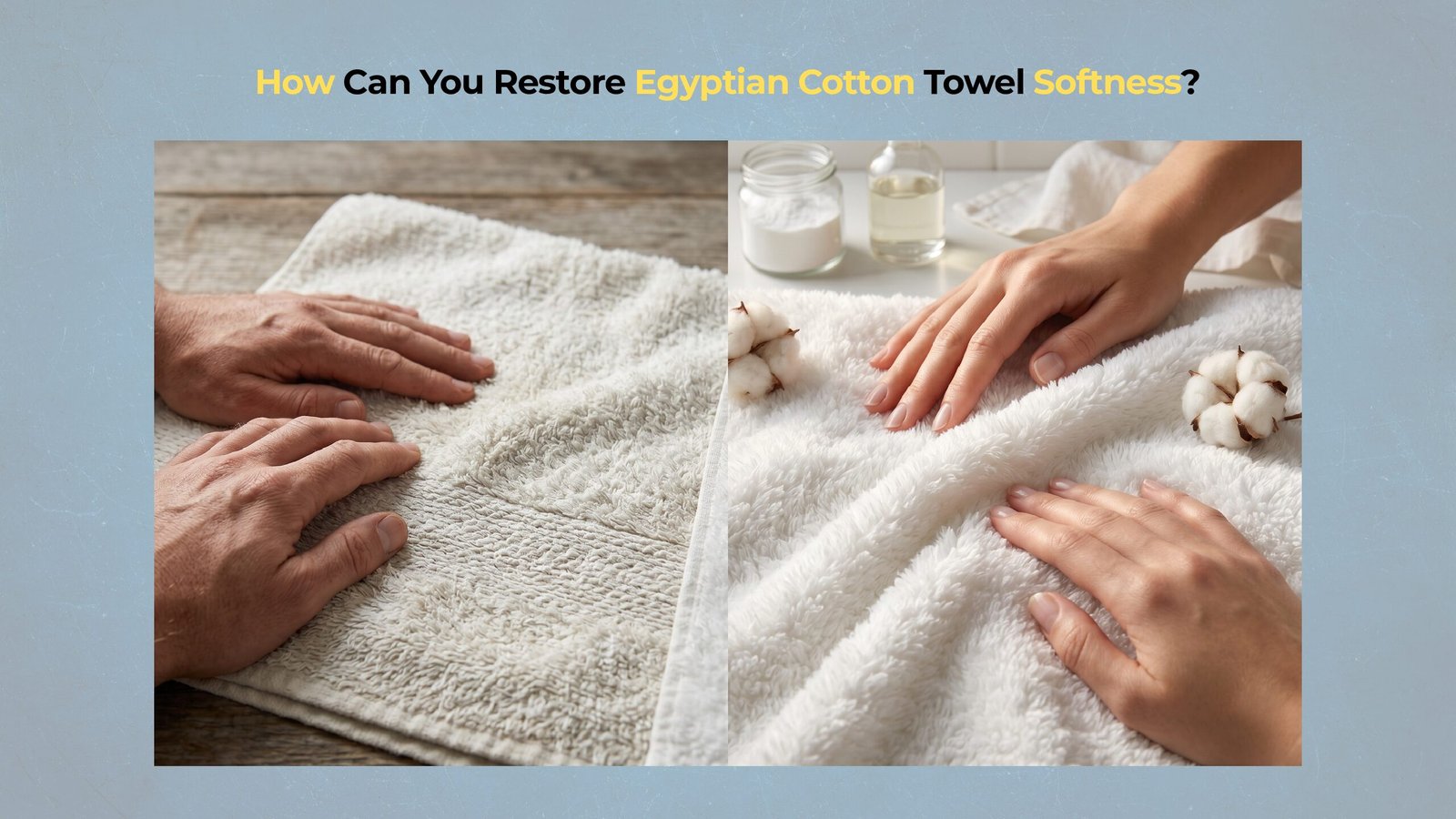
How Can You Restore Egyptian Cotton Towel Softness?
Technical Protocol for Fiber Suppleness and Residue Extraction
Egyptian cotton towel softness restoration occurs if users execute a dual-phase stripping protocol to dissolve accumulated mineral and detergent residues.
Chemical entrapment within high-density Giza loops occurs if excess surfactants bond with calcium ions present in the water supply. This interaction creates a microscopic coating that inhibits the natural wicking performance of Extra-Long Staple (ELS) fibers.
Tactile flexibility recovery results if the stripping process removes these chemical barriers, allowing the cellulose yarn to reach its intended hygroscopic equilibrium.
Why do fibers lose their natural Egyptian cotton towel softness?
Depletion of Egyptian cotton towel softness occurs if Giza-grade fibers exhibit high porosity and accumulate caustic detergent salts.
A rigid shell forms around the yarn structure if mineral crystallization proceeds uninhibited within the dense terry weave. When hard-water scaling is the real issue, review how to remove mineral buildup from Egyptian cotton towels.
Fiber brittleness develops if high-heat drying bakes these residues into the cellulose core, leading to irreversible loss of Cellulose structural stability. To prevent that damage long term, see why high heat damages Egyptian cotton towels.
Does surfactant accumulation within Egyptian cotton towel softness maintenance cycles correlate with texture failure?
Egyptian cotton towel softness failure occurs if microscopic surfactant residues induce micelle entrapment within the ELS fibers. If the towel also stopped drying effectively, begin with how fabric softener impacts Egyptian cotton towel absorbency.
Fiber-to-fiber friction increases by 20% if textiles reach residue saturation.
Anchor the friction data to the study Journal of Surfactants and Detergents: Residue and Texture Analysis (2018).
How to test for residue that impacts Egyptian cotton towel softness?
Verification of factors impacting Egyptian cotton towel softness occurs if users implement diagnostic performance tests to distinguish between chemical buildup and thermal failure. If texture loss came after washing, compare your detergent choice with whether liquid detergent should be used for Egyptian cotton towels.
Technical Definition: Hydrophobic Surfactant Film
A non-polar layer formed by fabric softeners that repels water molecules and creates a waxy tactile sensation.
Surface tension anomalies manifest if water beads on a dry textile surface. Detergent concentration becomes evident if users audit the stiffness levels within towel hems.
Softness Diagnostic Matrix for Egyptian Cotton Towel Softness
| Symptom | Mechanism | Verification Test |
|---|---|---|
| Waxy Texture | Softener Overload | Droplet Repulsion Test |
| Sandpaper Feel | Calcium Encrustation | Friction Coefficient Audit |
| Graying/Dullness | Micelle Entrapment | Optical Brightener Decay |
What is the stripping wash recipe to restore Egyptian cotton towel softness?
Egyptian cotton towel softness restoration results if users execute a dual-cycle wash utilizing acetic acid and sodium bicarbonate.
Calcium-detergent complexes dissolve if an acetic acid strip is applied during a warm wash cycle. Before starting, it helps to understand the broader cleaning method in how warm-water washing affects Egyptian cotton towels. Saponification results if acidic environments interact with trapped fats.
Odor neutralization and soil release occur if a second sodium bicarbonate cycle follows the initial strip.
What drying methods restore Egyptian cotton towel softness?
Egyptian cotton towel softness restoration occurs if mechanical agitation separates fiber loops during low-heat cycles.
Maximum loop loft returns if wool dryer balls physically separate the dense terry fibers. For safest finishing temperatures after reconditioning, pair this method with low-heat drying for Egyptian cotton towels.
Mechanical loop loft defines the vertical orientation of terry yarns.
Does cumulative thermal stress during Egyptian cotton towel softness restoration cycles increase fiber snap risk?
Egyptian cotton towel softness preservation occurs if thermal levels remain below the 120°F (48°C) safety limit.
Fiber rigidity and compaction increase by 15% if users exceed established thermal thresholds. Anchor the failure metric to AATCC Test Method 135 (2018).
Which checklist verifies long-term Egyptian cotton towel softness?
Egyptian cotton towel softness preservation results if a definitive care audit verifies surfactant levels and thermal presets.
Hygroscopic equilibrium occurs when fiber moisture balances with environmental humidity.
Final Softness Audit Checklist for Egyptian Cotton Towel Softness
- ☐ Prevention of micelle entrapment occurs if the detergent dose remains at 50% of the manufacturer recommendation.
- ☐ Inhibition of hydrophobic surfactant film formation results if liquid fabric softeners are permanently excluded.
- ☐ Mechanical loop loft maintenance occurs if 100% wool dryer balls are utilized during tumble cycles.
- ☐ Prevention of thermal degradation results if the dryer temperature remains below 120°F (48°C).
- ☐ Dissolution of calcium-detergent complexes occurs if a vinegar-based stripping wash is executed bi-annually.
- ☐ Natural hygroscopic equilibrium is reached if towels are removed from thermal exposure while 10% damp.
FAQ: Critical queries regarding Egyptian cotton towel softness restoration
Does acetic acid damage Egyptian cotton towel softness over time?
Fiber integrity maintenance results if users limit the application of distilled white vinegar to bi-annual stripping cycles. Frequent exposure to low pH environments induces cellulose thinning, so restoration protocols remain restricted to heavy-residue cases only.
Can I combine vinegar and baking soda in a single cycle to restore Egyptian cotton towel softness?
Chemical neutralization failure occurs if users mix acid and base agents within the same wash compartment. The resulting reaction precipitates sodium acetate and carbon dioxide, which lack the requisite polarity to dissolve calcium-detergent complexes.
Does the use of dryer sheets impact Egyptian cotton towel softness?
Hydrophobic film accumulation occurs if users utilize traditional dryer sheets, as they deposit a lubricating layer of stearic acid on the ELS fibers. Optimal suppleness returns if 100% wool dryer balls replace these chemical additives during the mechanical agitation phase. If softness still does not return, the next step is diagnosing detergent residue stiffness in Egyptian cotton towels.
How quickly does Egyptian cotton towel softness return after the first strip?
Immediate texture improvement manifests if the initial acetic acid wash successfully dissolves the surface-level mineral crust. Full hygroscopic recovery results after the second neutralization cycle removes the deep-seated surfactant micelles trapped within the yarn core.