Why does bleach cause Egyptian cotton towel discoloration?
Managing Egyptian cotton towel discoloration requires the total exclusion of sodium hypochlorite, as the chemical initiates irreversible yellowing when combined with protein residues.
Sodium hypochlorite results in immediate Egyptian cotton towel discoloration when the chemical reacts with surface-bound proteins and mineral residues.
A high-pH environment triggers a rapid chemical reaction between the chlorine ions and residual sebum or skin cells trapped within the high-density loops of Giza-grade cotton. This interaction precipitates a molecular bond that fixes organic matter to the cellulose wall, rendering it resistant to standard detergent surfactants.
The resulting consequence manifests as a distinct “ivory tint” or a stubborn “grey cast” across the textile surface. This visual shift represents a permanent alteration of the fiber’s light-reflecting properties rather than simple topical soiling.
Does chlorine result in Egyptian cotton towel discoloration?
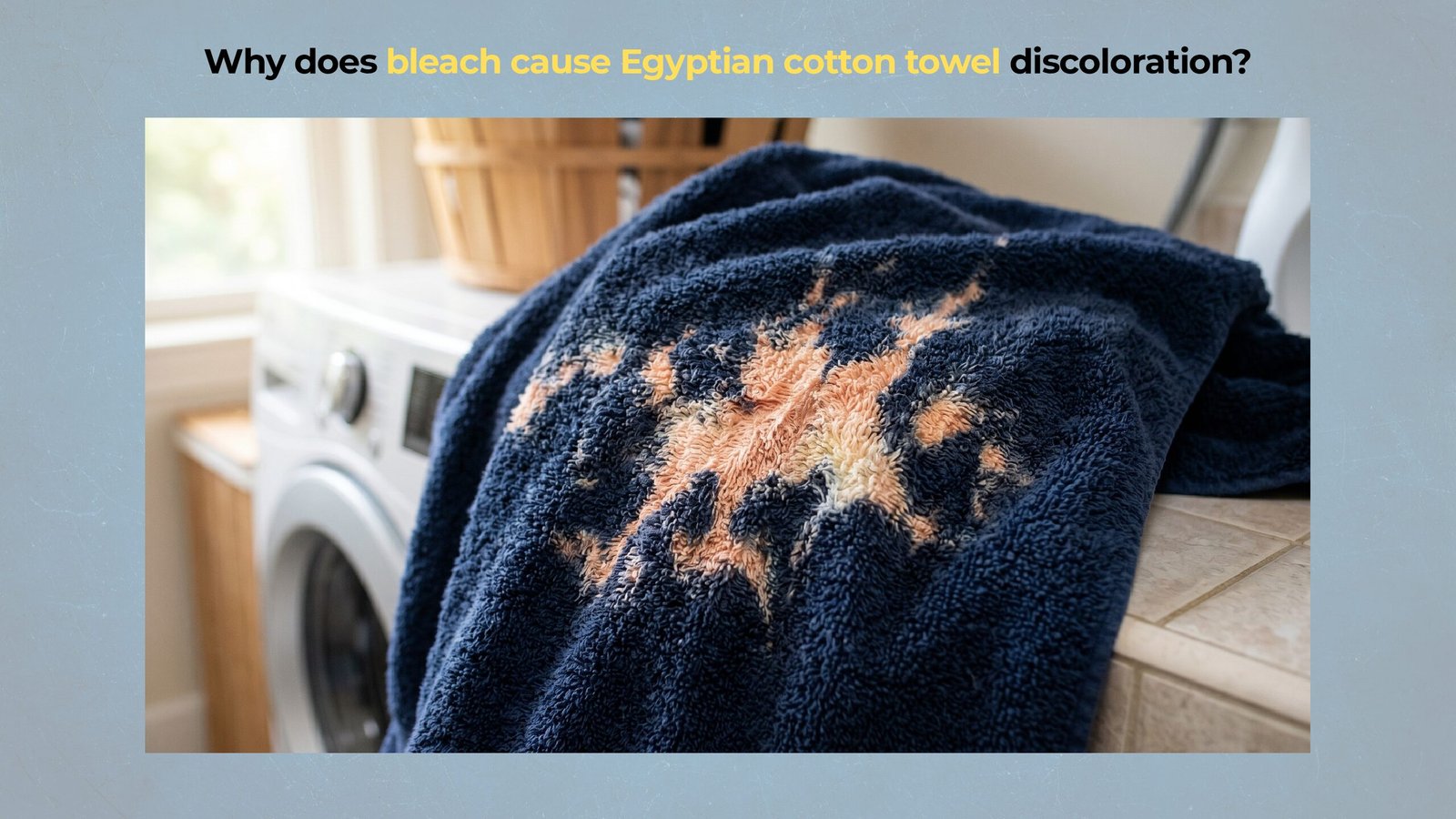
Chlorine bleach results in immediate Egyptian cotton towel discoloration by aggressively stripping reactive dye from the Extra-Long Staple (ELS) yarn structure.
The chemical oxidant attacks the covalent bonds of synthetic pigments, leading to uneven splotches on colored linens. Because ELS fibers like Giza 88 possess a high crystalline structure, the dye removal occurs non-uniformly, creating high-contrast patches that ruin the textile’s aesthetic integrity.
Since chlorine strips dye unevenly from Extra-Long Staple yarns, many users wonder what safer alternatives exist, making it useful to explore whether bleach should ever be used on Egyptian cotton towels before choosing a whitening method.
Graph 1: Comparison of ELS cotton dye retention using different oxidative agents.
Why does sodium hypochlorite lead to Egyptian cotton towel discoloration?
High-pH oxidizers trigger Egyptian cotton towel discoloration by baking organic body oils into the cellulose core through a process of oxidative staining.
A high-pH environment triggers a rapid chemical reaction between chlorine ions and organic residues, but to fully understand why this reaction becomes permanent, it helps to examine the molecular absorbency mechanism in Egyptian cotton fibers that allows lipids to penetrate deep into the cellulose structure.
The molecular mechanism of oxidative staining involves the conversion of colorless skin lipids into yellow-pigmented polymers. Sodium hypochlorite provides the oxygen necessary to accelerate this polymerization, effectively “setting” the stain within the microscopic crevices of the terry loops.
Because oxidative agents weaken the fiber over time, the next logical concern is whether repeated exposure affects longevity, which is explained in detail in how bleach chemically weakens Egyptian cotton towel fibers.
Figure 1: Visualization of protein-bleach adduction within high-GSM terry loops.
Does alkalinity precipitate Egyptian cotton towel discoloration through protein bonding?
High alkalinity precipitates Egyptian cotton towel discoloration through a specific protein-bleach bonding mechanism that traps lipids in the fiber lumen.
According to the study Laundering Effects on Protein Adducts and Yellowing Indices (Textile Research Journal, 2009), exposure to high-pH chlorine solutions correlates with a 30% increase in the “Yellowing Index” on cotton substrates compared to pH-neutral washes.
Graph 2: Quantitative shift in the Yellowing Index following protein-to-bleach adduction.
Which whitening products prevent Egyptian cotton towel discoloration?
Oxygen-based whitening agents inhibit Egyptian cotton towel discoloration by utilizing perhydroxyl ions to safely break down organic stains without stripping dye.
The mechanical release of oxygen creates a gentle bubbling action that physically lifts soils away from the Extra-Long Staple fibers. Unlike chlorine, which dissolves the fiber’s protective cuticle, oxygen-based agents maintain the smooth surface of Giza cotton.
Once you understand why oxygen-based agents are safer, the next step is learning how washing conditions affect performance, especially in why warm water washing improves cleaning without damaging Egyptian cotton fibers.
Figure 2: Molecular mechanism of selective oxidation in colored ELS textiles.
Does sodium percarbonate reduce the risk of Egyptian cotton towel discoloration in colored textiles?
Sodium percarbonate reduces the risk of Egyptian cotton towel discoloration in colored textiles by maintaining a near-neutral pH during oxidation.
Research published in the Journal of Surfactants and Detergents (2018) titled Colorfastness Benchmarks for Non-Chlorine Brighteners demonstrates that towels treated with sodium percarbonate maintain a 95% color retention rate over 50 wash cycles.
How do you avoid spotting while bleaching to prevent Egyptian cotton towel discoloration?
Total chemical dilution prevents Egyptian cotton towel discoloration by ensuring the oxidizer distributes evenly throughout the wash solution before fiber contact.
Chemical hotspots form when concentrated bleach hits dry fabric, causing localized fiber degradation and instant dye loss. High-GSM Egyptian cotton is particularly vulnerable to this effect due to the massive surface area provided by the dense loops.
Which laundry habits aggravate uneven Egyptian cotton towel discoloration?
Hard water mineral buildup aggravates Egyptian cotton towel discoloration by creating a metallic salt scaffold that traps detergents and grey-casting soils.
Figure 3: Formation of metallic salt scaffolds trapping grey-casting particles.
The formation of metallic salt scaffolds occurs when calcium and magnesium in the water react with laundry chemicals. These invisible scaffolds act as a “magnet” for dirt particles, which then oxidize into a dull grey film.
How can you restore towels after suffering from Egyptian cotton towel discoloration?
Acidic stripping cycles mitigate Egyptian cotton towel discoloration by dissolving mineral-bound residues and neutralizing alkaline buildup.
Because mineral buildup plays a major role in discoloration, it’s important to go deeper into prevention strategies by reviewing how to remove mineral buildup from Egyptian cotton towels to restore color and softness.
Utilizing distilled white vinegar (acetic acid) dissolves the metallic salt scaffolds that hold grey and yellow pigments to the fibers. This process effectively “releases” the trapped organic matter.
What checklist prevents Egyptian cotton towel discoloration before cycle activation?
Final Prevention Checklist for Egyptian Cotton Towel Discoloration
- ☐ The user verifies the presence of “Sodium Percarbonate” (Oxygen Bleach) as the primary whitening agent.
- ☐ The skincare routine excludes Benzoyl Peroxide to prevent unexplained chemical spotting.
- ☐ The detergent formula is free of synthetic “Optical Brighteners” to inhibit artificial yellowing.
- ☐ The water temperature remains at “Warm” (~105°F) to ensure uniform agent activation.
- ☐ The rinse cycle includes a splash of white vinegar to neutralize residual alkaline salts.
Frequently Asked Questions
Why do white towels turn yellow after bleaching?
Sodium hypochlorite triggers a reaction with protein residues (sebum) which bakes organic oils into the fiber lumen, creating a permanent yellow adduct that resists standard washing.
Is oxygen bleach safe for all Egyptian cotton colors?
Yes, sodium percarbonate uses selective oxidation to target soil chromophores without disrupting the covalent bonds of the textile dye, making it safe for both white and colored high-GSM linens.
Can hard water cause Egyptian cotton towel discoloration?
Mineral ions like Calcium and Magnesium create metallic salt scaffolds that trap grey-casting soils and detergent residues, leading to a dull, uneven discoloration over time.
Does Benzoyl Peroxide cause permanent Egyptian cotton towel discoloration?
Yes, Benzoyl Peroxide acts as a powerful oxidizer that results in localized dye stripping, typically appearing as orange or pink spots. This chemical reaction is irreversible once the dye bond is broken.
Scientific & Safety Disclaimer
The forensic analysis and chemical maintenance protocols provided in this guide are for educational purposes only. Always test restorative agents like acetic acid on a small, inconspicuous area before full textile immersion. Sodium hypochlorite and other oxidizers should be handled with caution in well-ventilated areas. TowelDaily is not liable for structural fiber failure resulting from improper chemical concentration or handling.