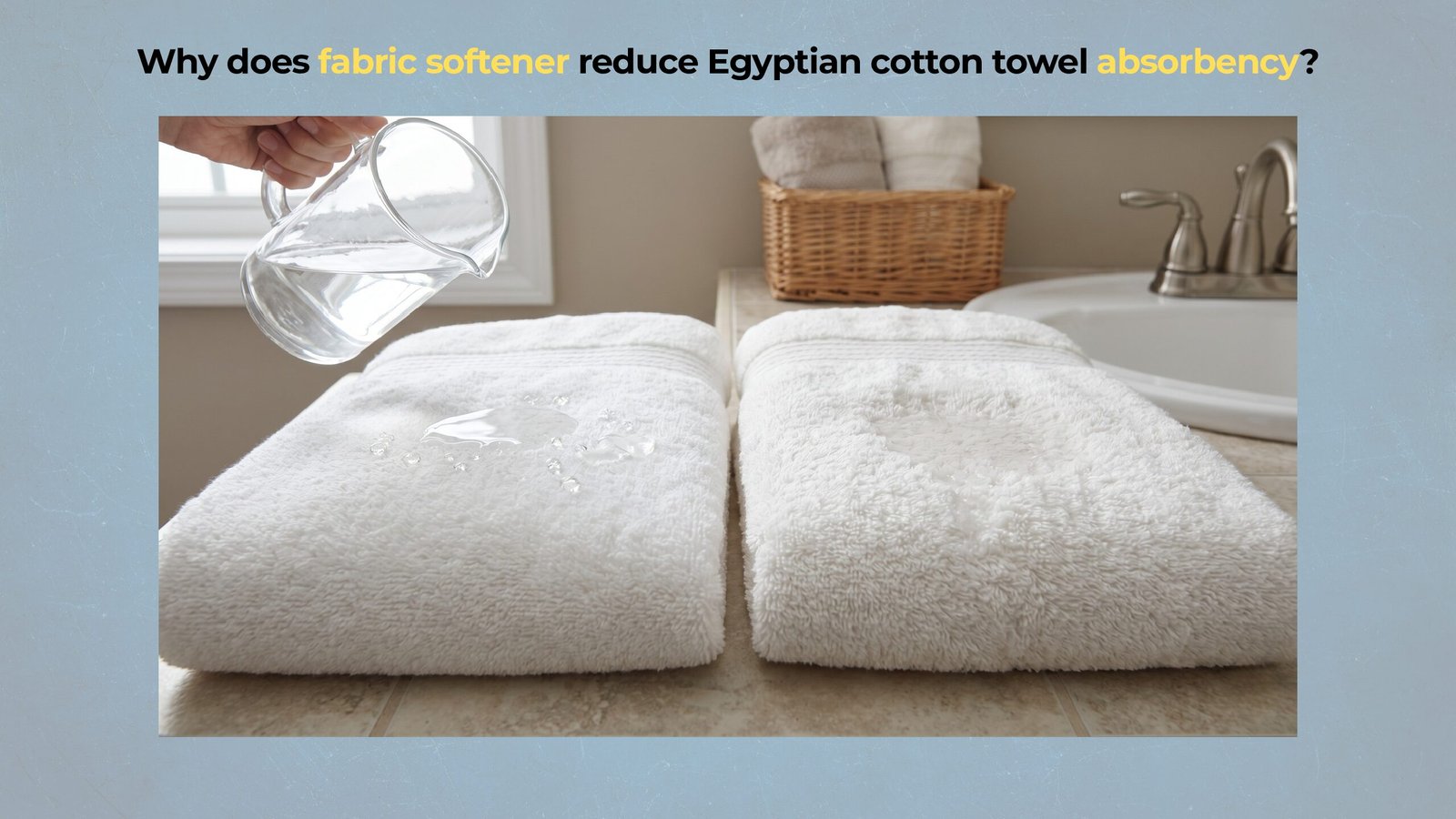
Why does fabric softener reduce Egyptian cotton towel absorbency?
Conditioning agents result in a significant reduction of Egyptian cotton towel absorbency.
Cationic surfactants within commercial softeners execute a molecular process of hydrophobic encapsulation. This chemical interaction wraps the extra-long staple (ELS) fibers—such as Giza 86 or Giza 45—in a synthetic lipid layer that neutralizes the cotton’s natural polarity. If you’re comparing why premium fibers react differently than standard cotton, see how extra-long staple fineness affects Egyptian cotton towel performance.
The resulting loss of tactile hygroscopicity stems from the physical obstruction of the cellulose lumen. When these waxy residues occupy the interstitial spaces between the yarn twists, the textile exhibits immediate water-repellency rather than wicking. To understand the clean-state moisture pathway first, review the natural absorbency mechanism of Egyptian cotton towels.
Does regular conditioning decrease Egyptian cotton towel absorbency? (Quick answer)
Frequent fabric softener application precipitates immediate Egyptian cotton towel absorbency loss. Because residue builds gradually, many owners first notice stiffness before severe repellency develops, which is explained in why detergent residue causes Egyptian cotton towel stiffness.
The cumulative nature of these coatings creates a waxy buildup that repels moisture at the surface level. If you’re deciding whether to keep using conditioner products at all, compare the broader care guidance in whether fabric softener should be used on Egyptian cotton towels.
Hydrophobic barrier: A synthetic, water-repellent layer formed by non-polar chemical tails that prevents moisture from penetrating the structure of natural fibers.
How does the chemical coating block Egyptian cotton towel absorbency?
Surfactant accumulation blocks Egyptian cotton towel absorbency.
The mechanism of polarity neutralization occurs when the positively charged (cationic) molecules in the softener bind to the negatively charged cotton fibers. This bond creates a unified surface energy that is lower than the surface tension of water, causing liquid to bead rather than soak.
This interaction triggers the inhibition of capillary action within the yarn structure. Because the surfactant fills the microscopic valleys between individual fibers, the “suction” force required to pull water into the towel’s core vanishes.
Capillary action: The physical ability of a liquid to flow in narrow spaces without the assistance of external forces, facilitated by inter-molecular forces.
Does surfactant accumulation within Egyptian cotton towel absorbency cycles correlate with wicking failure?
Egyptian cotton towel absorbency levels correlate with wicking failure when surfactant residues exceed the 1% weight-of-fabric threshold.
Research published in the Textile Research Journal: Cellulose Flammability & Lifespan (2015) identifies a critical point where performance degrades. A recorded 15% increase in drying time occurs once the fabric reaches this 1% threshold.
This phenomenon, known as “Hydrophobic Encapsulation,” prevents the yarn from reaching its hygroscopic equilibrium. While the towel feels soft, its internal moisture-carrying capacity remains dormant.
Which diagnostic markers identify low Egyptian cotton towel absorbency?
Identifying low Egyptian cotton towel absorbency involves monitoring the rate of water beading on the textile surface. Surface beading often appears alongside mineral scaling in hard-water homes, so it helps to read how to remove mineral buildup from Egyptian cotton towels.
Diagnostic testing focuses on detecting surfactant saturation by applying a droplet test (~105°F). If the droplet maintains its spherical shape for more than three seconds, the textile has reached a surface energy threshold that precludes effective moisture transport.
How do you execute a restorative cycle to recover Egyptian cotton towel absorbency?
Restorative stripping protocol
The primary phase involves a high-temperature wash (~105°F) with one cup of baking soda to facilitate the dissolution of waxy residues. This alkaline environment breaks the chemical bond between surfactants and the fiber.
The secondary phase utilizes an acetic acid rinse to restore hydrophilic pathways. By neutralizing the pH, the process clears the remaining chemical debris, allowing the Giza cotton to regain softness and function. Once absorbency returns, the next concern is texture recovery covered in how to restore softness to Egyptian cotton towels.
Frequently Asked Questions
Distilled white vinegar is safe for colorfast Egyptian cotton. Its low acidity effectively dissolves mineral deposits and surfactant buildup without bleaching the pigments. Household vinegar (5% acidity) is the recommended benchmark.
For residential use, a restorative cycle every 6 to 8 weeks is sufficient to maintain peak absorbency. If you observe water beading on the surface or a “sour” odor following a single use, the textile has reached a saturation threshold requiring intervention.
Wool dryer balls are the superior mechanical alternative. Unlike chemical softeners that coat fibers in wax, wool balls physically agitate the terry loops during drying while preserving wicking capacity. For safest machine finishing, pair them with low-heat drying methods for Egyptian cotton towels.
Technical Disclaimer
The information provided in this technical bulletin is based on current material science standards and reported textile performance data. However, individual results regarding Egyptian cotton towel absorbency recovery may vary significantly due to local water hardness levels, specific textile manufacturing processes, and the chemical concentration of commercial laundry agents used. Always consult the care label of your specific textile before applying restorative cycles.
Peak Absorbency Validation Checklist
The textile surface energy permits water droplet absorption in under 1.5 seconds.
Yarn interstices remain free of visible waxy sheen under concentrated light.
Fabric pH tests within the neutral range (6.0 – 7.5) to ensure surfactant removal.
Weight-of-fabric measurements confirm a return to standard moisture regain thresholds.