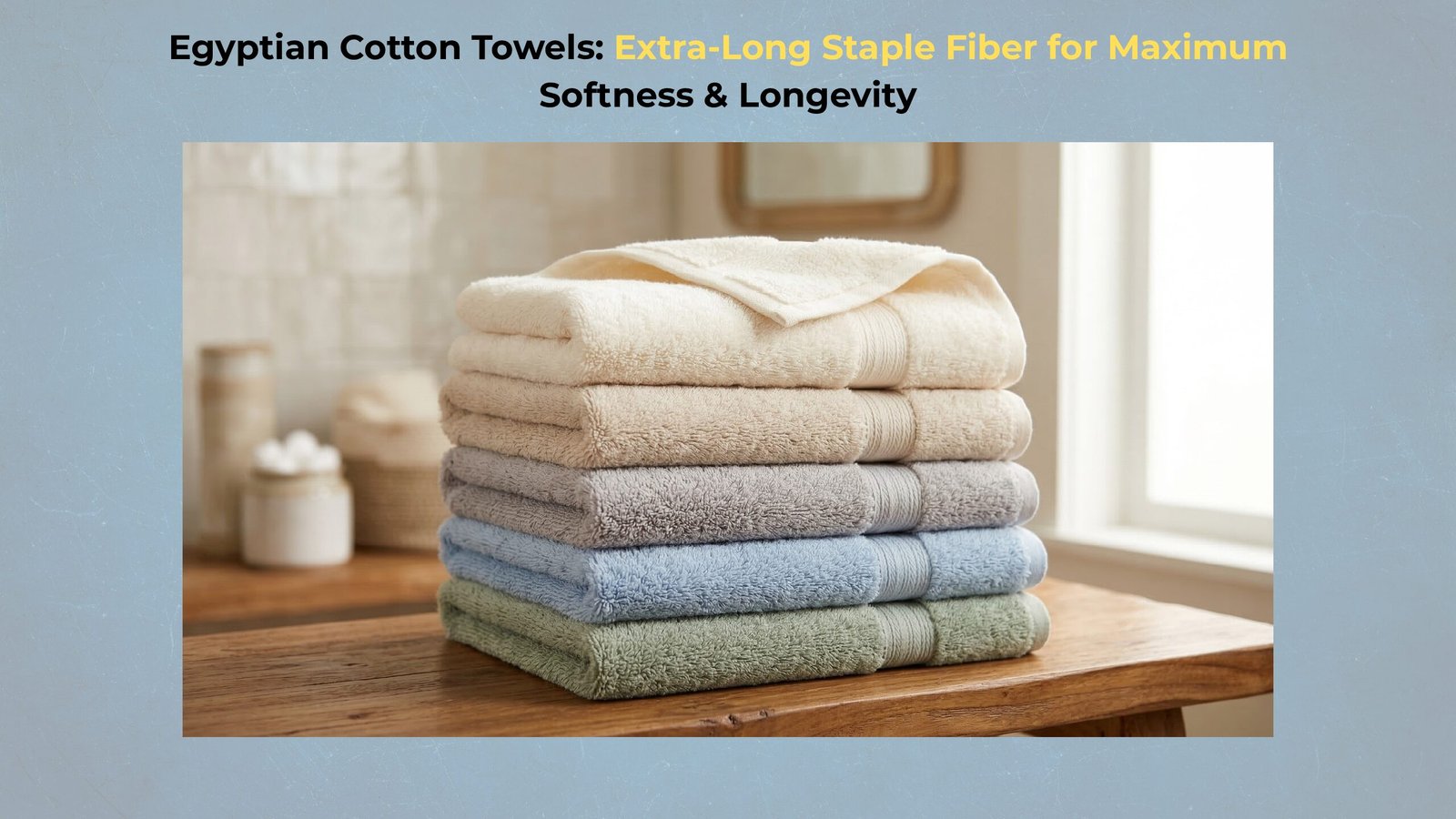
Egyptian Cotton Towels: Extra-Long Staple Fiber for Maximum Softness & Longevity
Engineering moisture retention and tensile integrity through Giza-origin textiles.
Egyptian cotton towels define the global standard for textile luxury because the premium varieties belonging to the species Gossypium barbadense utilize Extra-Long Staple (ELS) fibers to optimize water storage and tactile silkiness. Establishing the technical requirement for Egyptian cotton towels to utilize fibers exceeding the ELS threshold of 34 mm ensures that origin and cultivar define the mechanical hierarchy of linens. Superior cellulose maturity in Giza fibers establishes authoritative mechanical superiority over standard Upland varieties. This maturity provides the foundation for the silkiness and absorbency expected in high-end hospitality operations.
The environmental conditions of the Nile Delta dictate the specific Giza fiber specifications required for elite textile production.
What Makes Egyptian Cotton Towels the Gold Standard of Luxury Linens?
Egyptian cotton towels achieve “Gold Standard” status because the unique confluence of high humidity and irrigation in the Nile Delta supports slow cotton maturation and consistent fiber development. Once the article establishes the role of Giza-origin ELS fibers, the next logical step is to review the full Egyptian cotton towel performance guide for a broader breakdown of softness, absorbency, and longevity. Nutrient-rich alluvial soil facilitates the steady development of the secondary cell wall in Egyptian cotton towels, resulting in a more robust cellulose structure.
Why Do the Giza-Origin Requirements Define Authentic Egyptian Cotton Towels?
Authentic Egyptian cotton towels are harvested exclusively from the Giza region of the Nile River Delta, where regional cultivars like Giza 45 and Giza 92 provide high fiber fineness and breaking resistance. Giza 45 represents a very small portion of Egypt’s total cotton production to signal high technical rarity. Tensile strength of Giza 92 occupies the high end of the typical 35–45 g/tex ELS range.
Unique Insight: Hand-picked harvesting preserves the full length and natural twist of the fibers, eliminating the machine-induced stress that weakens standard cotton strands.
How Do Extra-Long Staple (ELS) Characteristics Improve Egyptian Cotton Towels?
Egyptian cotton towels utilize Extra-Long Staple (ELS) fibers measuring between 34 mm and 40 mm to create a yarn surface with significantly fewer interruption points than standard cotton. Data shows that Giza fibers demonstrate a high Uniformity Index of 85% to 89% via HVI testing. The combing process removes short fibers to increase yarn continuity and tensile strength.
[Extra-Long Staple fibers] -> [increase yarn continuity] -> [maximize surface luster in Egyptian cotton towels].
Why Does the High-Absorbency Profile Distinguish Egyptian Cotton Towels?
Egyptian cotton towels possess a high-absorbency profile because the dense molecular alignment of Giza fibers creates an expansive internal capillary network that absorbs several times its weight in water. After explaining capillary sorption and dense loop storage, the next useful question is how the Egyptian cotton towel absorbency mechanism works in more technical detail.
This dense fiber structure also facilitates lifecycle durability and resilience.
Why Do Egyptian Cotton Towels Offer Superior Longevity Compared to Other Textiles?
Egyptian cotton towels offer superior longevity because the higher tensile strength of Giza ELS fibers resists the mechanical abrasion and chemical stressors that cause short-staple linens to fray. When the article shifts from softness to lifecycle durability, linking to Egyptian cotton towel longevity helps readers validate the long-term performance claims.
How Does Tensile Strength Support the Lifecycle of Egyptian Cotton Towels?
Egyptian cotton towels maintain structural integrity over 100 to 200 industrial wash cycles because the long-staple fibers provide more overlapping anchoring points within the yarn core. ASTM D5034 grab testing protocol results show breaking strength in the typical ELS range of 35 to 45 g/tex. Standardized industrial lifecycle expectation is a maximum of 200 cycles under controlled laundering.
[High-tensile Giza fibers] -> [reduce microscopic fiber shedding] -> [prevent thinning in Egyptian cotton towels].
Why Do Egyptian Cotton Towels Become Softer After Every Wash Cycle?
Egyptian cotton towels undergo a “breaking in” period during the first 5 to 10 laundry cycles, where the dense loops relax and the ELS fibers achieve their peak tactile hand-feel. Research from the Textile Research Journal on cellulose relaxation mechanisms shows how the progressive removal of manufacturing sizing and oils triggers loft expansion.
While hand-feel is paramount, users must choose between Egyptian plushness and Turkish drying efficiency.
How Do Egyptian Cotton Towels Compare to Turkish Cotton for Plushness and Drying?
Egyptian cotton towels prioritize moisture storage and thermal warmth, contrasting with Turkish cotton’s focus on rapid atmospheric evaporation and turnover speed. To compare Egyptian plushness against a faster-drying long-staple alternative, readers naturally benefit from reviewing Turkish cotton towels side by side.
Why Should You Compare the Weight-to-Performance Ratio of Egyptian Cotton Towels?
Egyptian cotton towels offer a superior weight-to-performance ratio for users seeking maximum immersion, though they require more mechanical drying energy than Aegean-origin textiles. AATCC 199 drying rate concepts explain why dense ELS yarns exhibit high moisture retention after mechanical extraction.
| Performance Metric | Egyptian Cotton Towels | Turkish Cotton Towels |
|---|---|---|
| Region of Origin | Nile River Delta (Egypt) | Aegean Region (Turkey) |
| Staple Length | 34–40+ mm (Extra-Long) | 30–34 mm (Long) |
| Absorbency Speed | High (Capillary Sorption) | Moderate (Rapid Wicking) |
| Texture Profile | Silky, Dense, & Heavy | Fluffy, Light, & Breathable |
| Dry Time | Slow (High Retention) | Fast (High Evaporation) |
Maximizing performance requires selecting the correct GSM and thread count.
Which GSM and Thread Count Should You Select for Egyptian Cotton Bath Towels?
Selecting the correct GSM and thread count for Egyptian cotton towels ensures that the fabric’s density aligns with the specific comfort and laundering requirements of the facility. Understanding how these fibers fit within broader towel material categories reveals why origin and cultivar define the mechanical hierarchy of luxury linens.
When to Select a Medium-Weight GSM for Everyday Egyptian Cotton Towels?
Egyptian cotton towels in the 400–600 GSM range are optimized for daily residential use because they provide elite ELS softness while maintaining manageable drying durations. A 600 GSM Egyptian towel frequently outperforms an 800 GSM Upland towel due to finer fiber packing and higher surface area.
Why Select a 700+ GSM for the Ultimate Luxury Egyptian Cotton Towel Experience?
Egyptian cotton towels exceeding 700 GSM are engineered for “Hotel Collection” standards, utilizing a high loop density to provide maximum thermal retention and opulent plushness. 900+ GSM towels are reserved for ultra-heavy luxury bath mats and high-end spa rugs. Zero-twist or low-twist engineering in high-GSM towels keeps loops “open,” increasing the wicking surface area for a “thirsty” drying experience.
Selecting the right weight is only effective if you can verify authenticity.
How Do You Recognize Authentic Egyptian Cotton Towels When Shopping?
Recognizing authentic Egyptian cotton towels requires auditing the product for the Cotton Egypt Association gold seal and verifying the fiber’s natural genomic sequence. Because luxury claims are only meaningful when the fiber is genuine, the next step for cautious buyers is learning how to verify authentic Egyptian cotton towels before committing to an investment.
How to Verify the DNA Certification of Authentic Egyptian Cotton Towels?
Authentic Egyptian cotton towels carry the “Official Golden Seal of Authenticity” issued after DNA genomic fingerprinting to confirm the presence of 100 percent Nile Delta fibers. This is achieved via a partnership between the Cotton Egypt Association and Bureau Veritas for genomic verification. A traceability system tracks the cotton from the bale to the final lot number. DNA testing identifies the unique sequence of Nile Delta Gossypium barbadense, distinguishing it from standard varieties.
How to Identify the Natural Sheen and Luster of Egyptian Cotton Towels?
Egyptian cotton towels exhibit a characteristic natural sheen because the ultra-long ELS fibers, specifically Giza 87, reflect light more uniformly than the jagged surfaces of short-staple yarns. Uniform fiber surfaces result in a distinctive visual reflection.
Checklist: Egyptian Cotton Towels Authenticity Audit Checklist
Verification must be linked to essential laundry protocols required to activate the fiber.
Which Laundry Steps Should You Follow to Preserve Egyptian Cotton Towels?
Preserving Egyptian cotton towels requires technical adherence to low-temperature laundering and chemical restrictions to prevent the molecular breakdown of the extra-long fibers. Once readers understand the fiber’s value, they usually want a dedicated reference for Egyptian cotton towel washing guidelines to preserve softness and prevent structural breakdown. Care cycles should follow the ISO 6330 laundering standard.
How to Execute a Low-Temperature Wash for Egyptian Cotton Towels?
Egyptian cotton towels benefit from wash temperatures between 30 and 40 degrees Celsius because excessive heat triggers cellulose fiber contraction. Structural damage primarily results from oxidation and mechanical agitation rather than thermal settings alone. High-end hospitality towels utilize “peracetic acid” systems to maintain hygiene without inducing fiber damage.
Why Should You Avoid Bleaching Agents on Egyptian Cotton Towels?
Egyptian cotton towels must never be treated with chlorine bleach because oxidative chemicals induce chain scission in cellulose polymer structures, leading to permanent yellowing. Cotton is composed of cellulose and contains no protein binders; bleach damage occurs at the polymer level.
[Chlorine bleach] -> [induces cellulose chain scission] -> [causes structural thinning of Egyptian cotton towels].
Maintenance must resolve absorbency issues and restore matted loops.
How Can You Fix Absorbency Issues or Odors in Matted Egyptian Cotton Towels?
Fixing absorbency issues or odors in matted Egyptian cotton towels involves executing a chemical reset to strip away the hydrophobic layers of detergent and hard-water minerals.
How to Use Wool Dryer Balls to Restore the Loft of Egyptian Cotton Towels?
Egyptian cotton towels recover their original loft through mechanical agitation with wool dryer balls, which physically separate and lift the dense ELS loops during the tumble cycle. Prohibit the use of liquid softeners which utilize silicones to seal the fiber’s surface, nullifying the towel’s primary wicking benefit. Wool balls support more uniform moisture evaporation through improved airflow distribution.
How to Troubleshoot Detergent Buildup in Egyptian Cotton Towels with Baking Soda?
Egyptian cotton towels regain their natural wicking capacity when laundered with half a cup of baking soda (sodium bicarbonate), which neutralizes odors and adjusts wash pH levels. Acetic acid (vinegar) rinses remain the primary method for dissolving mineral calcification.
Restoration must be followed by optimized storage health.
How Do You Optimize Egyptian Cotton Towel Storage to Prevent Mustiness?
Optimizing Egyptian cotton towels storage requires verifying complete core dryness and maintaining a low-compression environment to preserve the air-trap within the dense loops.
Why Must You Ensure Complete Dryness Before Folding Egyptian Cotton Towels?
Egyptian cotton towels require thorough atmospheric exposure to ensure the center of the dense loops has reached equilibrium, as any trapped moisture triggers the growth of odor-causing bacteria. At 65% RH, cotton has a natural moisture regain of 7 to 8 percent. Microbial growth is likely when fabric moisture levels exceed approximately 15 percent in stagnant air.
Why Should You Avoid Over-Compressing Egyptian Cotton Towels in Storage?
Egyptian cotton towels should be loosely folded rather than tightly stacked to prevent the mechanical crushing of the terry pile, which reduces future tactile hand-feel. Structural engineering principles for pile geometry preservation prevent permanent flattening.
Quality maintenance audit facilitates asset management.
Proof Asset: How Do You Use This Egyptian Cotton Towel Quality and Care Checklist?
Using this Egyptian cotton towel quality and care checklist empowers buyers to standardize their inventory performance and verify that their maintenance protocols match the molecular needs of Giza fibers.
Checklist: Egyptian Cotton Towels Maintenance Audit Checklist
Technical Frequently Asked Questions
Why are Giza 45 and Giza 92 cultivars specifically required for premium towels?Giza 45 and 92 provide the highest Uniformity Index and tensile strength (up to 45 g/tex) among ELS varieties. These cultivars ensure that the terry loops resist mechanical fraying and maintain a silky tactile profile over 200+ wash cycles, which standard Upland cotton cannot match.
Can I use standard chlorine bleach on white Egyptian cotton towels?Standard chlorine bleach is highly discouraged. Oxidative chemicals induce chain scission in the cellulose polymers of the Giza fibers. This leads to irreversible structural thinning, yellowing, and a significant reduction in moisture retention capacity.
What is the “Bloom” period, and why does it matter?The bloom period occurs during the first 5 to 10 wash cycles as manufacturing sizing and natural oils are stripped away. This allows the ELS fibers to relax and expand, maximizing the surface area for capillary sorption and increasing the plush hand-feel of the towel.
Why do my towels feel “waxy” and stop absorbing water?This is typically caused by the buildup of silicone-based liquid fabric softeners or excessive detergent. These substances coat the extra-long staple fibers, blocking the internal capillary network and forcing water to bead on the surface rather than being absorbed into the core.
Is high-heat drying safe for ELS fibers?Excessive heat triggers cellulose fiber contraction and can make the towel feel brittle. We recommend low to medium heat settings. Utilizing wool dryer balls provides the mechanical agitation needed to lift the loops and restore loft without the thermal stress of high heat.
The performance metrics, including absorbency rates and tensile strength benchmarks (35–45 g/tex), detailed in this guide are based on standardized textile engineering tests (ASTM D5034, AATCC 199) under controlled laboratory environments. Actual real-world performance of Egyptian cotton towels is conditional upon local variables, including but not limited to, the pH level of water supply, airflow velocity during storage, and the specific chemical concentration of laundering agents.
References to Giza cultivars and DNA authentication protocols (CEA Golden Seal) are provided for technical classification and textile origin verification purposes only. This guide does not serve as medical advice for dermal health; users with specific dermatological sensitivities should consult with a clinical professional regarding textile interactions with the skin barrier.