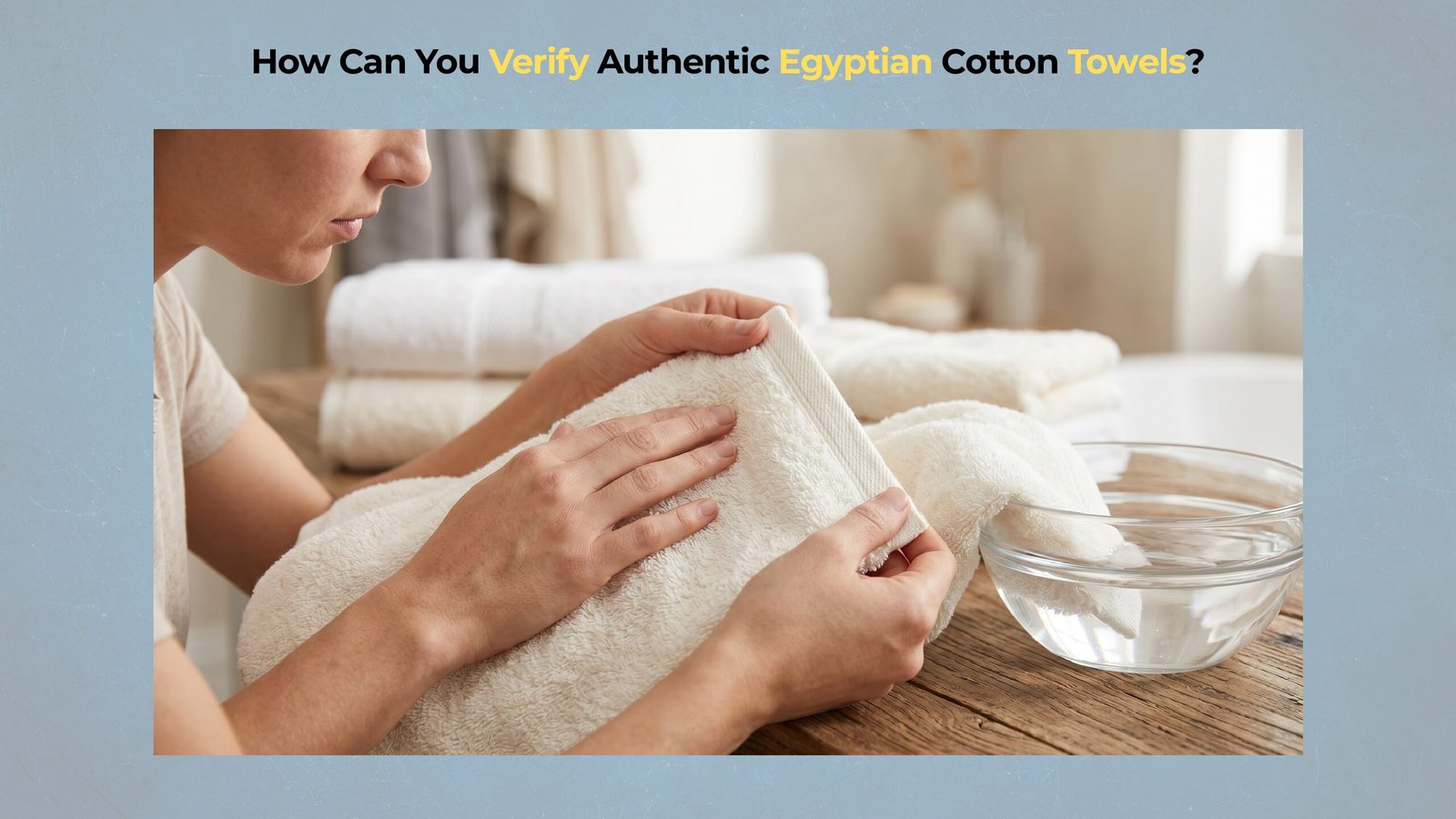
How Can You Verify Authentic Egyptian Cotton Towels?
Verifying Egyptian cotton towel authenticity requires a combination of official certification auditing and a physical assessment of the Extra-Long Staple (ELS) fiber structure. This protocol addresses the systemic market proliferation of counterfeit “Egyptian-style” blends by providing technical metrics for consumer-level provenance verification and supply-chain auditing standards.
Extra-Long Staple (ELS) fiber structure represents the definitive physical characteristic of genuine Giza-region cotton. These fibers typically measure 32mm or greater in length, allowing for the spinning of fine, high-tenacity yarns that resist pilling.
The absorbency of Egyptian cotton towels begins with the moisture-handling advantages of extra-long staple fibers, which create dense yet efficient yarn structures. To understand this foundation, it is useful to explore how extra-long staple Egyptian cotton fibers improve durability and performance.
Counterfeit labeling frequently exploits vague marketing terms to mask the inclusion of Upland cotton or short-staple waste fibers. These inferior materials lack the intrinsic tensile strength found in Giza cultivars, leading to rapid performance degradation.
Why does Egyptian cotton towel authenticity protect your long-term investment?
Egyptian cotton towel authenticity protects your performance-standard investment by ensuring that the high initial entry cost corresponds to the structural integrity of genuine Giza cotton. This material investment prevents the “replacement loop” common with inferior textiles that lose absorbency after minimal laundering cycles.
Maintaining absorbency over time depends on preventing detergent buildup and preserving fiber openness during laundering. To connect this with everyday use, it is useful to review what care instructions should be followed to preserve towel absorbency and longevity.
Genuine Giza cotton displays superior cellulose structural stability when compared to non-certified variants. Cellulose structural stability refers to the molecular arrangement within the fiber that maintains tensile strength and hygroscopic capacity over long durations.
Technical Note: While Giza 45 is classified as extra-long and Giza 92 as long-staple, retail labels rarely specify these grades, necessitating a reliance on official certification marks.
How does technical verification support Egyptian cotton towel authenticity?
Technical verification supports Egyptian cotton towel authenticity because visual inspection alone cannot always detect short-staple cotton blends masked by silicone-based finishing agents. High absorbency is also influenced by towel density, pile height, and weave design rather than fiber type alone. To connect this with broader buying decisions, it is useful to review what determines towel absorbency and how it affects real-world performance.
Short-staple cotton blends exhibit a significantly higher rate of yarn breakage during high-heat drying. Performance degradation occurs as these broken fibers detach from the yarn core, resulting in excessive lint production and reduced surface fiber density.
Greater moisture retention can also slow drying speed, especially in humid environments. Because of this trade-off, it is helpful to understand how quick-dry performance impacts towel usability and moisture control.
Which physical markers provide clues for Egyptian cotton towel authenticity?
Evaluating Egyptian cotton towel authenticity through physical markers involves assessing tactile smoothness, though consumers must recognize that luster and softness are often weak indicators easily mimicked by finishing treatments. Authentic ELS textiles rely on fiber fineness rather than chemical coatings to achieve their hand-feel.
Thicker and heavier towels often retain more water, which can improve drying comfort but also increase saturation time. Since this directly affects usability, you may want to explore how towel weight affects absorbency, handling, and drying behavior.
Reduced yarn hairiness serves as a primary indicator of genuine ELS material. Reduced yarn hairiness occurs because the long fibers overlap more extensively during the spinning process, leaving fewer loose ends protruding from the yarn surface.
Surface friction is minimized in authentic towels due to this fiber alignment. In contrast, matte luster is an unreliable indicator as high-quality Giza cotton may not always exhibit a high sheen if the Micronaire value—a measure of fiber fineness and maturity—falls within specific technical ranges.
How do official seals validate Egyptian cotton towel authenticity for consumers?
Official seals validate Egyptian cotton towel authenticity by providing a verified audit trail, primarily through the Cotton Egypt Association (CEA) Gold Seal which supports supply-chain traceability. This seal ensures the product has undergone verification within the Egyptian Ministry of Industry and Trade’s framework.
Supply-chain traceability is further reinforced through DNA marker testing. DNA marker testing involves a laboratory-grade genomic analysis of the cotton fibers to verify they contain the specific Giza-region genetic sequence.
OEKO-TEX verification serves as a secondary audit layer. While it does not verify origin, it ensures the absence of harmful finishing agents that might otherwise mask inferior fiber quality.
Can at-home tests verify Egyptian cotton towel authenticity?
Verifying Egyptian cotton towel authenticity at home is not scientifically possible, as household tests can only indicate fiber condition and moisture absorption behavior rather than confirming material origin. These tests are useful for auditing performance but cannot replace laboratory provenance checks.
Moisture absorption behavior can be assessed using the Absorbency Drop Test. If you want to measure whether your towel is still performing properly after repeated washing, you can use a towel absorbency test template to evaluate real moisture performance.
Fiber porosity determines the towel’s capacity for hygroscopy. The “Fiber Tug” provides an informal check of the yarn twist; if the loops easily distort or shed fibers, the material likely contains a high percentage of short-staple filler.
How do you avoid marketplace traps that compromise Egyptian cotton towel authenticity?
Avoiding marketplace traps that compromise Egyptian cotton towel authenticity requires recognizing that ‘thread count’ and vague labels like ‘Egyptian Comfort’ are often misleading indicators. To compare Egyptian cotton with other towel materials based on absorbency, drying speed, and overall feel, you can use a towel finder tool to match materials to your preferences and needs.
Misleading indicators are often supported by the application of silicone-based finishing agents. Silicone-based finishing agents are chemical surfactants that increase artificial slipperiness but simultaneously form a hydrophobic barrier that inhibits water uptake.
Pricing red flags should also be monitored. Genuine Giza cotton is subject to strict harvest cycles and export quotas, making exceptionally low-priced “100% Egyptian” towels an economic impossibility.
Deceptive Marketing vs. Genuine Indicators for Egyptian Cotton Towel Authenticity
| Metric | Deceptive Indicator | Genuine Authenticity Marker |
|---|---|---|
| Labeling | “Egyptian Comfort” / “Egyptian Quality” | CEA Gold Seal / License Number |
| Tactile Feel | Oily, slick, or waxy smoothness | Crisp, dense, and naturally heavy hand |
| Linting | High lint volume after 3+ washes | Minimal shedding (ELS integrity) |
| Absorbency | Beading or slow water uptake | Rapid hygroscopic saturation |
Frequently Asked Questions About Egyptian Cotton Towel Authenticity
Why do some Egyptian cotton towels feel waxy or non-absorbent when new?
This phenomenon is typically the result of silicone-based finishing agents applied during the post-weaving phase. Manufacturers use these chemicals to provide an artificial tactile smoothness for the retail environment, which unfortunately creates a hydrophobic barrier that must be laundered away before the towel reaches peak absorbency.
Does “Made in Egypt” guarantee the use of Extra-Long Staple (ELS) cotton?
Geographic manufacturing and material provenance are distinct variables. A towel may be manufactured in Egypt using imported short-staple cotton, making the “Made in Egypt” label insufficient for verifying Egyptian cotton towel authenticity; consumers should instead look for the Cotton Egypt Association (CEA) license.
Can a “Burn Test” verify if a towel is genuine Egyptian cotton?
A burn test can only distinguish between natural cellulose (cotton/linen) and synthetic polymers (polyester). It cannot determine fiber staple length or cultivar origin, meaning it is an ineffective method for confirming the genomic markers of Giza cotton.
How does Giza cotton differ from standard Egyptian cotton?
Giza refers to the premium cultivars grown in the fertile Nile Delta region under specific climatic conditions. While all Giza cotton is Egyptian, not all cotton grown in Egypt meets the rigorous Extra-Long Staple (ELS) requirements necessary for high-performance luxury towels.
Which checklist ensures Egyptian cotton towel authenticity before purchase?
Using this checklist to verify Egyptian cotton towel authenticity before purchase facilitates a final audit of material traceability and construction standards.
Final Audit Checklist
Technical & Legal Disclaimer
The information provided in this guide is for technical and educational purposes only. While every effort is made to ensure accuracy based on current textile engineering standards (AATCC/Cotton Egypt Association), individual consumer results may vary based on laundering techniques, local water hardness, and specific Giza seed variations. This guide does not constitute legal advice for trade disputes or official laboratory certification. Always refer to the specific manufacturer’s care labels and official CEA database for up-to-date licensing status.