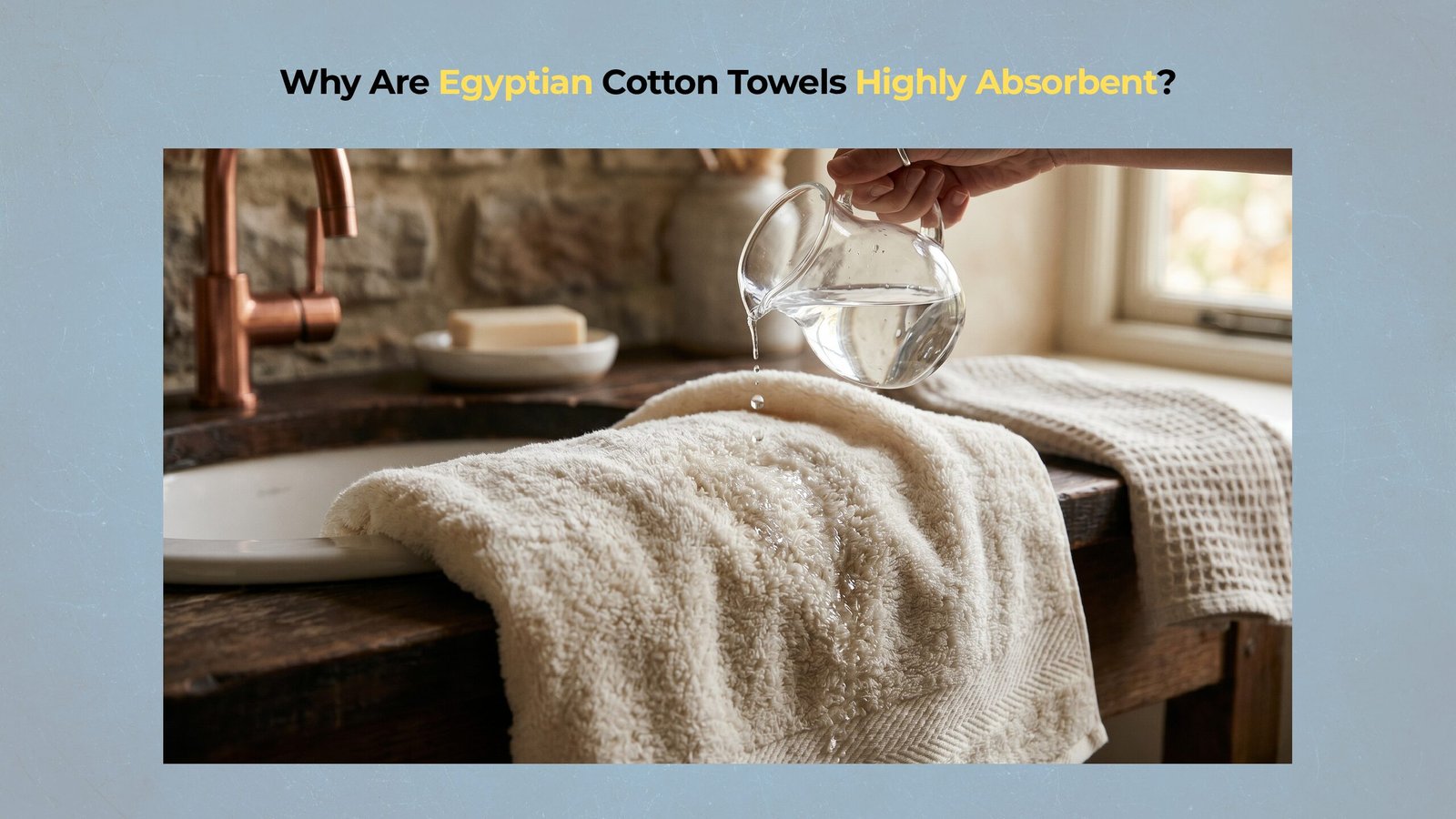
Why Are Egyptian Cotton Towels Highly Absorbent?
The high performance of Egyptian cotton towel absorbency reaches its peak because the construction utilizes Extra-Long Staple (ELS) fibers that are naturally finer and more porous than standard cotton varieties. Unlike shorter Upland cotton, these long-chain cellulose structures allow for a higher density of yarn loops, creating a massive surface-area-to-volume ratio that facilitates rapid moisture uptake.
Extra-Long Staple (ELS) cotton, specifically varieties like Giza 45 or 92, features fibers ranging from 1.25 to over 2 inches. This continuity reduces the number of fiber ends (breaks) within a single yarn strand, effectively turning each yarn loop into a “microscopic straw.” This structural integrity ensures that water molecules are drawn into the core of the fiber rather than just sitting on the surface.
Why does Egyptian cotton absorb more water than standard varieties in Egyptian cotton towel absorbency?
Superior Egyptian cotton towel absorbency consistently results from an increased staple length—typically exceeding 1.25 inches—which allows for a denser loop structure with more surface area for water bonding. In standard cotton, the high frequency of fiber joins creates “clog points” that impede fluid flow; conversely, since absorbency is directly influenced by fiber structure, understanding how extra-long staple Egyptian cotton enhances performance clarifies why these towels wick moisture so efficiently through a smooth, uninterrupted path for liquid transport.
Capillary Action — The ability of a liquid to flow in narrow spaces without the assistance of, or even in opposition to, external forces like gravity, driven by inter-molecular forces between the liquid and the surrounding solid surfaces.
Egyptian cotton towel absorbency thresholds are largely determined by fiber continuity…
Fiber continuity acts as the primary driver for lateral moisture transport. According to the Textile Research Journal: “Fluid Transport Efficiency and Staple Length in Terry Weaves” (2020), researchers observed a 25–40% increase in wicking speed when comparing ELS fibers to short-staple Upland variants. This phenomenon is categorized as the Continuous Capillary Pathway (descriptive model), where the lack of fiber interruptions allows water to travel across the towel’s surface via unbroken channels before being absorbed into the pile’s base.
What differentiates wicking speed from holding capacity in Egyptian cotton towel absorbency?
A comprehensive understanding of Egyptian cotton towel absorbency requires a functional balance between wicking speed (lateral moisture transport) and total holding capacity (volumetric saturation). High-quality ELS towels are engineered to provide “instant thirst,” meaning they pull water off the skin on contact (wicking) rather than requiring mechanical rubbing to force moisture into the loops (holding).
Wicking vs. Holding Metrics
Estimated performance data based on Giza 92 cotton weave profiles at 700 GSM.
Moisture Regain Equilibrium — The specific percentage of moisture a textile fiber will naturally absorb from the surrounding atmosphere at a standard temperature and humidity.
Egyptian cotton towel absorbency rates correlate with loop density…
According to AATCC Standards: “Test Method 79: Absorbency of Textiles” (2021), high-density ELS towels typically achieve 100% saturation within less than 3 seconds. This efficiency is defined by the Surface Tension Anchor Model (descriptive model). In this model, the high frequency of fine loops acts as a mechanical anchor that breaks the surface tension of water droplets, forcing them to disperse across the fiber surface instantly.
How does fiber porosity drive high-performance wicking in Egyptian cotton towel absorbency?
The optimization of Egyptian cotton towel absorbency depends on the high internal porosity of Giza staples, where the hollow center of the fiber acts as a natural reservoir. This hollow core, or lumen, expands when wet, allowing the fiber to hold up to 27 times its weight in water without feeling structurally compromised or “slimy.”
Lumen Expansion — The physical swelling of the central cavity of a cotton fiber as it hydrates, increasing the volumetric capacity of the yarn strand.
Egyptian cotton towel absorbency stability increases if combing protocols…
The removal of “neps” (tangles) and short-fiber fragments is critical for maintaining performance over time. Cotton Incorporated: “The Impact of Combing on Absorbency” (2018) revealed that combed ELS yarns retained 15–20% higher wicking efficiency after 50 wash cycles compared to uncombed variants. This process follows the Pore Blockage Mitigation (descriptive model), which ensures that microscopic fiber “dust” does not settle within the yarn twists to block liquid access to the fiber lumens.
Comparing Egyptian vs. Turkish cotton for drying efficiency in Egyptian cotton towel absorbency
While high-density Egyptian cotton towel absorbency provides the maximum possible ‘soak’ capacity, because not all cotton performs the same, comparing Turkish cotton absorbency characteristics provides context for how Egyptian cotton differs in real-world use when Turkish alternatives are often engineered for faster drying times.
GSM (Grams per Square Meter) — The standard metric for fabric density; higher GSM typically correlates with higher absorbency but longer drying times.
Absorbency & Drying Comparison Matrix for Egyptian Cotton Towel Absorbency
| Material Type | Wicking Speed | Water Capacity | Drying Duration |
|---|---|---|---|
| Egyptian (ELS) | Highest | MAXIMUM | Longest |
| Turkish (Aegean) | High | High | Fast |
| Bamboo Blend | Medium | Medium | Fast |
Does higher fabric weight always improve results in Egyptian cotton towel absorbency?
Total Egyptian cotton towel absorbency capacity generally increases as the fabric weight rises. Since loop density also affects how much water a towel can hold, reviewing how fabric density impacts absorbency helps balance performance with drying time, preventing a towel from becoming too heavy to air-dry.
Which care habits protect the wicking ability of Giza fibers for Egyptian cotton towel absorbency?
Maintaining peak Egyptian cotton towel absorbency requires the total exclusion of liquid fabric softeners. If you want to maintain peak performance, it’s important to understand how fabric softener impacts Egyptian cotton absorbency to avoid blocking the fibers with a water-repellent layer.
Hydrophobic Surfactant Coating — A waxy chemical film left by softeners that repels water molecules, preventing them from entering the cotton fiber loops.
Identifying permanent loss of Egyptian cotton towel absorbency
Permanent failure of Egyptian cotton towel absorbency can occur if high heat or harsh chemicals cause the cellulose fibers to become brittle and collapse. When absorbency declines over time, learning how to remove mineral buildup from Egyptian cotton towels can help restore their original wicking efficiency before the internal structure of the Giza staples is compromised through “Fiber Scorching.”
Technical FAQ: Optimizing Egyptian cotton towel absorbency
The removal of residual spinning oils and waxes typically requires 3–5 initial wash cycles to fully engage peak moisture transport. Once these factory processing lubricants are stripped away, the cellulose lumens can expand freely, significantly increasing the towel’s volumetric saturation threshold.
Using dryer sheets results in the immediate deposition of waxy fatty acids that block the fiber’s capillary channels. For high-performance Egyptian cotton, it is technically superior to use wool dryer balls, which mechanically agitate the loops for softness without compromising wicking speed.
Achieving a balance of 700–800 GSM provides the highest ratio of loop density to drying efficiency. While 900+ GSM towels offer higher total capacity, their restricted airflow often leads to moisture stagnation, which can degrade fiber integrity over long-term use.
Zero-twist construction enhances absorbency by keeping the ELS fibers uncompressed. Because fiber twist controls how open the yarn remains, exploring how fiber twist reduction improves absorbency helps explain the mechanics behind faster water uptake and a more porous “open-cell” feel that wicks water up to 2x faster than traditional twisted yarns.
Checklist for verifying authentic, high-performance Egyptian cotton towel absorbency
Adhering to this audit checklist ensures that your purchase meets the high standards of genuine Egyptian cotton towel absorbency found in Giza-grade textiles.
Final Absorbency Audit Checklist for Egyptian Cotton Towel Absorbency
- Product is certified as 100% Giza or Extra-Long Staple (ELS) cotton.
- The weight (GSM) falls between 600 and 900 for optimized capacity.
- A water drop test shows immediate intake (under 3 seconds).
- The yarn is “Low-Twist” or “Zero-Twist” to preserve fiber porosity.
- The loops are free of “slick” or “greasy” chemical finishes.
Technical Performance Disclaimer
The material performance metrics, wicking speeds, and saturation thresholds discussed in this guide are based on standardized textile laboratory conditions. Real-world performance of Egyptian cotton towel absorbency may vary significantly depending on local water hardness, chemical detergent composition, laundering temperature, and the specific age of the textile fibers.
Consolidating your knowledge of Egyptian cotton towel absorbency
Final analysis of Egyptian cotton towel absorbency confirms that the secret to a thirsty towel lies in the microscopic pathways found only in high-quality Giza cotton. By prioritizing staple length and eliminating chemical blockers, users can maintain a material performance that standard cotton simply cannot replicate.