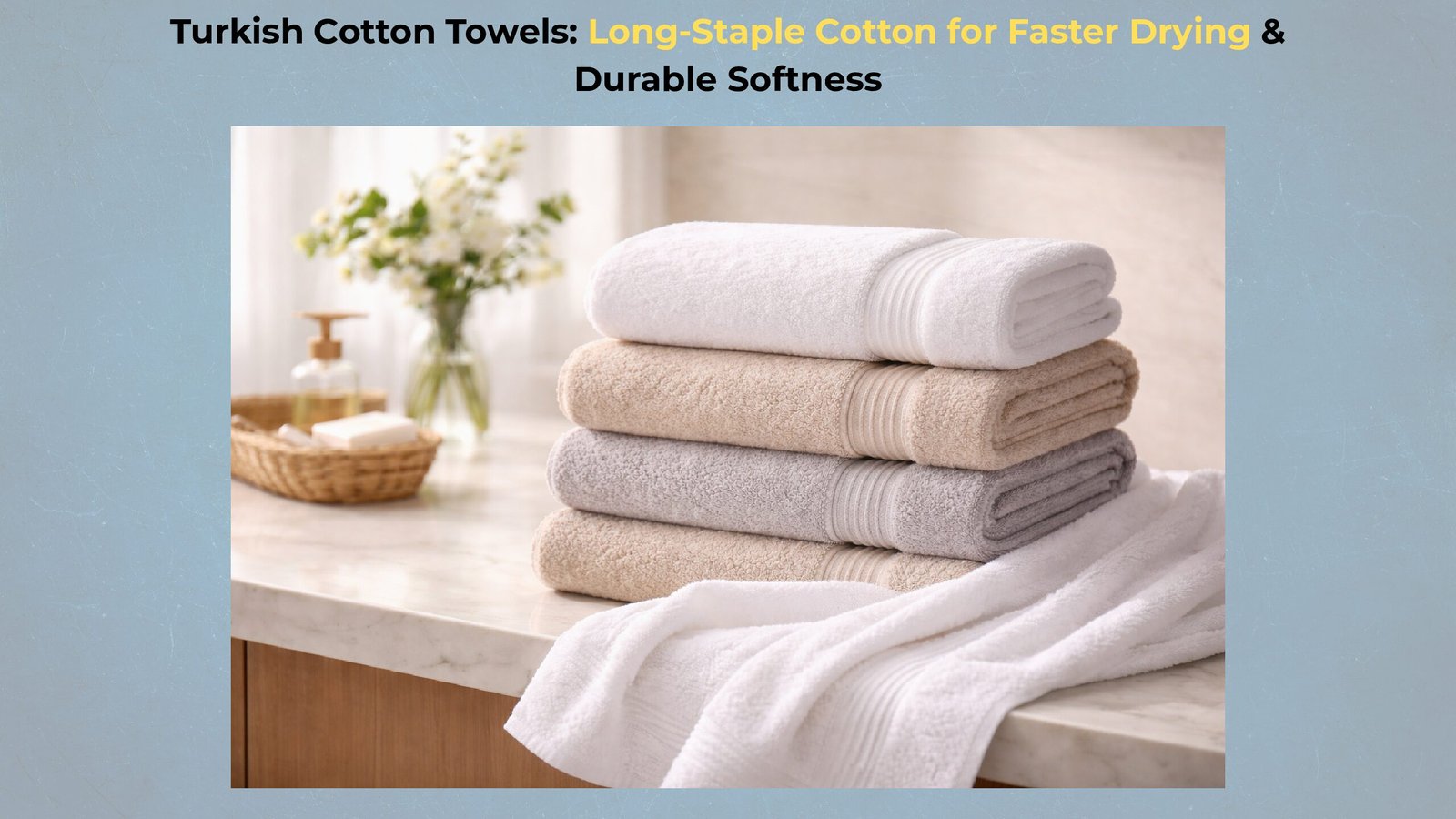
Turkish Cotton Towels: Long-Staple Cotton for Faster Drying & Durable Softness
An Engineering Audit of Aegean Textile Performance
Turkish cotton towels optimize resource efficiency and mitigate microbial odors because the Aegean long-staple fibers (> 30 mm) facilitate high-velocity atmospheric evaporation while maintaining structural tensile strength.
This guide provides a technical audit of Aegean cotton, focusing on the Izmir region’s 200-year legacy of cultivating Gossypium hirsutum. Unlike standard short-staple varieties, the unique environmental pressures of Western Anatolia produce a fiber that balances hydrophilicity with rapid air-exchange, as detailed in our Cotton Towels Comfort & Absorbency Guide.
Regional growth conditions—characterized by high UV exposure and controlled irrigation—establish the foundation for the Aegean quality standards explored in this selection protocol.
What Makes Turkish Cotton Towels Different From Regular Cotton Towels?
Turkish cotton towels differ from regular cotton towels because the specific climatic stressors and alluvial soil of the Aegean region produce fibers with a unique balance of strength, length, and hydrophilicity. The national ban on GMO seeds in Turkey ensures fiber purity, preventing the molecular contamination often found in global short-staple commodity blends.
Why Does the Aegean Origin Define Authentic Turkish Cotton Towels?
Authentic Turkish cotton towels originate exclusively from the Aegean region, where high solar radiation and specific irrigation protocols yields cotton with a flatter fiber profile than standard Upland varieties. Regional varieties such as Nazilli 84 and Carmen are hand-harvested to preserve full staple length and natural twist, preventing the fiber breakage associated with machine picking. This flatter fiber profile allows for a denier of approximately 1.6, which facilitates a dense but breathable weave that optimizes airflow.
How Do Long-Staple Fiber Characteristics Support Turkish Cotton Towels?
Turkish cotton towels utilize long-staple fibers (29.5–31 mm) to create smoother yarn surfaces that reduce the number of exposed fiber ends prone to friction and fraying. In this context, Turkish Cotton Staple Length Explained highlights how high-count yarn integrity ensures that long-staple fibers in Turkish cotton towels increase yarn cohesion, thereby reducing surface pilling and lint shedding over time.
What Mechanical Process Triggers the Unique Bloom of Turkish Cotton Towels?
Turkish cotton towels undergo a mechanical “bloom” as the long-staple fibers gradually untwist and expand within the weave during the first several laundering cycles. Initial saturation and mechanical drying cause the flat Aegean fibers to re-inflate, which increases the towel’s tactile loft without increasing its physical mass. Unlike short-staple towels that thin out, the structural “bloom” means that Turkish cotton towels often reach peak softness and absorbency after 5 to 10 wash cycles, supporting superior durability.
Why Do Turkish Cotton Towels Provide Superior Durability Compared to Standard Linens?
Turkish cotton towels provide superior durability because the higher tensile strength of Aegean long-staple fibers prevents the premature thinning and structural collapse common in short-staple alternatives. Standard ASTM D5034 grab testing demonstrates that Aegean fibers maintain a lifespan of 5 to 10 years in high-utilization environments, whereas lower-quality Upland towels may fail within 24 months. Understanding Turkish Cotton Towels Long-Term Value requires an analysis of how these fibers resist tensile fatigue over multiple laundry cycles.
How Do Long-Staple Fibers Prevent Surface Pilling in Turkish Cotton Towels?
Turkish cotton towels resist surface pilling by maintaining tight fiber alignment within the yarn bundle, limiting the migration of short fibers to the textile surface. Comparative 50-wash simulations show that Turkish cotton towels experience only a 20% prevalence of pilling, whereas Egyptian ELS counterparts may exceed 70% due to fiber compaction. Pilling is a structural warning that the textile is losing mass; Turkish towels maintain structural integrity because the long staples have fewer interruption points in the yarn core.
How Do Turkish Cotton Towels Compare to Egyptian Cotton for Drying Speed and Hygiene?
Turkish cotton towels provide a distinct advantage over Egyptian cotton by prioritizing evaporation velocity, which reduces the window of time that moisture remains trapped within the fiber loops. Further Turkish Cotton Towels Drying Speed Analysis confirms that while Egyptian cotton is celebrated for absolute absorbency, its dense fiber structure often leads to prolonged dampness in standard humidity environments.
Why Should You Compare the Absorbency-to-Evaporation Ratio of Turkish Cotton Towels?
Turkish cotton towels balance absorbency with rapid drying by utilizing a fiber profile that pulls moisture from the skin but refuses to hold it stubbornly during atmospheric exposure. This contrasts with Egyptian Cotton Extra-Long Staple Performance, which excels in saturated absorbency but exhibits a 38% decrease in softness over 50 cycles due to detergent buildup in dense loops. Flat-woven peshtemal constructions utilize a lower yarn count (6–8 picks per inch) that creates large capillaries for rapid moisture dispersion.
| Performance Metric | Turkish Cotton Towels | Egyptian Cotton Towels |
|---|---|---|
| Staple Length | 29.5–31 mm (Long) | 35–50 mm (Extra-Long) |
| Softness (50 Washes) | 12% Increase | 38% Decrease |
| Absorbency Retention | 9% Decline | 22% Decline |
| Drying Velocity | Very Fast / High Evaporation | Slow / High Retention |
| Microbial Risk | Low (Dries quickly) | Moderate (Stays damp) |
Which GSM Levels Should You Select for Your Turkish Cotton Towels Based on Usage?
Selecting the correct GSM levels for Turkish cotton towels ensures that the fabric’s mass matches the specific mechanical and environmental demands of the user’s facility. We define Grams per Square Meter (GSM) as the standard metric for measuring fabric density and weight; in Turkish cotton, this metric directly dictates the evaporation-to-mass ratio.
Why Select a Lightweight GSM for Travel-Friendly Turkish Cotton Towels?
Turkish cotton towels in the 300–400 GSM range are optimized for travel and gym use because they provide adequate wicking while minimizing the volumetric bulk required for storage. A 400 GSM towel may fully air-dry in 2 hours, whereas a 700 GSM towel in identical conditions can require up to 5 hours to reach equilibrium.
When Should You Select the 550–600 GSM Sweet Spot for Turkish Cotton Towels?
Selecting Turkish cotton towels in the 550–600 GSM range identifies the engineering “sweet spot” that balances luxury tactile loops with inherent quick-drying properties. Every incremental increase of 100 GSM typically adds approximately 15 to 20 minutes to the required mechanical drying duration.
How Do You Recognize Authentic Long-Staple Turkish Cotton Towels When Shopping?
Recognizing authentic Turkish cotton towels requires auditing the label for regional origin and executing a tactile check to identify the presence of a tight, stable ground weave. Ring-spun cotton—produced through continuous twisting—creates a more durable loop than standard open-end spinning methods.
Checklist: Turkish Cotton Towels Authenticity Audit Checklist
Origin Check: Verify “Made in Turkey” or “Aegean Region” on the care label.
Staple Verification: Look for “Long-Staple” or “LS” designations.
Safety Vetting: Confirm OEKO-TEX Standard 100 “Product Class 1” certification.
Which Steps Should You Follow to Wash Turkish Cotton Towels to Maximize Softness?
Washing Turkish cotton towels correctly requires a technical focus on fiber opening and residue prevention to ensure the long-staple cotton reaches its maximum absorbent potential.
How Does an Initial Cold-Water Soak Prepare Turkish Cotton Towels?
Turkish cotton towels benefit from a 12-hour cold-water soak before the first wash because this process removes residual manufacturing oils and sizing that initially repel water. Cold hydration allows the Aegean fibers to expand and increase their future wicking capacity without the “thermal shock” of a high-heat wash. Research into How Washing Improves Turkish Cotton Towel Absorbency suggests that this step is critical for activating the natural capillaries.
Why Must You Adhere to the “No Softener” Rule for Turkish Cotton Towels?
Turkish cotton towels must never be treated with liquid fabric softeners because these chemicals coat the long-staple fibers in a hydrophobic wax that destroys the towel’s natural breathability. Liquid softeners on Turkish cotton towels clog the cellulose capillary channels, permanently reducing moisture-wicking efficiency. A detailed look at How Fabric Softener Affects Turkish Cotton Towels reveals that the resulting surface film prevents deep fiber hydration.
How Can You Fix Absorbency Issues or Odors in Older Turkish Cotton Towels?
Fixing absorbency issues or odors in older Turkish cotton towels requires a chemical reset to dissolve mineral calcification and detergent buildup trapped within the terry loops.
How Do Vinegar Rinses Prevent Musty Smells in Turkish Cotton Towels?
Turkish cotton towels recover their original breathability when laundered with one cup of white distilled vinegar (acetic acid), which neutralizes alkaline residues that harbor odor-causing bacteria. Acetic acid lowers the wash pH, causing mineral deposits from hard water to dissolve and release from the cotton fiber core.
How Do You Monitor Molecular Integrity in Turkish Cotton Towels?
Monitoring the molecular integrity of Turkish cotton towels involves identifying the onset of cellulose chain scission caused by excessive chemical exposure or high-heat mechanical agitation. Repeated laundering can cause the average molecular mass of cellulose to decrease from 1,320 kDa to 151 kDa. Turkish cotton’s long staples mitigate this degradation by maintaining a higher degree of surface area and reactivity compared to short-staple Upland variants.
Why Are Turkish Cotton Towels a Sustainable Choice for a Modern Bathroom?
Turkish cotton towels are a highly sustainable choice because their rapid evaporation rate materially reduces the thermal energy required for mechanical drying, lowering the facility’s total ecological footprint.
| Performance Metric | Standard Heavy Plush Cotton | Turkish Cotton Towels | Resource Efficiency |
|---|---|---|---|
| Avg. Drying Time | 65–75 minutes | 35–45 minutes | ~40% Time Reduction |
| Est. Energy Use | 4.8 kWh per load | 3.0 kWh per load | 1.8 kWh Energy Savings |
| Dry Cycle Throughput | Low (Standard) | High (Optimized) | ~43% Velocity Increase |
Proof Asset: How Do You Use This Turkish Cotton Towel Quality and Care Checklist?
Using this Turkish cotton towel quality and care checklist empowers buyers to standardize their inventory performance and verify that their maintenance protocols match the molecular needs of Aegean fibers. Periodic audits ensure that laundry throughput and user comfort remain optimized throughout the asset’s lifecycle.
Checklist: Turkish Cotton Towels Maintenance Audit Checklist
Source Check: Does the label confirm “100% Long-Staple Aegean Cotton”?
Preparation Check: Has the 12-hour initial cold-water soak been performed?
Drying Check: Are you using a low-heat drying cycle to protect the fibers?
Ventilation Check: Is the storage area well-ventilated with sufficient airflow?
Residue Check: Have you replaced chemical fabric softeners with wool dryer balls?
Restoration Check: Have you executed a monthly white-vinegar flush?