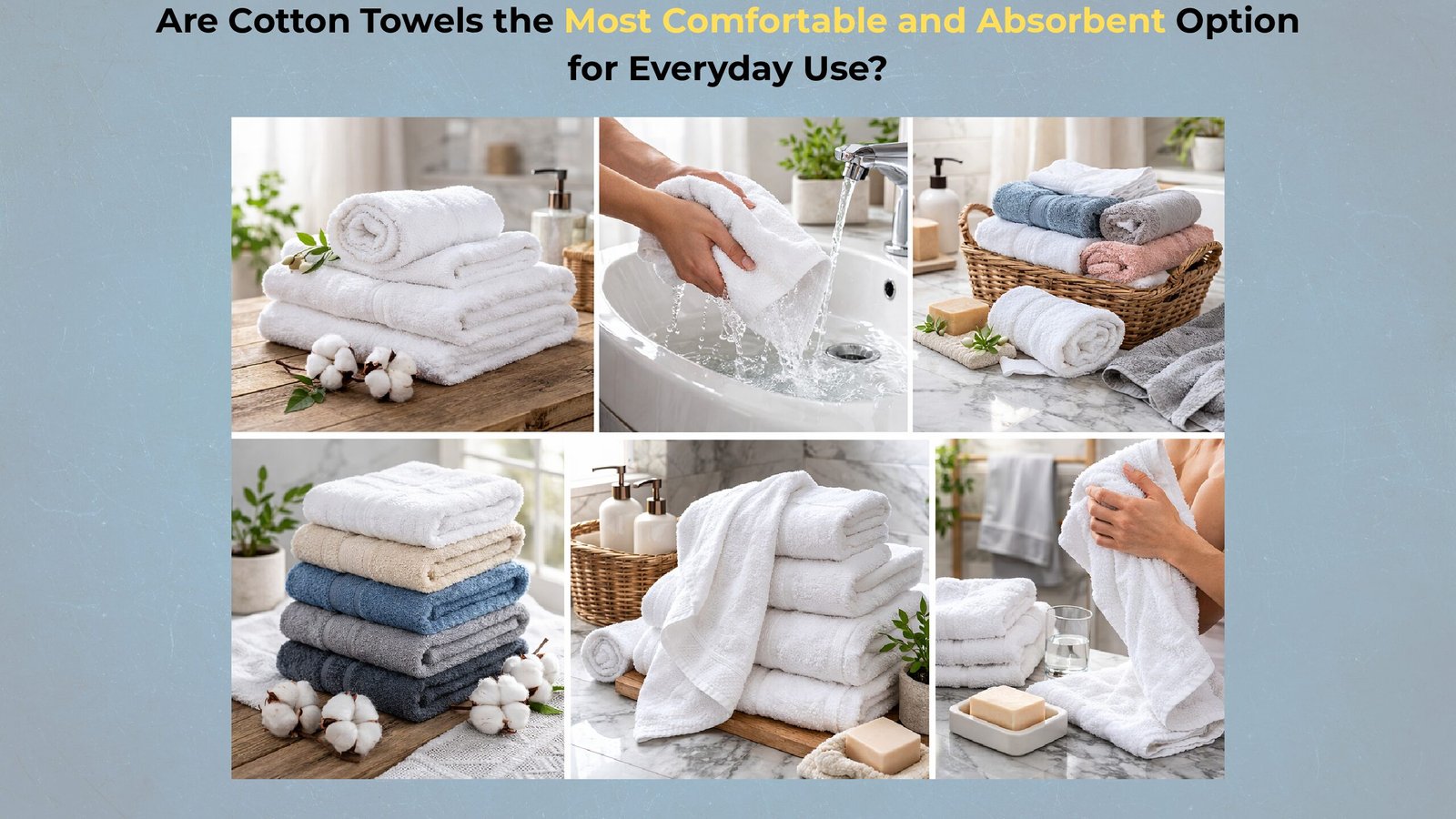
Cotton Towels represent the most comfortable and absorbent option for capacity because their natural cellulose fiber structure is hydrophilic and chemically bonds with water. This guide serves as an architectural blueprint for an authoritative, informational comparison within our Towel Materials Engineering Hub. It is engineered to analyze the scientific reality of Cotton Towels, proving they are the benchmark for capacity (holding water) while identifying where they fail in speed (drying time) compared to synthetics.
Contextualizing the cellulose structure as a polymer of glucose with exposed hydroxyl (-OH) groups allows for a deeper understanding of why cotton outperforms synthetic polymers in liquid interaction.
Why are Cotton Towels the Benchmark for Water Capacity and Comfort?
Cotton Towels serve as the benchmark for water capacity and comfort because the fiber’s biological structure swells to hold moisture, providing a substantial, non-abrasive feel. This physical expansion facilitates a non-friction environment for the skin, even at high saturation levels.
Identifying the Hydrophilic Mechanism in Cotton Towels
Identifying the hydrophilic mechanism in Cotton Towels reveals how the hollow fiber absorbs liquid into its core rather than trapping it on the surface. Cotton fibers absorb approximately 20–27% of their dry weight in atmospheric moisture and significantly more under full liquid saturation due to specific Cotton Absorbency Factors and Capillary Action. Liquid moves into the **”lumen”** (the central cavity of a cotton fiber that stores moisture) via capillary action, moving moisture away from the surface where it could feel damp against the skin.
Correlating Cotton Towels with Superior Post-Wash Softness
Correlating Cotton Towels with superior post-wash softness reveals that high-quality fibers “bloom” or untwist slightly over time, increasing their surface area and plushness. Long-staple fibers reduce pilling and fraying compared to short-staple variants because fewer fiber ends protrude from the yarn surface. **Blooming** is defined as the relaxation of internal stresses within the fiber loops during the drying process, a critical part of learning how to maintain cotton softness after washing, which allows the textile to expand into its most voluminous state.
Evaluating the Comfort Trade-Off: Cotton Towels vs. Synthetic Alternatives
Evaluating the comfort trade-off between Cotton Towels and synthetic alternatives highlights the difference between a soft, gliding texture and a “sticky,” friction-heavy feel. Cotton typically demonstrates higher vapor permeability than dense microfiber constructions due to its porous cellulose structure. Synthetics utilize mechanical “hook” shapes to trap water on the surface, which creates skin friction, whereas the smooth tubular structure of cotton minimizes mechanical irritation during use.
How Do You Compare Different Types of Cotton Towels for Performance?
Comparing different types of Cotton Towels for performance involves analyzing the staple length and origin, factors that dictate the yarn’s strength and softness.
Distinguishing Between Turkish, Egyptian, and Upland Cotton Towels
Distinguishing between Turkish, Egyptian, and Upland Cotton Towels facilitates choosing between maximum water capacity (Egyptian) and faster drying times (Turkish). Extra-Long Staple (ELS) varieties such as Giza 45 account for less than 0.5% of global crops. While the Egyptian Cotton Absorbency Mechanism provides the absolute peak of capacity, the Turkish Cotton Drying Speed Advantage balances absorbency with its long-staple structure and commonly lighter yarn constructions.
Comparison Matrix: Cotton Towels Types by Staple Length
This comparison matrix maps the staple length of Cotton Towels to their specific absorbency and drying speed profiles.
| Cotton Towel Type | Staple Length | Best Feature (Absorbency) | Drying Speed |
|---|---|---|---|
| Egyptian / Pima | Extra-Long (1.38″ – 2.5″) | Max Capacity (Deep Absorption) | Slow |
| Turkish | Long (1.12″ – 1.37″) | Balanced (Surface Wicking) | Medium |
| Upland | Short (0.8″ – 1.1″) | Low Capacity | Fast |
Analyzing Zero-Twist and 2-Ply Constructions in Cotton Towels
Analyzing Zero-Twist and 2-Ply constructions in Cotton Towels explains how yarn engineering prioritizes either extreme softness or extreme durability. Zero-twist yarns maximize loop surface area for immediate water contact, while 2-ply constructions use two yarns twisted together to ensure the textile can withstand the mechanical rigors of frequent high-heat industrial laundering.
When Does the Slow Drying Speed of Cotton Towels Become a Problem?
The slow drying speed of Cotton Towels becomes a problem in environments lacking ventilation or when laundry efficiency constitutes a priority. Understanding the Plush Cotton vs Drying Speed Trade-Off is essential for choosing textiles that suit high-volume households.
Prioritizing Non-Cotton Towels for Humid, Unventilated Bathrooms
Prioritizing non-cotton towels for humid, unventilated bathrooms prevents the persistent dampness that leads to musty odors and bacterial growth. Certain bacterial species multiply rapidly on persistently damp textiles under warm, low-airflow conditions. In these specific environments, the hydrophilic nature of cotton becomes a drawback, necessitating strict Cotton Mildew Prevention and Musty Odor Control protocols as the fibers refuse to release moisture quickly enough.
Balancing Cotton Towels for Laundry Volume and Efficiency
Balancing Cotton Towels for laundry volume is necessary because their high mass and water retention consume significant washer capacity and energy. High-GSM bath sheets retain substantially more water mass than mid-weight towels, which dictates an increase in drying time and higher mechanical load on drying equipment.
Selecting Lightweight Cotton Towels for Fast Hair Drying Needs
Selecting lightweight Cotton Towels for fast hair drying reduces neck strain and minimizes the time wet fabric sits against the hair shaft. Heavy wet towels increase cervical strain when wrapped around the head due to elevated water mass and the leverage applied to the cervical spine when the user is in an upright position.
How Can You Preserve the Absorbency and Comfort of Cotton Towels?
Preserving the absorbency and comfort of Cotton Towels involves avoiding chemical coatings and using heat responsibly.
Restoring Absorbency by Stripping Residue from Cotton Towels
Restoring absorbency requires stripping residue from Cotton Towels using an acid-base wash cycle to remove the detergent and softener buildup that seals the fibers. Repeated use of silicone-based softeners significantly reduces absorbency by creating a hydrophobic surface coating that blocks capillary action. This coating effectively “waterproofs” the hydrophilic cellulose, causing water to bead on the surface rather than entering the lumen.
Data Table: Maintenance Violations Specific to Cotton Towels
This data table identifies specific maintenance violations that degrade the cellulose structure of Cotton Towels.
| Violation | Impact on Cotton Towels | Mechanism of Damage |
|---|---|---|
| High Heat | Stiffness and brittleness | Thermal degradation and oxidative stress of cellulose chains |
| Fabric Softener | Hydrophobic coating | Blocked capillary action |
| Over-Bleaching | Fiber dissolution | Oxidative reduction of tensile strength |
How Do You Validate Quality Claims in Cotton Towels Before Buying?
Validating quality claims in Cotton Towels before buying involves executing a physical audit of the fiber length, finish, and scent.
Executing a 4-Step Cotton Towels Audit
This 4-step Cotton Towels audit is a “Cotton Quality Test” box designed to spot short-staple imposters.
Verify “Combed,” “Pima,” or “Egyptian” labels for long-staple content. Vague “100% Cotton” labels usually indicate inferior Upland short-staple crops.
Look for the slight sheen produced by proper mercerization. This indicates the fibers have been treated to swell and strengthen, improving dye uptake and absorbency.
Pinch a loop and pull gently to ensure zero immediate lint shedding. Stable loops indicate high-integrity yarn construction.
Check for aggressive scents indicating synthetic filler coatings or heavy finishing resins designed to hide scratchy, short-staple fibers.
Frequently Asked Questions
Absorbency loss is almost always due to the accumulation of detergent residue and silicone-based fabric softeners. These substances coat the hydrophilic cellulose fibers with a hydrophobic (water-repelling) film, preventing water from reaching the lumen.
Not necessarily. While Egyptian cotton has a higher total liquid capacity due to its extra-long staple length, Turkish cotton is engineered to balance absorption with wicking speed. If your environment is humid or poorly ventilated, Turkish cotton is often the superior functional choice.
Technically, blooming is the relaxation of internal torque and stresses within the spun yarn. During the first few wash-and-dry cycles, the twisted fibers untwist slightly and expand, which increases the total surface area of the terry loops and improves plushness.
Yes. Repeated exposure to high temperatures causes thermal degradation and oxidative stress on cellulose chains. This results in “fiber fatigue,” making the loops feel brittle, scratchy, and less capable of swelling to hold moisture.
GSM (Grams per Square Meter) measures fabric density. A higher GSM indicates more loops per square inch and more cellulose mass, meaning the towel can hold more water. However, higher GSM also increases drying time and mechanical load during laundry.