Why should fabric softener be avoided with Turkish cotton towels?
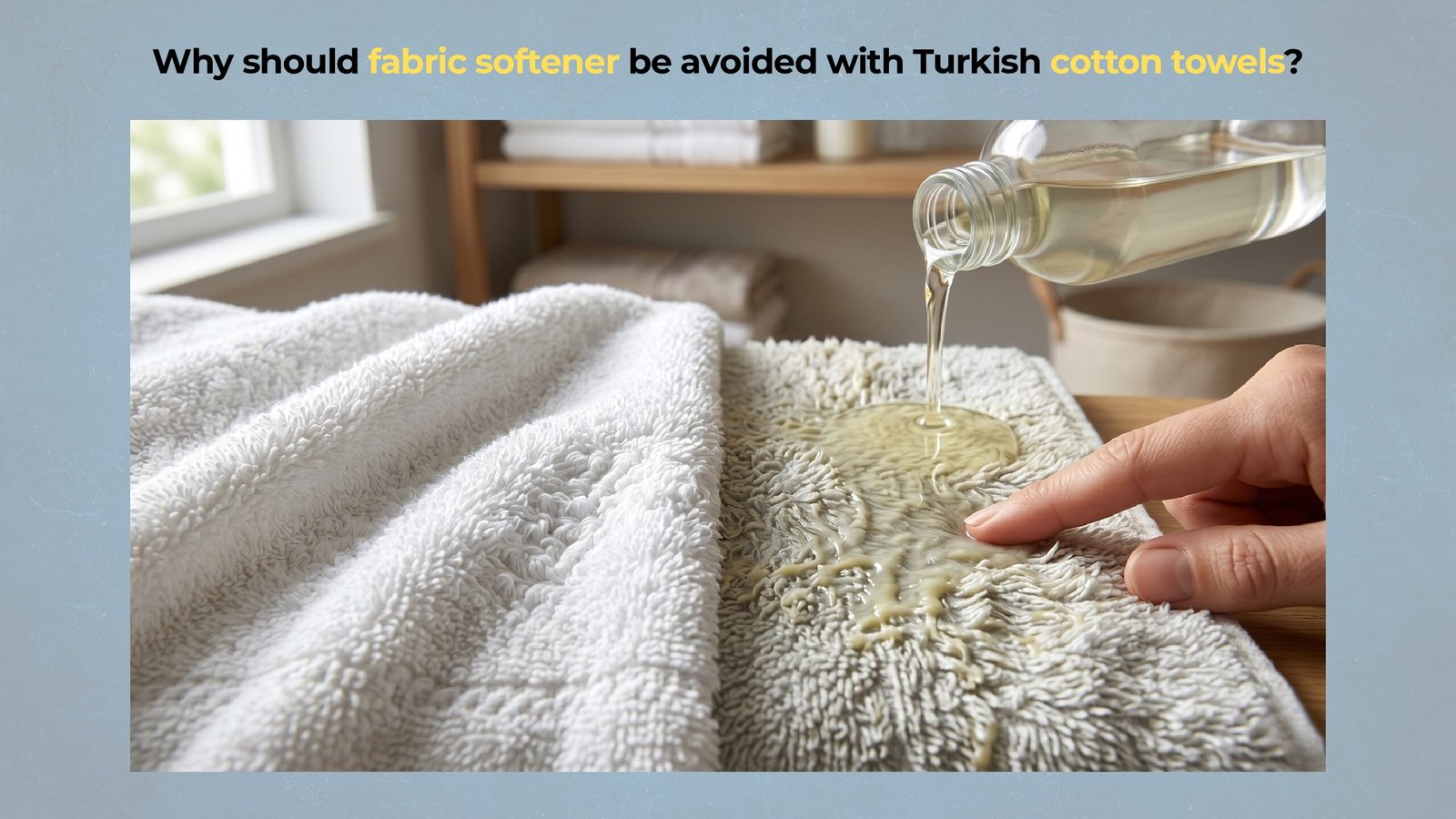
Turkish cotton towel fabric softener avoidance typically preserves the hydrophilic nature of the pile by preventing synthetic lubricants from coating the Aegean Sea long-staple cotton filaments, which otherwise leads to significant absorbency failure. While consumer marketing suggests that softeners improve the tactile experience, the chemical reality for luxury linens is one of performance degradation.
Identify the “Wick-Killing” effect in Turkish cotton towel fabric softener avoidance?
Turkish cotton towel fabric softener avoidance can maintain high-velocity moisture transit because it prevents silicone polymers from significantly increasing the contact angle of water on the fiber surface, which would otherwise cause water to bead. To understand how this moisture interaction works at the fiber level, it is useful to explore how absorbent Turkish cotton towels are and how they manage moisture transfer. According to research cited in the Journal of Applied Polymer Science, surfactant accumulation can increase the fiber-water contact angle from a hydrophilic state to one that is functionally non-polar.
Identify the chemical inputs that drive Turkish cotton towel fabric softener avoidance?
Turkish cotton towel fabric softener avoidance is supported when the user identifies and limits Dimethyl Ammonium Chloride and other petroleum-derived lubricants within the laundry cycle to prevent long-term residue buildup. Since this issue is rooted in chemical buildup, a natural next step is to review how chemical residues affect Turkish cotton towel performance and absorbency. These molecules are specifically designed to remain on the fabric after the rinse cycle, creating a persistent film.
Analyze the role of silicone lubricants in Turkish cotton towel fabric softener avoidance?
Turkish cotton towel fabric softener avoidance can succeed because it prevents silicone polymers from potentially coating the Fiber Lumen, which may reduce the moisture-holding capacity of the towel over time. Polymer stratification, as noted in the Textile Research Journal, can create a persistent residue that often requires forensic stripping.
Explain how molecular physics drive the Turkish cotton towel fabric softener avoidance system behavior?
Turkish cotton towel fabric softener avoidance relies on maintaining high surface energy on the cellulose matrix to facilitate the absorption of water molecules through a process of molecular attraction rather than repulsion. Because this behavior originates at the microscopic level, it is helpful to understand what the fiber structure of Turkish cotton towels looks like and how it affects wicking.
Mechanism Matrix for Turkish Cotton Towel Fabric Softener Avoidance
| Chemical Input | Physical Action (System Behavior) | Potential Result for Turkish Cotton Towels |
|---|---|---|
| Silicone Polymers | Hydrophobic Shielding | Water can bead on the surface; absorbency can reduce. |
| Cationic Surfactants | Electrostatic Fiber-Bonding | Loop matting may occur; the textile may lose loft. |
| Fatty Acids | Fiber Lumen Interference | The internal core can block; moisture may trap odors. |
Compare natural softening agents to optimize Turkish cotton towel fabric softener avoidance?
Turkish cotton towel fabric softener avoidance is often improved when the user selects Acetic Acid (White Vinegar) to help dissolve mineral deposits rather than depositing synthetic resins that create a waterproof coating on the fibers. To connect this with real-world usage, it is useful to review what care instructions should be followed to maintain towel absorbency and longevity.
Softening Alternative Comparison Table
| Method | Technical Mechanism | Effect on Wicking | Expert Recommendation |
|---|---|---|---|
| White Vinegar | Alkaline Neutralization | Enhances wicking | Primary Choice |
| Baking Soda | pH Buffering | Neutral impact | Deodorizing |
| Wool Dryer Balls | Mechanical Agitation | Preserves loft | Drying Phase |
Which laundry protocols execute Turkish cotton towel fabric softener avoidance?
Turkish cotton towel fabric softener avoidance typically utilizes the “Vinegar-Reset” protocol to strip residual alkaline salts and maintain a favorable fiber environment for maximum loop expansion and soft texture. Absorbency failure caused by residue buildup directly impacts how effectively the towel performs during daily use. Since this is a key user-facing outcome, you may want to explore what determines towel absorbency and how it affects real-world performance.
Execute the “Vinegar-Reset” rinse for Turkish cotton towel fabric softener avoidance?
Turkish cotton towel fabric softener avoidance can be enhanced by the addition of white vinegar to the final rinse cycle to sequester detergent minerals. Lowering the pH optimizes cotton fiber softness because Acetic acid can help dissolve calcium carbonate without leaving a hydrophobic residue.
How can you fix absorbency loss to restore Turkish cotton towel fabric softener avoidance?
Turkish cotton towel fabric softener avoidance baseline performance can be improved if the user resolves chemical saturation through a forensic stripping process that uses heat to liquefy and remove trapped polymers. If your towels already show signs of reduced absorbency or coating buildup, you can diagnose the underlying issue using a towel failure diagnostics tool to identify washing-related performance problems.
Strip silicone buildup to restore the Turkish cotton towel fabric softener avoidance baseline?
Turkish cotton towel fabric softener avoidance performance is often recovered if the user executes a hot wash cycle with sodium bicarbonate to help dissolve polymers and open up the fiber pores. Sequential pH shifts can catalyze the release of silicone resins that have bonded to the matrix.
How do you audit your linens with this Turkish cotton towel fabric softener avoidance checklist?
Turkish cotton towel fabric softener avoidance can be verified through a 5-point audit of absorbency speed and tactile fiber friction. If you want to verify whether softener residue has already affected your towel’s performance, it is helpful to use a towel absorbency test template to measure actual water absorption behavior.
- ☐ Absorbency Test: A water droplet is absorbed into the Aegean pile rapidly without beading or runoff.
- ☐ Residue Test: Surface friction feels “velvety” or “grippy” rather than “slimy,” “slick,” or “waxy.”
- ☐ Drying Metric: The towel typically dries within a standard time frame consistent with its local humidity.
- ☐ Scent Profile: The textile remains neutral or slightly acidic rather than perfume-heavy.
- ☐ Visual Audit: Terry loops stand upright and show visible “Bloom” after tumble drying.
Frequently Asked Questions regarding Turkish cotton towel fabric softener avoidance?
Will avoiding softener make my towels feel scratchy or stiff?
Initially, towels may feel different without their chemical coating, but by using the Vinegar-Reset protocol and avoiding high heat, the long-staple fibers remain naturally soft and velvety without sacrificing wicking ability.
Are dryer sheets as harmful as liquid fabric softeners?
Yes. Dryer sheets contain heat-activated lubricants and paraffin-based waxes that melt directly onto the Aegean cotton filaments during the drying cycle, creating an identical hydrophobic barrier.
How often should I perform a forensic stripping process?
Stripping is only necessary when absorbency fails significantly. For most high-use linens, a stripping cycle every 4–6 months is sufficient to maintain the Turkish cotton towel fabric softener avoidance baseline.
Can I use white vinegar in every single wash cycle?
Yes. Adding 1/2 cup of white vinegar to the final rinse cycle is safe for the cellulose matrix and helps sequester detergent minerals that would otherwise cause loop stiffness.
Does the high-performance profile of Turkish cotton towel fabric softener avoidance fit your luxury needs?
Turkish cotton towel fabric softener avoidance establishes the foundation for a laundry routine that prioritizes long-term fiber health and authentic absorbency over the temporary slickness of synthetic lubricants. To maintain optimal performance and prevent future residue buildup, you can follow a structured towel care habit protocol designed to preserve fiber integrity.
Disclaimer
The information provided in this guide is for educational purposes regarding textile care and engineering. While these methods are designed to restore absorbency to Aegean cotton, individual results may vary based on specific laundry equipment, water hardness, and towel age. Always test a small area before applying forensic stripping protocols to your linens. TowelDaily is not responsible for damages resulting from improper execution of these protocols.