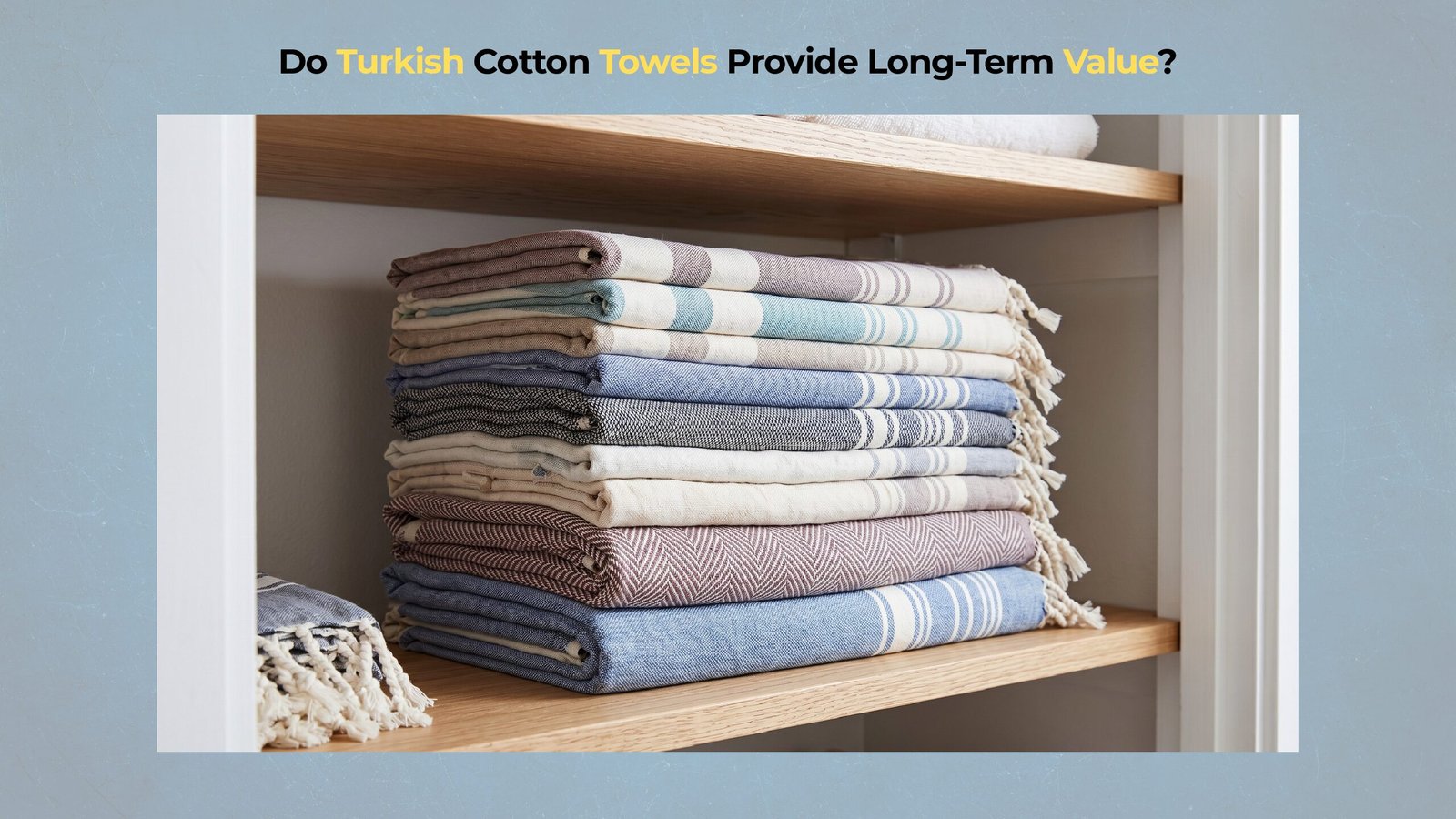
Do Turkish Cotton Towels Provide Long-Term Value?
Turkish cotton towel long-term value is determined by the intersection of fiber tensile strength and a Cost-Per-Wash (CPW) ratio that generally outperforms standard short-staple alternatives over a five-year horizon. This premium textile investment reconciles a higher initial capital outlay with superior textile longevity and sustained fiscal utility for the discerning household. Short-staple alternatives often suffer from rapid fiber breakage, leading to early replacement costs that negate their initial low price.
How do you assess Turkish cotton towel lifespan value to optimize your budget?
Assessing Turkish cotton towel lifespan value requires a shift from “purchase price” metrics to a “replacement cycle” model, where the durability of long-staple fibers reduces the total cost of ownership. This transition from a disposable mindset to a durable textile strategy allows consumers to view linens as semi-permanent assets, especially when considering how durable Turkish cotton towels are with regular use.
A higher initial investment correlates with a lower frequency of replacement because the structural integrity of the Aegean cotton remains intact for 150 to 300 washes. By avoiding the annual replacement of thinning, non-absorbent towels, homeowners effectively buy back both time and money over the long term. If you want to calculate whether a premium towel actually delivers better value over time, you can use a towel lifespan calculator to estimate cost-per-use and long-term ROI.
Why is the cost-per-wash metric vital for Turkish cotton towel long-term value?
The Golden Formula for Textile ROI:
$CPW = Price / (Washes Per Week × 52 × Years)The cost-per-wash (CPW) metric serves as the most accurate indicator of Turkish cotton towel long-term value, as it accounts for the hundreds of additional cycles these towels withstand compared to standard cotton. To understand this foundation, it is useful to explore what staple length Turkish cotton towels typically have and why it improves durability.
What factors sustain Turkish cotton towel long-term performance?
Specific material factors sustain Turkish cotton towel long-term performance, most notably the unique physical structure of Aegean long-staple fibers that soften with repeated washing. Because this originates at the microscopic level, it is helpful to understand what the fiber structure of Turkish cotton towels looks like and how it affects longevity.
Hygroscopy, the fiber’s ability to attract and hold water molecules from the surrounding environment, remains high in Turkish cotton because the long-staple structure maintains its moisture regain capacity over years of use. To connect this with real-world usability, it is useful to review how absorbent Turkish cotton towels are and how they manage moisture.
How does the durability of Turkish cotton towels compare to standard alternatives?
A durability comparison reveals that Turkish cotton towel long-term value is preserved through a slower rate of fiber breakage, maintaining structural integrity long after standard cotton has reached rag-grade quality. Comparative testing shows significant divergence in absorbency retention between Aegean and upland cotton varieties.
| Usage Milestone | Standard Cotton Towels | Turkish Cotton Towels | ROI Impact |
|---|---|---|---|
| 50 Washes | Significant pilling / thinning | Fibers begin to soften and expand | Break-even |
| 100 Washes | Loops begin to snag and fray | Peak moisture absorption | High Value |
| 200 Washes | Non-absorbent / Material failure | 90% Tensile Strength Retention | Max ROI |
How do you calculate the cost efficiency of Turkish cotton towel long-term value?
Faster drying reduces energy usage and prevents odor buildup, which contributes to long-term efficiency. Because of this, it is helpful to understand how fast Turkish cotton towels dry under real conditions.
How can you protect Turkish cotton towel value retention through care protocols?
Protecting Turkish cotton towel value retention depends on adhering to care protocols that prevent the thermal degradation of cellulose and the buildup of hydrophobic chemical residues. To connect this with everyday use, it is useful to review what care instructions should be followed to maintain towel performance and lifespan.
What habits destroy Turkish cotton towel long-term performance and texture?
Several common household habits destroy Turkish cotton towel long-term performance, specifically the use of high-heat drying cycles and excessive detergent volumes. To ensure your towels retain their performance and avoid early wear, you can follow a structured towel care habit protocol designed for long-term durability.
| Harmful Habit | Impact on Value | Corrective Protocol |
|---|---|---|
| High-Heat Drying | Causes thermal degradation | Low Heat / Delicate |
| Over-detergent Use | Clogs fibers; reduces wicking | Use 1/2 standard amount |
| Using Sharp Hooks | Permanent snags/tears | Drape over wide bars |
Which checklist confirms Turkish cotton towel long-term value before you buy?
10-Year Service Quality Audit
Frequently Asked Questions
When maintained correctly, Turkish cotton towels have a functional lifespan of 150 to 300 wash cycles. For the average household, this equates to 5 to 10 years of service before the textile enters “rag-grade” status.
Why is the Cost-Per-Wash (CPW) lower for expensive towels?While the initial capital outlay is higher, the durability of Aegean long-staple fibers means you replace the towel 3-4 times less often than standard cotton. Over 5 years, the cost per individual use is significantly lower.
Does fabric softener ruin the value of Turkish cotton?Yes. Liquid softeners coat the loops in a waxy, hydrophobic film. This destroys the towel’s hygroscopic wicking ability, meaning the towel will push water around rather than absorbing it.
What is the ‘Bloom Effect’ in Turkish towels?The ‘Bloom’ refers to the unique property of Turkish cotton where the fibers expand and open up after the first few washes. Unlike standard cotton which compacts and gets scratchy, Turkish cotton actually gets softer as it ages.
Can high heat destroy a towel’s long-term value?Absolutely. High heat causes “Thermal Shock,” which snaps the delicate long-staple fibers and leads to a stiff, crunchy texture. Drying on low heat is essential for preserving the $CPW ratio.
Disclaimer: The economic projections and textile longevity data presented in this analysis are based on standard material science testing and industry benchmarks for 100% Aegean cotton. Actual product lifespan and “Cost-Per-Wash” (CPW) results may vary based on specific manufacturing quality, water mineral content, detergent chemistry, and adherence to recommended care protocols. This information is intended for educational purposes and does not constitute a legal guarantee of product performance.