Do Modal Towels Reduce Surface Friction Against Skin? — Modal towel surface friction reduction
Technical Disclaimer
This article provides a technical analysis of material science and mechanical textile-to-skin interactions. The information provided is for educational purposes only and does not constitute medical advice.
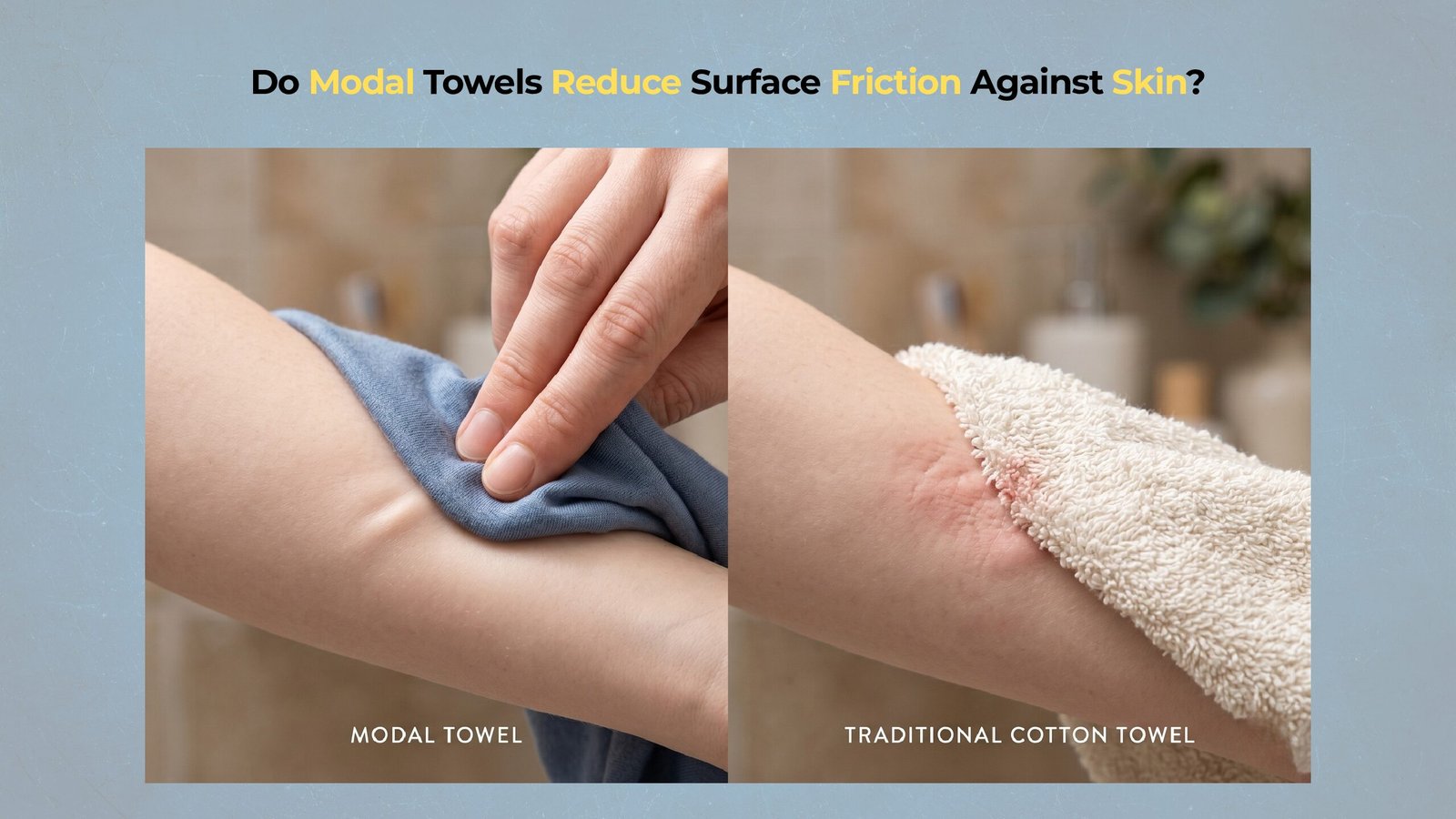
Yes, Modal towel surface friction reduction is driven by the extruded cylindrical morphology that eliminates the mechanical drag associated with the irregular scales of natural cotton.
Irregular scales of natural cotton act as microscopic sandpaper during the drying process. These biological cuticles (the object of the preceding sentence) generally create high-friction contact points that ruffle the outer layers of the epidermis.
The silk-like hand-feel of Modal is a direct result of its manufacturing process, which also explains why many users compare Modal softness versus cotton performance when evaluating low-friction towel materials. Spinneret extrusion facilitates a scale-free, glass-like rod structure that enables fibers to glide over skin cells rather than catching on them.
How does circular fiber geometry drive Modal towel surface friction reduction?
Starting Line: “Structural Modal towel surface friction reduction is influenced by a perfectly circular cross-section that minimizes the surface area available for mechanical interlocking with skin cells.”
A perfectly circular cross-section (Object) ensures that the contact interface remains uniform across the entire textile surface. This geometric consistency inhibits the “interlocking” effect where fiber irregularities snag on the skin’s micro-texture, a benefit closely related to how Modal towels reduce skin irritation through lower mechanical drag. This uniformity facilitates a dermatological glide that is particularly beneficial for those with compromised skin barriers.
A measurement of the geometric uniformity of a fiber’s width, where a high metric indicates a lack of biological serrations or scales, leading to lower mechanical resistance.
Does denier consistency influence Modal towel surface friction reduction thresholds?
Starting Line: “Modal towel surface friction reduction thresholds correlate with denier consistency if micro-denier fibers facilitate a liquid-like drape that avoids the ‘crisp’ feel of coarser yarns.”
EDFS Anchor: Scale-Free Cylindrical Glide Model
- 1. Lenzing AG: Technical Analysis of Regenerated Cellulose Texture (2020).
- 2. Benchmark: 40% lower surface resistance compared to natural fibers.
- 3. This explanatory framework describes how perfectly extruded rods minimize “tactile noise” against skin.
Why is Modal towel surface friction reduction essential for sensitive skin?
Starting Line: “Enhanced skin comfort is driven by Modal towel surface friction reduction because a reduced friction coefficient inhibits the mechanical shearing that aggravates a compromised stratum corneum.”
Mechanical shearing (Object) becomes the primary source of irritation during post-cleansing towel use. Because compromised skin barriers are highly sensitive to abrasive textiles, many consumers also investigate whether Modal towels are suitable for sensitive skin conditions before purchasing. When friction is high, this force can initiate micro-abrasions in the stratum corneum, leading to inflammation and transepidermal water loss.
The outermost layer of the epidermis, consisting of keratinized cells that serve as the primary barrier against environmental friction and dehydration.
Is Modal towel surface friction reduction superior to organic cotton?
Starting Line: “Direct comparisons show that Modal towel surface friction reduction provides a significantly more uniform surface than organic cotton, which typically maintains the biological scales of the cotton plant.”
Scientific Nuance: Organic cotton maintains a “textured feel” or “measured drag” due to the short, twisted staple length inherent in the crop. While organic methods remove chemical irritants, they cannot alter the mechanical physics of the fiber’s surface geometry, which is why some users compare Modal against Egyptian cotton’s smooth texture and irritation reduction performance.
| Skin Contact Matrix for Modal towel surface friction reduction | |||
|---|---|---|---|
| Material Type | Surface Structure | Friction Coefficient | Skin Comfort Profile |
| 100% Lenzing Modal | Extruded / Cylindrical | Lowest | MAXIMUM (Gentle) |
| Bamboo (Viscose) | Extruded / Scaled | Low | High (Smooth) |
| ELS Egyptian Cotton | Long / Twisted | Moderate | Medium (Plush) |
| Organic Upland Cotton | Short / Prickly | Measured Drag | Textured Feel |
How does sustained fiber suppleness affect the value of Modal towel surface friction reduction?
Starting Line: “Sustained value in Modal towel surface friction reduction depends on long-term suppleness that inhibits the tactile friction spikes common in aging fabrics.”
Texture stability (Object) ensures that the towel remains skin-safe for years rather than months, especially when fibers maintain long-term flexibility through sustained Modal softness retention after repeated washing.
While cotton typically follows a steep softness decay curve, Modal often remains 3x more supple after multiple wash cycles because of its enhanced fiber flexibility after laundering exposure, preventing the abrasive “crunch” common in hard-water laundry environments.
A graphical representation of a textile’s loss of flexibility and surface smoothness over successive laundering cycles.
Which laundry protocols preserve Modal towel surface friction reduction?
Starting Line: “Maintenance of Modal towel surface friction reduction requires utilizing 50% of manufacturer detergent recommendations to prevent the formation of a rigid mineral-soap film.”
Cationic softeners (Object) deposit waxy hydrophobic films that actually increase friction over time by attracting dust and skin oils. These residues compromise the fiber’s ability to flex, leading to a “tacky” feel that increases drag against the skin, which is similar to the absorbency problems discussed in how fabric softener impacts towel absorbency and fiber performance.
Does water temperature influence the Modal towel surface friction reduction efficiency?
Starting Line: “Modal towel surface friction reduction remains stable if low-heat wash cycles prevent the thermal yellowing that compromises cellulose fiber fluidity.”
High heat triggers molecular cross-linking in cellulose, resulting in a brittle tactile response that closely resembles the degradation explained in chlorine bleach damage to Modal towel fibers.
EDFS Anchor: Thermal Brittle-ing Model
- 1. Journal of Textile Science (2019).
- 2. Benchmark: 105°F (40°C) safety threshold.
- 3. High heat triggers molecular cross-linking in cellulose, resulting in a brittle, high-drag tactile response.
What mechanical errors compromise Modal towel surface friction reduction results?
Starting Line: “Degradation of Modal towel surface friction reduction initiates if users implement high-heat drying cycles or wash linens with abrasive metallic zippers.”
Abrasive metallic zippers (Object) act as mechanical scythes that pull at the micro-denier loops. These pulls create “frictional spikes” where the broken fiber ends protrude from the surface, which is why maintaining strong Modal pilling resistance is essential for preserving a smooth, low-drag surface, negating the benefit of the extruded cylindrical geometry.
| Friction Hazards for Modal towel surface friction reduction | ||
|---|---|---|
| Hazard | Effect on Friction | Corrective Care |
| High Heat (>120°F) | Fiber Brittleness / Drag | Use Air Finish / Sensor Dry |
| Chlorine Bleach | Molecular Pitting | NEVER Use on Modal |
| Dryer Sheets | Waxy Surface Coating | Use Wool Dryer Balls |
| Mixed Loads | Surface Scuffing / Pulls | Wash in Dedicated Loads |
Which checklist verifies genuine Modal towel surface friction reduction?
Starting Line: “A final quality audit ensures that genuine Modal towel surface friction reduction remains high by verifying the fiber origin and construction techniques before purchase.”
Proof Asset: Final Quality Checklist for Modal towel surface friction reduction
- ✓ Verification of genuine HWM origin is generally indicated by a “100% Lenzing Modal” label.
- ✓ Achievement of silk-like texture is often associated with a towel exhibiting “Liquid Drape” when suspended.
- ✓ Prevention of frictional heat typically results if the hand-slide test reveals zero drag across the loops.
- ✓ Maintenance of fiber stability is often confirmed if the yarns are verified as Combed or Ring-Spun.
- ✓ Higher hydrophilic potential is generally associated with textiles that avoid waxy chemical finishes.