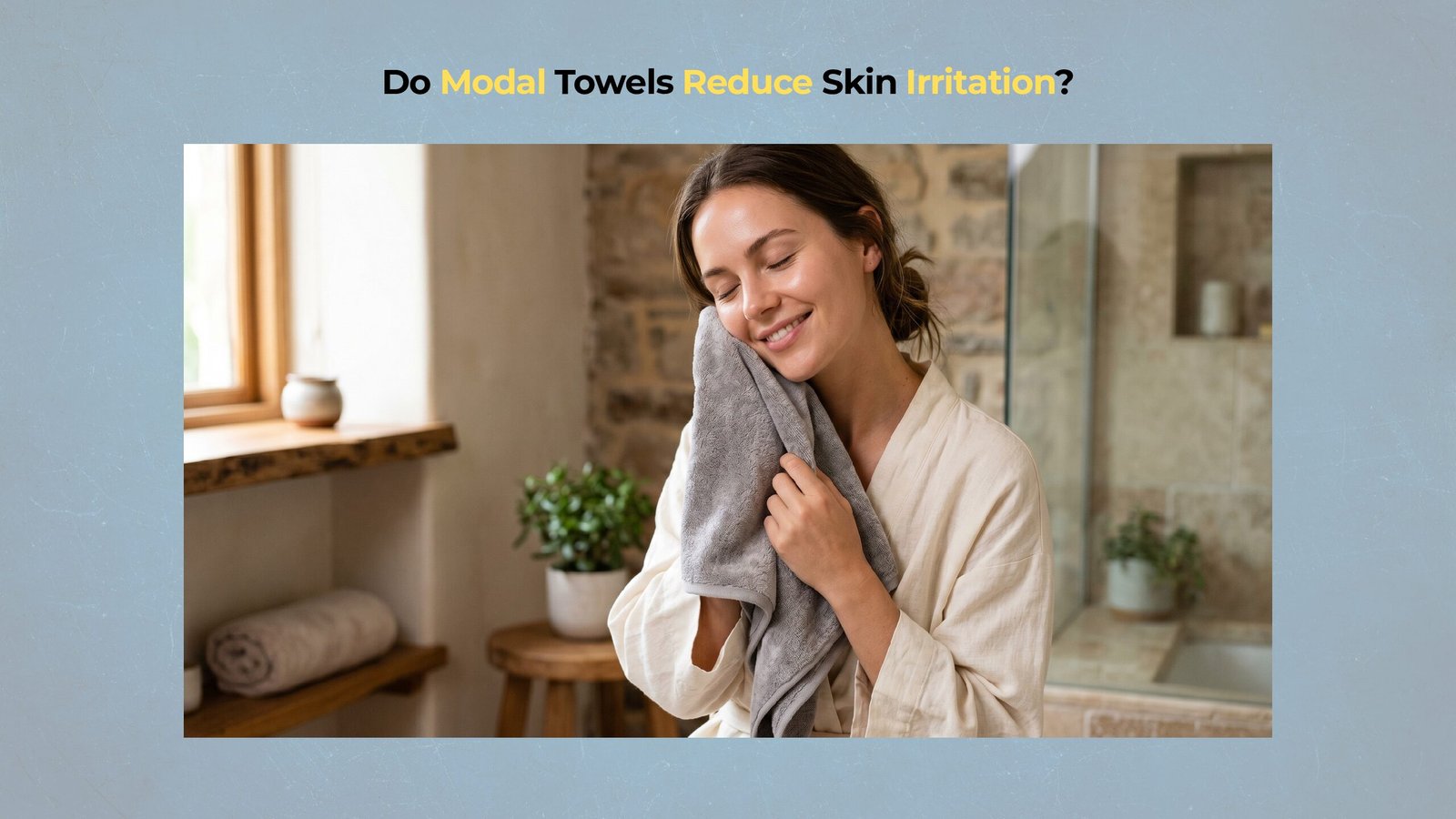
Do Modal Towels Reduce Skin Irritation? — Modal towel skin irritation reduction
High Modal towel skin irritation reduction results if the uniform extruded cellulose structure facilitates a gentler surface interaction that lacks the natural irregularities of cotton.
Achieving peak Modal towel skin irritation reduction results if the textile utilizes a uniform extruded cellulose structure. High dermatological safety occurs if the smooth fiber morphology facilitates a lower friction coefficient than twisted cotton ribbons. Maintaining this protective finish succeeds when users implement low-residue laundering and avoid thermal settings that cause fiber brittleness.
Natural irregularities act as micro-abrasive points that compromise epidermal integrity during the drying process. These microscopic protrusions trigger localized inflammation when wet skin, which possesses a higher friction coefficient than dry skin, undergoes mechanical stress.
Why do smooth modal fibers facilitate Modal towel skin irritation reduction?
Fiber convolutions are the natural twists and ribbon-like folds characteristic of cotton fibers that develop during biological growth. These convolutions create a textured surface that increases abrasive contact points, whereas the uniform extruded profile of modal remains smooth to support Modal towel skin irritation reduction.
Because friction reduction is central to Modal towel skin irritation reduction, readers comparing textile smoothness may also want to understand how modal fiber smoothness compares with cotton and other towel materials. Industrial spinneret extrusion removes the irregular twists and rough scales characteristic of natural cotton fibers, resulting in a scale-free cylindrical profile.
Irregular twists and rough scales in organic fibers provide the mechanical grip necessary for yarn strength, but they simultaneously increase surface friction. This friction induces micro-tears in the stratum corneum when the towel is pulled across the skin surface.
High Wet-Modulus (HWM) refers to the ability of modal fibers to maintain structural integrity and dimensional stability when saturated.
Does the circular cross-section improve Modal towel skin irritation reduction benchmarks?
Modal towel skin irritation reduction benchmarks improve if the circular cross-section of the fiber reduces the surface area available for friction against the skin. According to research by Lenzing AG (2020), modal fibers demonstrate a significantly lower surface friction coefficient compared to combed cotton.
Because lower surface friction directly affects tactile comfort, users frequently continue to explore how modal creates a silky skin feel that reduces abrasive contact. The “Smooth-Surface Glide Model” provides an explanatory framework where the towel moves across the skin as a unified front.
How does protecting the stratum corneum improve Modal towel skin irritation reduction?
Protection of the stratum corneum improves Modal towel skin irritation reduction if the lower abrasive contact of the fibers inhibits the disruption of the skin’s lipid barrier. Readers concerned about reactive or eczema-prone skin may also benefit from learning why modal towels are considered suitable for sensitive skin conditions.
The outermost layer of the epidermis, consisting of dead cells (corneocytes) that form a protective barrier.
Is the performance of Modal towel skin irritation reduction superior to standard cotton?
Superior Modal towel skin irritation reduction against standard cotton varieties results if the more uniform fiber profile provides a consistent surface that lacks abrasive impurities. Standard cotton often contains minute seed hull fragments that create a “prickle factor” on sensitive skin.
Skin Comfort Matrix for Modal towel skin irritation reduction
| Material Type | Fiber Structure | Surface Friction | Skin Barrier Impact |
|---|---|---|---|
| Lenzing Modal | Highly Uniform Cylindrical | Lowest | MAXIMUM |
| Bamboo (Viscose) | Smooth / Cylindrical | Low | Smooth Glide |
| Egyptian Cotton | Long / Twisted | Moderate | Measured Drag |
| Standard Cotton | Prickly / Twisted | High | Textured Feel |
How does sustained softness optimize Modal towel skin irritation reduction value?
Once users understand why smooth fibers protect the skin barrier, the next logical question is whether the fabric also remains comfortable after repeated laundering, which is explained in how modal towels retain softness over time. Unlike cotton, modal remains pliable over its entire lifespan.
The Softness Decay Curve measures the rate at which a textile loses its tactile gentleness.
Which laundry protocols maintain Modal towel skin irritation reduction?
Maintenance of Modal towel skin irritation reduction requires the exclusion of waxy fabric softeners to prevent the accumulation of hydrophobic chemical films. Since irritation often increases when fabrics become rough after washing, it helps to explore how modal fibers maintain flexibility after repeated wash cycles.
Does surfactant-free rinsing improve Modal towel skin irritation reduction efficiency?
The discussion about detergent residue and surfactant buildup naturally connects to how mineral buildup and residue affect modal towel texture and skin comfort. Modal towel skin irritation reduction efficiency remains stable if an extra rinse cycle ensures a significant reduction of surfactant molecules from the fiber core.
What laundering mistakes destroy Modal towel skin irritation reduction efficiency?
Catastrophic failure of Modal towel skin irritation reduction efficiency results if detergent overload or high-heat drying cycles compromise the surface. Since overheating can damage cellulose integrity and increase roughness, readers should also review how proper washing methods preserve modal towel durability and softness.
Irritation Hazards for Modal towel skin irritation reduction
| Hazard | Effect | Corrective Action |
|---|---|---|
| High Heat (>120°F) | Fiber Brittleness | Use Air Finish / Sensor Dry. |
| Detergent Overload | Gluey Residue | Execute Vinegar Strip Wash. |
| Fabric Softeners | Waxy Barrier | Use Wool Dryer Balls. |
| Hard Water Ions | Mineral Calcification | Add 1/4 cup White Vinegar. |
Which checklist verifies Modal towel skin irritation reduction quality?
Verification of genuine HWM origin is generally indicated by a “100% Lenzing Modal” label for Modal towel skin irritation reduction.
Prevention of chemical irritation is supported when the product carries the OEKO-TEX Standard 100 seal.
Achievement of peak tactile comfort is generally associated with a GSM between 500 and 700.
Maintenance of fiber wicking often results if the loops remain free of waxy chemical finishes.
Higher Modal towel skin irritation reduction results if the textile utilizes a lower-friction structure.
Which FAQ answers address Modal towel skin irritation reduction?
Why is modal better for sensitive skin?
Modal towel skin irritation reduction results from the manufacturing process that creates a scale-free, cylindrical fiber that glides over skin ridges without triggering inflammatory responses.
Does washing modal frequently cause irritating pilling?
No, maintaining Modal towel skin irritation reduction is easier because modal resists the fiber fraying that causes aging cotton to become abrasive.
Medical Disclaimer
This technical analysis is provided for educational and informational purposes only and does not substitute for professional medical advice, diagnosis, or treatment. Always seek the advice of your dermatologist or other qualified healthcare provider regarding specific skin conditions or reactive profiles.