Exploring the Self-Refining Surface of Regenerated Cellulose
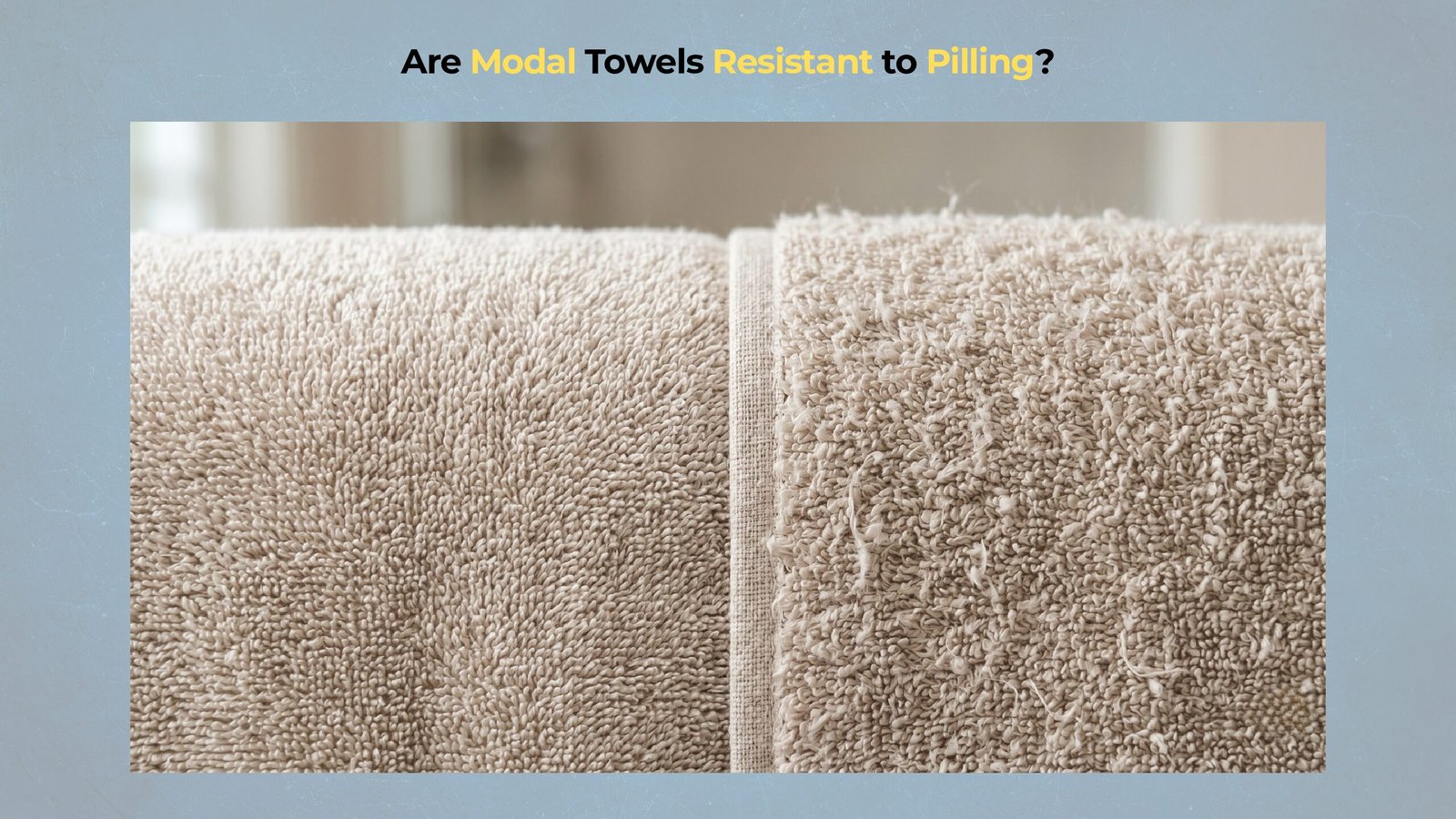
Yes, Modal towel pilling resistance is exceptionally high because the uniform, scale-free fibers prevent the mechanical entanglement that initiates surface fuzzing.
Mechanical entanglement occurs when rough fiber ends snag and twist into knots during the agitation of a wash cycle. Since Modal utilizes a high-wet-modulus (HWM) production process, the resulting staples lack the microscopic surface “scales” found on natural cotton.
Surface scales act as microscopic barbs that catch adjacent fibers, whereas the cylindrical morphology of Modal ensures that loose fibers simply slide past one another. This “Self-Refining Surface” model explains why Modal textiles often become smoother with age while standard cotton alternatives begin to bloom with pills and fuzz.
Why does fiber smoothness enhance Modal towel pilling resistance?
Enhanced Modal towel pilling resistance is driven by a low friction coefficient that inhibits the anchor-migration of broken fibers to the textile surface.
Anchor-migration describes the process where short fibers buried within the yarn core work their way outward due to the mechanical energy of laundering. In high-friction fabrics like cotton or polyester blends, these migrating fibers catch on the surface and tangle.
Tangling is prevented in Modal because the smooth fiber surface lacks the “grip” necessary to form a stable knot. Consequently, any loose fiber ends that do reach the surface are typically shed cleanly in the rinse water, a hallmark of modal vs cotton fiber smoothness behavior.
Technical Definition: Friction Coefficient Metric
A quantitative measurement of the resistance to motion between two surfaces; Modal possesses a metric approximately 30% lower than standard cotton, facilitating its superior surface integrity.
Does fibrillation resistance facilitate Modal towel pilling resistance during saturation?
Modal towel pilling resistance during saturation is facilitated by fibrillation resistance which prevents the cylindrical fiber surface from splitting into microscopic hooks.
Microscopic hooks are the result of “fibrillation,” a phenomenon where a single fiber peels back its outer layer when wet and under stress. According to the Lenzing AG: Technical Manual on Regenerated Cellulose Performance (2020), Modal fibers exhibit a 50% smoother surface texture compared to Upland cotton over a 12-month interval of simulated heavy use.
This data supports the “Surface Refinement Lifecycle Model,” which posits that Modal towels maintain their tactile finish because the fibers do not degrade into the splintered state that invites mineral trapping, which aligns with research on modal fiber fraying resistance mechanisms.
Is Modal towel pilling resistance superior to standard cotton alternatives?
Direct comparisons show that Modal towel pilling resistance provides a significantly more stable aesthetic over 100+ wash cycles compared to the surface fuzzing common in standard cotton, as the latter is limited by cotton fiber structure and absorbency factors.
High-wet-modulus (HWM) stability preserves surface uniformity by ensuring the yarns remain tightly bound even when fully hydrated. While Egyptian cotton is highly resistant to pilling, its “blooming” characteristic often results in a loss of the original silky sheen—a failure of aesthetic integrity that Modal avoids while maintaining a superior profile to Egyptian cotton fiber softness and structure.
Polyester-blend towels represent the lowest standard of performance, as the high-strength synthetic fibers act as permanent anchors for lint, resulting in “critical” pilling levels within just 10-15 cycles, a trait mirroring polyester fiber surface behavior and retention issues.
Surface Integrity Matrix for Modal Towel Pilling Resistance
| Material Type | Pilling Risk | 50-Wash Texture | Integrity Winner |
|---|---|---|---|
| 100% Modal | MINIMAL | Silky / Smooth | Modal is superior |
| Egyptian Cotton | Low | Plush / Blooming | Tie (Subjective) |
| Standard Cotton | High | Fuzzed / Rigid | Modal is superior |
| Polyester Blends | CRITICAL | Heavy Pilling | Cotton is superior |
How does aesthetic longevity increase the ROI of Modal towel pilling resistance?
Financial ROI for Modal towel pilling resistance is driven by an “aesthetic lifespan” model that accounts for a 3x reduction in replacement frequency compared to pilling-prone fabrics.
Pilling-prone fabrics often reach their “Aesthetic Expiration” threshold long before the textile actually loses its functional ability to absorb water. Once a towel becomes covered in abrasive fiber knots, most consumers relegate the item to a “rag” status, necessitating the purchase of a replacement.
Aesthetic expiration for standard cotton towels typically occurs at the 6-to-8-month mark in high-frequency households. By contrast, a high-quality Modal towel remains in its “as-new” state for years, effectively lowering the cost-per-use to a fraction of that of cheaper alternatives, especially when considering modal wash durability over long-term use.
Which laundering protocols protect Modal towel pilling resistance?
Maintenance of Modal towel pilling resistance requires utilizing “Monolithic Loads” to eliminate the external fiber contamination that triggers induced fuzzing.
External fiber contamination occurs when Modal is washed with “rough” fabrics like denim, heavy canvases, or velcro-fastened items. These abrasive materials can physically shred the delicate surface of the Modal loops, inducing a pilling effect that would not occur in a protected environment, illustrating how microfiber texture and surface interaction effects can negatively impact regenerated fibers.
Does water temperature influence Modal towel pilling resistance and fiber anchorage?
Modal towel pilling resistance remains optimal if low-heat wash cycles prevent the thermal stress that weakens the yarn’s internal fiber anchors.
Thermal stress is highlighted in the Journal of Textile Science: Thermal Impact on Regenerated Cellulose (2019), which identifies 105°F (40°C) as the safety threshold for HWM anchor stability. Temperatures exceeding this limit can cause the yarn structure to expand, loosening the grip on individual staples.
The “Thermal Anchor Compromise Model” illustrates that heat-loosened fibers are significantly more likely to migrate to the surface during the spin cycle. Preserving the “cold-set” of the yarn is therefore a primary defense against pilling and helps maintain modal flexibility after repeated washing.
What chemical errors compromise Modal towel pilling resistance?
Catastrophic failure of Modal towel pilling resistance precipitates if users utilize chlorine bleach or liquid softeners that glue fiber ends into pill-mats, demonstrating how chlorine bleach damages modal fiber structure.
Pill-mats are dense clusters of lint and broken fibers held together by the waxy residue found in traditional fabric softeners. These chemicals coat the smooth Modal fibers, creating the very friction the material is designed to avoid.
Surface Hazards for Modal Towel Pilling Resistance
| Harmful Habit | Effect on Surface | Corrective Action |
|---|---|---|
| High-Heat Drying | Brittle Snap / Tangles | Tumble Dry Low (90%) |
| Chlorine Bleach | Fiber Bond Dissolution | Use Oxygen Whiteners |
| Fabric Softeners | Fiber Gluing / Matting | Use Citric Acid Rinse |
| Mixed Loads | External Pill Capture | Wash Towels Separately |
Which checklist verifies genuine Modal towel pilling resistance?
A final quality audit of Modal towel pilling resistance ensures that the fiber grade and surface finishing techniques align with professional smooth-finish standards.
Professional smooth-finish standards include the implementation of “Singe-Finishing”—a process where the fabric is passed over a gas flame to burn off any microscopic protruding fiber ends. This industrial step removes the “starters” that would otherwise grow into pills after the first few domestic launderings.
Final Quality Checklist for Modal Towel Pilling Resistance
Verification of genuine HWM origin results if the tag is labeled “100% Lenzing Modal.”
Prevention of initial fuzzing occurs if the textile utilizes Combed fibers to remove short staples.
Maintenance of surface smoothness is supported by a “Singe-Finish” gas flame process.
Achievement of anchor stability results if the GSM remains between 500 and 700.
Inhibition of mechanical snags initiates if the fabric exhibits a “Dull Luster” rather than a greasy silicone feel.
Frequently Asked Questions — Modal towel pilling resistance
Achieving peak Modal towel pilling resistance results in a surface that stays smooth for over 100 wash cycles, whereas standard cotton often exhibits visible fuzzing within the first 15-20 cycles.
While Modal towel pilling resistance makes pilling unlikely, using a fabric shaver is discouraged as it can weaken the surface staples; instead, a double-rinse cycle usually removes any captured external lint.
Increased pilling risk occurs in blends because the higher friction coefficient of the cotton component creates anchor points for broken fibers, slightly reducing the overall Modal towel pilling resistance compared to 100% HWM versions.
Restoring Modal towel pilling resistance after “induced pilling” is possible by performing a stripping wash with citric acid to remove the waxy chemical residues that cause fibers to mat together.
Legal & Scientific Disclaimer
The information provided regarding Modal towel pilling resistance is based on industry standards and laboratory benchmarks (e.g., Lenzing AG 2020). However, functional results for textile durability and pilling resistance vary significantly depending on individual laundry chemistry, water hardness, washer mechanical force, and drying thermodynamics. This guide serves as an educational resource and does not guarantee a pill-free experience under all household conditions.