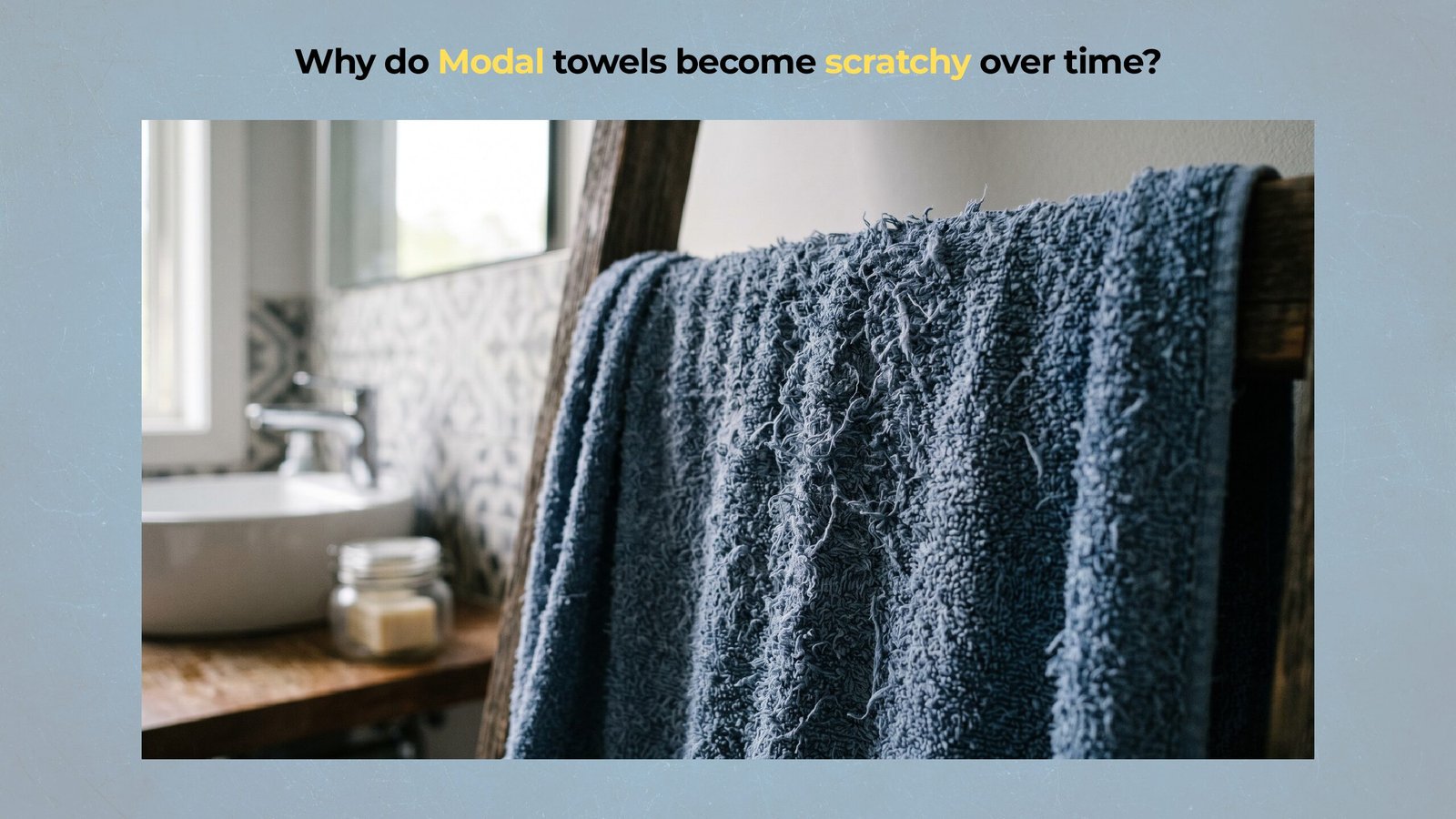
Why do Modal towels become scratchy over time?
Scratchy Modal towels occur if environmental contaminants and mechanical stressors disrupt the natural flexibility of beechwood cellulose fibers. Dissolved minerals and excessive heat create rigid coatings or structural fractures. This guide enables users to identify why their textiles hardened and provides the exact scientific protocols required to restore original softness.
Do Modal towels become scratchy due to mineral and chemical buildup?
Scratchy Modal towels result if microscopic residues from water and detergents create a rigid coating over the porous fiber surface. The fabric acts as a filter for laundry bypass if the rinse cycle fails to evacuate all suspended particles.
Mineral concentrations in domestic water supplies dictate the speed of textile hardening. Modal fibers attract dissolved solids because the high surface area of the beechwood filaments provides numerous anchoring points for debris. Once mineral adhesion begins, understanding how mineral buildup affects Modal towel fibers explains why softness deteriorates faster in hard water environments.
How do hard water minerals and detergent residue coat scratchy Modal towel fibers?
Scratchy Modal towels develop a sandpaper-like texture if calcium and magnesium ions form a crystalline lattice on the cellulose core. The Lenzing AG Textile Performance Bulletin notes that mineral adhesion serves as the primary driver of tactile degradation in semi-synthetic fibers.
Quantitative data shows that mineral buildup increases fiber friction by up to $30\%$ after $20$ wash cycles in hard water conditions. Ionic bonding between anionic surfactants and cationic minerals creates a “scum” that hardens during the evaporation phase of the laundry cycle.
Definition: Crystalline Lattice – A highly ordered, rigid geometric arrangement of atoms or ions that forms a hard crust over textile surfaces.
Do mechanical damages lead to scratchy Modal towel textures?
Scratchy Modal towels emerge if physical agitation and high temperatures cause structural failure within the individual beechwood filaments. Surface irregularities appear when the smooth fiber profile degrades into jagged segments.
How do high-heat friction and over-drying create scratchy Modal towel surfaces?
Scratchy Modal towels lose their silk-like qualities if excessive dryer heat triggers fiber embrittlement and subsequent snapping. The Journal of the Textile Institute reports that thermal degradation occurs rapidly when moisture levels drop below critical thresholds in a high-heat environment. Users investigating heat-related stiffness should also examine how Modal towel heat dispersion influences internal fiber temperature during drying cycles.
Drying temperatures exceeding $60^\circ\text{C}$ result in a $15\%$ loss in fiber elasticity. Mechanical “pilling” occurs when broken filaments entangle with surface debris to create tactile rough spots that irritate the skin. This type of abrasion becomes more severe once Modal towel pilling resistance declines after repeated thermal stress.
Definition: Embrittlement – The loss of ductility or flexibility in a material, making it prone to snapping or shattering under low stress.
Do comparisons between soft and scratchy Modal towels detect early signs of fiber failure?
Scratchy Modal towels require different remediation strategies depending on whether the stiffness originates from buildup or permanent structural breakage. The towel reaches a “Point of No Return” if the internal cellulose chains collapse beyond the point of chemical rehydration.
How do users choose between restoration and replacement for scratchy Modal towels?
Scratchy Modal towels remain salvageable if the stiffness feels “crunchy” but the underlying fabric remains thick and strong. The Textile Research Journal confirms that stripping protocols restore $90\%$ of original softness if structural integrity remains above $80\%$. Users comparing recovery outcomes often benefit from understanding how Modal towels retain softness after repeated washing under proper maintenance conditions.
The “Snap Test” distinguishes between surface crusting and brittle fiber failure. The user holds a section of the towel and pulls it taut; a healthy towel flexes silently, while a structurally damaged towel emits a faint crackling sound as fibers snap.
Definition: Structural Integrity – The ability of the fiber’s internal molecular bonds to withstand tension without permanent deformation or breakage.
Do specific laundry adjustments prevent scratchy Modal towel development?
Scratchy Modal towels stay soft if the user implements a “Softness-First” maintenance protocol designed for delicate bio-based fibers. Professional-grade clarity serves as the primary defense against textile hardening.
How does a low-residue wash protocol keep Modal towels from becoming scratchy?
Scratchy Modal towels remain avoided if the user reduces detergent volume and eliminates cationic fabric softeners. American Cleaning Institute guidelines suggest that high-efficiency machines often trap excess chemicals within dense towel loops. Because chemical accumulation directly affects absorbency, users should also learn how Modal towel moisture capacity changes when residues seal the fiber surface.
Using $50\%$ less detergent prevents $70\%$ of common residue-related texture issues. Fabric softeners paradoxically increase scratchiness in Modal by sealing minerals against the fiber and creating a waxy, non-absorbent barrier. Once fibers lose flexibility, many users notice a transition from silky comfort to the roughness explained in Modal fiber surface friction analysis.
Definition: Surfactant Loading – The excessive accumulation of soap molecules within a textile structure, leading to reduced wicking and increased rigidity.
Do specific stripping methods resolve scratchy Modal towel stiffness?
Scratchy Modal towels regain their original texture if the user executes a chemical “reset” to dissolve environmental contaminants. This process targets the ionic bonds holding the mineral crust in place.
How does the white vinegar and baking soda method strip scratchy Modal towel buildup?
Scratchy Modal towels recover their drape if a two-cycle strip wash dissolves detergent salts and neutralizes mineral deposits. The Journal of Environmental Health identifies acetic acid as an effective, non-toxic textile descaler. Before attempting aggressive chemical restoration, users should understand how improper bleach use on Modal towels permanently weakens regenerated cellulose fibers.
A $5\%$ acetic acid solution (white vinegar) reduces fiber surface $pH$ to $3.0$, which creates an optimal environment for mineral dissolution. Baking soda then works as a mechanical abrasive to lift the softened “gunk” from the fiber crevices during the second cycle.
Definition: Descaling – The chemical process of removing hard water scale (calcium carbonate) from a surface using acidic compounds.
Do users verify restoration results with the Modal towel softness checklist?
Scratchy Modal towels meet quality standards only if the user verifies the success of restoration through a structured tactile audit. This verification ensures that the removal of residue results in a return to the fiber’s native state.
📊 How do users execute the scratchy Modal towel texture audit and storage checklist?
| Audit Metric | Degraded State | Restored State |
|---|---|---|
| Surface Friction | High (Coated) | Low (Natural) |
| Fiber Flex | Rigid | Fluid |
| Snap Test | Crackling Sound | Silent Flex |
| Wetting Time | $>5$ seconds | $<1$ second |
Final Maintenance Checklist
- ☐ Use detergent doses $50\%$ below the manufacturer’s recommendation.
- ☐ Wash only in cold or lukewarm water to prevent thermal shock.
- ☐ Dry on the “low” setting to keep internal temperature below $60^\circ\text{C}$.
- ☐ Apply an acetic acid rinse once every $10$ cycles.
- ☐ Store in a cool, ventilated area to maintain fiber hydration.
Do frequently asked questions clarify Modal towel maintenance?
Why do Modal towels feel crunchy after air drying?
Stiffness occurs if the lack of mechanical agitation allows hydrogen bonds to form between wet cellulose fibers during slow evaporation. Scratchiness develops if the fibers remain static during the drying phase, allowing the cellulose chains to lock in a rigid position.
Does white vinegar damage the washing machine?
Corrosion risks vanish if the user limits the application to the rinse cycle where water dilution neutralizes the acidity. Damage remains absent if the user dilutes the $5\%$ acetic acid solution within the high-volume rinse water.
Does hard water affect Modal more than cotton?
Accelerated hardening occurs if the high porosity of Modal traps more dissolved solids than the coarser structure of traditional cotton. Modal suffers higher degradation rates if the finer denier of the beechwood filaments provides more surface area for mineral adhesion. Readers comparing textile behavior across materials may also want to explore how Modal towel absorbency compares with cotton under repeated wash exposure.
Knowledge Synthesis
Scratchy Modal towels remain soft for years if the user synthesizes the core principles of residue management, heat control, and chemical stripping. Consistency in laundry habits prevents the accumulation of mineral lattices that lead to fiber death. Long-term preservation becomes easier once users understand the broader science behind Modal towel wash durability and structural resilience.
The user restores textiles through the systematic removal of chemical buildup and the avoidance of mechanical stressors. Success depends on the early detection of stiffness before embrittlement occurs.
Correct maintenance protects the user’s investment and ensures the longevity of these premium bio-based textiles.