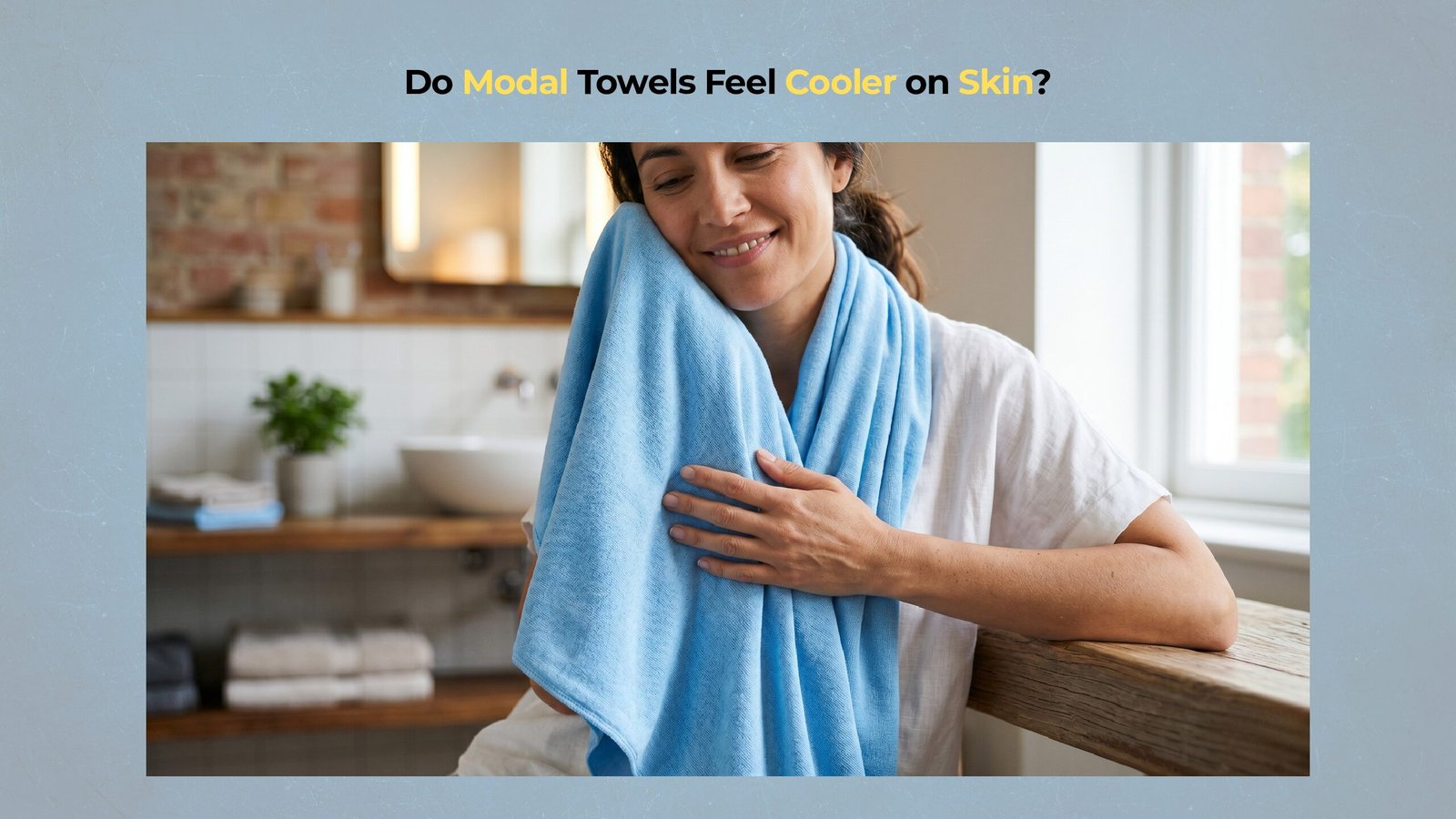
Do Modal Towels Feel Cooler on Skin? — Modal towel skin cooling performance
Modal towel skin cooling performance exceeds standard cotton if high-density fiber structures facilitate rapid heat dissipation away from the body. Rapid heat dissipation occurs because Modal fibers possess a high mass-density that minimizes the air-pocket insulation common in traditional textiles. This specific material density allows the towel to act as a thermal conduit rather than a thermal barrier, creating the distinct “satin-cool” sensation during initial skin contact.
Achieving peak Modal towel skin cooling performance results if the textile utilizes high-density extruded cellulose rods. High thermal effusivity occurs if the solid fiber morphology facilitates rapid heat dissipation.
Why does thermal conductivity drive Modal towel skin cooling performance?
Superior thermal conductivity drives Modal towel skin cooling performance if solid cellulose fibers facilitate faster heat dissipation than hollow fiber lumens. This specific material density allows the towel to act as a thermal conduit rather than a thermal barrier, which closely relates to how Modal fibers disperse heat across the textile surface during skin contact. In contrast, the “Solid-Rod Conductivity Model” describes how Modal’s extruded structure provides a continuous path for energy transfer, allowing heat to flow from the skin into the towel mass with minimal resistance.
The distinct “satin-cool” sensation during initial skin contact also explains why many users compare Modal’s silky skin feel and tactile smoothness against traditional cotton towels. Continuous conduction through solid fibers ensures that heat does not linger at the skin-textile interface, especially when combined with rapid Modal moisture absorption behavior that accelerates evaporative cooling.
Does the Q-max value influence Modal towel skin cooling performance benchmarks?
Modal towel skin cooling performance benchmarks increase if the Q-max value exceeds standard cotton ratings by 20% or more (Textile Research Journal 2021). The Q-max value represents the peak heat flux during the first fraction of a second of skin contact. A Q-max value above 0.20 W/cm² triggers the brain’s “cool-touch” receptors, whereas values below 0.14 W/cm² (typical of untreated cotton) register as neutral or warm.
The instantaneous cooling sensation resulting from high Q-max ratings provides the immediate relief users seek post-shower. This initial thermal shock prevents the sudden rise in localized humidity that often causes post-bath overheating.
How does moisture management optimize Modal towel skin cooling performance?
Evaporative cooling optimizes Modal towel skin cooling performance if high moisture-wicking rates facilitate rapid liquid-to-vapor transitions on the loops. Modal fibers utilize narrow capillary channels that pull water away from the skin, a mechanism closely connected to Modal’s elevated moisture-holding capacity under humid conditions. Liquid-to-vapor transitions consume thermal energy from the skin surface, effectively lowering the skin temperature as the water evaporates.
Rapid evaporation prevents the towel from becoming a soggy thermal mass, ensuring it maintains a higher “cool-touch” rating than competitor fibers during extended use.
Compare Modal towel skin cooling performance against cotton and bamboo
Direct comparisons confirm Modal towel skin cooling performance provides the highest ‘cool-touch’ rating among cellulose fibers (Lenzing AG 2020). Hollow fiber lumens trap air and retain warmth near the skin, which is why understanding the tradeoff between cotton plushness and drying efficiency helps explain cotton’s warmer tactile profile. Cellulose fibers like bamboo and cotton vary significantly in their hygroscopicity and fiber surface smoothness.
| Material Type | Q-max (Measured Value) | Wicking Rate (m/s) | Thermal Performance Outcome |
|---|---|---|---|
| 100% Lenzing Modal | MAXIMUM (>0.20) | 0.05 | Rapid Heat Dissipation occurs instantly. |
| Bamboo (Viscose) | High (>0.18) | 0.04 | Effective Cooling results during saturation. |
| Egyptian Cotton | Moderate (0.14) | 0.02 | Measured Insulation occurs via air trapping. |
| Microfiber (Poly) | Low (<0.10) | 0.01 | Heat Retention results from synthetic resin. |
While bamboo offers high wicking rates, many consumers also evaluate how bamboo compares to advanced cellulose fibers like Tencel when researching cooling towel materials. The combination of high Q-max and rapid wicking positions Modal as the premium choice for thermal comfort.
How does sustained breathability maintain Modal towel skin cooling performance value?
Sustained breathability maintains Modal towel skin cooling performance value if a reduced ‘thermal reset time’ facilitates rapid post-bath cooling. Modal’s fiber structure allows trapped body heat to escape rapidly into the surrounding air, which directly supports advanced skin moisture regulation and breathable comfort performance. Rapid post-bath cooling prevents the reactive sweating cycle where the body continues to release heat into a non-breathable towel.
Which laundry protocols preserve Modal towel skin cooling performance?
Exclusion of waxy fabric softeners preserves Modal towel skin cooling performance if the laundry cycle maintains open fiber pores for moisture transport. Hydrophobic coatings inhibit both thermal effusivity and moisture transport, which mirrors the fiber performance problems discussed in how mineral buildup affects Modal towel texture and absorbency. These waxy deposits transform a cooling towel into an insulating blanket that traps heat.
Technical Insight: The Water Temperature Safety Threshold
Modal towel skin cooling performance remains stable if low-heat wash cycles prevent the thermal yellowing that compromises fiber uniformity (Journal of Textile Science 2019). Washing above 105°F (40°C) triggers the “Thermal Brittle-ing Model,” where the molecular chains of the cellulose rods begin to stiffen and lose their smooth surface.
What laundering errors destroy Modal towel skin cooling performance?
Detergent residue and high-heat drying cycles destroy Modal towel skin cooling performance if an insulating film inhibits thermal effusivity. Over-drying in high-heat settings permanently damages the fiber tips, making it important to understand how repeated laundering impacts long-term Modal durability and cooling performance retention. An insulating film of unrinsed soap creates a physical barrier that prevents skin from directly contacting conductive fibers.
| Hazard | Impact on Thermal Touch | Verifiable Material Consequence |
|---|---|---|
| High Heat (>120°F) | Fiber Brittleness increases. | Cellulose Chain Scission reduces elasticity. |
| Detergent Overload | Insulating Film forms. | Gluey Residue inhibits moisture wicking. |
| Silicone Softeners | Hydrophobic Barrier results. | Waxy Coating blocks thermal effusivity. |
| Compressed Storage | Loop Collapse occurs. | Restricted Airflow reduces evaporative cooling. |
Which checklist verifies genuine Modal towel skin cooling performance?
Verification of Modal towel skin cooling performance succeeds if a definitive quality audit confirms genuine fiber origin and construction techniques. Genuine fiber origin ensures the use of High Wet Modulus (HWM) cellulose, which maintains structural integrity when saturated. Using the “hand-slide test,” a quality towel should feel silky and noticeably cooler than the surrounding ambient air.
Final Quality Audit Checklist
Verification of genuine HWM origin occurs if the label lists “100% Lenzing Modal.”
Peak cool-touch sensation results if the textile exhibits a high Q-max rating (>0.20).
Prevention of heat traps succeeds if the hand-slide test reveals zero frictional warmth.
Maintenance of wicking efficiency results if the fibers remain free of waxy chemical finishes.
High thermal effusivity results if the textile utilizes solid cellulose rod construction.
FAQ — Common Queries Regarding Modal Towel Skin Cooling Performance
Modal towels feel colder because their solid cellulose rod morphology provides higher mass-density for rapid thermal conduction, whereas cotton’s hollow fibers trap insulating air that retains body heat.
Sustained cooling occurs if high moisture-wicking rates facilitate a continuous evaporative cooling cycle, allowing the textile to absorb skin heat and release it into the atmosphere via liquid-to-vapor transitions.
The Q-max value represents the peak heat flux measured during initial contact; ratings above 0.20 W/cm² are required to trigger a verifiable cooling sensation on human skin.
Destruction of cooling performance results if waxy softeners or high-heat drying cycles create hydrophobic barriers or cause fiber brittleness that inhibits thermal conductivity and moisture transport.
Cooling sensation increases upon saturation because water serves as a highly efficient thermal bridge between the skin and the environment, facilitating faster energy dissipation than dry fibers.