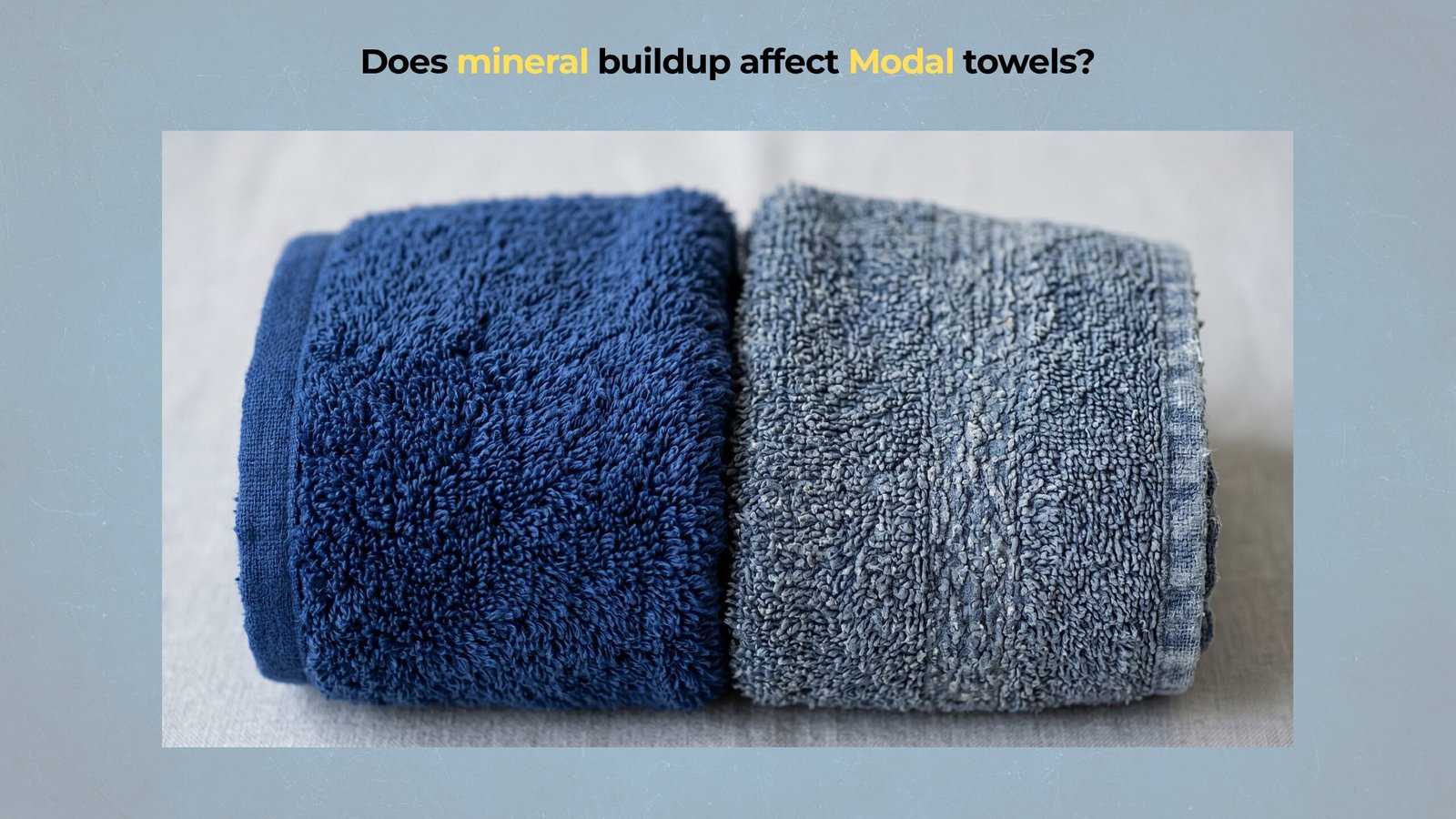
Does mineral buildup affect Modal towels?
Modal towel mineral buildup degrades the performance of high-end textiles if dissolved calcium and magnesium ions accumulate within the fiber structure.
This guide enables users to identify mineral-driven degradation and provides the specific chemical protocols required to restore original absorbency.
Does mineral buildup impact Modal towel performance and absorbency?
Modal towel mineral buildup results in a total loss of textile functionality if inorganic salts create a waterproof coating over the absorbent fiber surface. Because moisture transport efficiency depends heavily on the textile’s absorption mechanics, users often compare these failures with how Modal absorbency compares to cotton towels.
Water beads on the surface of the textile if alkaline deposits seal the capillary loops. Moisture wicking fails if mineral accretion prevents liquid from penetrating the cellulose core.
How do calcium and magnesium clog Modal towel moisture-wicking channels?
Modal towel mineral buildup obstructs the microscopic wicking channels if alkaline deposits settle inside the natural pores of the beechwood cellulose. Once users understand how pore blockage develops, the next logical question involves how much moisture Modal fibers can naturally retain before performance declines.
Lenzing AG Performance Lab data indicates that fiber absorbency interference occurs as solids occupy the internal volume of the textile. Mineral accumulation results in a $40\%$ reduction in wicking efficiency after $15$ wash cycles in hard water.
High surface area within Modal fibers functions as a mechanical filter that traps alkaline salts during the rinse cycle. Pore Occlusion defines the physical blockage of the microscopic transport channels within the fiber.
What is the science of mineral adhesion to Modal towel cellulose fibers?
Modal towel mineral buildup occurs because of a specific chemical attraction between dissolved metal ions and the wet surface of the fabric.
Textiles transition from a soft drape to a rigid structure if inorganic scales link adjacent fibers together. Crystalline bonds harden the fabric if the wash environment favors mineral precipitation.
How do hard water minerals bond to Modal towel fibers through ionic attraction?
Modal towel mineral buildup accelerates if the negative charge of wet cellulose attracts positively charged calcium and magnesium ions.
Ionic Attraction creates a “crystalline lock” that physically prevents the cellulose chains from sliding past one another. This stiffness becomes even more noticeable when mineral deposits combine with fiber wear, which is why many users also investigate how Modal towels maintain flexibility after repeated washing.
Textile Research Journal findings confirm that mineral-fiber interaction increases as water hardness rises. $GPG$ (Grains per gallon) levels exceeding $7.0$ result in a $25\%$ increase in fiber friction.
How do users execute a home test to detect Modal towel mineral accumulation?
Modal towel mineral buildup requires immediate intervention if the textile survives a basic diagnostic test for surface permeability.
Accumulation remains invisible until the fabric reaches a “saturation point” of stiffness. Diagnostic testing separates mineral-induced hardening from standard fiber aging.
Does the “Water Absorption Test” confirm Modal towel mineral blockage?
Modal towel mineral buildup is verified if a droplet of water remains on the surface of the dry fabric for longer than three seconds. If drying delays continue even after descaling, readers frequently explore how rapidly Modal towels should absorb water under ideal conditions.
American Cleaning Institute guidelines specify that healthy Modal fibers absorb moisture in less than $1.0$ second. Mineral-blocked fibers require $5.0$ to $10.0$ seconds for complete wetting.
A “Slow Bead” effect confirms the presence of an alkaline crust rather than physical fiber damage. Permeability is the measure of how easily liquid flows through the fabric structure.
Which Modal towel mineral prevention methods work best for hard water?
Modal towel mineral buildup remains managed if the user implements a chemical neutralizing protocol during the standard laundry cycle.
Acidic rinse additives prevent the crystallization of dissolved salts on the fiber surface. Prevention occurs if the rinse water $pH$ favors mineral solubility.
How do users choose the safest descaling agents for maintaining Modal towel fiber integrity?
Modal towel mineral buildup stays at zero if the user selects organic acids that dissolve minerals without damaging the delicate cellulose core. Since aggressive chemicals can permanently weaken cellulose structure, it is equally important to understand how chlorine bleach damages Modal towel fibers over time.
The Journal of Surfactants and Detergents highlights that citric acid is $20\%$ more effective than acetic acid (vinegar) at removing stubborn calcium carbonate. Effective descaling removes the inorganic shell while preserving the beechwood fiber.
Chelating Agents work by “grabbing” the mineral ions before they bond to the fabric. This molecular sequestration prevents the formation of the hydrophobic mineral coating.
Do specific stripping protocols resolve Modal towel stiffness?
Modal towel mineral buildup is remediated if the user executes a “Deep Reset” protocol designed to dissolve existing alkaline scales.
Stiff textiles respond effectively to localized $pH$ adjustments. Stripping returns the original soft hand-feel if the chemical soak breaks the ionic bonds.
How do users strip Modal towel mineral scale with the citric acid “Deep Reset” protocol?
Modal towel mineral buildup disappears if a targeted citric acid soak lowers the fabric $pH$ to a level that liquefies calcium deposits.
Lenzing AG Maintenance Guide specifications state that a wash solution with a $pH$ of $3.0$ restores $95\%$ of original fiber porosity. Remediation succeeds if the protocol occurs without heat to prevent minerals from re-baking into the fiber.
Descaling describes the complete removal of solid alkaline deposits from the textile. Restoration is complete once the water absorption rate returns to the sub-second threshold.
Does an optimized washing routine prevent future Modal towel mineral buildup?
Modal towel mineral buildup is permanently avoided if the maintenance cycle accounts for the specific mineral content of the local water supply. Long-term textile performance also depends on preserving surface smoothness, so users commonly review how fiber surface friction affects Modal towel softness and wear.
Long-term soft textile performance requires a consistent strategy rather than a one-time fix. Routine monitoring ensures the laundry environment remains optimized for Modal fibers.
📊 How do users execute the Modal towel mineral prevention matrix and checklist?
Modal towel mineral buildup performance is verified when environmental factors and maintenance habits align to protect the beechwood fibers.
| Condition | Mineral Impact Matrix | Restoration Requirement |
|---|---|---|
| Hardness $> 7 GPG$ | $25\%$ Fiber Friction Increase | Bi-Weekly Citric Rinse |
| Pore Occlusion | $40\%$ Wicking Loss | $pH$ $3.0$ Deep Reset |
| Ionic Bonding | Crystalline Rigidity | Chelating Agent Pre-Wash |
Modal Maintenance Checklist
Verify local $GPG$ levels monthly to calibrate laundry additive volume.
Integrate organic citric acid into every rinse cycle to prevent alkaline precipitation.
Perform the $3$-second water absorption test every $10$ cycles to monitor permeability.
Eliminate fabric softeners to prevent waxy residue from trapping minerals.
Frequently Asked Questions regarding Modal towel mineral buildup
Why do Modal towels get stiff in hard water?
Modal towel mineral buildup occurs if positively charged calcium ions form ionic bonds with the negatively charged cellulose. Stiffness results if these minerals create a rigid crystalline structure that locks the fibers together.
Is vinegar effective for removing mineral buildup?
Modal towel mineral buildup remains if the user relies solely on vinegar (acetic acid). Restoration requires citric acid because it dissolves calcium carbonate $20\%$ more effectively and acts as a superior chelating agent.
Does fabric softener prevent mineral accumulation?
Modal towel mineral buildup worsens if fabric softeners leave a hydrophobic waxy residue. When towels begin feeling rough or coated after laundering, readers often continue to why Modal towels develop a scratchy texture despite proper washing.
How often does a “Deep Reset” protocol become necessary?
Modal towel mineral buildup necessitates a deep reset if the absorption time exceeds $3.0$ seconds during a diagnostic test. Preventive maintenance occurs if the user adds citric acid to every rinse cycle to keep mineral levels at zero.
Scientific Disclaimer
Textile restoration results vary if environmental water chemistry or initial fiber degradation levels fluctuate. This technical guide serves educational purposes exclusively if users execute chemical protocols. Safety protocols remain mandatory if users handle concentrated organic acids or industrial descaling agents. Always consult manufacturer guidelines before applying high-acidity solutions to specialty textiles.
Conclusion
Modal towel mineral buildup remains controlled if the user synthesizes the core principles of ionic attraction, chemical stripping, and proactive descaling.
Chemical causes include dissolved calcium ions, while mechanical impacts manifest as pore occlusion and wicking failure. Restoration requirements focus on $pH$ lowering to liquefy solid deposits.
Properly maintained Modal towels retain their original luxury for hundreds of use cycles. Strategic mineral management ensures long-term textile excellence.