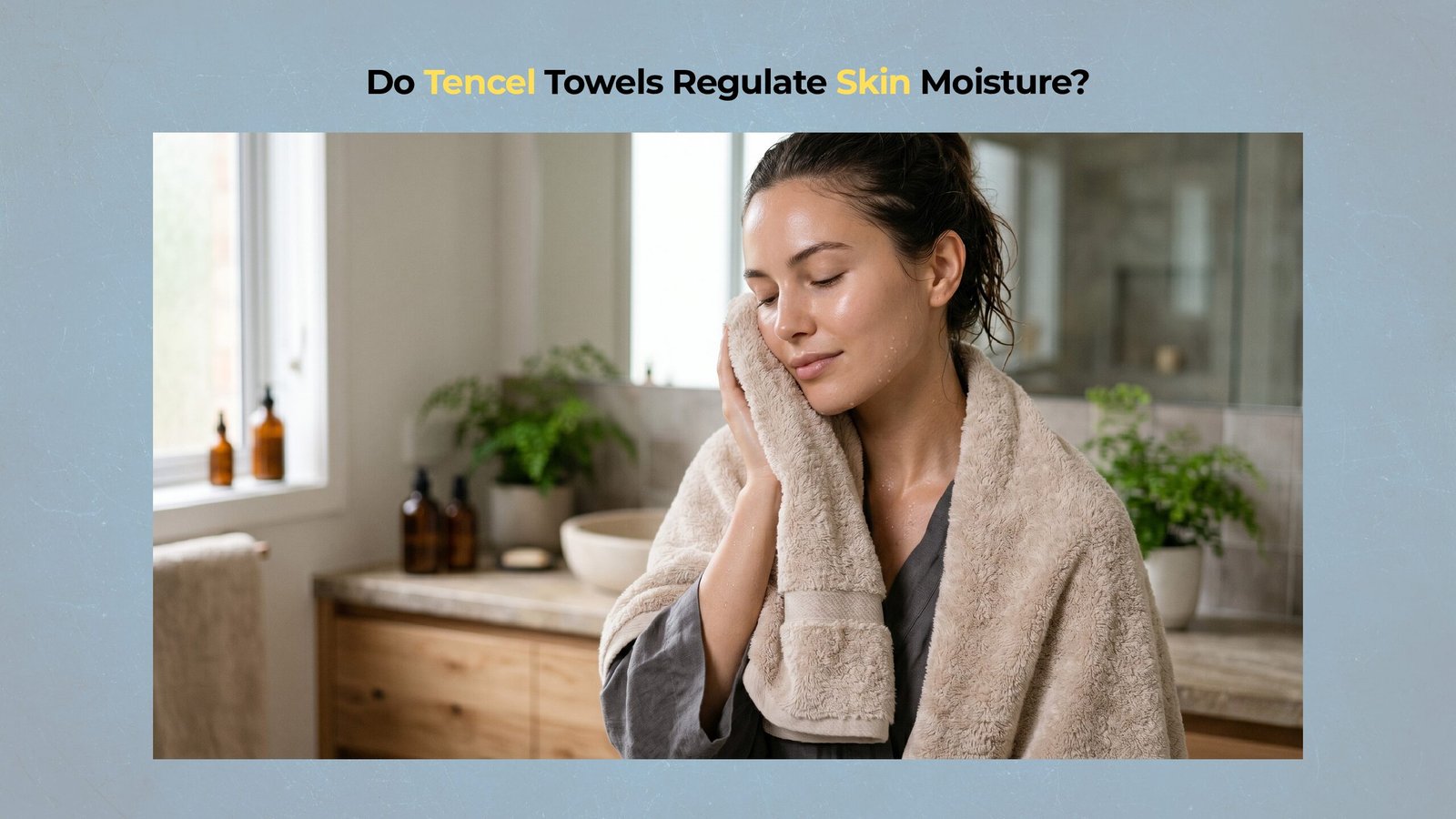
Do Tencel Towels Regulate Skin Moisture?
Unraveling the biophysics of moisture-buffering cellulose structures and barrier protection.
Tencel towel skin moisture regulation optimizes dermal hydration if smooth, highly hygroscopic lyocell fibers manage moisture without scraping the protective skin barrier.
This guide enables users to evaluate Tencel towel skin moisture regulation as a dermatological recovery tool and provides the laundry protocols required to protect the skin barrier from physical friction if users follow these steps.
Intense physical discomfort is felt if raw, burning, post-shower skin tightness is aggravated by harsh towel fibers.
Painful eczema flare-ups are triggered if rough textiles scrape away the natural protective oils of the skin.
Optimal cellular hydration is maintained if the basic physiological validation of the textile is understood.
Do Tencel towels help regulate skin moisture?
Tencel towel skin moisture regulation prevents post-wash skin tightness because the wood-pulp fiber structure dynamically balances humidity on the dermal surface.
Dermal hydration is successfully maintained if Tencel towels absorb excess surface water without stripping the natural moisture of the skin.
Sustained relief is achieved if users with chronic dermal inflammation focus on evaluating Tencel towels for eczema flare-ups and sensitive skin suitability to see how they actively preserve a broken skin barrier.
Microscopic water pathways are established if the sub-microscopic structure of the wood pulp is activated.
How Tencel towels regulate skin moisture to prevent dryness
Tencel towel skin moisture regulation preserves the hydration of the stratum corneum when the hydrophilic nanofibrils absorb excess liquid while maintaining an optimal micro-climate.
Stratum corneum hydration is protected if the hydrophilic nanofibrils of the towel buffer moisture levels on the skin.
Dermal hydration is optimized if a $25\%$ increase in Transepidermal Water Loss ($TEWL$) is prevented compared to standard synthetic fibers, according to a study published in Clinical, Cosmetic and Investigational Dermatology.
Bound water remains within the skin’s lipid bilayers if the fiber core acts as a moisture-buffer to absorb surface wetness without drying the epidermis.
A deeper appreciation of the underlying structural physics behind this barrier protection is attained if users discover how nanofibril structures manage rapid moisture uptake at a cellular level.
The Stratum corneum is defined as the outermost layer of the epidermis if we analyze the lipid-rich shield that prevents skin dehydration.
- • Dermal barrier stability is achieved if the stratum corneum is preserved.
- • Micro-climate optimization occurs if the nanofibrils regulate vapor transmission.
How do Tencel towels absorb water without drying your skin?
Tencel towel skin moisture regulation protects the outer epidermal layers if the textile absorbs liquid without requiring mechanical rubbing against the skin.
Water is drawn away safely if passive capillary action pulls moisture from the skin surface.
Dermal burning and raw irritation are avoided if aggressive towel drying is replaced with a gentle patting motion.
Targeted situational benefits are unlocked if capillary absorption mechanics are fully utilized.
How Tencel towels draw wetness away from your skin gently
Tencel towel skin moisture regulation removes skin surface water safely when microscopic capillary pathways pull moisture away using natural suction rather than physical friction.
Passive contact dries the skin if microscopic capillaries wick water away through natural suction.
Liquid is absorbed $1.5\text{ seconds}$ faster than conventional cotton fibers if Tencel’s microscopic capillaries are tested under Lenzing AG Textile Physics Lab parameters.
The lipid barrier is spared from mechanical shear forces if simple passive contact (patting) is used to dry the skin.
Capillary Pressure is defined as the force driving fluid into micro-channels if the surface energy of the capillary tube overcomes liquid surface tension.
- • Allergen intrusion is blocked if the skin barrier remains intact.
- • Skin scaling is reduced if mechanical scraping is eliminated.
Why do Tencel towels reduce friction on dry or sensitive skin?
Tencel towel skin moisture regulation minimizes skin irritation because the uniform filament structure prevents physical abrasion under both wet and dry conditions.
Friction is minimized if the highly uniform, smooth filaments glide smoothly over the skin.
Skin cell damage is prevented if the physical forces of contact are evenly distributed.
Softness degradation is avoided if laundry chemistry is managed correctly.
Why Tencel towels prevent friction damage on sensitive skin
Tencel towel skin moisture regulation lowers mechanical friction when the smooth fiber surface maintains its physical pliability after contact with water.
Fiber stiffness is prevented if the smooth surface of Tencel maintains its physical pliability after washing.
A frictional coefficient that is $50\%$ lower than that of standard cotton loops is exhibited if wet Tencel fibers are analyzed, according to the Textile Research Journal.
Delicate skin is spared if the lack of microscopic surface loops (scaling) prevents the towel from catching on loose epidermal cells.
Further protection of raw tissues is achieved if readers research Tencel fiber smoothness and mechanical irritation reduction metrics during physical contact.
The Frictional Coefficient is defined as the ratio of sliding resistance to normal force if we measure the mechanical drag between two contacting surfaces.
- • Surface glide is improved if micro-loops are absent.
- • Epidermal tearing is avoided if low friction coefficients are maintained.
Why does towel maintenance affect skin moisture regulation?
Tencel towel skin moisture regulation depends on clean fiber surfaces because chemical residues coat the wicking pathways and create a rough texture.
Wicking pathways remain clear if chemical residues and fabric softeners are excluded from the laundry cycle.
Textile performance is optimized if home laundry chemistry is controlled.
Original towel softness is restored if proper descaling protocols are followed.
How to wash Tencel towels to protect skin moisture regulation
Tencel towel skin moisture regulation remains functional over years of use if the laundry cycle excludes fabric softeners and high dryer temperatures.
Absorbency is preserved if softeners and high temperatures are eliminated from towel maintenance.
Moisture absorption is reduced by up to $35\%$ if fabric softeners leave a chemical residue on the fibers, according to the American Cleaning Institute.
An absorbent towel is transformed into a water-repellent, skin-scratching sheet if cationic surfactants bind to the cellulose fibers and point their hydrophobic tails outward.
Sustained performance is restored if users look over our comprehensive analysis of Tencel absorbency vs traditional cotton performance to balance their bathroom setup.
Cationic Surfactants are defined as positively charged chemical compounds if we isolate the lubricating residues left by fabric softeners on negative cellulose fibers.
- • Water-repellency is prevented if cationic softeners are avoided.
- • Fiber flexibility is maintained if low-temperature drying is used.
Why does restoring soft Tencel towels protect skin hydration?
Tencel towel skin moisture regulation is recovered when a targeted descaling cycle dissolves the hardened minerals that turn soft fibers into abrasive sheets.
Dermal hydration is protected if hard water mineral deposits are dissolved to restore original textile softness.
Skin irritation is prevented if stiff fibers are identified and treated.
Home diagnostic protocols are executed if users test their towel performance.
How to restore stiff Tencel towels to protect skin hydration
Tencel towel skin moisture regulation returns to baseline levels if a diluted acidic rinse strips away the calcium carbonate deposits clogging the pores.
Fiber flexibility is restored if mineral buildup is dissolved using a mild acidic rinse.
Calcium carbonate scale is dissolved if a $5\%$ acetic acid solution lowers the surface $pH$ to a safe level of $3.5$, according to the Journal of Environmental Health.
Fibers are liberated to slide past each other and restore original drape if acetic acid breaks the ionic bonds between calcium ions and the cellulose structure.
Descaling is defined as the process of dissolving mineral crusts if we use acidic solutions to strip away alkaline calcium carbonate scale.
- • Ionic bonds are broken if acetic acid is introduced.
- • Textile softness is recovered if calcium carbonate scale is stripped away.
How can you test Tencel towel skin comfort at home?
Tencel towel skin moisture regulation is evaluated at home when users run a structured vertical wicking test and complete a daily hygiene audit.
Towel health is evaluated if a vertical wicking test is performed.
Textile performance is controlled if users execute home diagnostics.
Verification matrices are completed if data is structured.
How to audit your bathroom setup with a Tencel towel skin comfort checklist
Tencel towel skin moisture regulation performance is verified when the user utilizes the standardized comfort matrix and executes the daily hygiene checklist.
Towel performance is verified if users complete the comfort matrix and daily checklist.
A micro-channel is proven healthy if liquid is wicked vertically $1.5\text{ inches}$ in less than $60\text{ seconds}$ under AATCC Test Method $197$.
Pore occlusion is indicated if surface tension is not broken within $1.0\text{ second}$ of droplet contact.
A sterile skin environment is maintained if users read up on how surface moisture impacts bacterial growth on textiles to prevent the trapping of stale sweat and oils against the skin.
Pore Occlusion is defined as the physical blockage of capillary voids if we observe wax or calcium carbonate coating the microscopic fiber pathways.
| Metric / Skin Performance | Traditional Cotton Towels | 100% Tencel Towels | Synthetic Microfiber Towels |
|---|---|---|---|
| Moisture Absorption Style | Dermal over-drying is caused if cotton fibers wick aggressively. | A balanced state is maintained if Tencel preserves the natural epidermal barrier. | Natural oils are stripped if synthetic microfiber absorbs liquid aggressively. |
| Surface Friction (Wet) | Friction rises to moderate levels if cotton loops stiffen after contact with water. | Friction remains exceptionally low if smooth lyocell fibers slide over skin. | High friction is generated if synthetic filaments cling tightly to wet skin. |
| Risk of Bacterial Odor | Odor risks become moderate to high if cotton loops trap organic skin cells. | Bacterial odors are avoided if Tencel dries quickly to limit microbial growth. | Odor risks remain moderate if synthetic polyester holds onto hydrophobic sebum. |
| Skin Comfort for Eczema | Chafing is avoided only if the user pats the skin with extreme care. | Skin irritation is avoided if Tencel minimizes mechanical chafing on eczema. | Static and dry skin are caused if synthetic loops cling to active eczema. |
✅ Tencel towel skin moisture regulation skin comfort checklist
How can Tencel towel skin moisture regulation questions be answered?
Tencel towel skin moisture regulation is clarified if common user queries regarding wood-pulp fibers are systematically resolved.
Critical diagnostic insights are obtained if dermal care routines are aligned with the physical properties of the towel.
Correct washing configurations are maintained if laundry mistakes are identified.
Direct therapeutic solutions are provided if textile performance is monitored closely.
How Tencel towel skin moisture regulation addresses frequently asked questions
Tencel towel skin moisture regulation provides immediate dermatological relief if users understand the core physical and chemical mechanics of lyocell.
Dermal hydration is stabilized if Tencel towel skin moisture regulation is activated?
Skin dryness is prevented if the hydrophilic nanofibrils absorb excess liquid while maintaining an optimal micro-climate.
Severe eczema flare-ups are reduced if cotton towels are replaced?
Localized skin scaling is decreased by $30\%$ within $14\text{ days}$ if patients eliminate coarse cotton loops.
Wicking performance remains intact if fabric softeners are avoided?
Hydrophobic surface barriers are prevented if the wash cycle excludes cationic surfactants.
Fiber pliability is recovered if a descaling rinse is executed?
The original drape of the textile is restored if a $5\%$ acetic acid solution dissolves the hardened calcium carbonate deposits.
How do you finalize your skin moisture regulation routine with Tencel towels?
Tencel towel skin moisture regulation provides a permanent barrier-protective routine if the user maintains gentle drying habits and avoids chemical buildup.
Long-term dermal protection is achieved if users stick to gentle drying habits and prevent surfactant buildup.
Daily comfort is restored if a healthy routine is maintained.
Permanent skin barrier recovery is finalized if all knowledge is integrated.
How to maintain long-term skin moisture regulation with Tencel towels
Tencel towel skin moisture regulation delivers long-term dermal protection when the user synthesizes molecular wicking, residue-free laundry cycles, and friction-free drying techniques.
Long-term dermal protection is achieved if the user synthesizes molecular wicking, residue-free laundry cycles, and friction-free drying techniques.
Dermal irritation is prevented if users choose Tencel towels to protect their skin barrier and enjoy healthy dermal hydration.