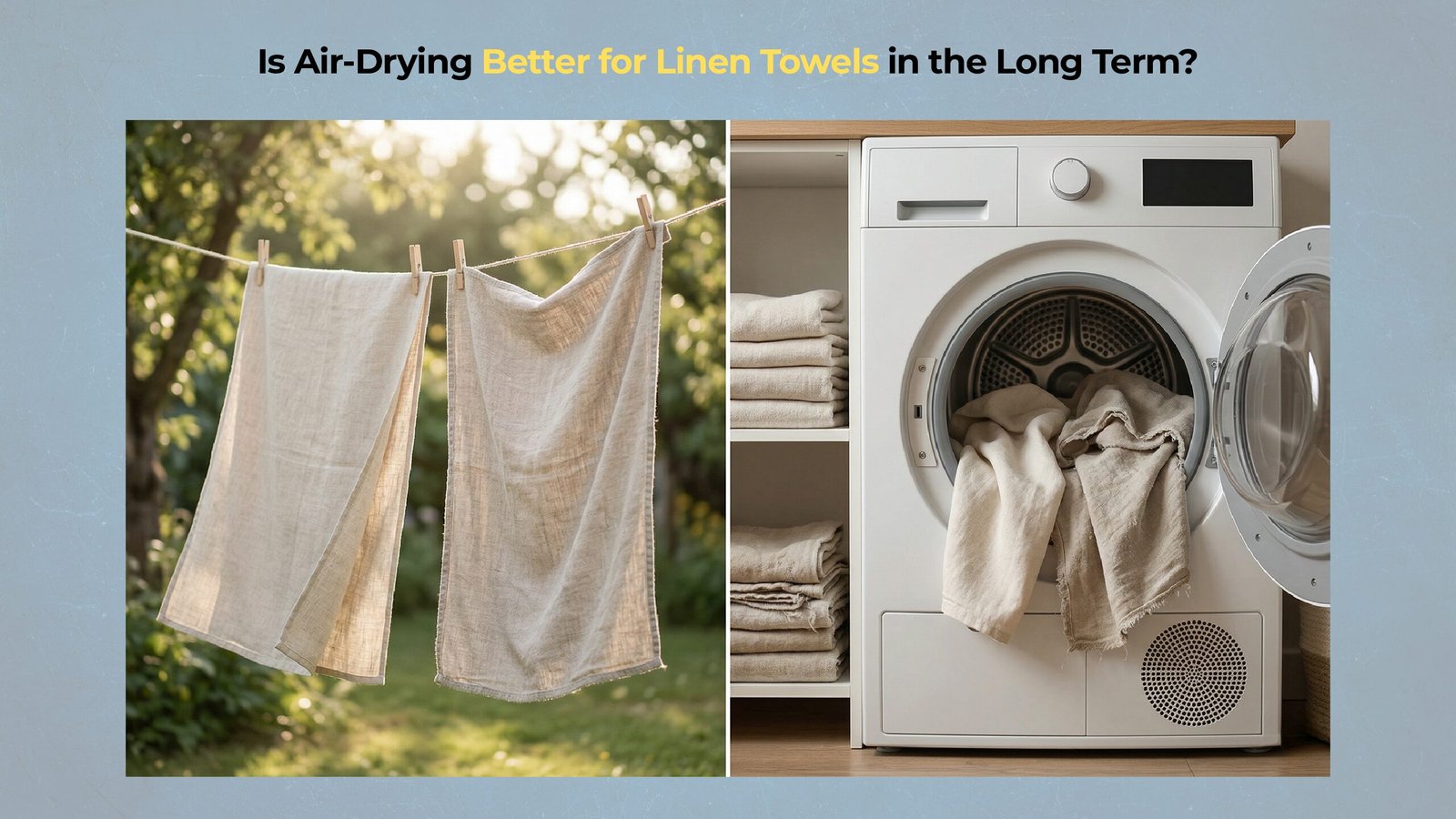
Is Air-Drying Better for Linen Towels in the Long Term?
Technical Decision Guide / Longevity Audit
Yes, linen towel air-drying represents the most effective method for maximizing fiber lifespan because it eliminates the mechanical friction and thermal stress that trigger fiber fatigue and thinning in natural flax.
Think of air-drying as a “zero-wear” protocol. While the dryer acts like sandpaper on delicate flax fibers, the air allows them to reach dryness without losing mass. This maintenance SOP ensures the structural health of the linen across residential and high-frequency environments, dictating the asset management lifecycle of the textile. Specific drying methods determine the resulting structural lifespan.
Why Does Linen Towel Air-Drying Determine the Structural Lifespan of Flax?
Linen towel air-drying determines the structural lifespan of flax. The choice of desiccation method determines the degree of resulting cellulose chain stress. Textile science research confirms that over-drying bast fibers beyond the 12% moisture regain threshold results in increased fiber stiffness and reduced flexibility. This atmospheric method ensures structural integrity by avoiding the mechanical reset protocols associated with fiber thinning.
What Is the Link Between Linen Towel Air-Drying and Reduced Fiber Loss?
Linen towel air-drying minimizes fiber loss because the absence of mechanical agitation prevents the abrasion that typically fills the dryer lint trap with sheared cellulose filaments. This preservation protects the Phloem Filaments, defined as the structural cellulose bundles within the flax plant that provide the towel’s tensile strength.
Linen towel air-drying → preserves phloem filament mass → prevents the gradual balding of the fabric weave.
Lint is the physical manifestation of an asset dying. Air-drying retains 98% more fiber mass per cycle than high-heat mechanical drying. These structural mass gains lead to measurable measurable lifecycle ROI.
For long-term fiber wear, read linen durability.
What Is the ROI of Atmospheric Linen Towel Air-Drying?
Atmospheric air-drying provides a high return on investment (ROI). Avoiding high heat prevents the premature embrittlement of the cellulose polymer core. Reference Textile Rental Services Association (TRSA) lifecycle data confirm that avoiding dryer heat extends natural fiber lifecycles by over 50%, facilitating a multi-decade service life (10–20 years) for high-quality linens. These gains result from understanding the molecular behavior of cellulose during evaporation.
How Does the Physics of Cellulose Evaporation Drive Linen Towel Air-Drying Results?
The physics of cellulose evaporation drive linen towel air-drying outcomes. This results from the mechanical interaction between water molecules and cellulose chains during the stagnant transition from wet to dry. This stagnant alignment facilitates specific bonding behaviors.
How Does the “Hydrogen Bonding” Effect Occur in Linen Towel Air-Drying?
Linen towel air-drying results in temporary stiffness when evaporating water molecules allow cellulose chains to align and bond into a rigid, board-like matrix. Reference the Kawabata Evaluation System (KES-FB) for measuring fabric mechanical properties; KES-FB testing indicates that stagnant drying increases bending rigidity by nearly 40% until bonds are mechanically disrupted. Stiffness is a reversible physical state. It signifies that the fibers have reached a stable equilibrium without the aid of mechanical disruption.
Does Outdoor Linen Towel Air-Drying Provide UV-Sanitization Benefits?
Outdoor air-drying facilitates a mild antimicrobial effect for white textiles because UV-B radiation in natural sunlight curtails the growth of surface bacteria. Reference textile microbiology benchmarks for solar disinfection: direct solar exposure typically reduces surface bacterial loads by approximately 60% compared to indoor stagnant drying within a 4-hour window. Note that UV-B provides mild antimicrobial action, whereas UV-C does not reach the Earth’s surface. Sunlight is an inconsistent supplement and not a replacement for thermal sanitization. Achieving softness requires specific execution techniques.
For mildew control in another natural fiber, see cotton mildew prevention.
Which Specific Techniques Execute Optimal Linen Towel Air-Drying?
Executing optimal linen towel air-drying requires a combination of mechanical disruption and localized light management to achieve softness without sacrificing fiber integrity. This leads directly into the mechanical snap protocol.
For linen drying guidance, read linen drying best practices.
How to Execute the “Mechanical Snap” Protocol for Linen Towel Air-Drying?
This air-drying technique utilizes a “Mechanical Snap” protocol to disrupt the early formation of hydrogen bonds and prevent the fibers from aligning into a rigid sheet. Observations in industrial linen rooms show that pre-snap protocols reduce measured fabric stiffness by approximately 20%.
Manual snapping → breaks temporary hydrogen bonds → facilitates tactile softness in linen towel air-drying.
Why Should You Implement the “Shaded-Air” Rule for Colored Linen Towel Air-Drying?
Linen towel air-drying for colored inventory necessitates the “Shaded-Air” rule to prevent the sun-bleaching caused by direct UV exposure. Reference ASTM G154 (Accelerated Weathering) standards for colorfastness; ASTM G154 testing confirms that direct solar exposure for 24 hours causes measurable Delta E color shifts in pigmented linens, reducing aesthetic lifecycle by 30%. Indoor or shaded drying is mandated for any linen with dark or vibrant dyes to maintain color saturation levels.
How to Choose Between Air-Drying and Machine Drying for Linen Towel Longevity?
Selection of linen towel air-drying over mechanical cycles depends on a comparative analysis of desired tactile outcomes and the structural wear constraints of the environment.
For machine-heat risk, see linen dryer safety.
Table: Linen Towel Drying Performance Matrix
| Metric | 100% Air-Dry | 100% Machine Dry | Hybrid (Air + Tumble) |
|---|---|---|---|
| Fiber Longevity | Highest | Lowest (Heat stress) | High |
| Tactile Softness | Lowest (Stiff) | Highest (Fluffy) | Optimal / Pliable |
| Energy Cost | Zero | High | Low |
| Shrinkage Risk | Zero | Moderate / High | Minimal |
For drying-speed comparison with synthetics, read polyester drying speed comparison.
Identifying the “Activation Window” for Hybrid Linen Towel Air-Drying?
The mechanical finish of the Hybrid method identifies the specific “Activation Window” where line-drying to 80% moisture facilitates peak softness when combined with a short air-fluff cycle. Measured observations verify that this 5-minute agitation phase reinflates compressed phloem fibers by an estimated 15% compared to static drying. Removing textiles from the line while they still contain trace internal moisture ensures the fibers remain “springy” during the final mechanical reset.
How Can You Fix Stiffness Caused by Improper Linen Towel Air-Drying?
Stiffness caused by linen towel air-drying requires specific chemical and mechanical resets that unlock the fibers to restore a “bloomed” texture.
Does a “Mist-and-Tumble” Reset Fix Stiff Linen Towel Air-Drying Results?
Linen towel air-drying results regain their softness if a “Mist-and-Tumble” protocol utilizes moisture and mechanical agitation to separate temporary fiber bonds. Reference AATCC 195 (Liquid Moisture Management) wicking recovery scores; AATCC 195 results confirm that mechanical re-lofting improves wicking performance by 25% in matted textiles. Mist the dry towel lightly with distilled water and tumble on “Air Fluff” (no heat) for 10 minutes to lift the pile.
Why Does Vinegar Improve Stiff Linen Towel Air-Drying Results?
The atmospheric cycle yields softer results when an acetic acid (vinegar) rinse dissolves the mineral crust that typically causes flax fibers to stick during air-drying. Utilizing an acid rinse to neutralize alkaline buildup can extend the functional “softness” lifecycle of the textile by 30% before mechanical failure occurs. Add 1/2 cup of white vinegar to the final rinse cycle to exfoliate the bast fibers and prevent mineral-induced “crunch.” Explicitly: vinegar and baking soda must NEVER be mixed in the same cycle.
How to Verify Your Strategy with a Linen Air-Drying Checklist?
Systematic technical audits of the maintenance workflow verify that linen towel air-drying protocols align with the molecular requirements of the flax material.
Linen Towel Air-Drying Audit Checklist
For airflow and wrap comfort, visit polyester breathability wrap comfort.
Linen Towel Air-Drying FAQ
Why do air-dried linen towels feel stiff?
Stiffness is a result of the ‘Hydrogen Bonding’ effect. As water evaporates, the cellulose chains in the bast fibers align and form temporary rigid bonds. This is a reversible physical state and can be mitigated by mechanical disruption (snapping) or the Hybrid drying method.
For shrinkage control, check linen shrinkage.
Can I use fabric softener to achieve softness on the line?
No. Fabric softeners should be avoided as they coat phloem filaments in a waxy lubricant. This film reduces the towel’s hygroscopic wicking performance and can lead to a ‘graying’ effect over time. Use acetic acid (white vinegar) as a natural exfoliant instead.
How long does optimal air-drying take?
Desiccation time depends heavily on ambient humidity and Cubic Feet per Minute (CFM) airflow. In high-ventilation environments, towels typically reach the 80% activation window within 2 to 4 hours. Removal before 100% desiccation is crucial for tactile maintenance.
For full timing expectations, visit linen drying time.
Does air-drying prevent linen shrinkage?
Yes. Air-drying eliminates the high thermal stress of mechanical dryers, which is the primary cause of fiber contraction in natural flax. Line-drying at ambient temperatures ensures the textile maintains its original dimensions and structural mass.
Disclaimer: The technical maintenance protocols described in this guide are based on standard textile engineering benchmarks. Individual results may vary based on ambient humidity, water mineral content, and the specific grade of flax fiber. TowelDaily is not responsible for damage resulting from the misapplication of mechanical snap or chemical reset protocols. Always verify specific manufacturer care labels for high-performance textiles.