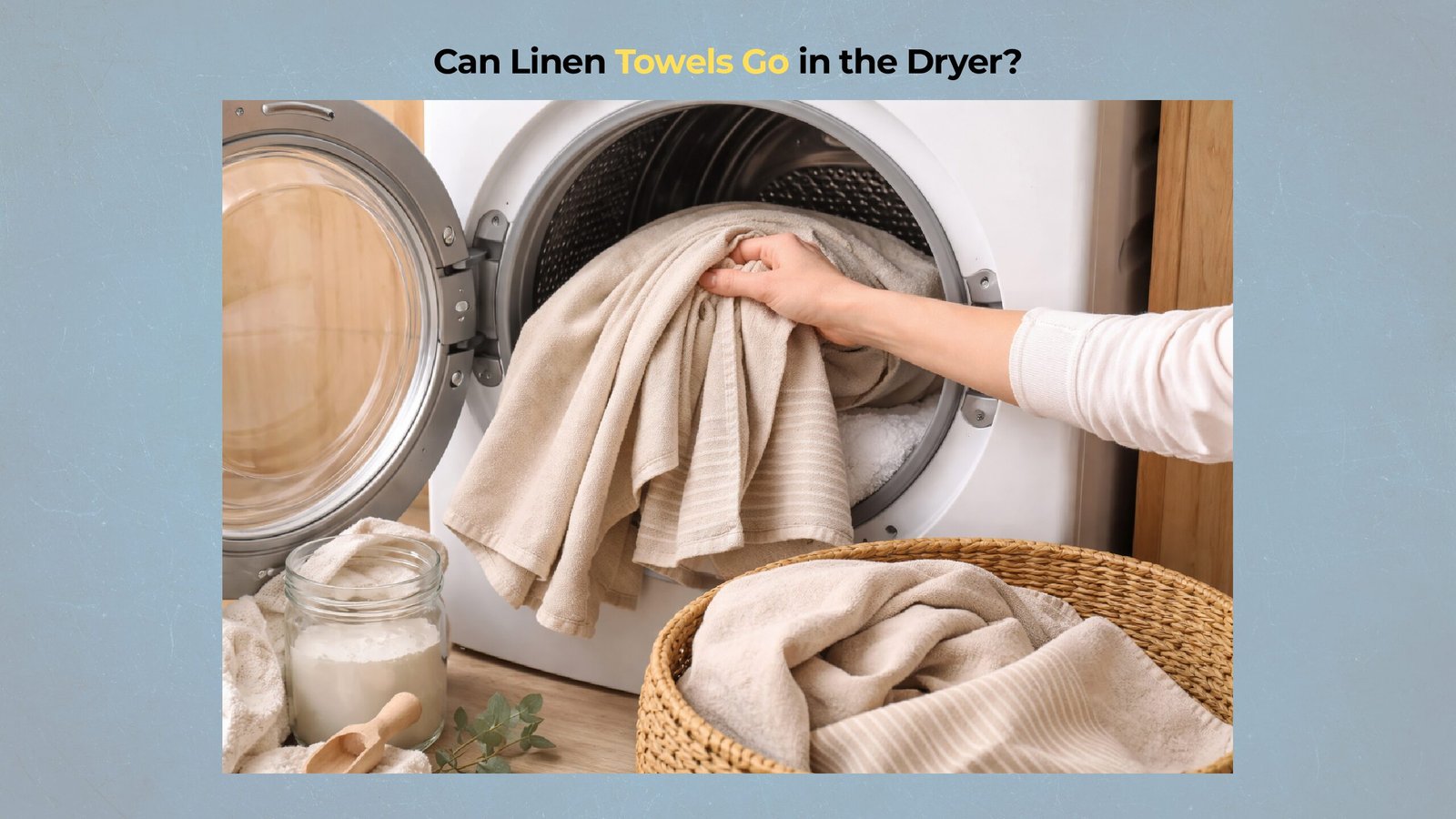
Can Linen Towels Go in the Dryer?
A Technical Blueprint for Bast Fiber Desiccation & Thermal Management
Yes, linen towel machine drying maintains structural integrity only when operators utilize gentle, low-heat cycles and extract the textile while slightly damp to prevent the shrinking and brittleness caused by over-drying. While air drying remains the primary preservation method, this controlled mechanical sequence avoids the over-drying that triggers fiber damage. In the broader context of all towel materials, linen requires a specific thermal management protocol to remain viable.
Simplified Explanation: “Think of the dryer as a mechanical massager for your towels. It provides the movement needed to keep fibers soft, but only if you keep the heat at a safe level.”
Ultimately, the longevity of the textile is determined by how laundering methods impact long-term fiber health.
Why Do Specific Linen Towel Machine Drying Methods Impact Long-Term Fiber Health?
Linen towel machine drying methods dictate long-term fiber health and structural durability. The speed and depth of moisture removal determine the degree of resulting cellulose chain stress. Research into the linen absorbency mechanism suggests that over-drying bast fibers beyond the 12% moisture regain threshold results in increased fiber stiffness and reduced flexibility. This tactile degradation connects the physical quality of the towel directly to the biological risk of fiber brittleness.
Does the Link Between Linen Towel Machine Drying and Fiber Brittleness Affect Durability?
Linen towel machine drying increases the probability of fiber breakage. This results from cycles that remove the natural internal moisture content required for flax resilience. In textile physics, Moisture Equilibrium is defined as the stable 10–12% internal water content required for flax fibers to remain flexible and resilient. When this balance is disturbed, users often encounter water absorption issues as the fibers become too rigid to swell effectively.
The causal progression is clear: [Over-drying to a bone-dry state] → [increases cellulose brittleness] → [accelerates thinning in linen towel machine drying]. Brittle fibers shatter under mechanical friction, whereas maintaining core moisture ensures the fibers bend rather than snap during use.
What Is the ROI of Specialized Linen Towel Machine Drying Protocols?
Linen towel machine drying provides a high return on investment (ROI). Utilizing specialized “low-and-slow” protocols extends the functional lifespan of premium flax textiles by 50% compared to high-heat cycles. When one contrasts the replacement costs of heat-damaged linens against towels maintained with low-heat cycles, the financial benefits are evident. These gains result from understanding the cellular-level changes in flax.
What Happens to Flax Fibers During High-Heat Linen Towel Machine Drying?
High-heat linen towel machine drying triggers irreversible structural changes in the cellulose filaments. These changes result in the “crunchy” or “stiff” texture characteristic of thermal degradation. This stiffness is primarily a result of the hydrogen bonding effect. Understanding these drying results is critical for anyone managing high-end linen inventory.
How Does the “Hydrogen Bonding” Effect Occur in Linen Towel Machine Drying?
Linen towel machine drying results in temporary hydrogen bonding and stiffening. This occurs as water molecules evaporate from between filaments and force the bast fibers to align into a rigid matrix. This phenomenon is comparable to the biological “snap” of dried phloem fibers. Mechanical tumbling is essential for optimal softness because it breaks these temporary bonds as they form, preventing the “board-like” texture common in stagnant air-drying.
Does High-Heat Induce Thermal Shrinkage Risks in Linen Towel Machine Drying?
Linen towel machine drying increases thermal shrinkage risks. Risks escalate when temperatures approach or exceed 140°F (60°C), triggering the contraction of the cellulose polymer chains. [Temperatures exceeding 60°C] → [trigger thermal fiber contraction] → [cause permanent shrinkage in linen towel machine drying].
Observations indicate that un-stabilized flax textiles experience up to a 10% dimensional loss when exposed to high-heat mechanical environments. If you are unsure about your specific towel, you can use the best towel finder to identify materials that might be more resilient to heat.
When Should You Avoid Linen Towel Machine Drying Entirely?
Linen towel machine drying protocols require the identification of high-risk textiles. Selective drying prevents the accidental destruction of vulnerable or aging bast fibers. This leads specifically into the criteria for evaluating delicate and antique textiles.
Do Delicate and Antique Textiles Fail Under Linen Towel Machine Drying Stress?
This drying process necessitates the total exclusion of antique or heirloom linens. Aging cellulose fibers possess significantly lower tensile strength compared to modern textiles. Operators must mandate flat-surface air-drying for any linen showing signs of yellowing or fiber-thinning. Mechanical tumbling shatters the degraded molecular bonds of old flax, turning historical textiles into lint-trap waste.
Does Lightweight Flax Face Structural Vulnerability During Linen Towel Machine Drying?
Linen towel machine drying exposes lightweight and loosely woven flax to structural vulnerability. A lack of yarn density allows the threads to “gap” or shift during high-speed rotation. Inspect the weave density: If light penetrates the gaps easily, switch to high-airflow air-drying.
Do Thinning and Fraying Indicate the End of Linen Towel Machine Drying Utility?
Linen towel machine drying utility terminates upon the appearance of visible “balding.” Transparent patches indicate the need for flat-surface air-drying to prevent total fabric failure. Identifying why towels fail early can save high-value inventory from permanent damage.
Which Specific Steps Execute a Safe Linen Towel Machine Drying Cycle?
Executing a safe linen towel machine drying cycle requires a technical shift in habit. Monitored “Damp-Pull” workflows preserve fiber loft by preventing the “bake-on” stiffness of a full cycle. This logic begins with a strict low-heat protocol.
How to Execute the “Low-Heat / Short-Cycle” Protocol for Linen Towel Machine Drying?
Linen towel machine drying utilizes “Low-Heat / Short-Cycle” protocols for a maximum of 10–15 minutes. This timing provides the mechanical movement needed to loosen fiber bonds. Referencing ISO 3758 care symbol guidelines, “Low Heat” is indicated by one dot. The 15-minute mark serves as the safety ceiling; beyond this, the evaporation rate outpaces the fiber’s ability to remain lubricated, leading to “thermal shock.”
Why Does the “Damp-Pull” Rule Optimize Linen Towel Machine Drying?
Linen towel machine drying results improve when removing textiles while they remain 10% to 20% damp. Finishing the process on a rack prevents the brittleness and static electricity of a full cycle.
The Cool-Down Finish: Remove towels while cool to the touch and finish on a flat rack for the final 20% of desiccation. [Executing the Damp-Pull rule] → [preserves core moisture equilibrium] → [secures superior softness in linen towel machine drying].
How to Choose Between Air-Drying and Machine Drying for Linen Towels?
Selection of linen towel machine drying depends on a comparative analysis of desired outcomes. Users must weigh the tactile finish against the mechanical wear constraints of the dryer. In some cases, analyzing microfiber vs linen drying speed reveals that linen’s unique bast fiber structure requires more deliberate attention than synthetics.
| Metric | Full Machine Dry | Full Air-Dry | Hybrid (Machine + Air) |
|---|---|---|---|
| Tactile Finish | Soft / Fluffy | Stiff / Crisp | Optimal / Pliable |
| Fiber Wear | Highest | Lowest | Moderate |
| Time (Estimated) | 45 Mins | 4–8 Hours | 2 Hours |
| Absorbency Sensation | High | Moderate | High |
Matching Weave Type to Your Linen Towel Machine Drying Method
Linen towel machine drying methods align with specific weave geometries. Waffle textures require a mechanical tumble to restore their honeycomb loft. “Waffle towels are like popcorn. They need the ‘heat and movement’ of the dryer to pop back into their thick, thirsty shape.”
How Can You Fix Stiffness Caused by Improper Linen Towel Machine Drying?
Stiffness caused by linen towel machine drying requires specific chemical and mechanical resets. These interventions unlock the fibers to restore a “bloomed” texture. If you frequently find yourself in this situation, you may want to diagnose your towel care mistakes to identify if the issue is thermal or chemical.
Does a Cool-Air Tumble Restore Over-Dried Linen Towel Machine Drying Results?
Linen towel machine drying recovery for over-dried inventory involves a cool-air tumble. Mechanical separation with wool dryer balls disrupts the temporary fiber alignment.
The Softness Reset Protocol:
- Mist the towel lightly with distilled water.
- Tumble on “Air Fluff” (no heat) for 10 minutes.
Why Does Vinegar Resolve Mineral “Crunch” in Linen Towel Machine Drying?
The mechanical cycle improves after the application of acetic acid (vinegar). A separate rinse dissolves the calcium deposits that heat-set into flax loops. You must execute a separate cycle with 1/2 cup of white vinegar in the rinse to exfoliate the bast fibers.
How to Verify Your Strategy with a Linen Machine Drying Checklist?
Linen towel machine drying protocols align with molecular needs when verified through technical audits. Systematic evaluation ensures the maintenance routine remains safe for the textile.
Checklist: Linen Towel Machine Drying Audit Checklist
- Thermal Audit: Is the dryer setting strictly confirmed as “Low” or “Extra Low” (< 110°F)?
- Moisture Check: Are towels removed while still cool and 10–20% damp to the touch?
- Mechanical Check: Are wool dryer balls used to provide mechanical “beating” without heat?
- Wear Audit: Is the lint trap free of excessive mass, signaling low fiber-shear?
- Wicking Test: Does the dry textile feel “springy” rather than “crunchy” or brittle?
Frequently Asked Questions: Technical Linen Care
Is it safe to put 100% linen towels in a high-heat dryer cycle?
No, high-heat cycles must be avoided as they trigger thermal contraction and irreversible fiber brittleness. Temperatures exceeding 60°C (140°F) cause the cellulose polymer chains to contract, leading to permanent dimensional loss and structural failure.
Why do my linen towels feel “crunchy” after drying?
Stiffness results from the formation of temporary hydrogen bonds when fibers are over-dried beyond the 10% moisture equilibrium threshold. Without internal lubrication, the phloem fibers align into a rigid matrix, resulting in a board-like texture.
How long should a linen towel stay in the machine dryer?
Cycles should be limited to 10–15 minutes on a low-heat setting. This duration provides the mechanical movement needed to disrupt fiber bonding without inducing thermal shock or excessive moisture depletion.
Can I use fabric softeners to make linen towels softer?
Chemical softeners should be avoided as they coat the bast fibers in a waxy film that reduces wicking efficiency. Instead, utilize white vinegar to strip mineral deposits and wool dryer balls for mechanical lofting during a short drying cycle.
Technical Disclaimer
The maintenance protocols and technical parameters provided in this guide are based on general textile engineering principles for bast fibers (Linum usitatissimum). However, linen towel machine drying results remain highly conditional upon several variables, including but not limited to: specific weave geometry, yarn density, pre-existing structural wear, and the calibration accuracy of residential drying equipment.
Toweldaily.com and its authors are not responsible for dimensional loss, fiber-shear, or textile failure resulting from improper implementation of these protocols. Users are advised to perform a patch-test on a small, inconspicuous area of the textile before executing a full-cycle mechanical desiccation. When in doubt, prioritize air-drying to ensure maximum fiber longevity.
Explore Related Linen Guides & Tools
Final Summary: Does Machine Drying Align With Your Maintenance Goals?
Linen towel machine drying strategies operationalize long-term fiber health by prioritizing “Hybrid” methods. This approach balances convenience with the preservation of bast fiber integrity.
Value Summary:
- Prioritize Moisture Equilibrium: Keep fibers lubricated with 10–12% internal water content.
- Control Thermal Contraction: Never exceed 60°C to avoid permanent shrinkage.
- Utilize Hybrid Drying: Combine short mechanical cycles with flat-surface finishing.
“Ultimately, a superior linen experience is defined by the precise linen towel machine drying results that turn raw flax into a soft, high-performance textile through technical maintenance.”