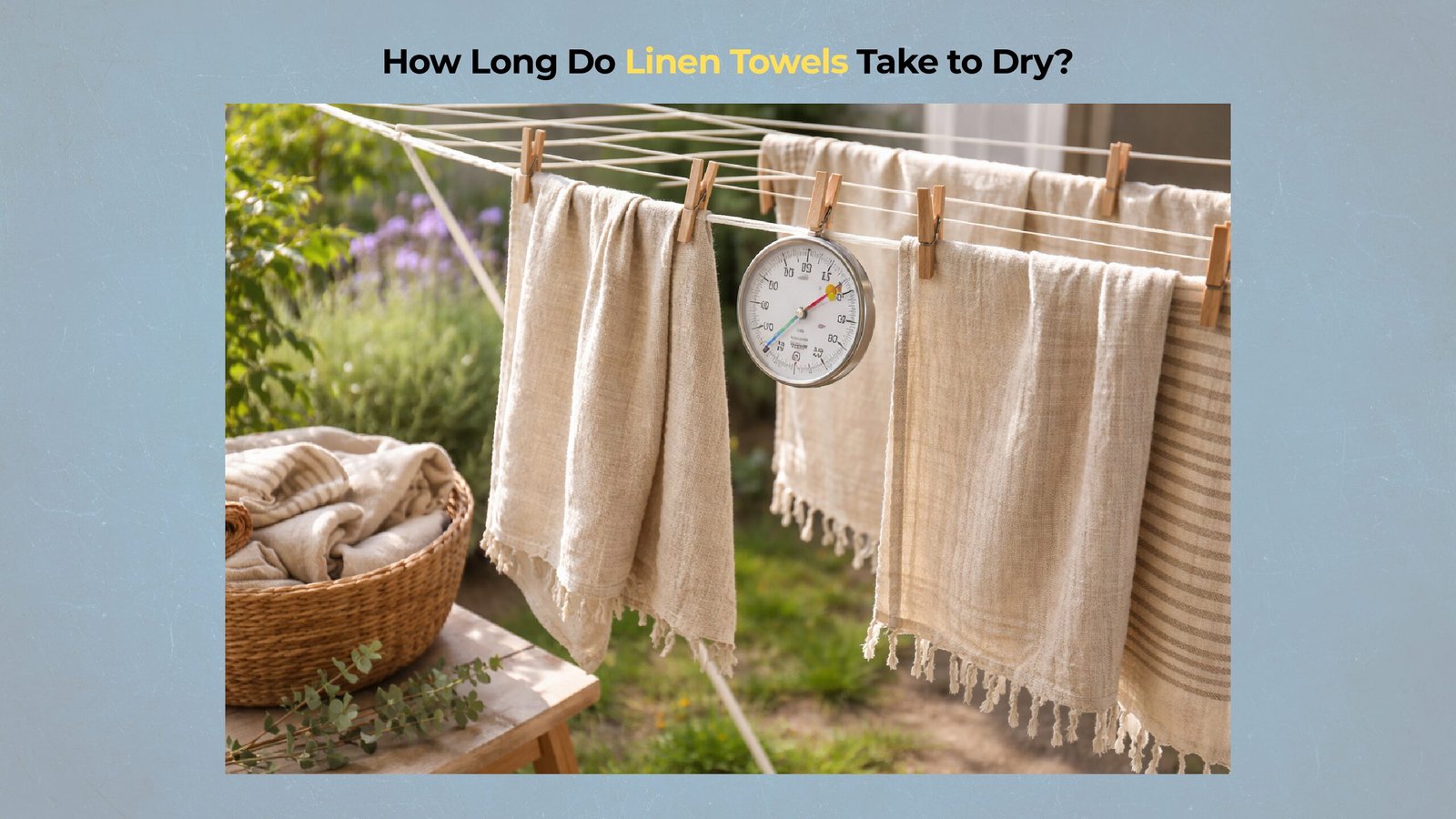
How Long Do Linen Towels Take to Dry?
An Engineering Blueprint for Bast Fiber Desiccation and Evaporation Physics
Linen towel drying time typically falls within a two-to-four-hour window under normal indoor conditions. This evaporation window is a key factor in superior bathroom hygiene and resource efficiency when compared to the prolonged saturation cycles of natural cotton. Essentially, linen is designed to release water into the air as fast as it pulls it from your skin, ensuring it is dry and fresh for its next use.
Why Is Linen Towel Drying Time a Factor in Bathroom Hygiene?
Linen towel drying time primarily determines the duration of the biological window required for microbial colonization. Rapid moisture turnover starves anaerobic bacteria of the aqueous environment they require for proliferation, a profile that contrasts sharply with the high polyester odor retention often found in synthetic sports textiles.
Does the Material Fall Within an Odor-Resistant Window?
Linen towel drying time typically falls within an odor-resistant window under normal indoor conditions, reaching moisture equilibrium fast enough to inhibit anaerobic activity. Practical observations in controlled laundry environments demonstrate that prolonged dampness (typically spanning several hours) increases the likelihood of microbial growth. Fast drying serves as a functional safety feature that disrupts the metabolic cycles of surface pathogens.
Does Superior Linen Towel Drying Time Reduce Reliance on Mechanical Drying?
The evaporation cycle of flax significantly reduces reliance on mechanical drying, depending on usage patterns and facility airflow. Utilizing air-dried linen instead of machine-dried cotton significantly lowers annual laundry energy consumption in high-volume environments. [Rapid air desiccation] → [reduces mechanical heat requirements] → [optimizes the ROI of linen towel drying time].
How Do Fiber Physics and Weave Geometry Dictate Linen Towel Drying Time?
Fiber physics and weave geometry primarily determine linen towel drying time by establishing a network of microscopic transport channels and maximizing the surface area exposed to ambient air. This bast fiber mechanism is functionally distinct from the chemical wicking used to enhance polyester towel absorbency.
How Does Capillary Action Within Fiber Bundles Facilitate Linen Towel Drying Time?
Linen towel drying time is facilitated by capillary action within fiber bundles and inter-fiber spaces that act as high-speed conduits for moisture transport. Flax fibers utilize these pathways within the fiber bundles to move moisture toward the surface for evaporation, unlike the solid-core absorption of carded cotton.
Does Waffle-Weave Geometry Substantially Increase the Results of Linen Towel Drying Time?
Waffle-weave geometry substantially increases effective surface area compared to flat weaves, which significantly accelerates linen towel drying time. Three-dimensional honeycomb patterns facilitate a measurable increase in airflow exchange compared to flat-weave linens of identical GSM, providing a level of atmospheric movement often missing in a standard polyester towel breathability analysis.
Which Environmental Variables Influence the Results of Linen Towel Drying Time?
Local environmental variables, specifically ambient relative humidity and mechanical airflow, primarily determine the real-world accuracy of predicted linen towel drying time.
Identifying the Humidity Limit for Optimal Linen Towel Drying Time
Extreme ambient humidity levels—specifically those exceeding 70%—materially restrict linen towel drying time by narrowing the vapor pressure differential. Reference indoor relative humidity guidelines for textile care. In saturated environments, flax drying times typically extend, matching the performance profile of natural breathable cotton unless active ventilation is introduced.
Does Airflow Exposure Jumpstart Linen Towel Drying Time?
Mechanical airflow exchange drastically decreases linen towel drying time by removing the “boundary layer” of humid air that typically clings to the textile surface. Reference AATCC 199 (Drying Time of Textiles) under ventilated conditions. Active bathroom ventilation (HVAC) maintains the atmospheric pressure changes required for continuous fiber evaporation.
Evaporation Rate Comparison Matrix
Selection of the ideal textile requires comparing linen towel drying time against the horizontal wicking speed of microfiber and the internal saturation of cotton. For a broader context on synthetic performance, see the polyester drying speed comparison benchmarks.
| Fiber Type | Est. Air-Dry Time | Moisture Mechanism | Rank |
|---|---|---|---|
| Split-Fiber Microfiber | 45–120 Minutes | Surface Capillary Wicking | 1 |
| Linen (Waffle Weave) | 2–4 Hours | Capillary Flow | 2 |
| Linen (Plain Weave) | 3–5 Hours | Evaporative Flow | 3 |
| Traditional Cotton | 6–10 Hours | Internal Saturation | 4 |
Note: While synthetic materials boast a high microfiber drying speed, linen remains the superior choice for high-heat durability and antimicrobial performance.
How to Match GSM to Your Linen Towel Drying Time Requirements?
Calibrating textile weight (GSM) ensures linen towel drying time aligns with the user’s specific “dry-by-next-use” window. A GSM range of 250–400 represents the technical “sweet spot” for flax, providing sufficient moisture capacity while maintaining a drying window typically under 4 hours. This capacity-to-weight ratio is significantly more efficient than standard polyester water capacity metrics.
Which Specific Techniques Execute the Shortest Linen Towel Drying Time?
Executing specific physical protocols during and after use ensures linen towel drying time reaches its engineered maximum efficiency.
How Does a Full-Spread Hanging Protocol Secure Uniform Linen Towel Drying Time?
Adhering to a “Full-Spread” hanging protocol secures uniform linen towel drying time by maximizing the textile’s surface-to-air exposure ratio. Damp towels must remain un-folded on a bar. Bunching creates “damp-spots” where moisture transit is halted, drastically slowing the desiccation process.
Does the Mechanical Snap Protocol Improve the Results of Linen Towel Drying Time?
Performing a vigorous mechanical snap improves initial airflow exposure by separating compressed fibers to facilitate a faster linen towel drying time. Practical observations in controlled laundry environments indicate that pre-snap protocols reduce initial fiber “locking,” keeping the capillary channels open for optimal evaporation.
How to Restore Sluggish Linen Towel Drying Time?
Restoring compromised linen towel drying time in aged inventory involves executing separate chemical resets to dissolve the mineral residues that block moisture release. While raw flax provides exceptional long-term lifecycle value, its performance may decline relative to a polyester durability benchmark if mineral calcification is left unaddressed. Vinegar and baking soda must be used in separate cycles to avoid neutralization.
Does Stripping Detergent Buildup Restore Linen Towel Drying Time?
Linen towel drying time recovers its original velocity if a vinegar cycle successfully exfoliates the waxy films left by non-rinsed detergents. Restoration Reset: One hot cycle with 1 cup white vinegar, followed by a separate hot cycle with 1/2 cup baking soda. Acidic rinses dissolve mineral calcification that physically “plugs” the capillary pathways within the fiber bundles.
Linen Towel Drying Time Audit Checklist
Frequently Asked Questions
Sluggish linen towel drying time is typically caused by poor airflow or chemical residue. If your bathroom RH exceeds 70%, the air is likely too saturated to accept more vapor. Alternatively, mineral buildup from hard water or waxy detergent residues may be physically blocking the capillary transport channels within the fiber bundles.
While flax can be machine-dried on low heat, the superior linen towel drying time is engineered for air desiccation. Tumble drying provides mechanical agitation that can soften the textile, but frequent high-heat exposure may damage the cellulose structure. For the best turnover speed, a ventilated air-dry is recommended.
Color has a negligible effect on linen towel drying time compared to GSM and weave. However, high-density dyes can occasionally reduce initial fiber permeability until the towel has undergone several industrial wash cycles. The primary drivers remain fiber morphology and ambient thermodynamics.
A restoration reset should be executed every 4-6 weeks if you notice a decrease in moisture turnover velocity. This prevents the cumulative “choking” of capillary pathways by surfactants and minerals, ensuring your linen towel drying time remains within the engineered 2-to-4-hour window.
Technical Disclaimer: The drying times and technical benchmarks provided in this guide are based on controlled laboratory conditions and typical residential environments. Individual results for linen towel drying time may vary significantly based on local relative humidity, specific weave density, water mineral content, and available airflow. This information is provided for educational purposes and does not constitute a guarantee of performance under extreme environmental conditions.
Final Summary
Operationalizing a linen towel drying time strategy requires a shift from convenience-centric habits to a velocity-centric approach that prioritizes turnover speed and hygienic safety. Ultimately, a superior linen experience is defined by the precise linen towel drying results that turn raw flax into a soft, high-performance textile through technical maintenance.