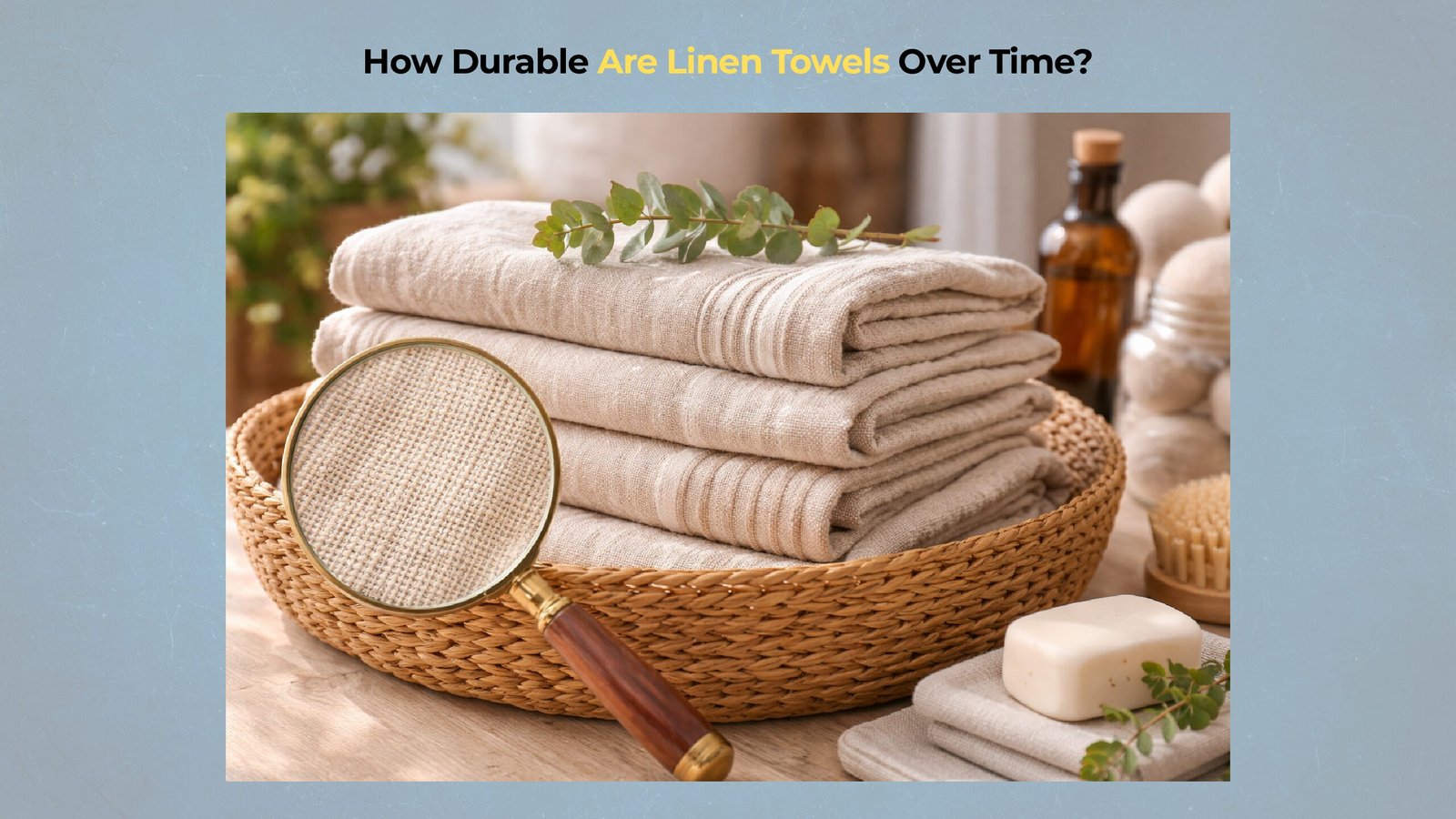
How Durable Are Linen Towels Over Time?
Technical Performance Guide | Asset ROI Analysis
Linen towel durability typically yields a service life of 15–20 years under optimal low-stress usage because flax fibers soften significantly with washing while maintaining structural strength longer than most natural fibers. Linen is essentially an heirloom asset; unlike cotton, which breaks down steadily over time due to staple-length limitations and seed-fiber morphology, flax is engineered by nature to maintain its strength while softening with every wash. This 15–20 year benchmark is an outcome of optimal care protocols and the successful removal of residual pectins during the mechanical break-in phase.
Why Is Linen Towel Durability a Factor in Long-Term Household Investment?
Linen towel durability primarily determines the economic viability of natural textiles by establishing a lifecycle denominator that is typically two to three times longer than standard cotton terry. This durability dictates a shift in perspective, moving from a standard domestic disposable mindset to one of textile engineering and asset management.
Does the “Cost-per-Use” ROI Justify Linen Towel Durability?
Linen towel durability dictates a superior cost-per-use (CPU) return on investment because a 15-to-20-year service life offsets the high initial acquisition capital required for European flax. Mathematically, a $50 high-GSM linen towel used over 15 years yields an annual cost of ~$3.33. In contrast, a $15 cotton towel, which typically exhibits fiber fatigue within 3–5 years, results in a recurring capital drain that exceeds the linen investment within the first decade.
How Does This Preservation Strategy Support Environmental Sustainability in Linen Towel Durability?
Linen towel durability supports environmental sustainability goals by reducing cumulative textile landfill waste and leveraging the low-water irrigation requirements of the flax plant. According to CELC sustainability benchmarks, flax production requires zero irrigation and significantly fewer synthetic inputs than conventional cotton. Long-term fiber integrity → reduces textile replacement frequency → optimizes the environmental footprint of linen towel durability.
What Molecular Physics Drive the Results of Linen Towel Durability?
Molecular physics drive linen towel durability by utilizing high-tenacity bast fibers that possess a crystalline framework resistant to the mechanical shearing found in seed-based fibers. Flax (Linum usitatissimum) is a structural bast fiber, unlike cotton, which acts as a protective seed casing. This structural origin provides a molecular foundation for multi-decade resilience.
Does the “Wet-Strength” Phenomenon Increase Linen Towel Durability?
Linen towel durability typically increases by approximately 10–25% during saturation—depending on fiber processing and yarn structure—because moisture facilitates molecular reorientation and load redistribution. While many natural and synthetic fibers soften or weaken when wet—a key consideration in the polyester drying speed comparison—flax exhibits a unique wet modulus. Technical standards confirm that saturated flax requires significantly more force to achieve fiber rupture than dry state counterparts, ensuring structural integrity through modern laundering standards.
Is the Degree of Polymerization a Primary Factor in Linen Towel Durability?
Linen towel durability depends on a high degree of polymerization within the crystalline cellulose structure, which significantly reduces pilling compared to short-staple fibers. The long molecular chains of the flax fiber prevent the fiber shearing and mass loss that typically degrades cotton terry towels. High degree of polymerization → inhibits fiber-shear mass loss → secures the long-term integrity of linen towel durability.
Which Specific Laundry Steps Activate Linen Towel Durability?
Activating linen towel durability requires a technical “break-in” phase that utilizes mechanical agitation to flex the bast fibers and initiate the natural fibrillation process.
Technical Insight: The “Wash-to-Wick” Transition
Initial “stiffness” is a marker of fiber purity. Frequent laundering in the first month is recommended to accelerate this transition. The mechanical flexing during the wash cycle slowly removes the remaining pectins (natural plant glues), allowing the fiber core to “bloom” without sacrificing the structural framework.
How Does Fiber Fibrillation Jumpstart Linen Towel Durability?
Linen towel durability reaches its peak functional performance typically within the first 5–15 wash cycles as fiber fibrillation (‘blooming’) massages the rigid filaments into a pliable state. This softening occurs gradually as the surface of the flax fiber develops microscopic fibrils that enhance tactile softness while the high-tenacity core remains unchanged. This 5–15 cycle window marks the full transition from raw textile to high-performance heirloom asset.
Does This Chemical Protocol Ensure Preservation of Linen Towel Durability?
Linen towel durability persists only when the laundry routine excludes chlorine bleach and liquid softeners that reduce absorbency and promote moisture retention. Chemical softeners coat the fibers in a silicone-like film, which reduces vapor transmission and lowers polyester breathability in blended textiles. This paradoxically leads to brittle fiber fatigue by trapping moisture in the core, ultimately maximizing durability through chemical-free preservation.
How to Select Resilient Linen Towel Durability Specifications for Your Household?
Selecting resilient specifications for linen towel durability involves auditing the Grams per Square Meter (GSM) and verifying geographic origin to ensure high tensile strength and structural stability.
| Metric | Lightweight Linen | Mid-Weight Linen | Heavyweight Waffle |
|---|---|---|---|
| GSM Range | 150–200 | 250–400 | 450+ |
| Durability Correlation | Moderate | High | Highest |
| Best Use-Case | Travel / Face | Daily Bath | Spa / Maximum Longevity |
Does “Masters of Linen” Certification Secure Linen Towel Durability?
Linen towel durability is verified by the “Masters of Linen” certification, which mandates 100% European-origin flax and strictly controlled industrial production standards. This certification from the European Confederation of Flax and Hemp (CELC) mandates that every stage of production—from field to loom—adheres to traceability standards that prevent the inclusion of inferior short-staple fibers.
How Can You Restore Compromised Linen Towel Durability Performance?
Restoring compromised performance in linen towel durability involves immediate mechanical repair of snags and periodic chemical resets to dissolve mineral calcification.
Does Snag Repair Prevent the Failure of Linen Towel Durability?
Linen towel durability remains intact when snags are trimmed immediately because cutting a loop in a woven bast fabric does not cause the structural unravelling common in knits. The high wet-modulus and dense woven structure mean that a cut loop does not create a “run.” Simply snip the snag flush to the surface to prevent it from catching further and causing structural stress during the spin cycle.
How Does Resolving Mineral Stiffening Support Linen Towel Durability?
Linen towel durability improves if a periodic white vinegar rinse dissolves the calcium deposits that “lock” bast fibers and lead to brittle fiber fatigue. Mineral calcification creates a “stiff” feeling that can eventually cause micro-cracks in the cellulose core. A Restoration Soak—adding one cup of white distilled vinegar to a warm wash cycle—acts as a mild decalcifier, restoring the natural elasticity of the flax.
How to Verify Your Strategy with a Linen Towel Durability Checklist?
Systematic technical audits of maintenance habits verify that current linen towel durability aligns with the molecular requirements of the flax material.
Checklist: Linen Towel Durability Audit Checklist
- Material Audit: Does the label confirm “100% Flax Linen” (European origin preferred)?
- Construction Check: Are hems double-stitched or reinforced at high-stress corners?
- Chemistry Audit: Is the laundry routine 100% free of liquid fabric softeners?
- Activation Check: Have new towels completed at least 5 washes to initiate fiber fibrillation?
- Flexibility Test: Does the dry textile feel “springy” rather than brittle or “crunchy”?
Frequently Asked Questions on Linen Towel Durability
Linen towels typically yield a service life of 15–20 years, whereas standard cotton terry towels begin to exhibit fiber fatigue and absorbency loss within 3–5 years. This multi-decade durability results from the high degree of polymerization in the flax stalk fiber.
This stiffness is caused by residual pectins (natural glues) and a highly ordered crystalline framework. The “crunchiness” is a technical indicator of high fiber purity and will resolve as mechanical agitation triggers fiber fibrillation (‘blooming’) over the first 5–15 washes.
No. Fabric softeners use quaternary ammonium compounds that coat the fibers in a hydrophobic silicone layer. This reduces water-wicking efficiency, increases polyester odor retention in blended items, and can lead to brittle fiber fatigue by trapping moisture in the core, ultimately compromising the long-term integrity of the towel.
While cotton can hold more total water weight in a dense terry loop, linen is more efficient at moisture wicking and transport. Linen can absorb up to 20% of its weight in moisture before feeling damp and dries significantly faster—shortening the average linen drying time—which prevents the anaerobic odor development and is a key factor in standard hygiene management.
While flax is heat-resistant, excessive high-heat drying can cause “brittle fatigue.” For maximum service life and to optimize linen air-drying longevity, tumble dry on medium heat and remove while slightly damp to allow the crystalline fibers to air-equilibrate with household humidity.
Final Summary: Does the Performance Profile of Linen Towel Durability Fit Your Goals?
Operationalizing a linen towel durability strategy requires a shift from convenience-centric habits to a preservation model that honors the 15–20 year structural health of the flax fiber.
Value Summary:
- Lifecycle Asset: Linen is a multi-decade investment that outperforms cotton in durability and cost-per-use.
- Biological Strength: The crystalline bast structure offers unique wet-strength benefits and resistance to fiber-shear.
- Technical Maintenance: Durability is contingent upon mechanical activation (blooming) and chemical exclusion (no softeners).
Ultimately, a superior linen experience is defined by the precise linen towel durability engineering that turn raw flax into a soft, high-performance heirloom through technical maintenance.
Technical Disclaimer: The performance metrics, tensile strength projections, and lifecycle benchmarks (15–20 year service life) presented in this guide are based on standardized textile engineering evaluations under optimal environmental conditions. Actual linen towel durability in a household setting may fluctuate based on local water mineral saturation, chemical concentrations in laundry detergents, and mechanical stress intensities. This guide serves as an educational resource for asset management and does not constitute a legal performance guarantee.