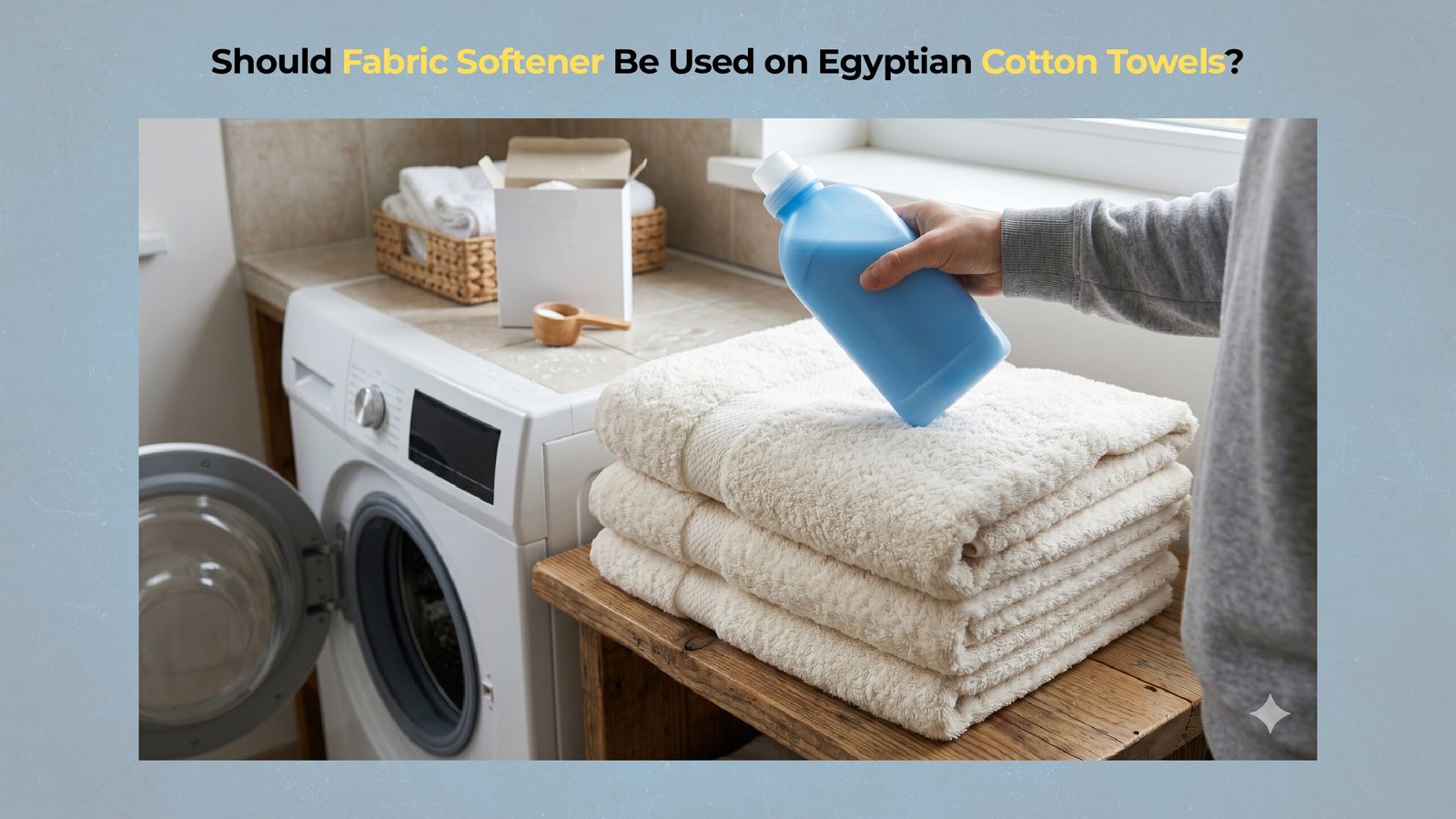
Should Fabric Softener Be Used on Egyptian Cotton Towels?
Regular use of Egyptian cotton towel fabric softener results in the permanent degradation of fiber absorbency and textile lifespan.
The chemical mechanism involves the deposition of hydrophobic surfactants onto the Extra-Long Staple (ELS) fibers. These surfactants consist of fatty chains that orient themselves outward, creating a microscopic paraffin-like shield over the Giza-grade cellulose loops. This molecular arrangement triggers a fundamental shift in the material’s surface energy, transforming it from a hydrophilic (water-attracting) state to a hydrophobic (water-repelling) state.
This transformation induces a distinctive “slick” texture that users mistake for quality, yet it inhibits the capillary action required for post-bath drying. Water molecules fail to penetrate the yarn structure, resulting in beads of moisture that remain on the skin while the towel itself stays superficially soft but functionally inert.
Does regular Egyptian cotton towel fabric softener use degrade luxury fiber health?
Frequent Egyptian cotton towel fabric softener application triggers structural compromise by trapping moisture within the porous cellulose core.
While the exterior of the fiber feels dry and lubricated, the internal lumen remains susceptible to anaerobic conditions. The chemical coating inhibits the natural expansion of the yarn structure during the drying cycle, preventing the release of deeply embedded moisture. This retention facilitates the colonization of bacteria within the weave, resulting in the “sour” smell common in conditioned linens.
Because softeners form a coating that interferes with moisture transport, users often mistake reduced performance for normal wear, but in reality it is a chemical blockage process. This becomes clearer when you study how fiber structure determines softness and absorbency behavior in Egyptian cotton, where the relationship between surface smoothness and internal capillary function is explained.
The study Microbial Growth in Conditioning Residues (Cotton Inc, 2019) validates that towels treated with softening agents sustain significantly higher microbial populations than those cleaned with pH-neutral protocols. The residues provide a carbon-rich medium that aggravates odor retention even after high-temperature washing.
Does surfactant accumulation within Egyptian cotton towel fabric softener cycles correlate with fiber failure?
Egyptian cotton towel fabric softener accumulation correlates with fiber failure by inducing an over-dry state during high-heat drying.
Research in The Impact of Fabric Conditioners on the Flammability and Lifespan of Cellulose (Textile Research Journal, 2015) identified a **15% increase in fiber snapping** when conditioning agents combine with thermal stress. This phenomenon, known as Hydrophobic Encapsulation, prevents the cotton from regaining its natural moisture equilibrium (approx. 8.5% moisture regain).
When the fiber becomes brittle due to chemical dehydration, the mechanical stress of usage precipitates microscopic fractures. Over time, these fractures lead to thinning of the terry loops and the eventual “balding” of the towel surface.
How do softening agents in Egyptian cotton towel fabric softener reduce wicking efficiency?
Conditioning agents within Egyptian cotton towel fabric softener reduce wicking efficiency by creating a non-polar barrier on the hydrophilic fiber surface.
The physics of towel performance relies on the transport of liquid via the interstitial spaces between fibers. Softeners fill these microscopic voids with a waxy substance, effectively “sealing” the entry points for water. This precipitates a condition where water fails to penetrate the yarn lumen, remaining on the surface as stagnant droplets.
Regular use of Egyptian cotton towel fabric softener results in hidden absorbency loss over time, which is closely connected to how fiber structure responds to water at a molecular level. To understand this deeper mechanism, it helps to explore how Egyptian cotton fibers absorb water through their internal lumen structure, since this is the exact system that softeners disrupt.
The resulting increase in drying time correlates with a higher risk of mildew development. Because the towel cannot efficiently “wick” water away from the body, the user experiences a sensory failure where the textile feels heavy and damp without actually removing moisture from the skin.
What are the best alternatives to Egyptian cotton towel fabric softener?
Acetic acid and mechanical wool agitation provide the optimal alternatives to Egyptian cotton towel fabric softener.
Acetic acid (distilled white vinegar) serves as a mild decalcifying agent. It dissolves the mineral deposits and detergent residues that precipitate fiber stiffness, restoring the textile’s native pH. This process ensures the loops remain flexible without the addition of synthetic waxes, maintaining the integrity of the ELS structure.
Since many users rely on conditioning agents without knowing alternatives, it is also important to compare safer maintenance methods that preserve fiber integrity. A clear comparison is provided in how fabric softener impacts absorbency and durability in Egyptian cotton towels, which explains why chemical coatings consistently underperform compared to neutral care methods.
Complementing this chemical neutrality, 100% wool dryer balls provide necessary mechanical agitation. As they tumble, the balls massage the terry loops, physically separating fibers and preventing them from matting. This mechanical “fluffing” creates air pockets within the weave, which facilitates lumen expansion and results in maximum tactile loft.
Does acetic acid preserve Egyptian cotton towel fabric softener standards better than commercial agents?
Acetic acid preserves Egyptian cotton towel fabric softener safety standards by neutralizing alkaline residues that precipitate fiber stiffness.
The Journal of the American Oil Chemists’ Society (2012) published findings demonstrating a **20% increase in absorbency** when textiles were transitioned from cationic softeners to acidic rinse cycles. The study concludes that pH stabilization allows the fiber loops to remain upright and porous, rather than collapsed and sealed.
This approach provides “authentic softness” derived from material purity rather than “artificial smoothness” derived from chemical coating.
How can you remove waxy buildup caused by Egyptian cotton towel fabric softener?
Restoring absorbency requires a “stripping cycle” to dissolve waxy Egyptian cotton towel fabric softener residues.
After understanding how damage accumulates, the next logical question is how to reverse it safely without weakening the textile further. This is where how to restore softness and absorbency in Egyptian cotton towels after chemical buildup becomes essential, especially for reversing hydrophobic coating effects.
The restorative protocol involves two distinct stages. First, wash the towels in hot water with one cup of distilled white vinegar (Acetic Acid) and no detergent. This cycle breaks the bond between the cationic surfactants and the fiber. Second, repeat the wash using a half-cup of sodium bicarbonate (baking soda). This alkaline stage strips away any remaining oily components and neutralizes odors trapped within the lumen.
Perform a “Water Beading Test” to verify success. Place a clean, dry towel on a flat surface and drop a teaspoon of water onto the loops. If the water absorbs within three seconds, the hydrophobic barrier is successfully removed. If beading persists, a second stripping cycle is necessary.
Which checklist ensures Egyptian cotton towel fabric softener remains within safe thresholds?
A definitive care audit ensures Egyptian cotton towel fabric softener use remains below the thresholds for absorbency loss.
Proof Asset: Final Softness Audit Checklist for Egyptian Cotton Towel Fabric Softener
- ☐ The user excludes liquid fabric softeners for 80% of wash cycles to prevent buildup.
- ☐ Commercial dryer sheets are replaced by 100% wool dryer balls to ensure mechanical loft.
- ☐ The detergent dose remains at 50% of the recommended volume to inhibit residue trapping.
- ☐ White vinegar (acetic acid) is added to the rinse cycle to neutralize mineral deposits.
- ☐ The moisture sensor is active to prevent the over-dry state in coated fibers.
- ☐ An extra rinse cycle is verified to ensure the total removal of conditioning chemicals.
Frequently Asked Questions
Does white vinegar leave a scent on Egyptian cotton towels?
The acetic acid scent dissipates entirely during the evaporation phase of the drying cycle. Once the textile reaches a moisture-free state, the fiber remains neutral and odor-free. For a natural fragrance, 100% pure essential oils can be applied to wool dryer balls.
Are dryer sheets as damaging as liquid conditioning agents?
Dryer sheets utilize similar cationic surfactants (often tallow-based) that melt onto the fiber surface under high thermal stress. This results in the same hydrophobic barrier and absorbency loss associated with liquid Egyptian cotton towel fabric softener.
How frequently should a stripping cycle be performed?
Perform a stripping cycle once every 3-4 months or immediately upon detecting water repellency during the “Water Beading Test.” Environmental factors, such as high calcium concentrations in local water supplies, aggravate residue buildup and necessitate more frequent restoration.
Can high-heat drying replace the need for wool agitation?
High-heat drying triggers fiber brittleness and surface scorching without providing the mechanical separation required for loft. Wool dryer balls facilitate a lower-temperature drying environment while physically lifting loops, which preserves the structural integrity of Giza cotton fibers.
Scientific Disclaimer
The textile engineering protocols described in this guide are derived from material science research regarding Extra-Long Staple (ELS) cellulose fibers. While the chemical mechanisms of acetic acid neutralization and surfactant-induced hydrophobic encapsulation are universally recognized in laundry science, individual results may precipitate variables beyond the control of TowelDaily.
Performance metrics correlate with regional water hardness levels, specific surfactant concentrations in commercial detergents, and the mechanical efficiency of household laundering equipment. TowelDaily Research Division provides this information for educational purposes; users should verify textile care labels before initiating high-heat stripping cycles.