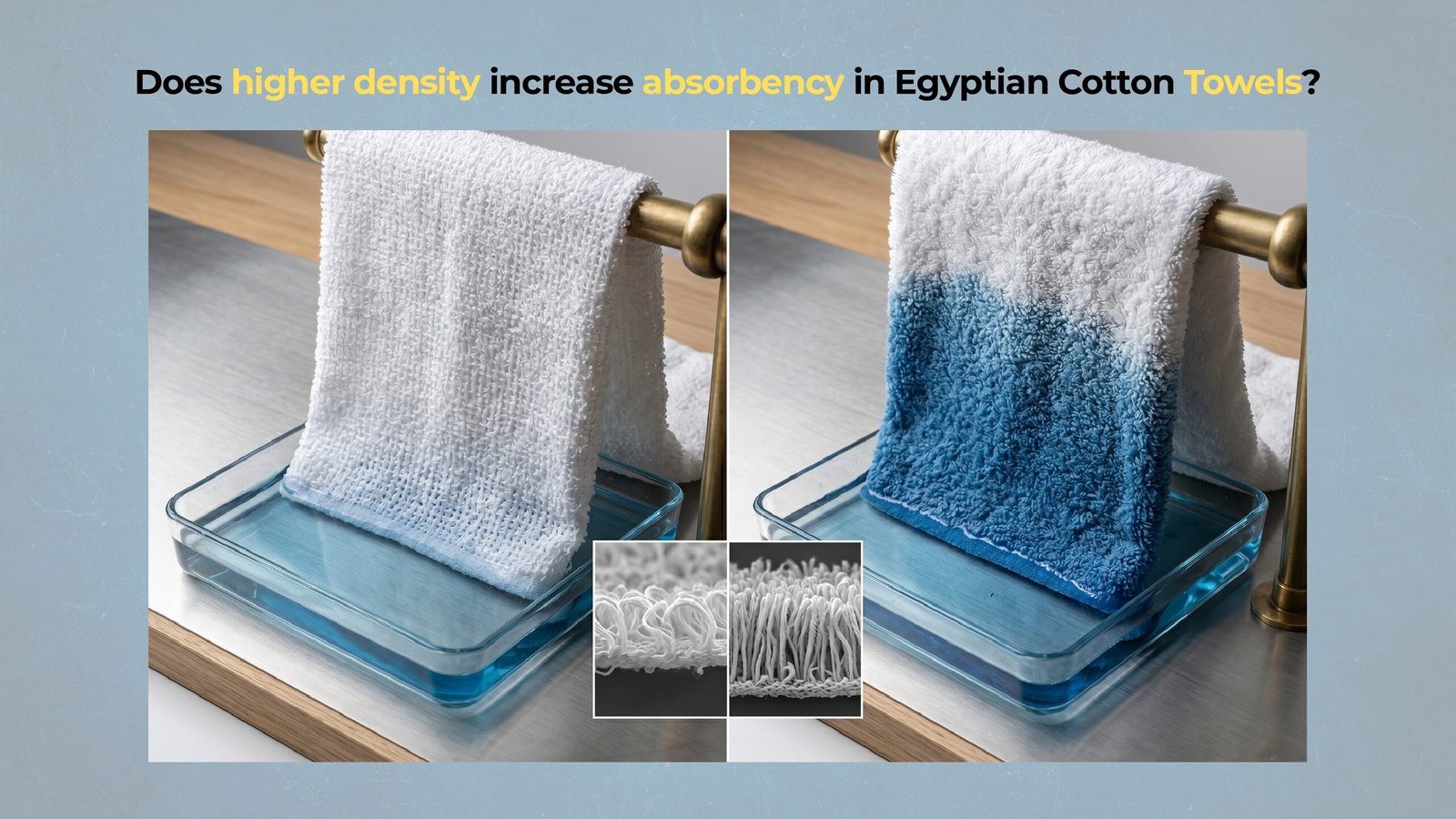
Does higher density increase absorbency in Egyptian Cotton Towels?
“Yes, Egyptian cotton towel density generally correlates with increased moisture-holding capacity if the added material mass provides a larger volume of hydrophilic cellulose to trap liquid.”
Achieving a superior tactile experience in luxury linens is fundamentally a matter of structural engineering. The Extra-Long Staple (ELS) structure of Egyptian cotton facilitates a significantly tighter weave than standard cotton varieties, allowing for finishing processes that maintain tactile flexibility despite high mass.
However, a technical distinction must be made between “total capacity”—the absolute volume of liquid a textile can hold—and “wicking efficiency,” which dictates the velocity of moisture transport. Increased Egyptian cotton towel density provides the former by sheer mass but can occasionally impede the latter if the weave is so compact that airflow is restricted.
What is Egyptian cotton towel density and how is it measured?
Egyptian cotton towel density is technically measured in Grams per Square Meter (GSM), a metric that quantifies the mass of the Extra-Long Staple (ELS) fibers typically packed into every square inch of the textile.
In the context of luxury linens, the Egyptian Cotton GSM Meaning serves as the primary industry benchmark for classifying towel weight tiers. This mathematical ratio of mass-to-area directly influences price-tiering, as higher density levels require a greater volume of premium Giza-grade yarn.
A metric used to define the weight of a fabric. In towels, it typically ranges from 300 to 900, with higher numbers indicating a denser, heavier pile.
Does fiber fineness influence Egyptian cotton towel density limits?
Egyptian cotton towel density thresholds typically increase if manufacturers utilize Giza-grade fibers with premium Micronaire values between 3.5 and 4.5.
According to the Textile Research Journal: Principles of Extra-Long Staple spinning, the use of finer fibers allows for more fibers to be packed into a single yarn cross-section. This leads to the “Fiber Compaction Resilience Model” (descriptive model), where the high tensile strength of Giza 45 or 92 fibers prevents the yarn from collapsing under its own weight, maintaining a lofty, dense pile that standard cotton cannot achieve at similar GSM levels.
How does Egyptian cotton towel density determine total moisture capacity?
The total moisture capacity of Egyptian cotton towel density is generally determined by the available inter-fiber voids and the total cellulose mass of the loops.
As loop count increases, the available surface area of the hydrophilic cellulose grows exponentially. This complex Absorbency Mechanism is driven by hygroscopicity—the physical property of a substance to attract and hold water molecules from the surrounding environment.
Does pile density dictate the wicking rate of Egyptian cotton towel density?
Egyptian cotton towel density wicking rates often correlate with pile-to-base ratios if the yarn construction facilitates immediate liquid transport.
Research from Cotton Incorporated’s Technical Bulletin on Absorbency indicates that high-density ELS towels typically achieve saturation in under 5 seconds in vertical wicking tests. Strategic Fiber Twist Reduction often enhances this immediate liquid transport by creating more open pathways within the yarn structure for surface tension to pull liquid droplets effectively.
Which Egyptian cotton towel density level aligns with your performance goals?
Selecting the optimal Egyptian cotton towel density involves matching the GSM weight category to your specific requirements for drying speed, while accounting for the nuances of your local climate.
GSM-to-Performance Matrix for Egyptian Cotton Towel Density
| GSM Range | Category | Absorbency | Drying Velocity | Best Use Case |
|---|---|---|---|---|
| 300 – 400 | Lightweight | Low | Fastest | Gym / Travel / Hair |
| 400 – 600 | Medium | Moderate | Fast | Daily Family Use |
| 600 – 800 | Heavy (Gold Standard) | High | Slow | Luxury Master Bath |
| 800 – 900+ | Ultra-Plush | MAXIMUM | Slowest | Spa / Deep Soak |
The 600–700 GSM range provides a balanced GSM Plushness Impact, offering the hefty, luxury feel of high pile density without the performance liability of taking 24 hours to air-dry in a standard bathroom.
Why is higher Egyptian cotton towel density not always better for performance?
Excessive Egyptian cotton towel density can become a performance liability if the environment lacks sufficient ventilation to air-dry the high-mass loops between uses.
This Plush vs Drying Speed trade-off is often referred to as the “Drying Paradox”—where a towel that is too dense may struggle to reach a volumetric recovery rate. If moisture remains trapped in the core of a 900 GSM towel for too long, it creates an ideal micro-environment for bacterial proliferation.
Does environmental humidity compromise Egyptian cotton towel density hygiene?
Egyptian cotton towel density hygiene generally decreases if stagnant air facilitates a measurable increase in moisture regain equilibrium.
According to AATCC Test Method 79, relative humidity (RH) above 60% drastically reduces the drying efficiency of high-mass textiles. The “Atmospheric Vapor Trapping Model” (descriptive model) explains that at high density, the moisture at the towel’s core is shielded from evaporation by the outer layers of damp fiber, effectively locking the liquid in place.
When should you choose high Egyptian cotton towel density for your lifestyle?
Choosing a high Egyptian cotton towel density is typically a functional necessity for individuals with sensitive skin who require rapid moisture intake without mechanical friction.
By using a 700+ GSM towel, users can employ the “pat-dry” technique. The massive cellulose reservoir pulls water off the skin instantly through mere contact, eliminating the need for the abrasive rubbing associated with lower-density, less absorbent towels.
The point at which a fiber has absorbed the maximum amount of moisture possible from the surrounding air based on current humidity levels.
Which maintenance steps preserve Egyptian cotton towel density and loft?
Preservation of Egyptian cotton towel density generally requires the total exclusion of chemical softeners due to the significant Fabric Softener Impact on fiber wicking and loop expansion.
Density Hazards vs. Correction Table
| Hazard | Impact on Density | Corrective Action |
|---|---|---|
| Fabric Softeners | Coats fibers; collapses loops | Use White Vinegar rinse |
| Overloading Dryer | Compresses loops; reduces loft | Dry in half-loads for airflow |
| Detergent Overuse | Creates “glue-like” residue | Use 50% of recommended dose |
| High-Heat Drying | Snaps fibers; reduces density | Use Low Heat / Delicate cycle |
Maintaining longitudinal flexural rigidity—the fiber’s ability to stand upright—is key. Regular Mineral Buildup Removal ensures that detergent residue doesn’t create ‘glue-like’ bonds between fibers, keeping the pile dense and upright.
Checklist for verifying authentic Egyptian cotton towel density and quality
Verification of authentic Egyptian cotton towel density typically succeeds if users audit the physical weight and fiber provenance listed on the product label.
Final Quality Audit Checklist
- The label explicitly lists a GSM (Grams per Square Meter) between 600 and 900.
- The textile is certified as 100% Giza or Extra-Long Staple (ELS) cotton.
- The loops are consistent in height and free of “bald” patches in the weave.
- The yarn is verified as “Combed” to ensure high-strength fiber density.
- The product avoids a “slick” chemical feel (which often masks low-density weaves).
Frequently Asked Questions (PAA)
Is 600 GSM good for an Egyptian cotton towel?
Yes, 600 GSM is typically the optimal Egyptian cotton towel density for standard master bathrooms; it provides high moisture capacity while generally allowing the loops to dry effectively.
What is the highest density for Egyptian cotton towels?
Consumer towels typically range up to ~900 GSM; while heavier densities exist, they generally require high-ventilation environments to maintain hygiene.