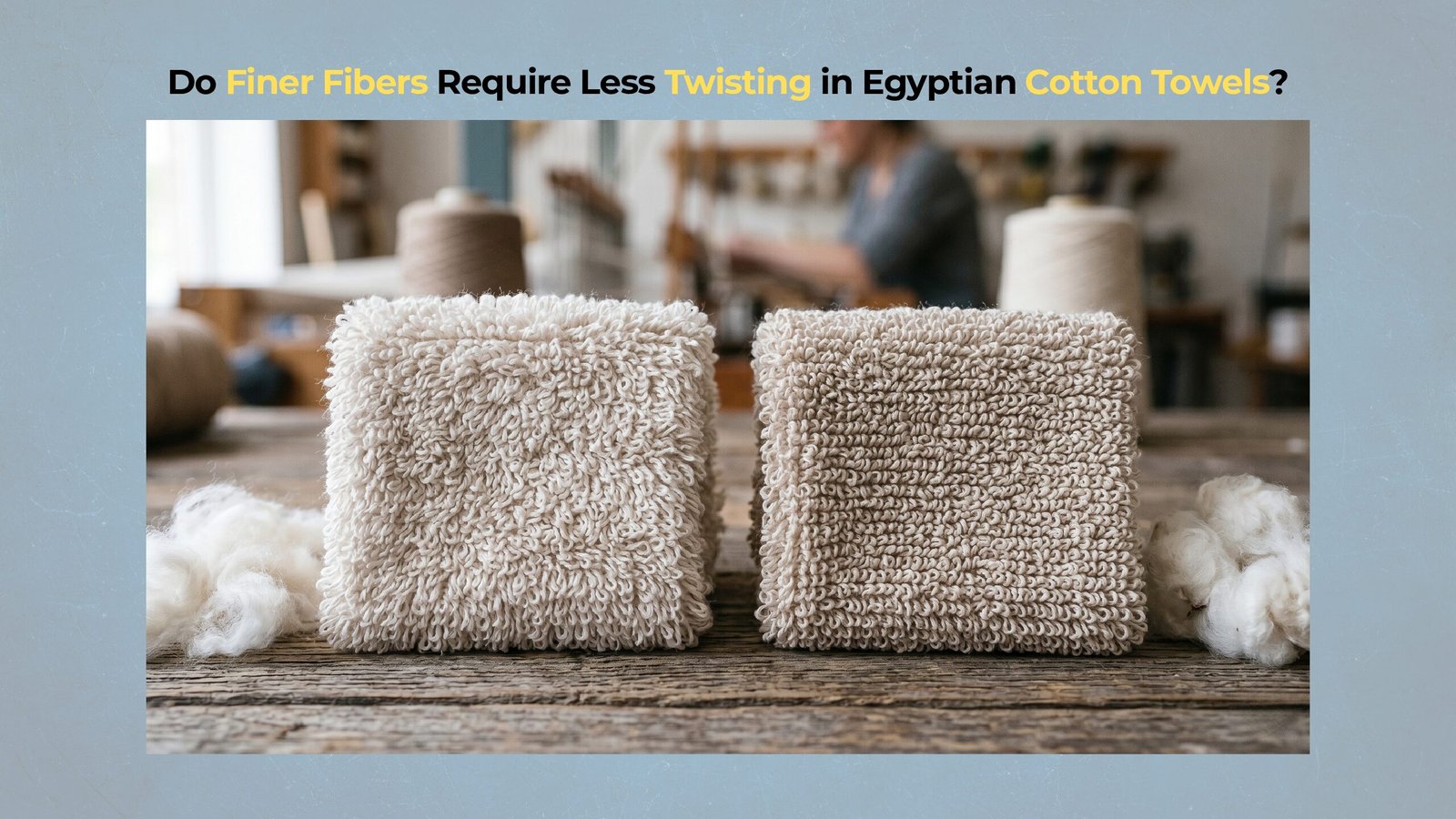
Do Finer Fibers Require Less Twisting in Egyptian Cotton Towels?
Egyptian cotton towel fiber twist reduction results if the textile construction utilizes certified Extra-Long Staple (ELS) fibers that facilitate natural frictional anchorage.
Premium Micronaire values (3.5–4.5) characterize high-grade Giza 45 and Giza 88 staples, allowing manufacturers to reduce Turns Per Inch (TPI) without compromising yarn integrity. This specific fineness ensures a higher density of fiber-to-fiber contact points within the yarn core, effectively distributing tensile loads across the longitudinal axis.
Yarn structural stability persists through the inherent tensile strength of longer staples despite lower rotational density. By leveraging the 1.25–2.0 inch length of Egyptian cotton, engineers produce “low-twist” or “zero-twist” yarns that avoid the tactile rigidity found in high-torsion mass-market products. To understand how this fiber advantage originates at the molecular level, see how extra-long staple fineness enhances Egyptian cotton performance.
Do finer Egyptian cotton fibers require less twisting in Egyptian cotton towel fiber twist?
Egyptian cotton towel fiber twist requirements decrease if fiber staple length exceeds ~1.25 inches and rotational density remains below threshold levels required for yarn cohesion.
A low Micronaire (3.5–4.5) facilitates an increased Surface Contact Area within Giza loop structures. Finer fibers pack more efficiently into a cylindrical yarn geometry, which generates higher internal friction at lower Turns Per Meter (TPM) compared to coarser, shorter fibers. This structural efficiency directly contributes to how Egyptian cotton absorbency mechanisms function at the fiber level.
Low-twist ELS yarns achieve significantly lower bending stiffness and higher volumetric recovery than high-twist Upland cotton. The reduction in torsional stress prevents the compaction of the fiber lumen, maintaining the “air pockets” essential for high-speed moisture absorption and plushness. If you’re comparing softness outcomes, this directly connects to how fiber structure influences Egyptian cotton softness.
Technical Definition: Turns Per Inch (TPI)
Turns Per Inch (TPI) represents the number of full rotations applied to a one-inch length of yarn during the spinning process. In Egyptian cotton towel fiber twist engineering, a lower TPI indicates a softer, more absorbent yarn facilitated by the natural anchorage of Extra-Long Staple fibers.
Does staple length influence Egyptian cotton towel fiber twist thresholds?
Egyptian cotton towel fiber twist thresholds correlate with staple length if longer fibers provide sufficient overlap to inhibit yarn slippage. Research published in the Textile Research Journal, “Effect of Staple Length on Yarn Strength and Twist Efficiency” (2019), confirms a 20–40% reduction in required TPI under controlled spinning conditions for ELS fibers. This efficiency stems from the Staple Anchorage Friction Model (descriptive model), where longer overlap zones amplify the mechanical bond between fibers, reducing the necessity for high rotational compression.
Why does fiber length determine Egyptian cotton towel fiber twist levels?
Egyptian cotton towel fiber twist minimization results if Extra-Long Staple (ELS) length facilitates maximum fiber-to-fiber overlap during the spinning phase.
The Overlap Friction Threshold dictates that 1.5-inch staples require significantly reduced TPM ranges relative to Giza yarn counts. This mechanical advantage allows the yarn to remain “open,” facilitating the entrance of water molecules into the capillary channels between individual fibers. This is especially important when evaluating how density impacts absorbency in Egyptian cotton towels.
Manufacturing engineers achieve low flexural rigidity when rotational density remains below the compaction threshold for Giza 88 yarns. High-twist yarns, by contrast, lock fibers in a rigid spiral, which increases the force required to bend the towel loops, resulting in a “scratchy” or stiff texture after repeated laundering.
How does Egyptian cotton towel fiber twist differ from regular cotton towels?
Egyptian cotton towel fiber twist levels remain lower than standard cotton if Giza-grade staples replace carded Upland fibers and short-staple fibers require increased torsion density to maintain yarn cohesion.
Standard cotton towels often fall into the Mechanical Bonding Trap, where high TPI counts exceed the cohesion requirements of ELS staples. This over-twisting is a compensatory measure for shorter fibers (~1.0 inch) which would otherwise shed or disintegrate under the mechanical stress of a towel’s lifecycle. This is a key reason behind why Egyptian cotton outlasts standard cotton towels.
An increased surface friction coefficient develops in 600 GSM towels when rotational density facilitates fiber compaction. While this produces a “strong” yarn, it destroys the longitudinal flexural rigidity required for a plush, spa-quality experience.
Does Egyptian cotton towel fiber twist optimization improve low-twist towel performance?
Egyptian cotton towel fiber twist selection optimizes functional performance if users prioritize loop expansion over commercial laundering longevity.
The Capillary Wicking Expansion occurs when a premium Micronaire (3.5–4.5) facilitates rapid moisture penetration of the core. Because the fibers are not tightly bound by high torsion, they expand upon contact with water, drastically increasing the effective surface area of the towel. For a deeper breakdown, see how Egyptian cotton performs in real-world moisture absorption scenarios.
A 10–15% linting increase (observed during initial laundry cycles in controlled conditions) correlates with zero-twist Giza 88 construction. Users must accept this minor fiber loss as the trade-off for the superior absorbency and “cloud-like” texture that low-torsion engineering provides. To minimize long-term effects, it helps to understand proper washing guidelines for Egyptian cotton towels.
Does yarn torsion influence Egyptian cotton towel fiber twist wicking rates?
Egyptian cotton towel fiber twist levels inversely correlate with wicking speed if high torsion compacts the yarn structure and inhibits moisture transport. According to Cotton Incorporated, “Fiber Properties and Liquid Transport Efficiency in Terry Fabrics” (2020), absorbency increases by 15–25% in low-twist weaves. This is explained by the Porous Lumen Access Model (descriptive model), where uncompressed fibers allow water to utilize the hollow center of the cotton fiber (the lumen) as a primary transport channel.
Which engineering techniques optimize Egyptian cotton towel fiber twist?
Egyptian cotton towel fiber twist optimization results if manufacturers implement combing protocols and PVA (polyvinyl alcohol) wrapping to manage spinning tension.
Water-soluble PVA yarns provide temporary twist relative to Giza construction requirements during weaving. Once the towel undergoes its first industrial wash, the PVA dissolves, leaving behind a “Zero-Twist” loop that maintains its shape solely through the length and fineness of the Egyptian cotton fibers.
Engineering Outcome Matrix for Egyptian Cotton Towel Fiber Twist
| Spinning Technique | Torsional Density | Tactile Result | Functional Performance |
|---|---|---|---|
| Zero-Twist | Lowest (PVA Wrapped) | High Volumetric Recovery | Maximum Absorbency |
| Low-Twist | Reduced (ELS Staples) | Low Bending Stiffness | Balanced Durability |
| Ring-Spun | Standard / High | Increased Friction | Maximum Longevity |
What are the risks of specific Egyptian cotton towel fiber twist structures?
Egyptian cotton towel fiber twist failure precipitates if low-quality staples lack the length required to support the loop integrity of a zero-twist weave.
Loop Disintegration occurs when non-continuous short fibers escape the yarn structure during mechanical agitation. Without enough Turns Per Inch to bind them, short fibers (found in non-certified “Egyptian-style” blends) simply wash away, leading to a thin, balding towel surface.
Higher Micronaire values (>4.5) correlate with increased fiber coarseness. Coarser fibers lack the flexibility required to perform under low-twist conditions, often resulting in Loop integrity failure—where the loops “kink” or collapse, reducing the towel’s ability to dry efficiently.
Which checklist validates Egyptian cotton towel fiber twist quality?
Egyptian cotton towel fiber twist validation succeeds if a definitive care audit verifies the certification of ELS fibers and the absence of loop kinking.
Final Fiber Twist Audit Checklist for Egyptian Cotton Towel Fiber Twist
- ☐ Achievement of maximum wicking occurs if the product label specifies “Low-Twist” or “Zero-Twist” construction.
- ☐ Prevention of fiber shedding results if Giza 88 cotton is certified as 100% Extra-Long Staple (ELS) with a 3.5–4.5 Micronaire range.
- ☐ Maintenance of yarn stability occurs if the combing process removes short-fiber fillers.
- ☐ Inhibition of tactile rigidity results if the twist level remains within reduced TPI ranges relative to yarn count.
- ☐ Preservation of mechanical loft occurs if loops maintain low bending stiffness and high volumetric recovery.
Frequently Asked Questions regarding Egyptian cotton towel fiber twist (PAA)
Does finer cotton require more or less twist?
Egyptian cotton towel fiber twist requirements decrease if fiber length exceeds ~1.25 inches; longer staples naturally facilitate frictional anchorage with fewer rotations.
What is the best twist for Egyptian cotton towels?
Low-twist is the optimal Egyptian cotton towel fiber twist for residential use; this construction maximizes loop expansion and moisture absorption while maintaining structural stability.
How does the conclusion consolidate Egyptian cotton towel fiber twist knowledge?
Consolidating Egyptian cotton towel fiber twist knowledge confirms that the interaction between staple length and rotational density dictates the final tactile and functional performance of the textile. By choosing Giza 45 or Giza 88 staples, consumers leverage the physics of long-staple friction to enjoy towels that are both more absorbent and softer than standard alternatives.
This technical audit reflects our commitment to evidence-based textile transparency and the preservation of Giza-grade performance. Selecting the correct twist level ensures your luxury towels remain a durable and absorbent household asset for years.
Technical Disclaimer
The information provided regarding Egyptian cotton towel fiber twist is based on standard textile engineering principles and laboratory-controlled performance data. Factors such as variations in raw Giza staple harvests, proprietary mill spinning tensions, and diverse home laundering environments may alter the specific absorbency and durability outcomes of low-twist textiles.