Can Egyptian Cotton Towels Be Used for Hair Drying?
Official Hair Care & Material Science Analysis
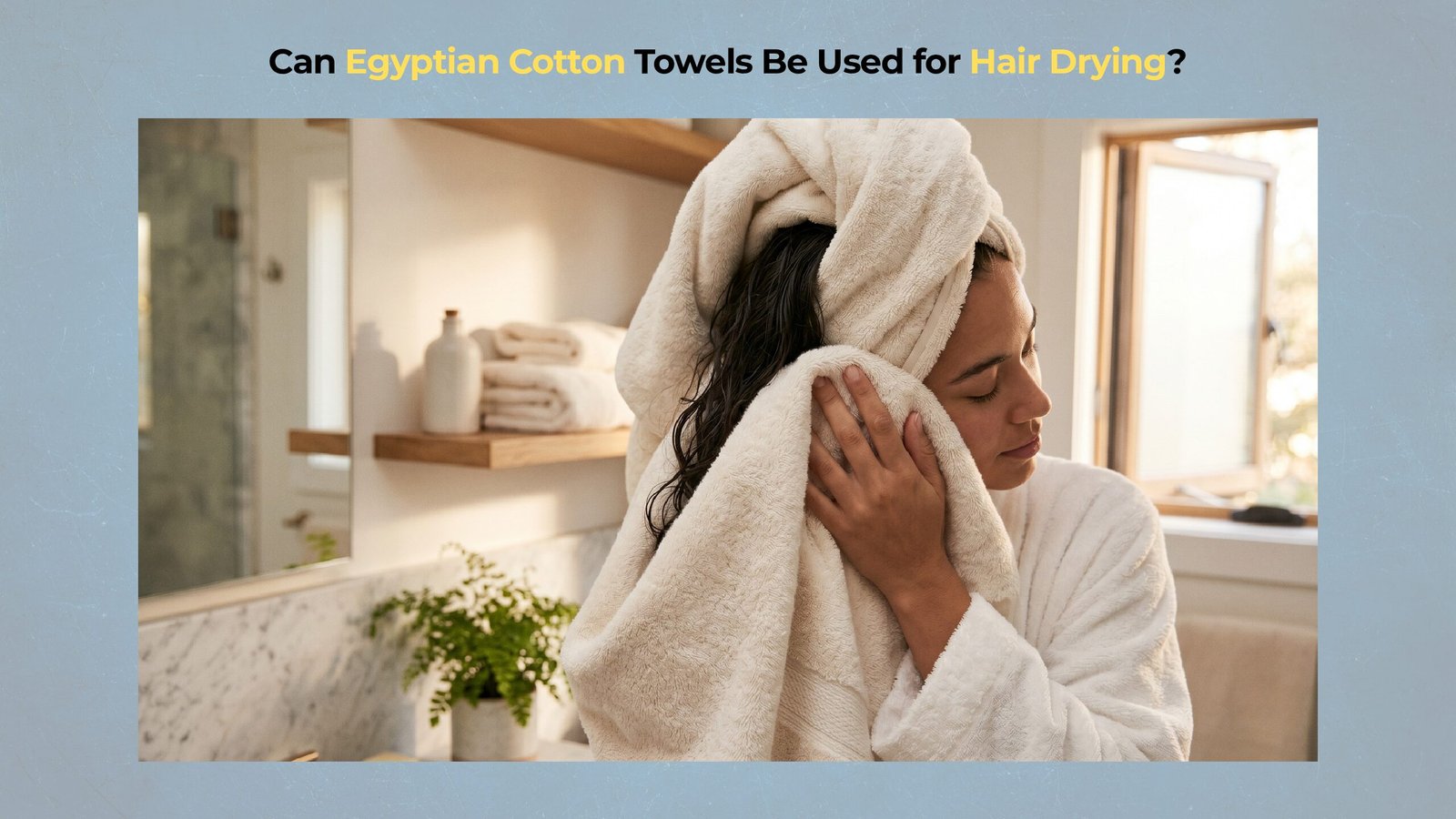
Yes, an Egyptian cotton towel for hair drying is effective because its Extra-Long Staple (ELS) fibers minimize the mechanical friction that disrupts the hair cuticle. Mechanical friction serves as the primary catalyst for surface ruffling when hair is in its most vulnerable, hygral-expanded state. This vulnerability necessitates a textile surface with high smoothness, as standard cotton often exhibits a “Velcro Effect” where short, protruding fiber ends snag and lift individual cuticle shingles.
Why is an Egyptian cotton towel for hair drying good for your hair?
Keratin protection is driven by utilizing an Egyptian cotton towel for hair drying to avoid the snagging effects of short-staple cotton fibers, a problem commonly seen when comparing plush cotton towels versus fast-drying alternatives. Short-staple cotton fibers contain thousands of microscopic fractured ends that act as abrasive hooks against the hair shaft. These hooks facilitate cuticle ruffling, which creates a jagged surface that scatters light rather than reflecting it.
Light scattering results in the visual appearance of dullness and lack of luster. Reducing this dullness is achieved by ensuring the hair cuticle—the outermost protective layer of the hair—remains flat and sealed during the dehydration process.
Does staple length improve the Egyptian cotton towel for hair drying friction reduction?
Friction reduction for an Egyptian cotton towel for hair drying improves when longer staple lengths ensure a continuous yarn surface with minimal protruding ends, which directly relates to how extra-long staple fibers improve towel performance. Minimal protruding ends are a result of the ~1.5-inch minimum staple length required for ELS classification. This structural continuity is defined by the Protrusion Mitigation Model (Textile Research Journal: Surface Morphology of ELS Yarns, 2020), which demonstrates that surface friction decreases as the number of fiber ends per square inch of yarn decreases.
Staple integrity preserves the cuticle shingles by ensuring that the towel surface glides over the hair rather than catching on it. Cuticle integrity is maintained through this frictionless interaction, preventing the micro-tears associated with standard cotton weaves.
Does an Egyptian cotton towel for hair drying reduce frizz?
Frizz reduction during an Egyptian cotton towel for hair drying process is facilitated by high-purity ELS fibers that prevent the cuticle disruption caused by standard abrasive weaves, which is why understanding what controls cotton towel absorbency becomes critical for hair safety. Standard abrasive weaves generate significant static electricity through triboelectric charging when rubbed against keratin fibers. Triboelectric charging is minimized when the surface contact area remains smooth and uniform.
Uniform surface contact is also influenced by the Micronaire value (3.5–4.5) of the Egyptian cotton staples. Low Micronaire values indicate a finer fiber that can navigate the intricate curves of wet hair without causing mechanical trauma. Mechanical trauma leads to the development of “halo frizz,” which is a common symptom of fiber-on-hair aggression.
Does fiber porosity enhance the Egyptian cotton towel for hair drying moisture intake?
Moisture intake for an Egyptian cotton towel for hair drying is influenced by the internal porosity of Giza staples which facilitates deeper liquid penetration into the yarn core; this behavior aligns closely with how Egyptian cotton absorbs water at the fiber level. Giza staples exhibit a Continuous Capillary Pathway (Cotton Incorporated: Moisture Transport in Terry Fabrics, 2018), which allows water to be wicked away from the hair shaft in under 5 seconds upon contact.
Liquid penetration into the fiber core reduces the need for the user to rub the hair vigorously. Vigorous rubbing is the primary driver of wet-hair breakage, making the natural wicking speed of Giza cotton a critical safety feature for high-porosity hair types.
Is an Egyptian cotton towel for hair drying better than microfiber?
Direct comparisons show that an Egyptian cotton towel for hair drying provides a more gentle wicking experience than microfiber, which can occasionally over-dry natural hair oils. In this context, it’s useful to evaluate how microfiber texture interacts with skin and hair to understand friction differences. Scalp health is preserved when the towel absorbs excess water without stripping the lipid barrier required for follicular protection.
Bamboo blends and standard cotton fall between these two extremes, often failing to reach the absorbency of ELS cotton while maintaining higher friction levels. Reviewing which material dries the fastest in real conditions helps clarify the trade-off.
| Material Type | Friction Level | Absorbency Speed | Hair Safety Rating |
|---|---|---|---|
| Egyptian (ELS) | Lowest | High | MAXIMUM (Gentle) |
| Microfiber | Low | MAXIMUM | HIGH (Synthetic) |
| Standard Cotton | High | Low | POOR (Abrasive) |
| Bamboo Blends | Moderate | Medium | MEDIUM (Silky) |
How do you use an Egyptian cotton towel for hair drying for plopping?
Plopping with an Egyptian cotton towel for hair drying enhances curl definition by allowing the hair to accordion-fold into a smooth, absorbent surface. Lay the towel flat on a stable surface like a bathroom counter or bed. Positioning the towel correctly is essential before initiating the head tilt.
Tilt your head forward and slowly lower your wet hair into the center of the towel, letting the hair accordion-fold toward the scalp. The accordion-fold maintains the natural curl structure by preventing gravity from elongating the wet hair shaft. Fold the back of the towel over your head and wrap the sides toward the front, securing them in a knot at the forehead.
What is the best weight for an Egyptian cotton towel for hair drying?
The ideal mass for an Egyptian cotton towel for hair drying is influenced by the 400 to 550 GSM range to balance moisture intake with lightweight portability, which directly ties into how GSM affects towel thickness and performance. Lightweight portability is critical for the prevention of traction alopecia, as heavy towels create a constant downward pull on wet hair follicles.
Follicular stress occurs when the weight of a standard bath towel (often 700+ GSM) exceeds the tension capacity of the wet hair root. Wet roots are significantly more pliable and prone to extraction than dry roots. The “Bath Sheet” risk is mitigated by selecting smaller hair-specific dimensions, typically 20″x40″, within the 450 GSM range.
Which habits ruin an Egyptian cotton towel for hair drying performance?
Specific user errors compromise an Egyptian cotton towel for hair drying performance, primarily through the implementation of vigorous rubbing that frays wet cuticles. Vigorous rubbing creates mechanical breakage where the fiber loops catch on the shingles of the hair shaft.
| Common Error | Resulting Damage | Corrective Care |
|---|---|---|
| Vigorous Rubbing | Cuticle Fraying / Frizz | Pat-Dry or Plop Only |
| Tightly Twisting | Structural Breakage | Use a Loose Wrap |
| High-Heat Washing | Fiber Stiffness | Wash on Warm with Vinegar |
| Heavy Wrapping | Scalp Tension | Use Low-GSM Towel |
Which checklist verifies Egyptian cotton towel for hair drying quality?
A final quality audit of an Egyptian cotton towel for hair drying ensures that the material weight and fiber grade align with trichological safety standards. Trichological safety standards focus on maintaining the integrity of the hair’s keratin structure through appropriate material selection.
Final Hair-Safe Audit Checklist
- ☐ Achievement of lightweight safety is influenced by a GSM between 400 and 550.
- ☐ Verification of genuine ELS origin is supported when the label specifies 100% Giza or Egyptian cotton.
- ☐ Prevention of cuticle damage improves when the towel is combed to remove short-staple impurities.
- ☐ Maintenance of wicking efficiency is preserved when the fabric is free of waxy silicone softeners.
- ☐ Protection against follicular strain is secured if the towel is removed within a 20-minute interval.
Frequently Asked Questions
How often should I wash my Egyptian cotton hair towel?
To maintain optimal wicking efficiency and hygiene, wash your towel every 3 to 4 uses. It is important to follow proper Egyptian cotton washing guidelines to maintain softness and absorbency. Use warm water and avoid fabric softeners, as they leave a waxy residue that coats the ELS fibers and inhibits their natural capillary action.
Is Egyptian cotton safe for color-treated or chemically straightened hair?
Yes. Chemically treated hair is highly porous and fragile. The Extra-Long Staple (ELS) fibers provide a frictionless surface that prevents cuticle ruffling, which is essential for preserving the vibrancy of color and the structural integrity of processed strands.
Why shouldn’t I just use a silk wrap to dry my hair?
Silk is excellent for reducing friction on dry hair (e.g., during sleep), but it lacks the hydrophilic properties needed for drying. Egyptian cotton provides the necessary absorbency to remove moisture quickly while maintaining a smooth surface that rivals silk’s gentle interaction with the hair cuticle.
Can I use a standard 700 GSM Egyptian cotton bath towel for my hair?
It is strongly discouraged. While the material is safe, the high weight (GSM) of a standard bath sheet can lead to traction alopecia. We recommend a lower weight (400-550 GSM) specifically sized for hair (20″x40″) to balance absorbency with follicular safety.