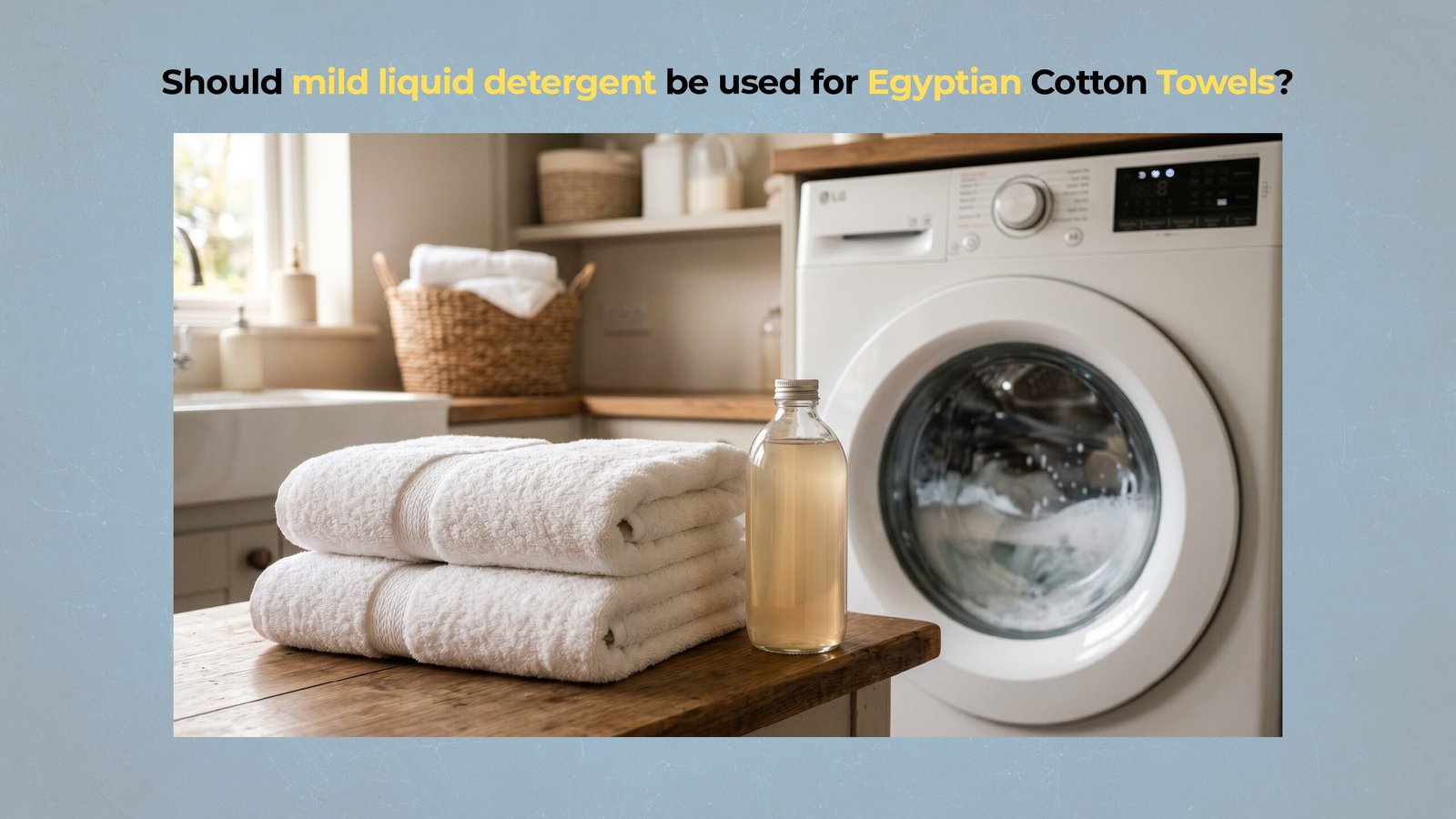
Should mild liquid detergent be used for Egyptian Cotton Towels?
Strategic textile care protocol for Giza ELS fibers
Laundering Egyptian cotton towels effectively necessitates the utilization of a pH-neutral Egyptian cotton towel detergent to prevent the accumulation of mineral residues and preserve the structural integrity of Extra-Long Staple (ELS) fibers.
Extra-Long Staple (ELS) fibers feature a high surface fiber density that allows for extreme water absorption, yet this same morphology makes them susceptible to chemical entrapment. Utilizing a mild liquid Egyptian cotton towel detergent ensures that the cleansing agents remain fully suspended in solution, allowing for a clean rinse that preserves the natural luster of Giza varieties.
How does the choice of Egyptian cotton towel detergent protect fiber integrity?
Selecting the appropriate Egyptian cotton towel detergent safeguards fiber integrity by employing non-ionic surfactants that facilitate soil suspension while following established Egyptian cotton washing guidelines to protect Giza cotton fibers from lipid-stripping.
Natural lipid-based coatings act as a protective barrier that maintains the inherent softness and flexibility of the cellulose structure. High-alkaline cleansers catalyze the removal of these protective waxes, leading to increased fiber stiffness and reduced yarn hairiness, which ultimately diminishes the tactile luxury of the textile.
Technical Definition
Micelle formation: The process by which surfactant molecules aggregate into spherical structures to encapsulate hydrophobic soils, allowing them to be rinsed away in an aqueous environment.
Why is a gentle chemical approach required for Egyptian cotton towel detergent?
A gentle chemical approach is mandatory for Egyptian cotton towel detergent because the high porosity of Giza cotton fibers (such as Giza 45) permits deeper surfactant penetration compared to standard upland cotton.
Deeper surfactant penetration requires a formula that prioritizes rinse efficiency to avoid the detergent residue stiffness buildup often caused by chemical retention. When residues are trapped within the dense loops of a high-GSM Giza 45 towel, the resulting crystallization of salts can lead to permanent fiber abrasion during use.
Why should you select a mild liquid soap to maintain Egyptian cotton towel absorbency?
Choosing a mild liquid Egyptian cotton towel detergent maintains absorbency by ensuring total solubility in warm water, a factor that prevents the deposition of insoluble grains within the cotton loops.
Insoluble grains originate from powder fillers and undissolved surfactants that wedge themselves between the micro-fibrils of the yarn. Implementing consistent mineral buildup removal techniques helps eliminate these blockages, ensuring the hydrophilic capacity of the towel is not compromised.
Technical Definition
Surfactant residue: The non-volatile chemical compounds that remain on textile fibers post-rinse, often leading to hydrophobic barriers and reduced wetting speeds.
How do various types of Egyptian cotton towel detergent compare in performance?
A comparison of various Egyptian cotton towel detergent formats reveals that non-ionic liquid cleansers offer superior fiber preservation over standard high-alkaline powders.
| Detergent Format | pH Profile | Residue Risk | Fiber Integrity Impact |
|---|---|---|---|
| Mild Liquid | Neutral (pH 7.0) | Low (Total Solubility) | Maximum Preservation |
| Standard Powder | Alkaline (pH 9.0+) | High (Insoluble Grains) | Performance Degradation |
| Standard Pods | Concentrated | Moderate (Rinse Issues) | Gradual Weakening |
What is the optimal dosage for your Egyptian cotton towel detergent?
The optimal dosage for your Egyptian cotton towel detergent is generally restricted to half of the manufacturer’s recommendation to ensure maximum rinse efficiency and inhibit surfactant accumulation.
Proper post-wash care is equally important; for instance, avoiding high heat drying damage and instead utilizing safe tumble drying methods will maintain the long-term fiber loft of your ELS towels.
Technical Definition
Hydrophilic capacity: The measure of a textile’s ability to attract, absorb, and hold water molecules within its fiber matrix.
Which chemicals degrade Egyptian cotton towel detergent performance?
Specific chemical additives degrade Egyptian cotton towel detergent performance, primarily through the inclusion of optical brighteners and chlorine-based bleaching agents that catalyze cellulose structural weakening.
Chemical additives can also affect performance; for example, fabric softener absorbency impact agents reduce hydrophilic efficiency by coating fiber surfaces in a hydrophobic wax film.
Harsh bleaching agents should also be avoided due to bleach fiber weakening effects that damage cellulose structure over time and lead to premature fraying of the terry loops.
| Chemical Additive | Mechanism of Action | Long-Term Durability Result |
|---|---|---|
| Chlorine Bleach | Oxidative stress on cellulose | Gradual cellulose degradation |
| Liquid Softeners | Hydrophobic wax coating | Irreversible loss of absorbency |
| Optical Brighteners | UV-reflective film buildup | Accelerated fiber weakening |
How can you verify Egyptian cotton towel detergent safety before use?
Verifying Egyptian cotton towel detergent safety requires a rigorous audit of the ingredient list to confirm the exclusion of synthetic pigments, UV-brighteners, and silicone-based additives.
Finally, correct storage practices such as folding loft preservation methods help maintain towel softness and long-term usability by preventing permanent fiber compression.
Final Quality-Control Checklist for Egyptian Cotton Towel Detergent
- ☐ The detergent label must explicitly state “pH Neutral” (pH 7.0) or “Mild” formula.
- ☐ The surfactant profile must be free of optical brighteners and synthetic fragrances.
- ☐ The cleanser format must be liquid to ensure total solubility in warm water.
- ☐ The ingredient list must exclude silicone-based additives or built-in softeners.
- ☐ The formula must be free of chlorine or oxygen-based bleaching agents.
Frequently Asked Questions (PAA)
Can I use standard detergent on Egyptian cotton towels?
No, standard detergents are too alkaline and cause fiber brittleness. They often contain harsh surfactants that strip the protective lipids necessary for Maintaining ELS fiber softness.
Is baby detergent safe for Egyptian cotton towels?
Yes, most baby detergents are pH-neutral and mild enough for ELS fibers. These formulas typically avoid optical brighteners and harsh enzymes that degrade high-GSM Giza cotton.
Scientific & Legal Disclaimer
The information provided is for educational purposes based on general textile engineering principles. Results may vary depending on local water hardness levels, specific machine drum types, and individual towel manufacturer technical specifications. Always test a small inconspicuous area before applying a new laundering protocol to high-value Giza cotton textiles.