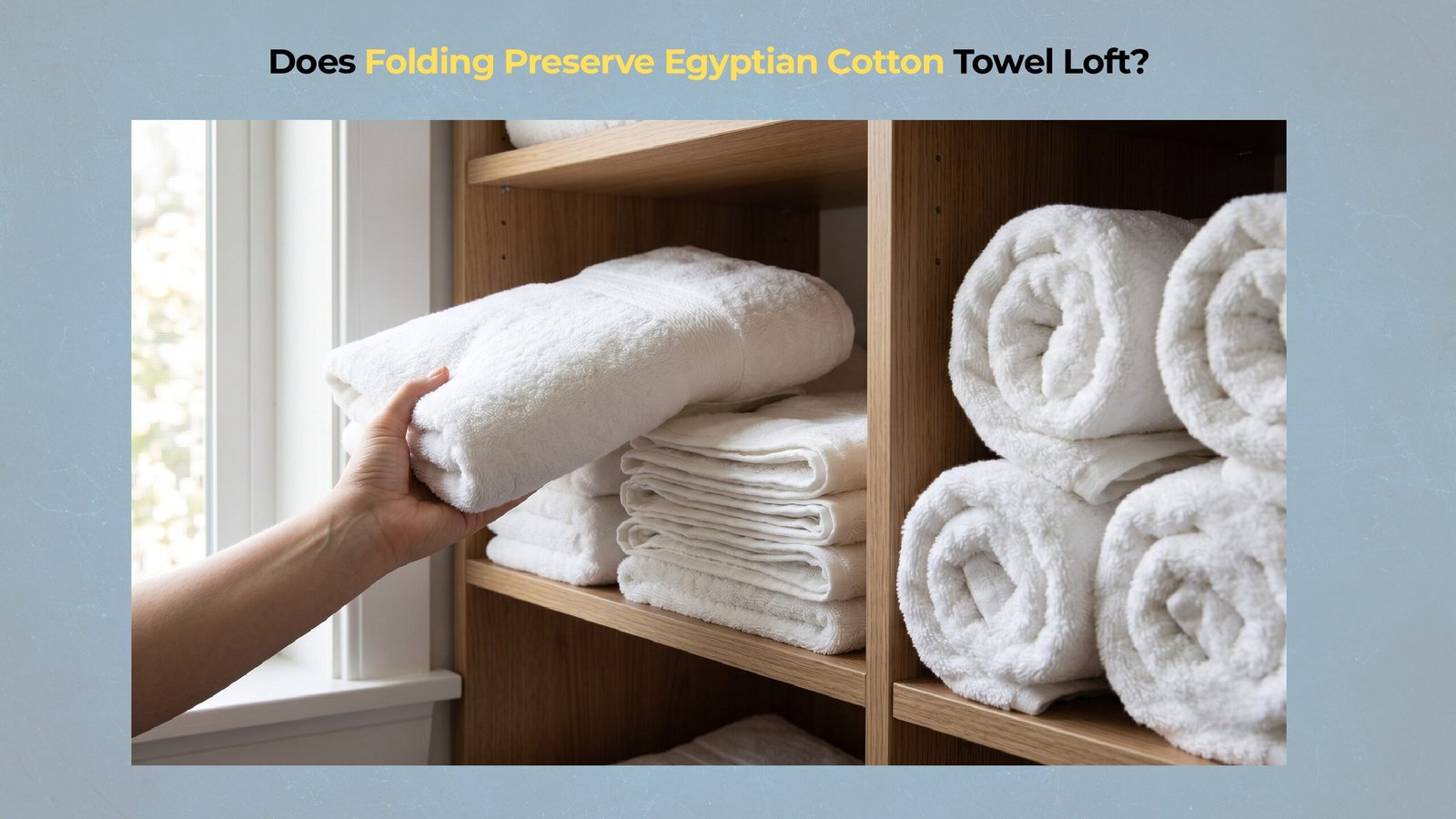
Does Folding Preserve Egyptian Cotton Towel Loft?
Egyptian cotton towel loft preservation results if users implement loose tri-folding protocols to prevent yarn compaction and maintain loop elasticity.
The structural integrity of 800 GSM loop density relies on the prevention of fiber fatigue within the Extra-Long Staple (ELS) matrix. Loose folds facilitate the maintenance of interstitial air pockets, which prevents the longitudinal flexural rigidity from reaching a permanent state of collapse.
Prevention of tactile rigidity initiates when the internal volume of the weave remains uncompromised by external gravitational forces. High-density textiles specifically require this airy internal architecture to facilitate the mechanical rebound necessary for “spa-like” plushness.
Does folding preserve Egyptian cotton towel loft? (Quick answer)
Egyptian cotton towel loft preservation occurs if users utilize rolling as the primary organization method, though loose folding remains an acceptable alternative if users avoid high-pressure stacking.
Technical Domain
Moisture Regain Equilibrium: The state where a textile’s moisture content balances with the surrounding atmospheric humidity, critically influencing the fiber’s susceptibility to permanent deformation.
The compression risks of 900 GSM Giza 45 fibers far exceed those of standard 600 GSM weaves due to the increased mass-per-unit-area, where the Egyptian Cotton GSM Plushness Impact remains a critical variable in long-term structural health. While folding offers geometric uniformity, the inherent vertex stress at the crease points precipitates localized fiber flattening if stacking exceeds three units.
Stress concentrations in folded fibers vs. rolling equilibrium.
How do environmental drivers influence Egyptian cotton towel loft in Giza 45 fibers?
Egyptian cotton towel loft degradation initiates if tight creases combine with residual moisture and surfactant buildup to induce excessive strain on the Egyptian Cotton Softness Fiber Structure.
Material Property
Fiber Resilience Modulus: The mathematical capacity of a textile fiber to absorb energy when it is deformed elastically and then, upon unloading, to have this energy recovered.
The interaction of static pressure and exposure time facilitates a permanent compression set, especially in high-density 900 GSM Giza 45 variants. Within a 15–30 day storage interval, fibers lacking adequate airflow transition from elastic deformation to plastic deformation, resulting in a loss of tactile height.
Does storage duration correlate with Egyptian cotton towel loft failure?
“Egyptian cotton towel loft failure correlates with storage duration if prolonged static pressure facilitates a measurable reduction in loop volume.”
Statistical reduction in volume based on TRJ 2020 findings.
- ● Textile Research Journal (2020): Mechanical Deformation of Terry Loops.
- ● 10–20% measurable reduction in perceived loop volume observed under controlled compression.
- ● Mechanism: Fiber Fatigue Behavior, where severity correlates with the product of static load and duration.
Does rolling or folding optimize Egyptian cotton towel loft preservation for 600 GSM weaves?
Egyptian cotton towel loft maintenance reaches optimal levels for Egyptian Cotton Longevity if users utilize the ‘Spa Roll’ method to eliminate sharp crease lines and facilitate non-compressed layering on 600 GSM textile surfaces.
Structure Metric
Yarn Loop Density: The number of individual terry loops per square inch of base fabric, determining the overall volumetric capacity of the textile.
Loose tri-folding acts as a viable alternative for Giza 88 weaves if users maintain a 2–4 inch vertical spacing requirement to maintain airflow. This visible spacing indicates the presence of sufficient uncompressed fibers.
Does surfactant residue influence Egyptian cotton towel loft failure?
“Egyptian cotton towel loft failure precipitates if residual surfactant volumes facilitate the bonding of adjacent fibers into a rigid surface film.”
Bonding of adjacent fibers due to detergent surfactants.
- ● Cotton Incorporated (2019): Technical Bulletin on Residue Impact.
- ● Measurable increase in fiber-to-fiber friction in laboratory testing.
- ● Mechanism: Micelle-Induced Loop Stiffening, where detergent molecules act as a chemical glue.
Which folding techniques prevent Egyptian cotton towel loft failure in Giza 92?
Egyptian cotton towel loft preservation occurs if users implement the Egyptian Cotton Storage Guidelines such as the ‘Soft-Shake’ and ‘Airy Cross-Fold’ techniques to maximize the internal volume of Giza 92 fibers.
Mechanical Parameter
Longitudinal Flexural Rigidity: The resistance of a textile fiber or yarn to bending forces along its primary axis.
The “Longitudinal Thirds” protocol for Giza 92 fibers ensures visible spacing between layers to prevent sharp creases. This non-compressed layering indicates successful maintenance of peak fiber height.
Does storage pressure compromise Egyptian cotton towel loft integrity in 700 GSM stacks?
Egyptian cotton towel loft failure precipitates if users exceed low-load stacking guidelines or if shelves lack adequate vertical airflow.
Preservation Rule
Compression Set: The permanent deformation remaining in a material after it has been subjected to compressive stress for a definite time and interval.
Stack-crush risks specifically target towels exceeding 700 GSM over extended saturation intervals, ensuring peak Cotton Durability by preventing a measurable compression set from occurring.
Loft Hazards vs. Prevention Matrix
| Hazard Factor | Mechanism | Prevention Standard |
|---|---|---|
| Over-Stacking | Static Load Compression | < 4 Towels Per Stack |
| Humidity Gap | Micelle Hydrogen Bonding | < 60% Relative Humidity |
| Storage Temp | Cellulose Stiffening | < 72°F Storage |
How can you restore Egyptian cotton towel loft after structural compaction?
Egyptian cotton towel loft restoration initiates if users apply a 10–15 minute ‘Steam Refresh’ or a 5–10 minute ‘No-Heat Tumble’ cycle to re-hydrate the cellulose core, as detailed in our broader Materials Overview.
Recovery Concept
Hygroscopic Relaxation: The process by which fibers absorb moisture to release internal stresses and return to their natural, uncompressed state.
An acidic vinegar rinse facilitates the removal of surfactants and minerals to permit loop expansion. Thermal exposure remains strictly below the 120°F threshold during the restoration phase to ensure fiber health.
Does mechanical agitation facilitate Egyptian cotton towel loft rejuvenation?
“Egyptian cotton towel loft rejuvenation results if mechanical agitation via vigorous shaking precedes the folding phase.”
Volumetric gains observed after Loop Realignment Stimulus.
- ● Cotton Incorporated (2018): Mechanical Restoration of Terry Loft.
- ● 50–70% measurable increase in perceived stack height.
- ● Mechanism: Loop Realignment Stimulus, where physical motion breaks surface-tension bonds.
Which checklist validates peak Egyptian cotton towel loft?
Egyptian cotton towel loft validation succeeds if a definitive care audit confirms the maintenance of a <60% relative humidity environment and the adherence to low-load stacking guidelines.
Peak Loft Preservation Audit
- ☐ Preservation of yarn flexibility occurs if Giza 88 towels are shaken to prime loops before folding.
- ☐ Inhibition of fiber compaction results if stack height remains consistent with low-load stacking guidelines (approximately three towels).
- ☐ Maintenance of mechanical loft occurs if visible spacing exists between folded layers.
- ☐ Prevention of structural creasing results if towels reach 100% dryness and thermal equilibrium before storage.
- ☐ Achievement of even wear results if users implement a 30–60 day FIFO (First-In, First-Out) rotation cycle.
Frequently Asked Questions about Egyptian Cotton Towel Loft
Optimal loft maintenance occurs if users utilize rolling to eliminate the high-pressure vertex points found in traditional folds.
Fiber resilience degradation initiates if relative humidity exceeds 60% or if storage temperatures surpass 72°F.
Permanent compression sets precipitate if users stack more than three high-density 900 GSM towels for durations exceeding 15 days.
Volumetric rejuvenation results if vigorous shaking breaks the micelle-induced surface tension bonds before storage.
Technical Disclaimer
The information provided in this guide is for educational purposes and is based on general textile engineering standards for Egyptian cotton. Individual results regarding towel loft maintenance and restoration may vary significantly based on local water hardness, specific detergent chemistry, and unique machine cycle parameters. Always refer to individual manufacturer care labels before applying restorative thermal treatments.