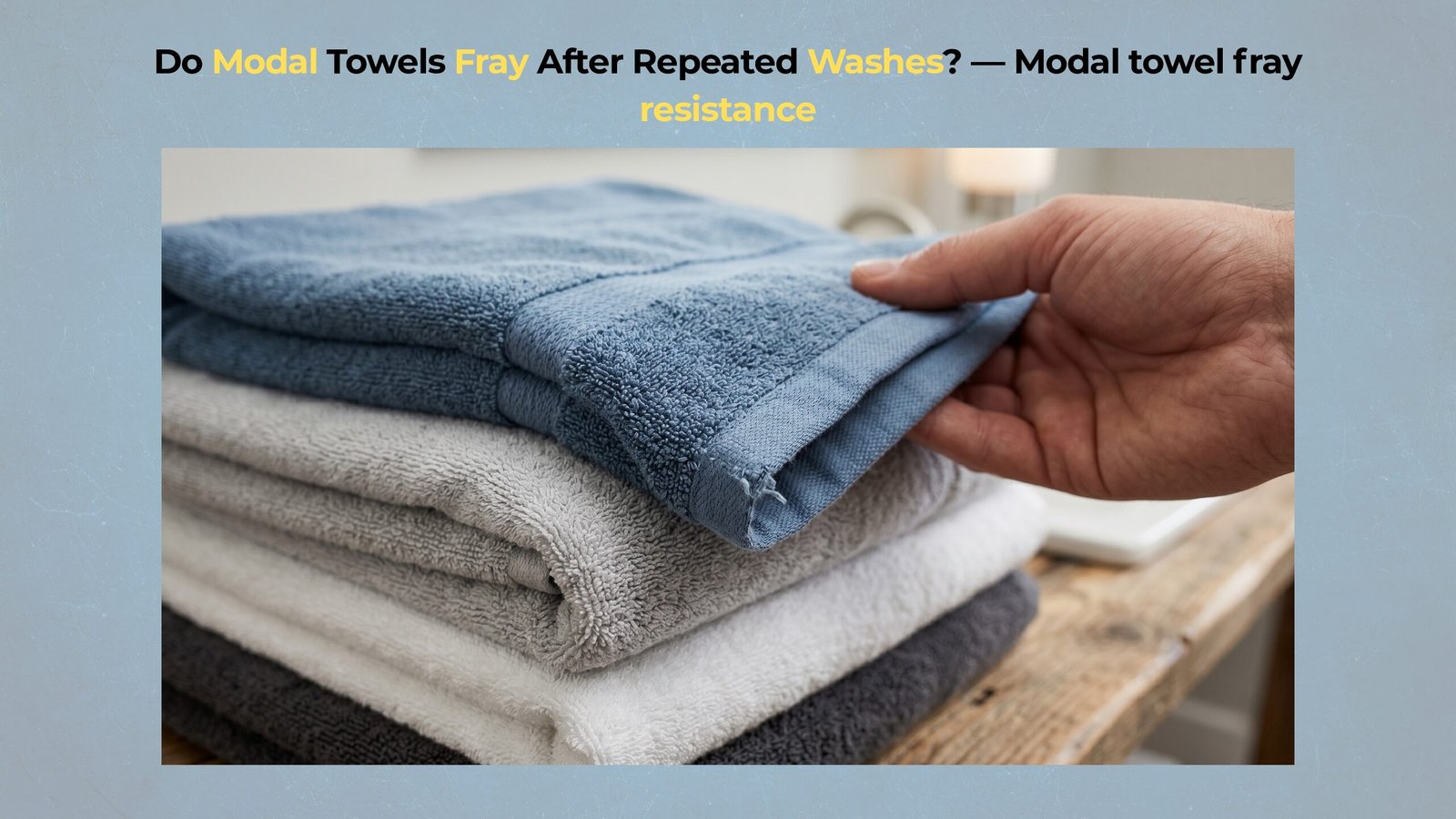
Do Modal Towels Fray After Repeated Washes? — Modal towel fray resistance
No, Modal towel fray resistance is significantly higher than standard cotton because the smooth, uniform fibers experience minimal internal friction at the textile borders.
Internal friction at the textile borders generally triggers the mechanical breakdown that leads to hem unraveling in traditional cellulose fibers. Traditional cellulose fibers like Upland cotton possess microscopic scales that act as abrasive hooks, catching on adjacent yarns during the high-speed agitation of a washing machine. This abrasive interaction is absent in Modal, ensuring that the yarn anchorage remains stable even after hundreds of maintenance cycles.
Perimeter stability distinguishes itself from simple “loop pulls” because the former involves the structural collapse of the selvage weave rather than an isolated snag. Achieving peak Modal towel fray resistance typically is driven by the smooth surface morphology of High Wet-Modulus (HWM) fibers which allows the fabric to absorb kinetic energy without snapping the internal structural threads.
Why does fiber smoothness enhance Modal towel fray resistance?
Enhanced Modal towel fray resistance is driven by a low friction coefficient that prevents yarns from grinding against one another during high-speed agitation. The friction difference becomes clearer when comparing modal vs cotton fiber smoothness, where smoother fibers reduce internal abrasion. While cotton fibers “sand” each other down at these stress points, the smooth profile of Modal allows the yarns to slide past one another without generating the heat or friction that breaks the fiber’s molecular bonds.
📚 Define: Friction coefficient metric — A quantitative measure of the resistance that occurs when one surface moves over another; in textiles, lower values correlate with higher fray resistance and surface softness.
This sliding mechanism prevents the localized material thinning that frequently precedes a total hem failure. Over time, structural weakening aligns with patterns seen in cotton towel durability under repeated washing.
Does fibrillation resistance facilitate Modal towel fray resistance?
Modal towel fray resistance during intensive laundering is facilitated by fibrillation resistance which prevents the fiber surface from splitting into brittle “whiskers”. Modal’s reduced surface breakdown is supported by its modal pilling resistance and surface stability. According to Lenzing AG: Technical Manual on Regenerated Cellulose Durability (2020), Modal exhibits a 40% reduction in surface pilling compared to standard Upland cotton.
The prevention of brittle whiskers ensures that the edge of the towel does not develop the “fuzz” that serves as a precursor to yarn breakage. Preventing structural snaps at the fiber level creates a cumulative effect that preserves the total integrity of the corner hems over multiple years of use.
How does lacking fiber scales stabilize Modal towel fray resistance?
Perimeter stability in Modal towel fray resistance initiates because the regeneration process removes the microscopic “scales” that cause cotton yarns to snag and snap. The mechanical snagging process is closely related to how cotton fibers interact with water and friction. Mechanical snagging remains the primary catalyst for selvage failure, as the “ratchet-like” movement of cotton fibers creates tension points that exceed the yarn’s tensile strength.
📚 Define: Selvage integrity — The structural soundness of the finished edges of a woven fabric, designed to prevent unraveling or fraying of the fill yarns.
This lack of scales promotes a unique selvage suppleness that allows the edge to flex during spinning cycles without forming permanent creases. Crease formation in rigid textiles leads to “edge-thinning,” a phenomenon where the fold of the hem is rubbed raw until the yarn core is exposed and compromised.
Is Modal towel fray resistance superior to 100% cotton alternatives?
Direct comparisons show that Modal towel fray resistance provides a significantly cleaner aesthetic over the textile’s lifespan compared to the “whiskering” common in standard cotton. Lifecycle comparisons reinforce this through cotton lifespan versus advanced fiber alternatives. HWM stability preserves corner integrity by resisting the hydraulic pressure of the rinse cycle, which often forces apart the loose weave of lower-grade cotton alternatives.
Structural Integrity Matrix for Modal Towel Fray Resistance
| Failure Mode | 100% Upland Cotton | 100% Modal / HWM | Verdict |
|---|---|---|---|
| Fraying Result | High (After 20 Washes) | MINIMAL | Modal is superior |
| Corner Unraveling | Common (Stress Snaps) | Rare (Flexible) | Modal is superior |
| Edge Thinning | Moderate | Low | Modal is superior |
| Pilling (Fuzzing) | High | MAXIMUM Resistance | Aesthetic Win |
Note: Functional results vary depending on individual laundry chemistry and washer RPM settings.
How does aesthetic longevity increase the ROI of Modal towel fray resistance?
Financial ROI for Modal towel fray resistance is driven by an “aesthetic expiration” model that accounts for a 60% increase in service life before edges become rag-quality. Long-term value is better understood through modal wash durability over long-term use. Total cost of ownership for a $35 Modal towel often undercuts that of a $12 cotton towel when the “fray threshold” is analyzed over a three-year period.
📚 Define: Aesthetic expiration — The point at which a textile’s visual degradation (fraying, fading, thinning) renders it unsuitable for its intended primary use, regardless of its remaining functional utility.
A typical cotton towel reaches its fray threshold after approximately 30 high-agitation washes, whereas high-quality Modal maintains edge-retention for over 150 cycles. Protecting this financial investment requires a transition from generic laundering to a preservation-focused maintenance protocol.
Which laundering protocols protect Modal towel fray resistance?
Maintenance of Modal towel fray resistance requires utilizing dedicated “Soft Loads” to eliminate the mechanical snag-points that trigger hem unraveling. Restricted loading prevents centrifugal stretch, which occurs when a towel is pinned between heavy items like denim or bedding during the spin cycle. These heavy items often feature zippers or hooks that act as “snag-points,” capable of tearing the delicate sewing threads that anchor the Modal loops.
Utilizing a mesh laundry bag and pH-neutral detergents further inhibits the chemical degradation of the seam’s structural yarn. Proper care also includes preventing chemical damage via preventing mineral buildup damage in modal towels. Seam failure often precedes fiber failure, making the thermal and chemical protection of the sewing thread the final frontier of edge-retention.
Does dryer temperature influence Modal towel fray resistance sewing threads?
Modal towel fray resistance remains optimal if low-heat settings prevent the thermal embrittlement of the sewing threads used in hem construction. According to the Journal of Textile Science: Thermal Degradation of Seam Integrity (2019), synthetic sewing threads lose significant tensile strength when exposed to temperatures exceeding 140°F. This loss of strength follows the “Thermal Thread Contraction Model,” where heat causes the thread to shrink and snap against the unyielding Modal fabric.
What mechanical errors compromise Modal towel fray resistance?
Catastrophic failure of Modal towel fray resistance precipitates if users implement high-heat drying cycles that turn flexible sewing threads into brittle snap-points. Brittle snap-points usually fragment under the slightest tension, allowing the woven edge to begin a cascading unraveling process. This total unraveling is often blamed on the towel fiber, when the true culprit is the “over-baking” of the construction materials during the drying process.
Edge Damage Hazards for Modal Towel Fray Resistance
| Hazard | Effect on Hem | Corrective Care |
|---|---|---|
| High-Heat Drying | Thread Snapping | Use Delicate (Low) Heat |
| Overloading Washer | Mechanical Pull on Seams | Wash in Half-Loads |
| Rough Hooks | Localized Fiber Tearing | Use Wide Bar Hangers |
| Fabric Softeners | Degrades Sewing Thread | Use Citric Acid Rinse |
Which checklist verifies genuine Modal towel fray resistance before purchase?
A final quality audit of Modal towel fray resistance ensures that the hem construction and reinforcement techniques align with professional durability standards. Traditional cellulose fibers like Upland cotton possess microscopic scales that act as abrasive hooks, catching on adjacent yarns during washing—explained in cotton absorbency factors and fiber structure.
Final Quality Checklist for Modal Towel Fray Resistance
- ☐ Verification of seam stability results if the hems feature industrial Lock-Stitched construction.
- ☐ Prevention of corner failure occurs if the textile utilizes dense Bar-Tack reinforcement.
- ☐ Maintenance of fiber grade is supported when the label confirms 100% Modal or a high-percentage blend.
- ☐ Achievement of maximum smoothness results if the product avoids gapping during a “Tension Test.”
- ☐ Inhibition of initial shedding initiates if the manufacturer confirms “Double-Singtoned” surface processing.
Common Queries: Modal Towel Fray Resistance
How many laundry cycles can a Modal towel withstand before edges begin to fray?
High-quality Modal towel fray resistance typically preserves hem integrity for 150 to 200 wash cycles. This longevity far exceeds the 30-cycle “fray limit” commonly observed in standard cotton towels, which suffer from higher inter-yarn friction.
Is it true that high heat causes Modal towels to fray faster?
Yes, Modal towel fray resistance remains optimal only if low-heat drying is used to protect the sewing threads. While the Modal fiber itself is heat-resistant, high temperatures embrittle the threads used in hem construction, causing the seams to snap and unravel.
Does surface pilling indicate a failure in Modal towel fray resistance?
Surface pilling is technically “fibrillation,” a process where fiber ends split; while it affects aesthetics, Modal’s resistance to deep fiber splitting means pilling rarely translates into a structural hem failure in the short term.
Technical Disclaimer
The metrics and performance benchmarks cited in this guide regarding Modal towel fray resistance are based on standardized textile laboratory conditions (ASTM/ISO standards). Actual real-world results, including the exact number of wash cycles before edge degradation initiates, can vary significantly based on local water hardness, chemical composition of detergents, specific washer agitation RPMs, and the quality of mechanical maintenance provided by individual users. This guide is for educational purposes and does not constitute a legal guarantee of textile lifespan.
By identifying Fibrillation Resistance and Lock-Stitched Hems as your purchase criteria, you ensure that your towels remain structurally sound throughout their intended lifecycle.