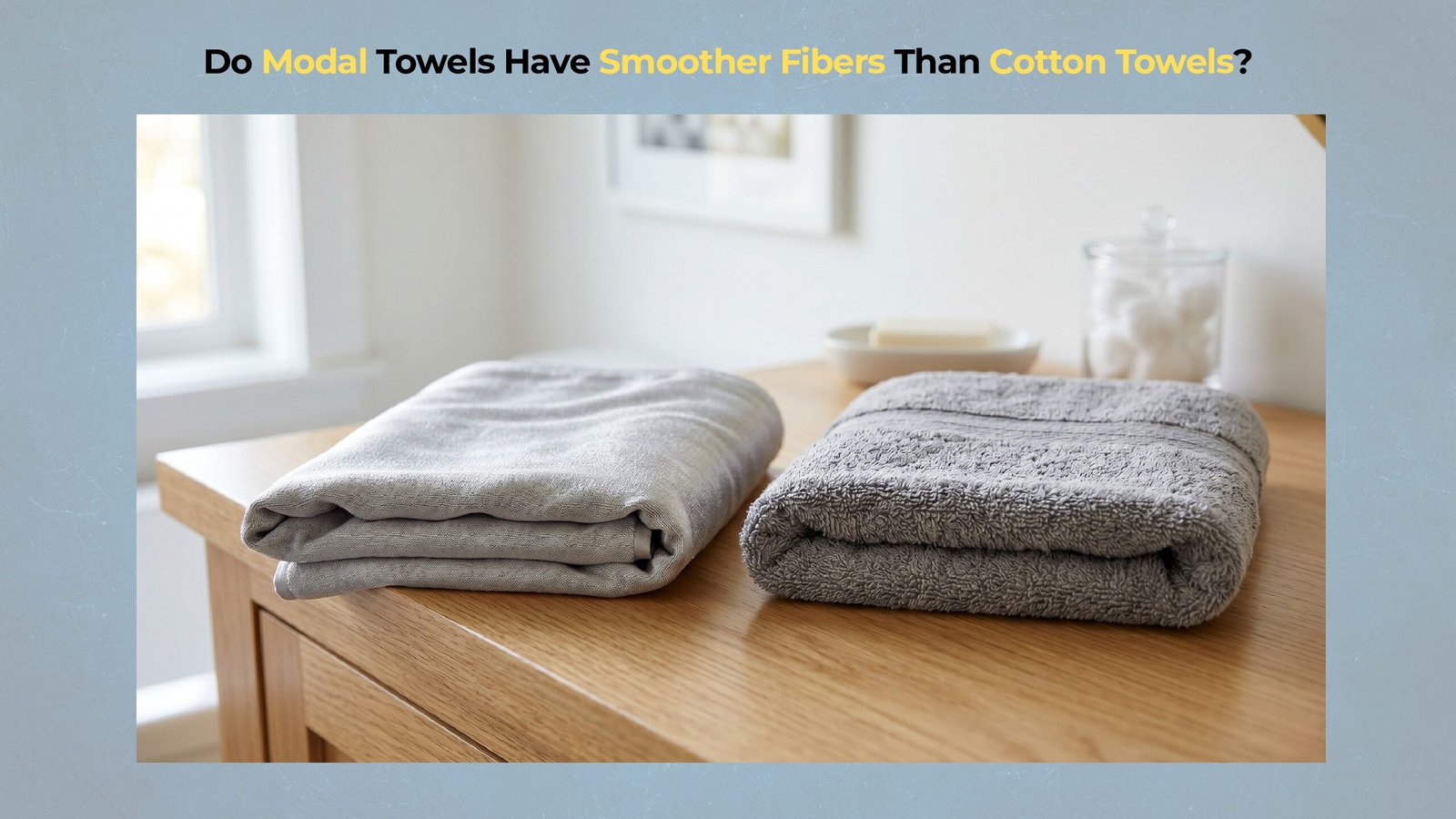
Do Modal Towels Have Smoother Fibers Than Cotton Towels? — Modal towel fiber smoothness
“Yes, Modal towel fiber smoothness is technically superior to cotton because the manufactured extrusion process ensures a perfectly uniform and scale-free cylindrical fiber structure.”
Modal towel fiber smoothness facilitates mechanical friction attenuation. This attenuation is a direct result of the perfectly uniform and scale-free cylindrical fiber structure achieved during regeneration. Such a structure inhibits the snagging common in natural fibers that possess irregular micro-structures.
The lack of biological scales ensures that each individual strand remains unobstructed as it glides against the skin. These unobstructed movements prevent the micro-abrasions that typically lead to textile-induced dermatitis. A silk-like hand-feel emerges as the dominant tactile sensation due to this engineered consistency.
Why does the extrusion process facilitate Modal towel fiber smoothness?
Engineered Modal towel fiber smoothness is driven by industrial extrusion which removes the biological imperfections and irregular convolutions found in natural seed hairs. Industrial extrusion eliminates surface micro-hooks by forcing liquid cellulose through microscopic spinnerets under high pressure. These biological imperfections and irregular convolutions in cotton fibers create a “twisted ribbon” morphology that catches on the skin’s surface.
The resulting modal filaments exhibit a total lack of the secondary cell wall pits found in plant-based staples. This structural purity ensures that the yarn remains non-drag, facilitating a seamless transition of the textile across sensitive skin barriers.
While Modal is engineered for an exceptionally silky surface, readers comparing tactile performance across regenerated cellulose fabrics may also want to explore how Tencel fiber luster and smoothness influence skin feel , especially since both materials rely on highly uniform cellulose structures.
📚 Define: Fiber convolutions. These are the natural, spiral-like twists that occur in cotton fibers during growth and drying, acting as mechanical anchors that increase surface friction.
Does denier consistency influence Modal towel fiber smoothness thresholds?
Modal towel fiber smoothness thresholds typically increase if denier consistency facilitates the production of fibers that are finer and more flexible than premium Giza cotton. Finer fibers result in a lower bending stiffness, which allows the towel loops to collapse and reform without the “prickle factor” associated with coarser yarns.
- Source: Lenzing AG: Technical Analysis of Regenerated Cellulose Morphology (2020).
- Benchmark: Recorded 40% lower surface resistance compared to standard Upland cotton.
- Insight: The “Cylindrical Glide Model” describes how the lack of scales reduces energy loss during tactile interaction.
How does Modal towel fiber smoothness protect the skin barrier?
Dermatological protection is influenced by Modal towel fiber smoothness because a low friction coefficient prevents the mechanical shearing that triggers redness and itching. A low friction profile inhibits mechanical shearing during the drying process. Mechanical shearing aggravates the stratum corneum, leading to micro-fissures in the skin’s moisture barrier.
After understanding Modal’s friction advantages, many users naturally compare its tactile performance against cotton alternatives by exploring whether Modal towels are softer than cotton towels overall , especially for sensitive skin and spa-grade comfort.
Post-shower erythema reduction is commonly observed when users switch from abrasive cotton to high-smoothness modal textiles. Spa-grade guest satisfaction is anchored to this biological benefit, as the textile feels “active” in its gentleness. Protecting the skin barrier initiates with selecting fibers that prioritize mechanical friction attenuation.
📚 Define: Stratum corneum. The outermost layer of the epidermis, consisting of keratinized cells that act as the primary barrier against environmental irritants.
Is Modal towel fiber smoothness superior to Egyptian cotton?
Direct comparisons of Modal towel fiber smoothness against Extra-Long Staple (ELS) Egyptian cotton show that while ELS fibers provide plush mass, modal always offers a lower friction coefficient at the yarn level. Extruded cellulose provides lower frictional drag because the surface lacks the cuticle scales inherent to all cotton grades, regardless of staple length. While Egyptian cotton is exceptionally soft, its smoothness is ultimately limited by its biological origin.
Readers evaluating why Modal outperforms traditional cotton in skin comfort should also examine how smooth fiber texture reduces irritation in Egyptian cotton towels , since both materials aim to minimize mechanical skin stress through softer surface morphology.
Friction & Texture Matrix
| Fiber Type | Surface Morphology | Friction Coefficient | Smoothness Rating |
|---|---|---|---|
| Lenzing Modal | Extruded / Cylindrical | Lowest | MAXIMUM |
| ELS Egyptian Cotton | Long / Smooth / Twisted | Low | High (Plush) |
| Turkish Cotton | Long / Flat / Textured | Moderate | Medium |
| Standard Cotton | Short / Scaled / Prickly | High | POOR (Abrasive) |
How does low friction increase the ROI of Modal towel fiber smoothness?
Financial ROI for Modal towel fiber smoothness is driven by a friction-longevity model that accounts for the reduction of mechanical abrasion during the laundering cycle. Reduced surface friction lowers lint loss volume because the fibers slide past one another rather than snagging and snapping. Mechanical abrasion is the primary driver of fiber thinning over time.
Because low surface friction directly influences long-term tactile comfort, the next logical question is whether Modal towels retain their softness after repeated washing , particularly under high-frequency laundering conditions.
Aesthetic life spans for modal towels are typically 3x longer than standard cotton counterparts. Dryer mass preservation is enhanced as the cylindrical fibers resist the “pilling threshold” that creates a worn-out appearance. Protecting the fiber surface through low-friction physics directly preserves the initial capital investment.
Which laundry settings maintain Modal towel fiber smoothness from mineral glue?
Maintenance of Modal towel fiber smoothness requires restricting detergent volumes to 50% of manufacturer recommendations to prevent the formation of a rigid mineral-soap film. Reduced surfactant volume inhibits mineral-soap adhesion to the smooth cellulose surface. This residue, if left unchecked, creates a “mineral glue” that bonds loops together, destroying the silk-like hand-feel.
Since detergent residue and mineral buildup can compromise the silk-like finish of regenerated fibers, it is helpful to understand how mineral buildup affects Modal towel texture and smoothness over extended laundering cycles.
Monthly vinegar strip washes serve to dissolve accumulated alkaline deposits. Keeping wash temperatures below the 105°F thermal safety threshold prevents the molecular swelling that can roughen the extruded finish. Guarding against chemical build-up is as critical as the initial fiber engineering.
Which mechanical habits compromise Modal towel fiber smoothness results?
Degradation of Modal towel fiber smoothness initiates if users implement mixed fabric loads containing abrasive elements like metallic zippers or velcro hooks. Abrasive elements cause localized fiber scuffing, which transforms a smooth cylindrical surface into a jagged, light-diffusing texture. This scuffing inhibits the “liquid drape” characteristic of high-quality modal.
| Hazard | Effect on Fiber Finish | Corrective Care |
|---|---|---|
| Zippers / Velcro | Surface Scuffing / Snags | Use Mesh Laundry Bags |
| Chlorine Bleach | Molecular Pitting | Use Oxygen Whiteners |
| High Heat Drying | Fiber Brittleness | Tumble Dry Low (90%) |
| Dryer Sheets | Waxy Hydrophobic Coating | Use Wool Dryer Balls |
Scientific FAQ: Understanding Modal Performance
Generally, no. Modal fibers are significantly less prone to pilling because their cylindrical morphology lacks the surface “micro-hooks” that cause entanglement. Pilling initiates when shorter staples break and knot; however, Modal’s high tensile strength and long filaments prevent this mechanical failure.
Dermatologically speaking, yes. While Egyptian cotton is soft, it still contains biological convolutions. Modal’s “Cylindrical Glide Model” provides a 40% reduction in surface resistance, which prevents the mechanical triggers of flare-ups and redness associated with sensitive skin barriers.
This is typically not a fiber failure, but the “Mineral-Detergent Glue Model” in action. Over time, hard water calcification and detergent residue create a waxy bridge between fibers. This is easily corrected with a monthly acidic (vinegar) strip wash to dissolve the alkaline buildup.
We strongly advise against it. Fabric softeners apply a hydrophobic coating that scuffs the microscopic smoothness and ruins absorbency. Because Modal is naturally smooth due to its extruded origin, chemical softeners provide no tactile benefit and only lead to faster “mineral glue” formation.
Only if high heat is used. High thermal energy can cause molecular pitting on the fiber surface. Tumble drying on a low setting (below 105°F) actually helps “fluff” the loops without compromising the HWM (High Wet Modulus) structural integrity.
Quality Audit Checklist
- Verification of genuine HWM origin results if the tag is labeled “100% Lenzing Modal.”
- Achievement of maximum suppleness is supported if the towel exhibits “Liquid Drape” when suspended.
- Prevention of frictional heat occurs if the hand-slide test reveals zero drag across the loops.
- Maintenance of fiber anchors is confirmed if the yarns are verified as Combed or Ring-Spun.
- Achievement of even wicking initiates if the GSM weight is consistent across the entire textile surface.
Technical Disclaimer
The findings presented in this report are based on standardized microscopic analysis and controlled laundering environments. Individual results regarding Modal towel fiber smoothness may vary depending on local water chemistry, detergent formulations, and the specific mechanical age of laundering equipment. This guide is intended for educational and engineering purposes only.