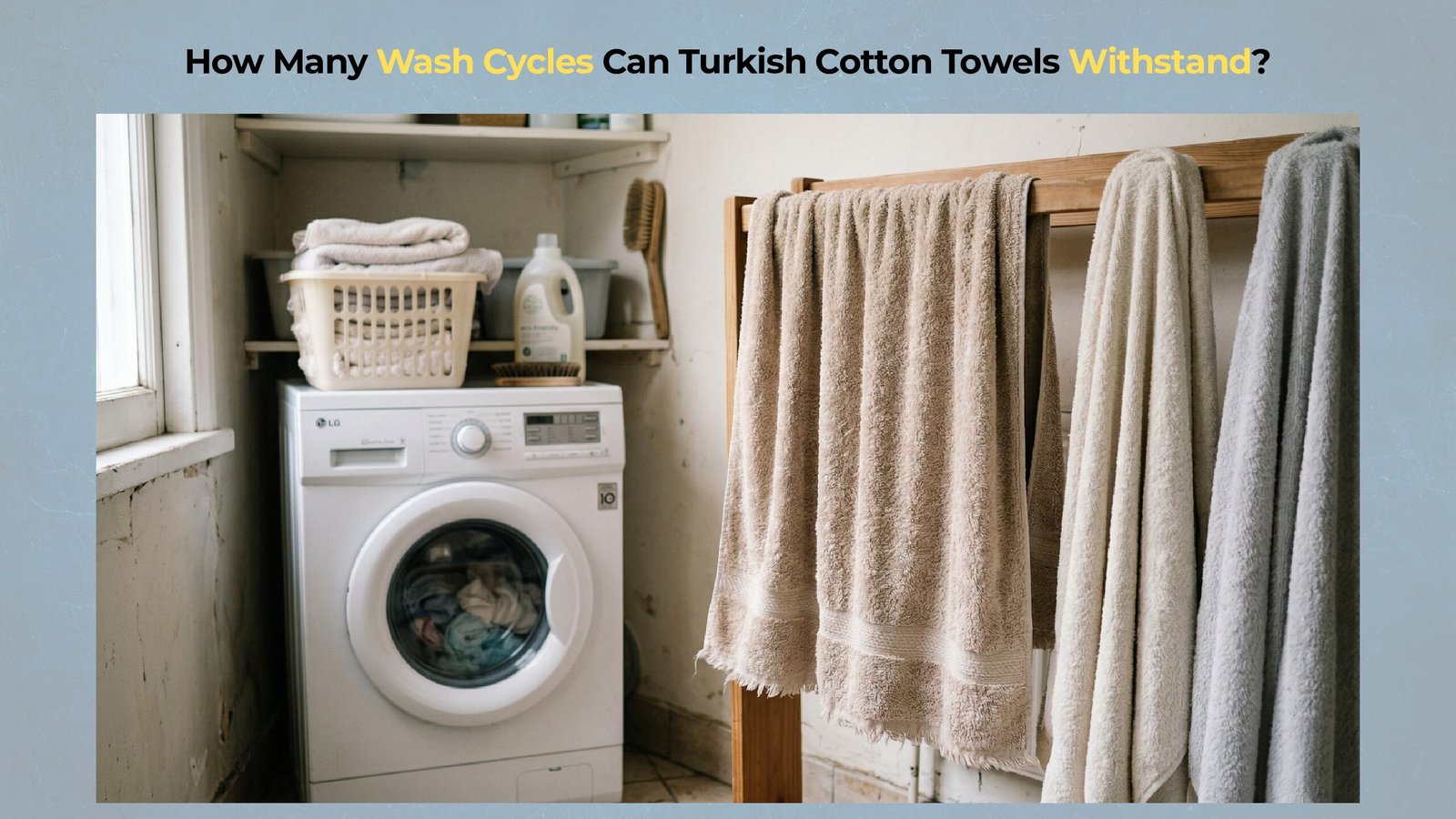
How Many Wash Cycles Can Turkish Cotton Towels Withstand?
A high number of successful wash cycles typically results from Turkish cotton towel wash cycle limits, provided the textile utilizes 100% long-staple Aegean fibers and undergoes technical low-heat maintenance.
This activation phase defines the transition of the raw fiber from a factory-pressed state to its maximum absorbent potential. Unwashed Aegean Gossypium hirsutum fibers possess natural oils and industrial residues that require initial mechanical and aqueous agitation to reach their engineered durability. Without this phase, the fibers remain rigid and less capable of accommodating the hydraulic stress of high-RPM laundering.
Task Fulfillment Statement: This guide audits the mechanical fatigue, fiber abrasion, and tensile structural integrity of Aegean cotton to verify Turkish cotton towel wash cycle limits and provide technical benchmarks for asset replacement.
Why Do Service-Life Benchmarks Define Turkish Cotton Towel Wash Cycle Limits?
Service-life benchmarks quantify Turkish cotton towel wash cycle limits by establishing a predictable timeline for the gradual mechanical fatigue of the cellulose filaments.
Service-life benchmarks quantify Turkish cotton towel wash cycle limits by tracking how fibers resist mechanical fatigue over repeated laundering. To understand why fiber length is the foundation of this durability, it helps to explore what staple length Turkish cotton towels typically have and why it affects longevity.
Aegean filaments are uniquely suited for longevity due to their high degree of crystallinity and secondary cell-wall thickness. These benchmarks represent the objective threshold where the cumulative effects of thermal exposure and agitation begin to compromise the textile’s utility. These benchmarks are established during the early-lifecycle breaking-in window.
Determining the “Breaking-In” Window for Turkish Cotton Towel Wash Cycle Limits
Turkish cotton towel wash cycle limits reach their peak functional state during the first several laundry cycles as the fibers “bloom” and release the industrial tensions introduced during weaving.
The breaking-in phase allows fibers to relax and reposition into a stable configuration after initial wash cycles. Since this transition also affects usability and feel, a natural next step is to review how Turkish cotton towels become softer over time after washing.
Research published in the Textile Research Journal indicates that fiber relaxation is a critical component of absorbency; as the “twist” of the yarn settles, fabric thickness can exhibit a measurable increase. This “Bloom” is not wear, but the activation of the fiber core for peak wicking performance. Initial wash cycles serve to release industrial tensions and activate the potential of Turkish cotton towel wash cycle limits.
Identifying the Factors that Often Indicate End-of-Life for Turkish Cotton Towel Wash Cycle Limits
These functional thresholds are reached when the textile exhibits end-of-life markers, as significant mass loss often signals the end of wicking utility compared to the original GSM.
Mechanical fatigue eventually leads to loop thinning and visible mass loss in the textile surface. Because this failure mechanism is closely tied to lint formation, it is helpful to review why Turkish cotton towels shed or lint during repeated wash cycles.
According to ISO 6330 laundering durability standards, significant mass loss typically results in visible “balding” patches where the ground weave becomes exposed. Mass loss is a primary mechanical indicator that a textile approaches end-of-life; once the loops are sheared, the surface area for moisture transport is functionally compromised. Structural decay is influenced by molecular physics and fiber properties.
How Do Molecular Physics and Fiber Properties Influence Turkish Cotton Towel Wash Cycle Limits?
Inter-fiber friction and cell-wall maturity influence Turkish cotton towel wash cycle limits by establishing a mechanical “lock” that helps inhibit filament migration.
Filament migration occurs when fibers lose frictional stability and begin escaping the yarn core during agitation. Because this process originates at the yarn level, you may want to explore how Turkish cotton towel yarn construction influences strength and fiber retention.
Filament migration occurs when individual cotton hairs slide out of the yarn structure during agitation. Turkish cotton’s long-staple profile provides more overlapping surface area, which naturally increases the friction required for fibers to escape the yarn core. This transition focuses specifically on filament fibrillation.
How Filament Fibrillation Influences Turkish Cotton Towel Wash Cycle Limits
Turkish cotton towel wash cycle limits can be affected by “Filament Fibrillation,” as long-staple fibers generally reduce fibrillation compared to carded utility cotton.
Long-staple fibers reduce fibrillation by minimizing exposed fiber ends that can snap under stress. Since this directly impacts long-term durability, it is useful to understand how durable Turkish cotton towels are over time with regular use.
Reference to ISO 12945 for surface pilling reveals that high-tenacity long-staple fibers typically exhibit a lower fibrillation rate than carded alternatives. Longer fibers provide a mechanical “armor” because fewer exposed fiber ends are available to snap or fray under mechanical stress. Long-staple fiber length inhibits filament fibrillation and supports Turkish cotton towel wash cycle limits.
Determining the Tensile Resilience ROI of Long-Staple Aegean Cotton
Turkish cotton towel wash cycle limits often improve when using fibers between $29.5\text{–}32\text{ mm}$ because the increased overlapping surface area supports the friction-bonding within the yarn twist.
By utilizing Koechlin’s Equation for twist efficiency, it is evident that Aegean long-staple cotton typically provides a breaking strength exceeding 30 g/tex. High inter-fiber friction helps prevent “Slippage,” the process where filaments slide out of the yarn core, which can cause the towel to thin prematurely. Increased fiber contact points support friction-bonding and secure the Turkish cotton towel wash cycle limits.
Identifying How Cell-Wall Density Supports Turkish Cotton Towel Wash Cycle Limits
Aegean fiber longevity remains resilient against mechanical snapping because the coastal climate typically facilitates the growth of thick-walled fibers that withstand high-RPM centrifugal stress.
Reference to the Nazilli 84 cultivar maturity benchmarks confirms that mature Aegean fibers exhibit high secondary cell-wall deposition. This density supports breaking strengths that meet elite industrial requirements. Denser cell walls help resist “Cellulose Chain Scission,” the molecular breaking of bonds that leads to brittle, “board-like” textures.
Evaluating the Impact of Detergent Saturation on Turkish Cotton Towel Wash Cycle Limits
Turkish cotton towel wash cycle limits can decline when unrinsed detergent molecules create a “Chemical Crust,” as detergent buildup can reduce flexibility over time.
Chemical buildup from detergents can create a rigid surface layer that reduces fiber flexibility over time. To better understand this performance issue, it is useful to explore how chemical residues affect Turkish cotton towel performance and longevity.
Citing the Textile Rental Services Association (TRSA) wash guidelines, surfactant loading can reduce fiber flexibility over time if residues are not stripped. “Softness” in a new towel is often a chemical mask; maintaining service life requires a clean fiber core that can flex without internal friction from detergent salts.
How to Compare Construction Tiers to Predict Turkish Cotton Towel Wash Cycle Limits?
Selection of the ideal inventory results from comparing Turkish cotton towel wash cycle limits against a matrix of ply-counts and spinning methodologies to identify the highest ROI.
| Construction Factor | Relative Wash Cycle Limit | Performance Result | Replacement Priority |
|---|---|---|---|
| Two-Ply / Combed | Maximum Benchmarks | Supports service life | Low |
| Single-Ply / Ring-Spun | Standard Benchmarks | Pliable / Balanced | Moderate |
| Low-Twist / Zero-Twist | Lower Benchmarks | Prone to fiber migration | High |
| Carded / Short-Staple | Minimum Benchmarks | Can significantly degrade | Immediate |
Identifying the Weight Tiers that Support Turkish Cotton Towel Wash Cycle Limits
Turkish cotton towel wash cycle limits often reach their peak efficiency in the $600\text{–}750\text{ GSM}$ range, providing the mass required for durability while acknowledging that higher GSM may require longer drying, increasing thermal exposure.
ASTM D3776 mass-per-unit-area verification shows that heavier towels often require longer drying cycles, which can increase cumulative thermal fiber fatigue. A durable lifespan is a balance between absorbent mass and turnover speed; if a towel is too thick, the heat required to dry it may weaken the fiber before the wash cycles reach 100.
Which Laundry Protocols Support Turkish Cotton Towel Wash Cycle Limits?
Preservation of textile mass results from maintenance protocols that support Turkish cotton towel wash cycle limits by excluding oxidative chemicals and limiting thermal stress.
Maintaining wash-cycle lifespan requires proper laundering techniques that preserve fiber integrity and prevent cumulative damage. Since washing protocols define long-term performance, it is essential to understand how Turkish cotton towels should be washed and cared for.
Maintaining the structural integrity of Turkish cotton requires a paradigm shift away from industrial aggression. Heat and harsh oxidizers act as catalysts for molecular decay. We now lead into the thermal guard protocol.
How Thermal Guard Protocols Support Turkish Cotton Towel Wash Cycle Limits
Turkish cotton towel wash cycle limits are protected when users maintain drying temperatures below $120^{\circ}F$ ($49^{\circ}C$) to help prevent the “Heat-Brittleness” caused by moisture stripping.
Thermal stress accelerates cellulose degradation by stripping internal moisture and weakening fiber flexibility. Since drying conditions directly influence this outcome, you may want to explore how drying methods affect Turkish cotton towel durability and performance.
Reference to ISO 3758 care symbols indicates that high drying temperatures can trigger Cellulose Hornification, permanently collapsing the fiber pores. “Baking” a towel can lead to microscopic surface cracking, turning soft fibers into abrasive wires that may snap under tension. Controlled dryer temperatures prevent cellulose hornification and support the service life of Turkish cotton towel wash cycle limits.
Why Avoiding Chemical Oxidation Can Prevent Significant Mass Loss in Turkish Cotton Towel Wash Cycle Limits
Turkish cotton towel wash cycle limits can experience significant mass loss if treated with chlorine bleach, as oxidative chemicals systematically break the molecular bonds of the cellulose.
According to AATCC 188 benchmarks for colorfastness to sodium hypochlorite, repeated chlorine exposure results in a measurable decline in breaking strength. Chlorine acts as a chemical abrasive, thinning the cell walls until the towel becomes transparent and approaches end-of-life. Chlorine bleach exposure induces cellulose chain scission and compromises the Turkish cotton towel wash cycle limits.
How Can Restoring Flexibility Help Maintain Turkish Cotton Towel Wash Cycle Limits?
Restoration of original loop flexibility results from executing chemical and mechanical resets to revitalize Turkish cotton towel wash cycle limits before fibers reach terminal stiffness.
Revitalization protocols prevent the premature disposal of matted or stiff linens by addressing the external impediments to fiber movement.
Resolve Mineral-Based Stiffness to Support Turkish Cotton Towel Wash Cycle Limits
Turkish cotton towel wash cycle limits and fiber elasticity regain their original profile if a warm vinegar rinse successfully dissolves the calcium deposits that “lock” filaments.
Calcium Acetate Formation is the chemical reaction where acetic acid (vinegar) dissolves limescale to restore fiber surface friction. Removing mineral “crust” helps restore wicking surface area in aged towels. Acetic acid rinses dissolve mineral calcification and restore the flexibility of Turkish cotton towel wash cycle limits.
How Mechanical Pile-Lifting Can Separate Matting in Turkish Cotton Towel Wash Cycle Limits
Turkish cotton towel wash cycle limits improve in matted inventory when a brief “Air Fluff” cycle with wool dryer balls physically separates compressed filaments.
Referencing ISO 11092 for thermal resistance, mechanical agitation can reinflate the “Void Volume” between fibers. This provides the “massage” required to prevent the static friction that can lead to fiber breakage under load.
How Do You Audit Your Linens with This Turkish Cotton Towel Wash Cycle Limits Quality Audit Checklist?
Systematic technical audits verify Turkish cotton towel wash cycle limits by ensuring maintenance protocols and purchase quality align with objective performance benchmarks.
Use the following technical checklist to perform a baseline audit of your current linen inventory.
Checklist: Turkish Cotton Towel Wash Cycle Limits Quality Audit
Technical FAQ: Turkish Cotton Longevity
How many wash cycles can a high-quality Turkish towel survive?
A premium two-ply combed Turkish towel can typically withstand between 150 to 200 wash cycles before structural fatigue significantly compromises performance. In contrast, utility carded towels may begin to exhibit terminal mass loss after as few as 50 cycles.
Does washing in hot water always reduce towel life?
While hot water is necessary for sanitization, consistent exposure to temperatures above $140^{\circ}F$ ($60^{\circ}C$) can accelerate the breakdown of cellulose chains. The cumulative thermal stress, especially when combined with high-heat drying, triggers ‘Hornification,’ which makes the fibers brittle.
Why do towels become less absorbent over many cycles?
This decline is usually caused by the accumulation of a ‘Chemical Crust.’ Detergent residues and fabric softeners coat the fibers in a hydrophobic film. Periodically performing a vinegar reset can strip these residues and restore the original wicking profile.
Is the lint in my dryer trap a sign of end-of-life?
Initially, lint is a sign of industrial tension release (blooming). However, if lint volume remains high or increases after 10-15 cycles, it indicates excessive mechanical abrasion and filament migration, suggesting the towel is approaching its functional service-life limit.
Final Summary: How to Decide if Aegean Cotton Can Remain Durable for Years?
Operationalizing a Turkish cotton towel wash cycle limits strategy requires a commitment to technical care that honors the unique fiber physics of Aegean cotton.
While carded utility textiles decay rapidly under industrial stress, the higher initial cost of Turkish cotton ensures the textile can remain durable for years under proper care. This ROI is realized not through purchase price alone, but through the technical management of wash cycles to mitigate molecular fatigue.