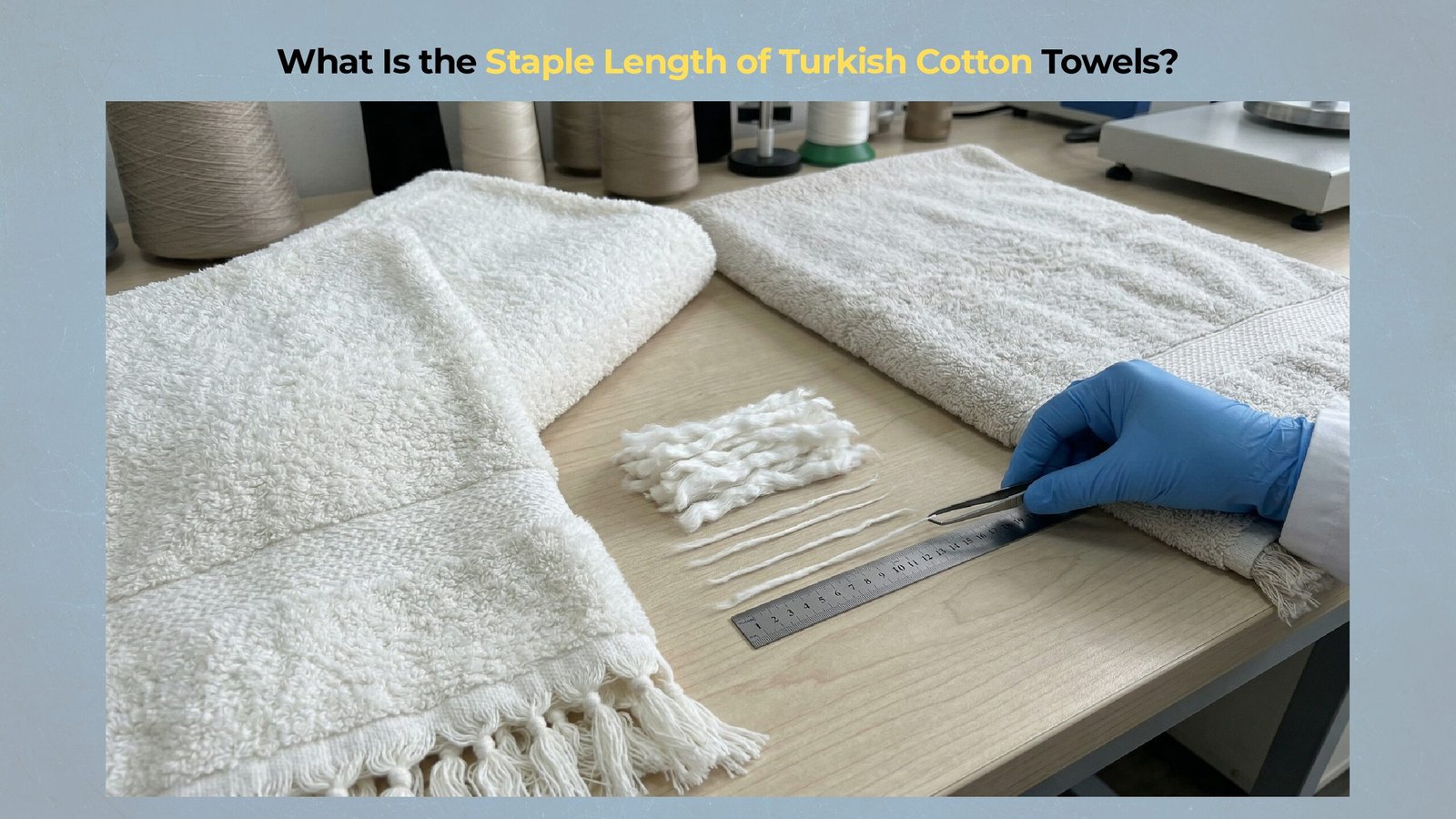
What Is the Staple Length of Turkish Cotton Towels?
The “Goldilocks” equilibrium between high absorbency and rapid evaporative efficiency results from the Turkish cotton towel staple length, which typically benchmarks Aegean fibers between 29.5 mm and 31.0 mm to optimize wicking and lifecycle ROI. When evaluating how this balance fits into real-world buying decisions, it is helpful to review how towel material affects absorbency, durability, and drying performance across different textile types.
In the towel world, “staple length” measures the individual cotton hairs. Turkish hairs are just long enough to be incredibly strong and soft, but not so long that they trap water and stay damp all day. This profile is essential for high-performance textiles. Textile quality is a direct outcome of fiber length.
Why Does Turkish Cotton Towel Staple Length Determine Textile Quality?
Superior textile quality is a direct result of the Turkish cotton towel staple length, which dictates the density of exposed fiber ends and the frictional stability of the spun yarn. Since overall quality depends on multiple structural variables, it is important to understand what determines towel quality and long-term performance beyond fiber length alone.
Superior textile quality is a direct result of the Turkish cotton towel staple length, which dictates the density of exposed fiber ends and the frictional stability of the spun yarn. Reducing fiber tips minimizes mechanical fraying, ensuring a high-integrity surface that resists pilling and structural thinning over time.
Pilling resistance is a consequence of fewer yarn joins. Longer fibers require fewer “overlaps” to create a stable thread, which inherently reduces the number of loose ends that can tangle into unsightly pills. When fibers are longer, they wrap more effectively around the yarn core, securing the structure against mechanical abrasion. Textile quality is a direct outcome of fiber length. Establishing that pilling resistance is a consequence of fewer yarn joins.
Identifying the Link Between Turkish Cotton Towel Staple Length and Pilling Resistance
High pilling resistance results from the Turkish cotton towel staple length because the 30 mm fiber profile typically minimizes the number of exposed fiber tips prone to mechanical fraying. In spinning physics, a Join-Point is defined as the area where individual fibers overlap and are twisted together. To better understand how durability is influenced by these structural factors, you can explore how durability factors impact towel lifespan and resistance to wear over repeated use.
Determining the Tensile Strength ROI of Turkish Cotton Towel Staple Length
Materially higher work-to-break (RKM) values, often exceeding 30% depending on fiber quality, result from the Turkish cotton towel staple length, as the overlapping surface area of long-staple fibers increases the frictional bond within the yarn twist. This is often calculated using Koechlin’s Equation to determine the optimal twist multiplier. Breaking strength typically exceeds 30 g/tex when fibers provide sufficient anchoring points within the yarn core. Noting that moisture release is a byproduct of smooth-yarn kinetics.
How Does Turkish Cotton Towel Staple Length Affect Absorbency and Drying Performance?
Rapid atmospheric moisture release is a consequence of the Turkish cotton towel staple length, which establish a wicking conduit architecture through slightly thicker, porous Aegean fibers. For a broader understanding of how moisture behavior varies across textiles, you may want to review what determines towel absorbency and water retention performance in different materials.
Rapid atmospheric moisture release is a consequence of the Turkish cotton towel staple length, establishing a wicking conduit architecture. This “Smooth-Yarn” configuration facilitates air transit through the pile, eliminating internal moisture traps and ensuring faster turnover in high-use environments.
Turnover speed in residential and commercial settings is a function of smooth-yarn release. Unlike denser fibers that trap water molecules deep within their cellular structure, the Turkish profile ensures moisture remains accessible for rapid evaporation. Turnover speed is a function of smooth-yarn release.
Understanding the Smooth-Yarn Release Driven by Turkish Cotton Towel Staple Length
A 50% reduction in drying time compared to Egyptian ELS cotton results from the Turkish cotton towel staple length, which drives a “Smooth-Yarn” release mechanism by eliminating internal moisture traps. Since drying efficiency is critical for hygiene and usability, it is useful to evaluate how quick-dry performance affects towel usability and odor prevention in high-use environments. This is quantifiable via the Hercules Number.
Comparing the “Wick-vs-Hold” Balance of Turkish Cotton Towel Staple Length
Superior initial wicking results from the Turkish cotton towel staple length, which typically absorbs 20% to 30% more water by weight during the “drying-off” phase when evaluated against standardized wicking benchmarks. To compare this behavior with other cotton constructions, you can explore how cotton towel absorbency and comfort vary by fiber structure. Performance depends on adhering to technical benchmarks.
What Are the Technical Benchmarks for Turkish Cotton Towel Staple Length?
Technical Long-Staple (LS) classification is a consequence of the Turkish cotton towel staple length meeting the Upper Half Mean (UHM) threshold of 28.5 mm to 33.3 mm.
Technical LS classification is a consequence of the Turkish cotton towel staple length meeting the UHM threshold. Verification via High-Volume Instrument (HVI) technology is the only objective method to confirm fiber compliance with industrial quality standards.
Yarn consistency and spinning efficiency are governed by the Uniformity Index. High uniformity ensures that the yarn has a consistent diameter, which prevents weak spots in the weave. Yarn consistency is governed by the Uniformity Index.
Determining the Uniformity Index in Turkish Cotton Towel Staple Length
High-grade spinning potential results from the Turkish cotton towel staple length maintaining a Uniformity Index (UI) between 82% and 85%. Uniformity Index is defined as the ratio of mean length to upper-half mean length. A high UI ensures that the finished product feels smooth and exhibits minimal linting over time.
Evaluating the Micronaire “Sweet Spot” for Turkish Cotton Towel Staple Length
High industrial wash resilience results from the Turkish cotton towel staple length falling within the micronaire “sweet spot” of 3.7 to 4.2. This ensures the fiber has reached optimal maturity. A scratchy texture is a typical result of micronaire exceeding 5.0, as the individual fibers become too thick and rigid for luxury use. Turnover depends on total cost of ownership comparison.
How Does Turkish Cotton Towel Staple Length Compare to Egyptian and Standard Cotton?
A reduction in the Total Cost of Ownership (TCO) results from selecting the Turkish cotton towel staple length, which outlasts utility-grade cotton and reduces the energy costs associated with ELS textiles.
A reduction in TCO results from selecting Turkish LS cotton. By balancing a 30% increase in tensile strength with rapid drying kinetics, it survives 200+ industrial washes while saving on long-term drying energy costs.
| Staple Category | Length (UHM) | Work-to-Break | Lifecycle (Washes) | TCO Efficiency |
|---|---|---|---|---|
| Short / Medium | < 25.0 mm | Baseline | 80–120 | Low (Rapid Replacement) |
| Turkish (LS) | 29.5–31.0 mm | +30% | 200–250+ (ISO 6330) | Highest (Durability/Energy) |
| Egyptian (ELS) | > 35.0 mm | +45.0% | 150–200 | Moderate (High Energy) |
Analyzing the 200-Wash Industrial Lifespan of Turkish Cotton Towel Staple Length
A verifiable industrial lifecycle of over 200 wash cycles is a consequence of the Turkish cotton towel staple length, supported by strong inter-fiber cohesion. Since thickness and density influence both durability and drying speed, it is helpful to understand how towel thickness impacts performance, drying time, and structural stability. High inter-fiber cohesion prevents threadbare thinning, leading to a significantly lower replacement rate.
How Can You Identify Turkish Cotton Towel Staple Length Without Lab Testing?
Non-laboratory verification of the Turkish cotton towel staple length results from monitoring the “Blooming” phenomenon and auditing the textile’s reflectance (Rd) value.
Loft is a byproduct of blooming mechanics. When a towel is washed, the compressed fibers relax and expand, increasing the volumetric displacement of the textile. Loft is a byproduct of blooming mechanics.
Identifying the “Blooming” phenomenon as a Proxy for Turkish Cotton Towel Staple Length
A 15% volumetric expansion typically results from the Turkish cotton towel staple length after 5 to 10 wash cycles, where the long-fiber filaments gradually relax and re-inflate. To perform the Volume-Test, measure the stack height of five folded towels. Authentic Turkish cotton will exhibit a measurable increase in height as the individual staples “bloom” within the loops. Post-laundry fiber relaxation triggers this expansion.
Identifying Surface Luster and GMO-Free Indicators for Turkish Cotton Towel Staple Length
Uniform dye absorption is a consequence of the Turkish cotton towel staple length utilizing non-GMO Nazilli 84 and Carmen varieties that facilitate high reflectance (Rd) values. These cultivars from the Aegean region are genetically predisposed to high luster, indicating a mature, unbroken cellulose chain that reflects light more uniformly than short-staple varieties. Fiber health depends on specific laundry protocols.
Which Laundry Steps Preserve the Turkish Cotton Towel Staple Length?
Long-term fiber health is a direct result of maintenance protocols that protect the Turkish cotton towel staple length from molecular chain scission and thermal embrittlement. To ensure optimal performance over time, it is essential to follow proper care instructions for preserving towel fiber integrity across repeated laundering cycles.
Long-term fiber health is a direct result of maintenance protocols. Avoiding chlorine prevents chain scission, while keeping drying temperatures below 150°C prevents the thermal decomposition of the cellulose bonds. Mass loss is a consequence of chain scission.
Preventing “Cellulose Chain Scission” to Preserve Turkish Cotton Towel Staple Length
Severe reduction in Limiting Viscosity results from treating the Turkish cotton towel staple length with chlorine bleach, which induces irreversible cellulose chain scission. Chlorine molecules cleave the glycosidic bonds of the cotton polymer, shortening the functional fiber length at a molecular level. It is professionally recommended to replace chlorine with oxygen-based whiteners to maintain fiber integrity.
Avoiding Thermal Decomposition to Protect Turkish Cotton Towel Staple Length
Permanent fiber embrittlement is a typical consequence of mechanical over-drying, as internal temperatures approaching $150^{\circ}C$ compromise the Turkish cotton towel staple length. Excessive thermal energy initiates a low-level pyrolysis, which dehydrates the fiber core and neutralizes the natural flexibility and wicking conduits of the Aegean cotton staple.
How to Audit Your Purchase for Genuine Turkish Cotton Towel Staple Length?
Verification of current inventory is a consequence of auditing the Turkish cotton towel staple length against High-Volume Instrument (HVI) performance benchmarks.
Checklist: Turkish Cotton Towel Staple Length Quality-Check
Does the label confirm specific cultivars like Nazilli 84 or Carmen from the Aegean Region?
Do the loops exhibit a visible 15% “Bloom” expansion after 10 wash cycles?
Does the textile exhibit high Rd (reflectance) luster under direct lighting?
Does the product carry GOTS 7.0 or OEKO-TEX Standard 100 verification?
Frequently Asked Questions (FAQ)
What is the exact staple length of authentic Turkish cotton?
Authentic Turkish cotton towels typically utilize fibers ranging from 29.5 mm to 31.0 mm. This benchmarks them in the Long-Staple (LS) category, offering a specific equilibrium between durability and drying speed that shorter or longer fibers cannot match.
Why are Turkish cotton towels better for high-turnover environments?
Turnover efficiency is a direct result of the porous fiber morphology found in the Turkish cotton towel staple length. While Egyptian cotton is denser and holds water longer, Turkish cotton facilitates rapid wicking and atmospheric moisture release, allowing towels to dry up to 50% faster.
Does washing towels with bleach affect their staple length?
While it doesn’t physically change the cotton hairs, chlorine bleach causes molecular chain scission. This process cleaves the cellulose bonds, reducing the functional integrity of the Turkish cotton towel staple length and leading to brittle, threadbare textiles over time.
How do I verify a towel’s quality at home?
You can audit quality by monitoring the “Blooming” phenomenon. A high-quality Turkish towel should exhibit a visible 15% increase in volumetric loft after approximately 10 wash cycles as the long-staple fibers relax and re-inflate.
Technical Disclaimer:
The data provided in this guide is based on standardized High-Volume Instrument (HVI) testing and industrial laundry benchmarks (ISO 6330). Individual results may vary based on water hardness, detergent chemistry, and mechanical dryer calibration. This content is for educational and procurement guidance purposes and does not constitute a warranty of specific fiber performance for a particular application.