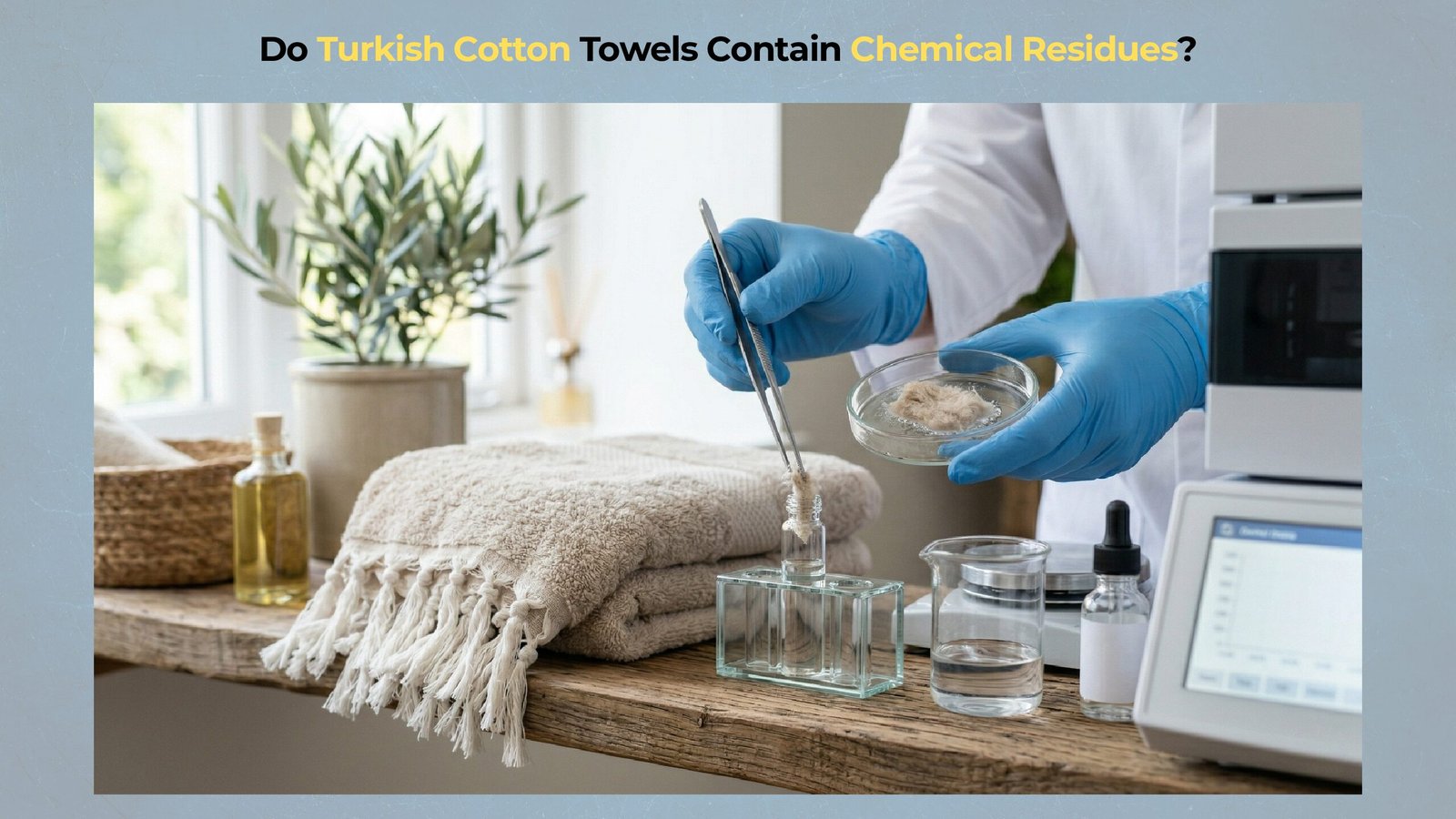
Do Turkish Cotton Towels Contain Chemical Residues?
A Technical Guide to Turkish Cotton Towel Chemical Residues
Safe levels for normal dermal exposure result from the technical purification of Turkish cotton towel chemical residues, which typically consist of a combination of agricultural pesticides, industrial sizing waxes, and surplus pigments.
Differentiating between botanical impurities (such as natural pectins) and the industrial chemical profile added during weaving is essential for maintaining textile integrity. While raw Aegean cotton is prized for its organic purity, the mechanical stress of industrial looms necessitates the introduction of synthetic lubricants that must be scoured before home use.
The technical removal of these residues typically serves as a mandatory prerequisite for achieving the high wicking performance of Aegean cotton. Failing to clear these industrial byproducts results in a non-functional textile that repels water rather than absorbing it.
What Chemicals Are Found in Turkish Cotton Towel Chemical Residues?
Auditing the concentration of free formaldehyde and extractable heavy metals identifies the primary compounds typically present within Turkish cotton towel chemical residues. This analysis is critical for establishing a baseline for human-ecological safety in home textiles.
Differentiating between botanical impurities and industrial chemical inputs is essential for maintaining textile integrity. Since fiber composition directly influences residue behavior, a natural next step is to explore what Turkish cotton towel composition reveals about purity and performance.
Auditing chemical concentrations such as formaldehyde and heavy metals establishes the baseline for human-ecological safety. Since these risks vary depending on manufacturing quality, it is important to evaluate what quality factors determine safe and high-performing towels.
While these chemicals facilitate efficient industrial production, they can pose risks if allowed to persist on the skin. Cumulative exposure to residual formaldehyde resins, often used for wrinkle-resistance in the finishing stage, can lead to respiratory sensitivities or contact dermatitis in predisposed individuals.
The rigorous identification of these compounds results from analyzing primary contamination sources across the global supply chain, ensuring that the final textile meets modern clinical safety standards for prolonged dermal contact.
What Are the Primary Sources of Turkish Cotton Towel Chemical Residues?
Manufacturing inputs typically represent the primary source of Turkish cotton towel chemical residues, as the weaving and finishing stages introduce significantly more persistent compounds than the initial agricultural phase. Most pesticide residues are neutralized during the rigorous scouring and bleaching processes, shifting the toxicological focus to factory-floor inputs.
The industry standard for safety, the OEKO-TEX Standard 100 (Class I), provides the most rigorous benchmarks for these residues. Class I certification is reserved for textiles intended for infants, mandating the lowest possible chemical thresholds across the entire manufacturing lifecycle.
Manufacturing inputs such as sizing agents and finishing resins represent the primary source of chemical residues. Because these substances directly affect long-term usability, it is useful to explore how cotton towel durability is affected by washing and repeated use.
Verified Class I textiles must maintain free formaldehyde levels below $16\text{ ppm}$ to ensure infant-grade safety. Industrial finishing stages ➔ may introduce persistent resins ➔ dictate the Turkish cotton towel chemical residues profile.
Which ppm Benchmarks Define Turkish Cotton Towel Chemical Residues?
Standardized parts-per-million (ppm) benchmarks define Turkish cotton towel chemical residues by establishing rigid limits for extractable lead, mercury, and cadmium under international safety protocols. These benchmarks act as the gatekeepers for consumer safety in the European and North American markets.
The REACH Regulation (EC No 1907/2006) provides the legal framework for chemical safety in textiles, listing restricted substances that must not exceed specific concentration levels. Safety compliance typically dictates phthalate concentrations remain below $0.1\%$ by weight to prevent systemic risk.
Furthermore, low-residue status often results from “Closed-Loop” scouring processes used in premium Aegean dye-houses, where chemicals are continuously filtered and recycled rather than allowed to pool in the textile fibers.
Which Manufacturing Stages Introduce Turkish Cotton Towel Chemical Residues?
Specific supply chain checkpoints typically introduce Turkish cotton towel chemical residues through the utilization of mechanical lubricants, high-saturation dyes, and wrinkle-resistant resins. These wrinkle-resistant resins are chemically engineered to bond with cellulose fibers, providing the “factory-crisp” appearance that consumers often mistake for quality.
Mechanical weaving requires sizing agents that may block absorbency. These waxes and starches coat the long-staple Turkish cotton loops, effectively “waterproofing” the towel until the first industrial or domestic laundering cycle clears the path for moisture.
Manufacturing Residue Profile Matrix
| Manufacturing Stage | Primary Residue Introduced | Risk Factors |
|---|---|---|
| Mechanical Weaving | Sizing (Waxes/Starches) | Can block wicking; inhibits absorbency |
| Vat-Dyeing | Heavy Metals / Mordants | May trigger dermatological reactivity |
| Oxidative Bleaching | Chlorine Residues | Can accelerate cellulose thinning |
| Final Finishing | Formaldehyde Resins | Possible respiratory and epidermal irritation |
How Do Manufacturing Stages Generate Turkish Cotton Towel Chemical Residues?
The generation of Turkish cotton towel chemical residues occurs at mechanical interfaces where fibers typically require lubrication or chemical fixation to survive high-speed industrial loom friction. These high-speed environments create intense heat, necessitating the application of paraffin waxes to prevent yarn breakage.
Compliance with the ISO 17050 standard for conformity assessment ensures that manufacturers document these inputs. High-speed looms typically require $2–8\%$ sizing-to-fiber weight depending on weaving conditions and loom velocity.
Do Sizing and Finishing Processes Contribute to Turkish Cotton Towel Chemical Residues?
A hydrophobic “Waterproofing” effect often results from Turkish cotton towel chemical residues, specifically when the starches and resins applied to the pile prevent moisture from reaching the absorbent core. This is why “water-beading” on new towels is a physical indicator of sizing presence.
The removal of industrial residues is a prerequisite for achieving proper absorbency in Aegean cotton textiles. Because moisture interaction defines real-world usability, it is helpful to understand what determines towel absorbency and how it affects performance.
Reference to AATCC 79 absorbency benchmarks confirms that industrial residues can increase wetting time by over $400\%$ compared to fully scoured Aegean fibers. This gap represents the difference between a technical asset and a non-functional household textile.
Industrial sizing creates a hydrophobic barrier that blocks water absorption in new towels. Since this directly impacts drying and hygiene performance, you may also want to review how quick-dry performance influences towel usability and moisture management.
Section 2: Health and Dermal Impacts
Why Do Turkish Cotton Towel Chemical Residues Impact Dermal Health?
Epidermal inflammation and “Towel Burn” can originate from Turkish cotton towel chemical residues, particularly when moisture and body heat act as catalysts for chemical release. This release allows industrial agents to bypass the skin’s natural defenses.
This migration is exacerbated by the “Wash-Off” effect, where water transports surplus pigments and residual surfactants directly onto the skin surface. Protecting the skin is a direct function of mitigating contact dermatitis through rigorous initial laundering.
Dermal irritation risks increase when chemical residues interact with heat and moisture during use. Because comfort and skin interaction are critical factors, it is helpful to understand how softness affects towel comfort and skin compatibility.
How Is Contact Dermatitis Triggered by Turkish Cotton Towel Chemical Residues?
Turkish cotton towel chemical residues may trigger irritant contact dermatitis through the “Wash-Off” effect, where moisture and heat release finishing chemicals onto the skin surface. This reaction technically impacts the Stratum Corneum—the outermost layer of the skin that serves as the primary barrier against potential industrial irritants.
Residual azo pigments ➔ may induce epidermal reactivity ➔ validate the risks of Turkish cotton towel chemical residues. Clinical data suggests that unwashed textiles can contain higher levels of residual chemicals compared to washed textiles.
Do Endocrine Disruption Risks Link to Turkish Cotton Towel Chemical Residues?
Systemic health risks may link to Turkish cotton towel chemical residues if uncertified textiles retain phthalates or APEOs (Alkylphenol ethoxylates) that can act as exogenous endocrine disruptors. These compounds are frequently utilized as emulsifiers in dyeing cycles to ensure color uniformity.
Reference to the REACH Annex XVII restricted substance list identifies APEOs as high-risk contaminants. A $0.01\%$ ($100\text{ ppm}$) concentration threshold typically defines the “High Risk” limit for APEO exposure. Certified Aegean towels typically mitigate this risk by utilizing GOTS-verified surfactants.
How Do You Choose Towels with Low Turkish Cotton Towel Chemical Residues?
Standardized selection of low-residue inventory involves auditing the dyeing method and identifying third-party human-ecological certifications for Turkish cotton towel chemical residues. Dye method selection directly influences the initial chemical load and the ease of subsequent purification.
Dye-Method Risk Matrix
| Dyeing Method | Residue Risk Level | Primary Contaminant | Recommended? |
|---|---|---|---|
| Undyed (Natural) | Lowest | Natural Pectins / Waxes | Yes (Elite Tier) |
| Solution-Dyed | Low | Minimal (Locked-in) | Yes (Gym/Utility) |
| Yarn-Dyed | Moderate | Fixatives / Salts | Yes (After purification) |
| Vat-Dyed (Dark) | Highest | Surplus Pigment / Mordants | No (Requires strip cycle) |
Selecting Optimal Certified Systems for Low Turkish Cotton Towel Chemical Residues
Verification of Turkish cotton towel chemical residues purity is achieved by identifying the OEKO-TEX Standard 100 Class I seal, which guarantees safety for direct infant contact. To perform a “License Audit,” locate the license number on the tag and visit the official database to confirm the status is active.
Which Specific Laundry Steps Eliminate Turkish Cotton Towel Chemical Residues?
Executing a “Purification Protocol” typically resets the textile to a safe state by utilizing thermal and chemical energy to dissolve Turkish cotton towel chemical residues. High-heat washing can emulsify sizing wax, making the fiber core accessible for moisture absorption.
How Does High-Temperature Purification Remove Turkish Cotton Towel Chemical Residues?
Turkish cotton towel chemical residues and industrial sizing agents typically dissipate during an initial wash, as higher temperatures (around 60°C) improve removal efficiency by providing the energy required to break molecular bonds. Reference to the ISO 6330 standard for domestic washing supports this thermal requirement.
Does an Acid-Neutralization Rinse Restore Turkish Cotton Towel Chemical Residues to Baseline?
Restoration of a skin-safe pH level results from treating Turkish cotton towel chemical residues with a distilled vinegar rinse to neutralize the alkaline salts used in dyeing. Add 1 cup of white distilled vinegar to the final rinse of the first wash to achieved this reset.
How Can You Fix Set-In Turkish Cotton Towel Chemical Residues?
Restoration of the original clean-fiber profile results from executing chemical resets that dissolve the “Chemical-Mineral Glue” that typically traps Turkish cotton towel chemical residues. Transitioning from simple washes to deep resets is necessary for long-term textile maintenance.
Proper purification protocols remove chemical residues and restore the natural functionality of the fibers. Since washing methods determine both safety and longevity, it is essential to review what care instructions should be followed to maintain towel safety and performance.
Resolving Off-Gassing Within the Turkish Cotton Towel Chemical Residues Profile
Neutralization of the Turkish cotton towel chemical residues profile occurs through a sodium bicarbonate (baking soda) soak that can help neutralize odor-causing compounds responsible for factory scents. A 4-hour soak with $1/2$ cup baking soda is the recommended protocol.
How Do You Strip Wax-and-Softener Bonding from Turkish Cotton Towel Chemical Residues?
Restoring the capillary action of Turkish cotton towel chemical residues requires a hot-water cycle with a specialized surfactant to help dissolve the hydrophobic silicone layers created by softeners. Mandate the exclusion of liquid softeners to maintain the wicking velocity verified under AATCC 79.
Frequently Asked Questions
Technically, no unwashed industrial textile is chemical-free. Turkish towels contain sizing waxes, factory lubricants, and surplus pigments from manufacturing that must be scoured during an initial 60°C wash to ensure dermal safety and optimal absorbency.
The most effective purification protocol is a high-temperature wash (60°C) with a standard detergent, followed by a cup of distilled white vinegar in the final rinse cycle. This process emulsifies industrial sizing and neutralizes alkaline pH levels.
This “waterproofing” effect is caused by hydrophobic sizing agents (like paraffin waxes) applied during the mechanical weaving process. Until these residues are removed through hot-water laundering, moisture cannot penetrate the long-staple cotton core.
OEKO-TEX Standard 100 Class I is the highest global safety certification for textiles. It guarantees that the product has been tested for over 100 harmful substances and meets the strictest limits, making it safe for direct contact with infant skin.
Yes. Residual formaldehyde resins and alkaline salts can trigger irritant contact dermatitis, especially when body heat and sweat act as solvents that migrate these chemicals into the pores. Initial laundering is the primary defense against this “New Towel Itch.”
Audit Your Linens
Technical Quality Audit Checklist
- ✓ Olfactory Test: Is the textile free of “chemical-sweet,” “metallic,” or “plastic” odors?
- ✓ Absorbency Test: Does a water droplet absorb instantly ($< 1.0\text{s}$) without beading?
- ✓ Rinse Audit: Is the discharge water clear after the second wash?
- ✓ Logo Verification: Does the label display an active OEKO-TEX Standard 100 license number?
Medical & Technical Disclaimer
The information provided in this technical guide is for educational and analytical purposes only and does not constitute professional medical advice. Turkish cotton towel chemical residues are an inherent byproduct of industrial manufacturing; individuals with chronic skin conditions, severe allergies, or chemical sensitivities should consult a clinical dermatologist before selecting new linens. Performance results may vary based on domestic laundry variables and local water hardness.