What Causes Fiber Breakdown in Turkish Cotton Towels?
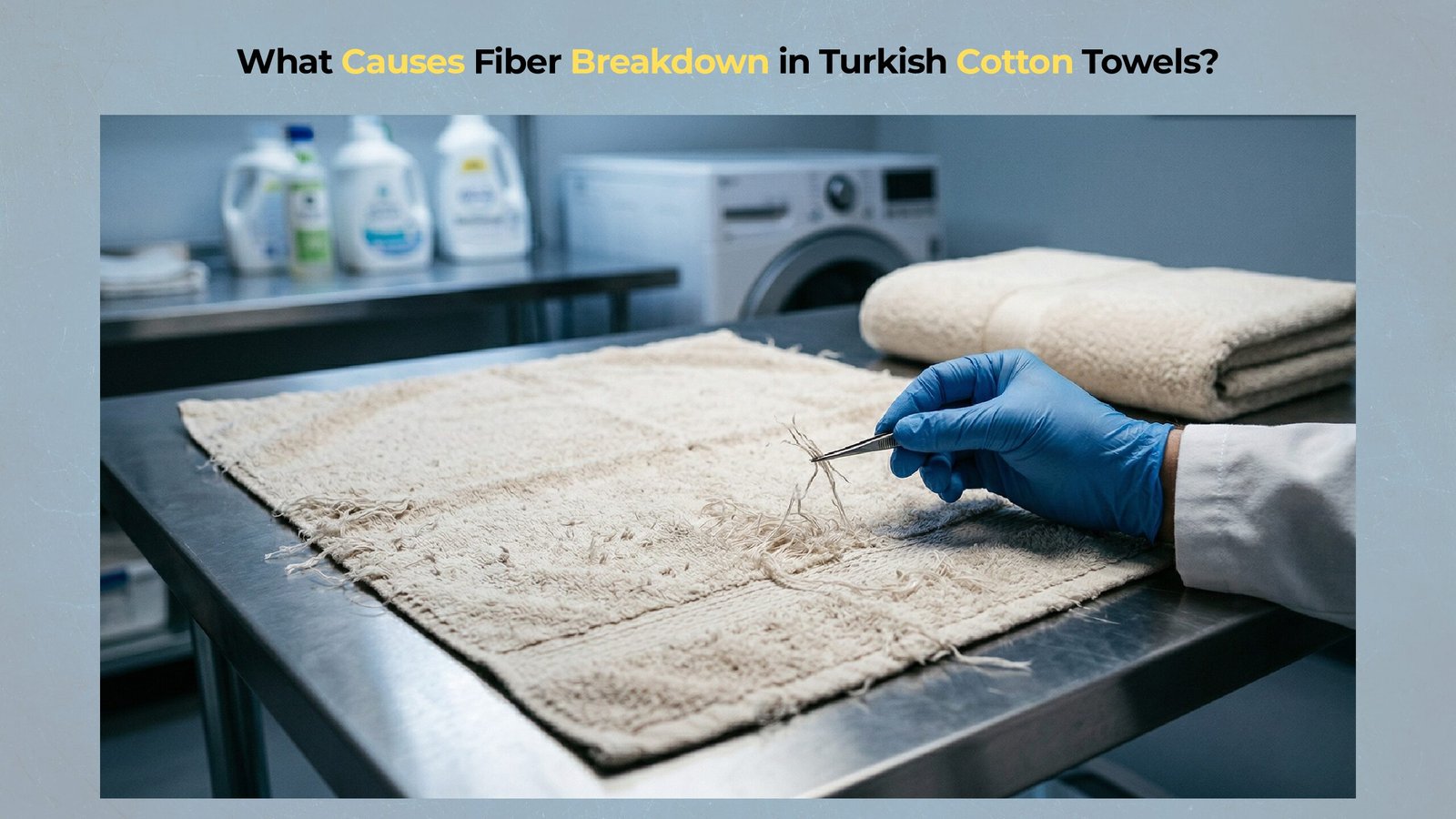
The accelerated thinning and structural failure of Aegean linens typically result from Turkish cotton towel fiber breakdown, as the combination of mechanical friction and molecular chain scission compromises the textile’s dry mass retention. This dry mass retention is the primary determinant of wicking efficiency, as high-density loops require a continuous cellulose structure to facilitate capillary action.
Cellulose chain integrity is the primary requirement for a stable fiber “backbone,” providing the tensile strength necessary to resist the centrifugal forces of high-G extraction. This fiber backbone is susceptible to degradation from oxidative catalysts and thermal dehydration, which gradually fragment the long-staple filaments into microscopic lint.
Operational Audit:
This guide audits the cellulose oxidation, hydrolytic degradation, and mechanical fatigue of Aegean cotton to verify Turkish cotton towel fiber breakdown and provide technical steps for mass preservation.
What Are the Primary Causes of Turkish Cotton Towel Fiber Breakdown?
Turkish cotton towel fiber breakdown is influenced by three primary triggers: chemical oxidation from bleach, thermal dehydration from high-heat drying, and mechanical abrasion during high-G wash cycles. These primary triggers act synergistically to degrade the molecular mass of the cotton strands, often starting with a loss of surface luster and progressing to visible pile thinning.
Mechanism Snippet
These catalysts facilitate the fragmentation of Gossypium hirsutum strands by stripping the protective primary cell wall, re-exposing the internal cellulose polymers to environmental stressors that eventually lead to catastrophic filament failure and textile “balding.”
How Do Chemical Catalysts Influence Turkish Cotton Towel Fiber Breakdown?
Turkish cotton towel fiber breakdown accelerates when the textile regularly encounters chemical catalysts like sodium hypochlorite (chlorine bleach), which induces the oxidative cleavage of the cellulose chains. According to the AATCC 188 protocol for colorfastness to sodium hypochlorite, repeated exposure results in a measurable decline in breaking strength and can significantly reduce tensile strength over multiple wash cycles. Bleach acts as a “Molecular Scythe,” shortening the cellulose polymers until they become brittle and lose their ability to bend without snapping.
Chemical oxidation from chlorine bleach accelerates molecular chain scission and weakens the fiber backbone. To better understand how chemical exposure impacts performance, it is helpful to review how chemical residues affect Turkish cotton towel performance and fiber integrity.
What Factors Drive Structural Fiber Loss Through Thermal Stress?
Structural fiber loss typically results from thermal stress when dryer temperatures consistently exceed $140^{\circ}F$ ($60^{\circ}C$), which can lead to pore collapse that renders filaments brittle. Following ISO 3758 care standards, temperatures above this threshold trigger internal fiber dehydration that materially reduces wicking surface area over time. This “Heat-Brittleness” turns flexible loops into rigid wires that may snap during use, leading to visible mass loss.
Thermal stress causes dehydration of cellulose fibers, reducing flexibility and increasing brittleness over time. Since drying conditions directly influence this degradation, you may want to explore how drying methods affect Turkish cotton towel durability and longevity.
Technical Definition: Hornification – The irreversible loss of fiber swelling capacity and flexibility caused by excessive mechanical heat, preventing the towel from “blooming” after laundry cycles.
How Does Molecular Physics Influence the Mechanics of Turkish Cotton Towel Fiber Breakdown?
Fragmentation and surface-shear drive the mechanics of Turkish cotton towel fiber breakdown when mechanical energy overcomes the inter-molecular hydrogen bonds holding the filaments together. These inter-molecular hydrogen bonds are the “glue” of the cotton fiber; once compromised by heat or chemicals, the mechanical agitation of the drum creates enough force to peel away layers of the fiber wall.
Fiber breakdown accelerates when inter-fiber friction is reduced and filaments begin escaping the yarn core. Since this stability originates at the yarn level, a natural next step is to review how Turkish cotton towel yarn construction influences strength and fiber retention.
How Filament Fibrillation Initiates Textile Thinning?
Textile thinning often initiates through “Filament Fibrillation,” where friction during the spin cycle typically can cause fibers to fragment and split from the main long-staple filament. Referencing ISO 12945 for surface pilling, high-speed extraction (1200+ RPM) facilitates fiber-shear mass loss compared to moderate 800 RPM cycles. The surface “fuzz” found in lint traps is literally the physical mass of the towel being shredded into lint through repeated mechanical agitation.
Mechanical abrasion during high-G wash cycles leads to surface shear and progressive mass loss. Because this process is closely tied to lint formation, it is useful to understand why Turkish cotton towels shed or lint during repeated use.
Use This Causation Matrix to Evaluate Turkish Cotton Towel Fiber Breakdown Drivers
Systematically auditing the drivers of Turkish cotton towel fiber breakdown requires a causative analysis of thermal, chemical, and mineral stressors.
| Cause | Physical Mechanism | Result for Turkish Cotton Towels |
|---|---|---|
| Chlorine Bleach | Molecular Oxidation | Brittle filaments and premature “balding” |
| High-Heat Drying | Polymer Dehydration | Loss of flexibility and microscopic snapping |
| Hard Water | Mineral Incrustation | “Fiber-lock” leading to mechanical breakage |
| Excessive Agitation | Surface Abrasion | Pile thinning and high lint production |
Why Do Aegean Fiber Properties Delay Fiber Degradation?
Superior structural tenacity and mature cell walls delay fiber degradation because longer staple lengths generally improve durability against the mechanical stress of high-turnover use. This biological backbone allows Turkish cotton to withstand hundreds of commercial laundry cycles without the premature thinning seen in shorter-staple carded cottons.
How Does Staple Length Influence Turkish Cotton Towel Fiber Breakdown?
Turkish cotton towel fiber breakdown risk typically decreases when utilizing fibers exceeding $28.5\text{ mm}$ in length because longer filaments create more overlapping anchoring points within the yarn twist. Using the Nazilli 84 cultivar maturity benchmarks, longer Aegean fibers facilitate an inter-fiber friction bond that resists “Slippage.” This means there are fewer yarn “joins” per yard, resulting in fewer weak points prone to snapping during agitation.
The structural failure of Aegean fibers begins when cellulose chains lose their integrity under repeated stress. To understand how long-staple fibers resist this breakdown, it helps to explore what staple length Turkish cotton towels typically have and why it improves durability.
Identifying How Cell-Wall Density Supports the Preservation of Turkish Cotton Towel Fiber Breakdown
Turkish cotton towel fiber breakdown is inhibited by the high cell-wall density of Aegean cotton, which provides the molecular depth needed to withstand high-RPM spin cycles. Based on ASTM D5034 grab strength tests, mature Aegean fibers exhibit breaking strengths that last significantly longer under proper care. Thick-walled fibers possess more crystalline cellulose regions, which act as a physical shield against chemical oxidation.
Which Laundry Protocols Help Prevent Turkish Cotton Towel Fiber Breakdown?
Supports preservation of wicking mass and tensile strength result from maintenance protocols that help maintain Turkish cotton towel fiber breakdown limits by excluding oxidative chemicals. These maintenance protocols focus on reducing the kinetic energy and chemical reactivity the fibers encounter during the wash loop.
Executing the “Thermal-Guard” Wash to Mitigate Turkish Cotton Towel Fiber Breakdown
Turkish cotton towel fiber breakdown remains controlled when users maintain wash temperatures at or below $104^{\circ}F$ ($40^{\circ}C$) to help prevent the excessive cellulose swelling that precedes chain fragmentation. ISO 6330 laundering durability tests show that maintaining temperatures below this threshold supports higher fiber mass retention over the towel’s lifecycle. Warm water provides enough energy for soil suspension without reaching the “Glass Transition” threshold of the polymer chain.
Fiber rigidity caused by mineral buildup or residue accumulation can mimic structural breakdown and accelerate damage. Since this often relates to washing conditions, you may want to understand how Turkish cotton towels should be washed and maintained.
How to Implement the “Chemical-Safety” Rule for Turkish Cotton Towel Fiber Breakdown?
Turkish cotton towel fiber breakdown is prevented by the “Chemical-Safety” rule, which mandates the replacement of chlorine bleach with oxygen-based brighteners to maintain the original thickness of the textile. Referenced in the GOTS 7.0 chemical restriction list, oxygen brighteners utilize hydrogen peroxide ($H_2O_2$) to lift stains without inducing the aggressive “Chain Scission” that thins the towel.
Technical Definition: Cellulose Chain Scission – The thermal-chemical breaking of polymer bonds that causes fibers to fragment into lint, directly resulting in a lower GSM (grams per square meter) over time.
How Can You Fix Stiffness to Restore Resilience Against Structural Fiber Loss?
Restoration of the textile’s flexural rigidity results from executing chemical and mechanical resets to mitigate structural fiber loss before fibers reach a terminal brittle state. These mechanical resets involve stripping the microscopic “crust” that often mimics the feel of fiber breakdown but is actually mineral buildup.
Stripping Mineral Buildup to Mitigate Turkish Cotton Towel Fiber Breakdown
Turkish cotton towel fiber breakdown regains its mechanical resilience if a warm vinegar rinse successfully dissolves the calcium “crust” that typically makes fibers brittle and prone to snapping. According to TRSA wash guidelines, acetic acid (vinegar) dissolves Calcium Carbonate at pH levels below 5.0. Removing this mineral shell re-exposes the flexible cotton core, allowing it to bend freely once more.
Does Mechanical Pile-Lifting Restore Turkish Cotton Towel Fiber Breakdown Resilience?
Turkish cotton towel fiber breakdown resilience recovers in matted inventory when a brief “Air Fluff” cycle with wool dryer balls physically separates compressed filaments. This mechanical agitation can increase void volume between yarns, reducing the static friction that leads to fiber breakage. Wool balls provide a mechanical “scouring” that forces non-anchored fibers into the lint trap, preventing them from abrading the healthy loops.
Once damaging factors are controlled, fibers can regain flexibility and improve tactile performance during recovery cycles. To follow that next stage naturally, it helps to explore how Turkish cotton towels become softer over time after washing.
How Do You Audit Your Set Using This Turkish Cotton Towel Fiber Breakdown Checklist?
Systematic technical audits verify Turkish cotton towel fiber breakdown levels by ensuring maintenance protocols align with objective structural benchmarks. Objective structural benchmarks allow facility managers and homeowners to predict the remaining useful life of their linens.
Checklist: Turkish Cotton Towel Fiber Breakdown Quality Audit
- Material Audit: Does the label confirm “100% Aegean Long-Staple Cotton”?
- Mass Audit: Has the lint trap volume stabilized to a minimal baseline since initial washes?
- Chemistry Check: Is the laundry routine strictly free of chlorine bleach and silicone softeners?
- Surface Check: Is the textile free of “shining” or glazed patches indicative of heat damage?
- The Tug Test: Does the dry textile withstand firm manual tension without a “crunchy” or snapping sound?
Technical FAQ: Understanding Turkish Cotton Towel Fiber Breakdown
Q: Why do Turkish cotton towels get thin over time?
Thinning is a physical manifestation of Turkish cotton towel fiber breakdown, primarily caused by cellulose chain scission from chemical oxidation and mechanical mass loss through filament fibrillation. As individual strands fragment into lint, the overall dry mass and wicking density of the textile decrease.
Q: What is the primary chemical catalyst for Turkish cotton towel fiber breakdown?
Sodium hypochlorite (chlorine bleach) is the most aggressive catalyst, as it induces oxidative cleavage that shortens cellulose polymers and materially reduces breaking strength. This process compromises the fiber backbone, leading to brittle loops prone to snapping.
Q: Why is 140°F (60°C) considered the critical thermal threshold?
Crossing this threshold triggers “Hornification,” an irreversible process where fiber pores collapse, leading to permanent dehydration and brittleness. At these temperatures, the internal moisture needed for fiber elasticity is evaporated, causing filaments to lose their swelling capacity.
Q: Does high-speed spinning damage the fibers?
Yes, spin cycles exceeding 1200 RPM generate significant G-forces that facilitate surface-shear, stripping fibrils from the main filament. This mechanical friction accelerates Turkish cotton towel fiber breakdown by literally peeling away the outer protective layers of the cotton strands.
Q: Is it possible to reverse fiber breakdown once it starts?
While broken cellulose bonds cannot be chemically reattached, “stiffness” caused by mineral incrustation can be reversed with acetic acid (vinegar) resets. This improves the textile’s flexural rigidity and reduces mechanical breakage by re-exposes the flexible cotton core.
Final Summary: Does the High-Tenacity Profile of Aegean Cotton Meet Your Lifestyle?
Operationalizing a Turkish cotton towel fiber breakdown strategy requires a commitment to technical care that honors the unique fiber physics of Aegean cotton. While standard carded cottons are prone to rapid thinning, the high-tenacity, “blooming” profile of Aegean long-staple fibers provides a lasting asset that actually improves in absorbency after the initial relaxation of internal hydrogen bonds. Peak durability results from the technical exclusion of oxidative chemicals and the strict adherence to moderate thermal windows.
Repeated wash cycles gradually reduce fiber mass and structural cohesion, leading to thinning and reduced performance. Because this process defines lifecycle limits, it is useful to explore how durable Turkish cotton towels are over time with regular use.
Ultimately, a superior bathroom experience is defined by the precise Turkish cotton towel fiber breakdown management that turns a high-performance fiber into a lasting asset that helps maintain performance over time through technical care.
Technical Disclaimer
The information provided in this guide is based on textile engineering principles and industrial benchmarks (AATCC, ISO, ASTM). Individual results regarding Turkish cotton towel fiber breakdown may vary significantly based on specific commercial or residential laundering machinery, local water chemistry (TDS levels), and variable environmental factors. This guide is for educational and asset-management purposes only. Always refer to the specific care label attached to your textile assets for manufacturer-validated maintenance protocols. Toweldaily.com does not assume liability for textile damage resulting from improper chemical or thermal application.