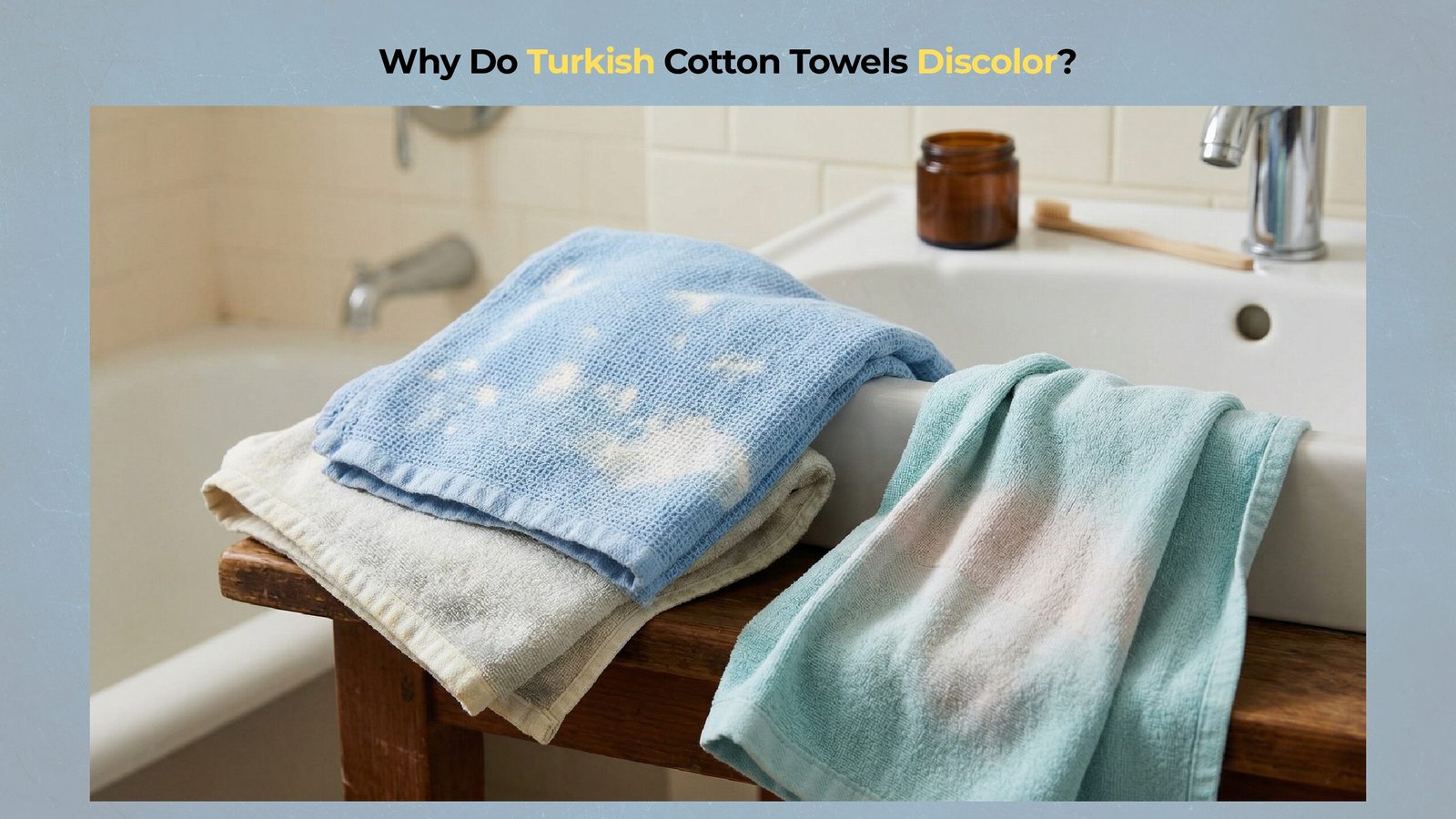
Why Do Turkish Cotton Towels Discolor?
The gradual loss of vibrancy or the appearance of localized spots typically results from Turkish cotton towel discoloration, as the interaction between high-tenacity Aegean fibers and external oxidizing agents compromises the molecular integrity of the textile’s dye.
This molecular integrity is sustained by the high-purity cellulose found in Gossypium hirsutum, which provides an expansive wicking surface area but also remains highly reactive to atmospheric and chemical triggers. This fiber reactivity ensures that the towel remains susceptible to aesthetic degradation if environmental pH levels or chemical catalysts are not strictly managed within residential or hospitality laundry cycles.
Technical Mandate:
This guide audits the oxidation chemistry, pH-neutrality, and mineral incrustation of Aegean cotton to verify Turkish cotton towel discoloration and provide technical steps for color preservation.
Why Do Chemical Catalysts and Minerals Trigger Turkish Cotton Towel Discoloration?
Turkish cotton towel discoloration is influenced by three primary stressors: chemical oxidation from skincare acids, high-alkaline detergent residues, and the accumulation of hard-water mineral salts.
The loss of color vibrancy in Aegean textiles begins when external oxidizers disrupt the molecular structure of reactive dyes. To understand how these chemical interactions affect overall textile performance, it is useful to explore how chemical residues affect Turkish cotton towel performance and fiber integrity.
These primary stressors act as catalysts that destabilize the ionic or covalent bonds of the textile dyes. By disrupting the dye chromophores, these agents fundamentally alter light reflection on the fiber surface, manifesting as visible hue shifts.
How Do Specific Chemicals Facilitate Turkish Cotton Towel Discoloration?
Permanent orange or white spots frequently result from Turkish cotton towel discoloration when the fibers contact benzoyl peroxide or sodium hypochlorite (chlorine bleach), which systematically strips the pigment from the cellulose core.
Oxidative catalysts such as benzoyl peroxide and chlorine bleach can permanently break dye chromophores within the fiber structure. Since this same mechanism also weakens the cellulose backbone, a logical next step is to review what causes fiber breakdown in Turkish cotton towels.
According to the AATCC 188 protocol for colorfastness, repeated exposure to strong oxidizers results in a measurable decline in color intensity and can significantly reduce the textile’s tensile strength. Benzoyl peroxide acts as a slow-release oxidizer that creates permanent “bleached” patches long before the first wash, as the chemical remains active within the fiber matrix until thermal agitation occurs in the laundry.
How Does Mineral Buildup Result in Turkish Cotton Towel Discoloration?
Turkish cotton towel discoloration can manifest as a “grayed” or “dingy” appearance when calcium and magnesium ions from hard water bind to the fiber surface to form a rigid mineral crust.
Mineral incrustation from hard water creates a surface layer that masks the original dye and traps contaminants. Because this buildup also affects moisture interaction, it is helpful to understand how washing improves absorbency in Turkish cotton towels.
Referencing the ISO 105-C06 standard for wash fastness, mineral incrustation can increase dry fabric mass by several percent over time, creating a “dull” visual layer. This crust acts as a “Crystalline Shield” that traps organic soil and detergent residues, effectively graying the textile and neutralizing the original vibrancy of the Aegean dye.
How Does Molecular Physics Influence Turkish Cotton Towel Discoloration Resistance?
Molecular physics influence Turkish cotton towel discoloration through the strength of the covalent or ionic bonds established between the dye molecules and the Aegean cellulose chains.
Dye stability depends on how well pigment molecules bond to the cellulose structure of the fiber. Since this structure originates at the microscopic level, you may want to explore what the fiber structure of Turkish cotton towels looks like and how it affects performance.
These molecular bonds dictate the kinetic threshold required for an external agent to displace a pigment molecule. High-energy Aegean cotton offers a superior substrate for dye anchoring, yet this same surface area increases the probability of oxidative collisions.
Why Does Dye-Bond Oxidation Lead to Irreversible Turkish Cotton Towel Discoloration?
Irreversible Turkish cotton towel discoloration occurs if high kinetic energy from oxidizing agents breaks the molecular structures of reactive dyes, rendering them colorless at the point of contact.
Research published in the Textile Research Journal indicates that chemical oxidation typically represents a “Point-of-No-Return” for pigmented textiles. Once the chromophore is cleaved by an acid or peroxide, the color cannot be “washed back” into the fiber, as the chemical structure of the dye itself has been permanently altered.
Use This Matrix to Evaluate the Mechanisms of Turkish Cotton Towel Discoloration
Systematically auditing the drivers of Turkish cotton towel discoloration requires a causative analysis of thermal, chemical, and mineral stressors.
| Cause | Physical Mechanism | Result for Turkish Cotton Towels |
|---|---|---|
| Benzoyl Peroxide | Chemical Oxidation | Permanent “Bleached” orange/white spots |
| High-Alkaline Soap | Dye Leaching | Uniform fading and loss of vibrancy |
| Chlorine Bleach | Molecular Oxidation | Brittle filaments and premature “balding” |
| Hard Water | Mineral Incrustation | Graying and loss of tactile softness |
Does Staple Length Influence the Visual Appearance of Turkish Cotton Towel Discoloration?
Perceived Turkish cotton towel discoloration is minimized when utilizing fibers exceeding $28.5\text{ mm}$ in length because longer staple lengths generally improve durability against the pilling that creates a “frosty” appearance.
Mechanical surface damage can create a “frosting” effect that mimics fading by scattering light across broken fibers. Because this effect is closely tied to fiber fragmentation, it is useful to review why Turkish cotton towels shed or lint during use.
Utilizing Nazilli 84 cultivar maturity benchmarks, high fiber uniformity ($UI > 82\%$) reduces the density of short fibers that typically break and entangle. “Mechanical Fading” is often a visual illusion caused by surface pilling scattering light, rather than actual pigment loss.
Technical Term: Frosting — The visual lightening of a colored textile caused by the entanglement of broken micro-fibers (pills) on the surface, which alters light refraction and mimics fading.
Which Textile Variants Should You Select to Mitigate Turkish Cotton Towel Discoloration?
Selecting optimized textile finishes can mitigate Turkish cotton towel discoloration by identifying dye-application methods that are technically engineered to resist common household oxidizers.
Repeated exposure to harsh chemicals and high temperatures accelerates both dye loss and fiber degradation. Since this directly impacts long-term usability, it is helpful to explore how durable Turkish cotton towels are over time with regular use.
| Priority | Recommended Finish | Technical Result | Rank |
|---|---|---|---|
| Bleach Resistance | Indanthrene-Dyed | Dyes are molecularly “locked” against bleach | 1 (Elite) |
| Cosmetic Safety | “Medication-Resistant” | Treated to resist skincare acid oxidation | 2 |
| Max Vibrancy | Yarn-Dyed Long-Staple | Deepest color penetration; resists graying | 3 |
| Easy Maintenance | Optical White | Can be whitened without “fading” concerns | 4 |
Which Specific Laundry Protocols Prevent Turkish Cotton Towel Discoloration?
Preservation of original hue results from maintenance protocols that support Turkish cotton towel discoloration limits by excluding oxidative chemicals and preventing beauty-product cross-contamination.
How Does “Beauty-Product Separation” Secure Turkish Cotton Towel Discoloration Protection?
Turkish cotton towel discoloration protection is secured when users execute “Beauty-Product Separation,” ensuring that towels are laundered separately from washcloths exposed to active skincare acids.
Following AATCC 130 soil release guidelines, trace amounts of peroxides in wash water can lead to localized spotting even if only one item is contaminated. Separation serves as a mechanical barrier against the “Leaching-Transfer” of bleaching agents during the spin cycle.
Why Do Low-Temperature Cycles Preserve the Profile of Turkish Cotton Towel Discoloration?
Turkish cotton towel discoloration remains controlled when wash temperatures stay at or below $104^{\circ}F$ ($40^{\circ}C$), as lower thermal energy typically prevents the dye-bond relaxation that facilitates bleeding.
Improper drying conditions can weaken fiber flexibility and increase the likelihood of color fading through thermal stress. Because drying methods influence both structure and appearance, you may want to review how drying methods affect Turkish cotton towel performance and longevity.
The ISO 6330 standard for domestic laundering confirms that maintaining temperatures below this threshold supports higher pigment retention over the textile’s lifecycle. High thermal energy provides the kinetic solvent power required to release reactive dyes from the cellulose matrix prematurely.
How Can You Fix Dullness or Spots to Restore Turkish Cotton Towel Discoloration Baselines?
Restoration of the original visual depth results from executing chemical and mechanical resets to revitalize Turkish cotton towel discoloration before fibers reach a terminal brittle state.
Does Mineral Stripping Neutralize the Factors of Turkish Cotton Towel Discoloration?
Turkish cotton towel discoloration regains its original visual luster if a warm vinegar rinse successfully dissolves the calcium “mask” that typically grays the appearance of dyed fibers.
TRSA wash chemistry guidelines indicate that acetic acid (vinegar) dissolves Calcium Carbonate at pH levels below 5.0. This “Chemical Exfoliation” re-exposes the underlying pigment, restoring the saturation levels verified during initial production.
How Does Oxygen-Based Brightening Restore the Original Finish of Turkish Cotton Towel Discoloration?
Restoration of the original brightness for Turkish cotton towel discoloration results from a sodium percarbonate (oxygen bleach) soak that helps lift organic stains without inducing the fiber scission caused by chlorine.
Technical Term: Cellulose Chain Scission — The thermal-chemical breaking of polymer bonds that thins the towel and contributes to visual aging and structural failure.
How Do You Audit Your Linen Set with This Turkish Cotton Towel Discoloration Checklist?
Systematic technical audits verify Turkish cotton towel discoloration levels by ensuring maintenance protocols align with objective structural and aesthetic benchmarks.
Maintaining color integrity requires proper laundering protocols that prevent chemical oxidation and mineral buildup. Since washing routines determine long-term appearance, it is essential to understand how Turkish cotton towels should be washed and cared for.
Quality Audit Checklist
Frequently Asked Questions
Why are my towels getting orange spots? ▼
Can I fix bleached spots on Turkish towels? ▼
Why are my white towels turning yellow or gray? ▼
How often should I perform a mineral strip? ▼
Technical Disclaimer
Technical Disclaimer: The protocols and chemical analyses provided in this guide are for educational purposes based on standard textile engineering benchmarks (AATCC/ISO). Actual Turkish cotton towel discoloration results may vary significantly based on local water mineral content ($ppm$), specific reactive dye formulations, and the concentration of external oxidizing agents. Always test restorative resets on a small, inconspicuous area before full-load application.