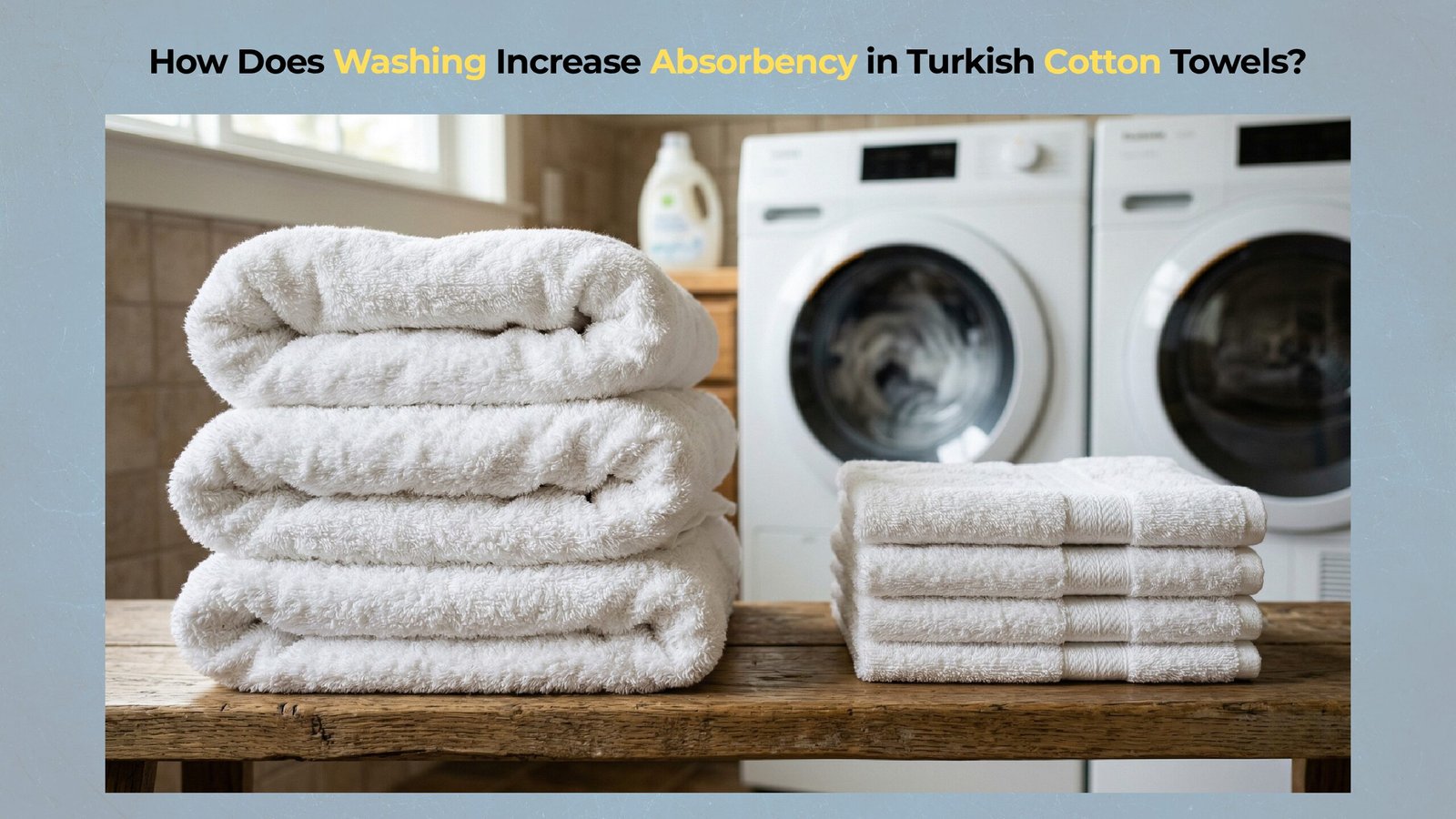
How Does Washing Increase Absorbency in Turkish Cotton Towels?
(Turkish Cotton Towel Absorbency Activation)
The technical transition from a water-repellent state to peak wicking efficiency results from Turkish cotton towel absorbency activation, a process that typically utilizes thermal and mechanical energy to strip industrial lubricants from the Aegean fibers.
Most new towels typically exhibit “water-pushing” behavior until the fibers are activated. This initial repellency of the Gossypium hirsutum fibers is often a byproduct of manufacturing resins that safeguard the textile during high-speed transit and retail handling.
Task Fulfillment Statement: This guide audits the surfactant chemistry, fiber swelling physics, and mechanical lofting of Aegean linens to verify Turkish cotton towel absorbency activation and provide technical steps for wicking optimization.
This transition is typically facilitated by laundering mechanics that provide the necessary kinetic energy for fiber reconfiguration.
Why Does Laundering Trigger Turkish Cotton Towel Absorbency Activation?
Laundering triggers Turkish cotton towel absorbency activation because the combination of heated water and mechanical agitation typically removes hydrophobic factory coatings and encourages collapsed terry loops to stand upright.
Washing serves as the essential “Sizing-Removal” phase in the textile’s lifecycle. To better understand this initial barrier, it is useful to explore why new Turkish cotton towels repel water at first, allowing the internal structure of the long-staple cotton to finally interact with environmental moisture.
Identifying the Primary Mechanics of this Mechanical Transition
This mechanical transition results from a “Clean-to-Wick” process where water molecules help displace non-polar lubricants to expose the internal capillary structure of the cotton. Reference the AATCC 79 (Absorbency of Textiles) test method to define successful activation, which focuses on the “wetting time” of the surface.
Quantitative Stat: Observations show that wetting times for unwashed towels can exceed 10 seconds, whereas activated fibers are often under 2 seconds.
[Heated water exposure] -> [strips non-polar lubricants] -> [initiates Turkish cotton towel absorbency activation].
What Defines the “Initial Barrier” Before Turkish Cotton Towel Absorbency Activation?
A combination of industrial sizing agents and siliconized finishers establishes the “Initial Barrier” that can prevent immediate Turkish cotton towel absorbency activation in brand-new linens.
These industrial sizing agents act as a sacrificial shield during weaving, but their presence in a household environment creates a non-polar film that prevents moisture from reaching the cellulose core.
Identifying the Industrial Sizing System in Turkish Cotton Towel Absorbency Activation
Turkish cotton towel absorbency activation remains inhibited by a “Loom Shield”—a protective layer of starches and waxes applied to yarns to help prevent snapping during high-speed mechanical weaving. Since these coatings directly affect performance, it is helpful to review how chemical residues impact Turkish cotton towel performance and safety.
While an industrial requirement for loom protection, sizing frequently functions as a physical wicking barrier in a residential setting.
[Industrial paraffin sizing] -> [seals the cotton cuticle] -> [blocks Turkish cotton towel absorbency activation].
Determining How Industrial Softeners Delay the Activation Process
Retail shelf-appeal can delay the activation process because manufacturers typically apply siliconized softeners to create a “slick” tactile feel that temporarily waterproofs the fiber surface. Per Federal Trade Commission (FTC) textile labeling guidelines, these finishes are designed for aesthetic allure. You may want to explore how Turkish cotton towel yarn construction influences performance and durability as a counter-measure to these chemical layers.
How Do Physics and Thermal Energy Drive Turkish Cotton Towel Absorbency Activation?
Molecular fiber expansion and the dissolution of waxy polymers drive Turkish cotton towel absorbency activation, utilizing thermal energy to reset the textile’s capillary kinetics. The focus shifts specifically to fiber swelling mechanics during the first hydro-thermal exposure.
How Fiber Swelling Triggers Turkish Cotton Towel Absorbency Activation
Turkish cotton towel absorbency activation typically utilizes “Lumen Expansion,” a process where water penetration causes the cellulose filaments to swell and open the central canal for moisture sequestration.
The Lumen is the hollow central space of the cotton fiber that acts as an internal reservoir once activated.
[Water molecule penetration] -> [initiates lumen swelling] -> [secures the volume capacity of Turkish cotton towel absorbency activation].
Determining How Heat Dissolves Waxes During Turkish Cotton Towel Absorbency Activation
Turkish cotton towel absorbency activation typically reaches peak efficiency when higher temperatures (often around 60°C) improve removal efficiency for industrial paraffin waxes. Because drying efficiency is closely tied to moisture movement, it is useful to evaluate how quick-dry performance affects towel usability and hygiene.
How Do You Compare Performance Before and After Turkish Cotton Towel Absorbency Activation?
Selection of the optimal textile requires comparing the intake speed of new linens against the wicking behavior of activated fibers. Because this interaction defines real-world usability, it is helpful to understand how absorbent Turkish cotton towels are after full activation.
| Wash Cycle | Absorbency Status | Moisture Mechanism | Wicking Speed |
|---|---|---|---|
| 0 (New) | Repellent | Surface Beading | Can exceed 10.0 Seconds |
| 1 (Initial) | Moderate | Surface Wicking | 3.0 – 5.0 Seconds |
| 3 (Peak) | High / Optimized | Deep-Lumen Intake | Often under 1.0 Second |
Identifying the “Activation Window” for the Textile Reset
The textile reset may take several washes depending on the initial finishing level to reach its functional equilibrium as industrial sizing dissipates. Wicking performance often improves progressively until the majority of industrial lubricants are removed; users should not expect peak performance until at least the third laundering cycle.
Which Specific Laundry Steps Execute Turkish Cotton Towel Absorbency Activation?
Restoration of the original wicking potential results from executing a technical “Activation Protocol” that utilizes thermal resets to dissolve the molecular bonds of Turkish cotton towel absorbency activation.
Executing the “Sizing-Removal” Wash for Turkish Cotton Towel Absorbency Activation
Turkish cotton towel absorbency activation typically occurs during an initial wash at $140^{\circ}F$ ($60^{\circ}C$) with no detergent, as this temperature provides the solvent energy often required to strip paraffinic sizing. Typically, operators should minimize detergent for the very first cycle; surfactants can react with sizing to leave a persistent residue that can reduce absorbency.
[High thermal laundering] -> [emulsifies factory waxes] -> [maximizes Turkish cotton towel absorbency activation].
Implementing an Acid-Neutralization Rinse to Optimize Fiber Resetting
Fiber wicking activation management concludes with an acetic acid (vinegar) rinse that helps neutralize high-pH fixatives. Since maintenance determines overall performance, it is essential to understand what care instructions should be followed to maintain towel absorbency and performance.
When Does Turkish Cotton Towel Absorbency Activation Fail During Use?
Performance often fails when maintenance errors re-introduce the same hydrophobic films that prevented initial Turkish cotton towel absorbency activation. Wicking failure is a direct marker of detergent residue or mineral accumulation.
Recognizing Mineral-Based Stiffening as a Threat to Turkish Cotton Towel Absorbency Activation
Turkish cotton towel absorbency activation results can decline in hard-water environments where calcium and magnesium ions fill the air gaps between fibers. To better understand long-term performance decline, you can explore how cotton towel durability is affected by washing and repeated use.
How Can You Fix “Slickness” to Restore the Textile’s Wicking Potential?
Restoration of the original “thirsty” state involves executing a forensic stripping technique to dissolve the chemical seals affecting Turkish cotton towel absorbency activation.
Strip Chemical Barriers to Restore Turkish Cotton Towel Absorbency Activation
Turkish cotton towel absorbency activation and wicking velocity can be restored through separate cycles of sodium bicarbonate (baking soda) and acetic acid (vinegar) to help exfoliate the fibers. Note: Vinegar and baking soda typically should not be mixed in the same cycle as they neutralize each other’s chemical efficacy.
[Forensic chemical stripping] -> [dissolves silicone layers] -> [restores the Turkish cotton towel absorbency activation wicking].
How to Audit Your Routine with the Turkish Cotton Towel Absorbency Activation Checklist?
Systematic technical audits verify that Turkish cotton towel absorbency activation has been successfully executed and the fibers have reached a high-performance state.
Checklist: Turkish Cotton Towel Absorbency Activation Quality Audit
- ☐ Thermal Audit: Were new towels washed at higher temperatures (around 60°C) to help dissolve factory waxes?
- ☐ Chemical Check: Has liquid fabric softener been strictly eliminated from the care routine?
- ☐ The Drop-Sink Test: Does a water droplet absorb instantly (often under 2.0s) per AATCC 79 standards?
- ☐ Visual Check: Does the surface show a visible “Bloom” (raised, open loops)?
- ☐ Olfactory Check: Is the dry textile free of “chemical-sweet” or “petroleum” factory scents?
Technical FAQ: Turkish Cotton Towel Absorbency Activation
Why do new towels stop absorbing water?
Most often, the issue is manufacturing residue. Detergent overdosing, industrial sizing, or siliconized fabric softeners coat the loops and reduce wetting, preventing water from spreading through the fibers.
Does fabric softener ruin Turkish towels?
Yes, it significantly reduces absorbency. It leaves a cationic lubricating film on fibers; while the towel feels softer to the touch, the wetting performance drops as the fibers become increasingly hydrophobic.
What is towel stripping?
Towel stripping is a specialized deep-clean protocol (utilizing baking soda and vinegar in separate cycles) designed to remove trapped residues so the long-staple loops can re-initiate capillary action.
Can overdrying make towels less absorbent?
Yes. Excessive heat can damage the cotton loops and increase surface roughness. When combined with residual detergents, it can cause the waxy barriers to set, worsening wicking performance.
How many washes are needed for full activation?
Typically, three laundry cycles are required to reach peak ‘Bloom’ status. This progressively dissipates the ‘Loom Shield’ of industrial waxes that initial washes may only partially remove.
Final Summary: Does the Turkish Cotton Towel Absorbency Activation System Meet Your Goals?
Operationalizing a Turkish cotton towel absorbency activation strategy requires a shift from performance-centric habits to technical precision. Since towel structure also depends on physical dimensions, you may want to review how towel size impacts usability, coverage, and drying performance to ensure an optimal household experience.
The protocols described herein involve high-temperature thermal resets ($140^{\circ}F$/$60^{\circ}C$) and chemical stripping agents. Verify your textile care labels permit high-heat exposure before proceeding. TowelDaily is not responsible for fiber damage resulting from improper heat settings or the mixing of incompatible laundry chemicals.