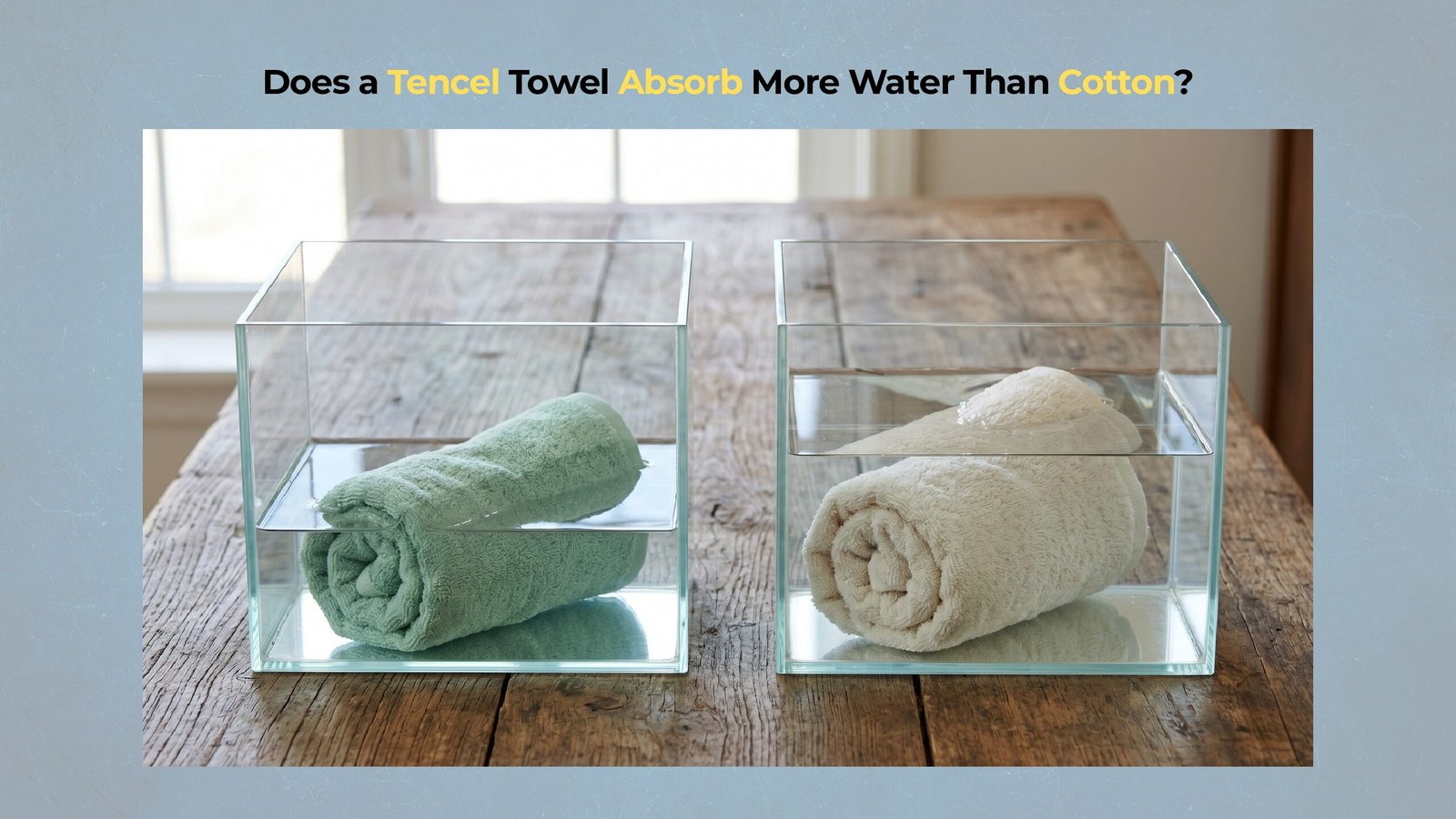
Does a Tencel Towel Absorb More Water Than Cotton?
Tencel towel water absorption provides a superior moisture management solution when hydrophilic lyocell fibers draw liquid away from the skin.
This guide enables users to evaluate Tencel towel water absorption as a high-performance alternative to cotton and provides the laundry protocols required to maintain original wicking speeds.
Traditional cotton towels feel heavy, soggy, and musty if stagnant moisture sits trapped inside their thick loops after a single bath.
Heavy fabrics struggle to dry efficiently if they rely solely on bulk weight-based water storage instead of molecular-level wicking.
Users maintain maximum textile lifespan if they connect these drying concepts directly to our specialized guides on Restoring Scratchy Tencel Textiles and executing Advanced Fiber Hygiene Protocols.
Does Tencel towel water absorption naturally exceed cotton towels?
Tencel towel water absorption exceeds cotton performance because the engineered cellulose structure exhibits a higher native moisture regain.
Tencel fibers absorb water much more efficiently than cotton if users compare their basic molecular properties.
Towels acquire a lingering dampness and stale smell if cotton loops fail to release absorbed water quickly.
Visual dampness transitions into dry comfort if the user understands the sub-microscopic fiber physics that drive regenerated cellulose wicking.
Contrasting these physical engineering variances is simplified if the user understands the foundational cotton towel absorbency factors that govern conventional fiber loops.
How do nanofibrils optimize Tencel towel water absorption at the molecular level?
Tencel towel water absorption increases at the molecular level when hydrophilic nanofibrils pull water molecules directly into the fiber core.
Nanofibrillar moisture transport works faster than simple cotton loop absorption if tiny, water-loving pathways draw moisture deep inside the fiber structure.
Lyocell fibers exhibit a native moisture regain of $13\%$ compared to only $7.9\%$ in conventional cotton under standard testing conditions if we evaluate data from the Journal of Natural Fibers.
Liquid spreads evenly without pooling on the towel surface if the solvent-spun Cellulose II crystalline structure distributes water directly throughout its amorphous regions.
Key Term
Hygroscopicity defines the mechanical ability of a textile fiber to attract and bind water vapor from the surrounding atmosphere if ambient humidity levels rise.
Why does Tencel towel water absorption optimize post-shower drying efficiency for sensitive skin?
Tencel towel water absorption optimizes post-shower drying efficiency because the smooth fiber surface minimizes mechanical friction against sensitive skin.
Eczema flare-ups decrease if the smooth lyocell fibers absorb water without irritating the outer layers of the skin.
Tencel fibers retain $94\%$ of their original softness after $24$ wash cycles, whereas conventional cotton retains only $78\%$ of its original softness if we measure performance using the Textile Research Journal parameters.
The natural lipids of the epidermal barrier remain intact if a towel wicks moisture instantly without requiring harsh scrubbing.
Eliminating post-wash inflammation is achievable if the user masters how Tencel towels support eczema-prone skin to optimize cutaneous comfort.
Key Term
Epidermal Friction occurs if a rough textile surface rubs repeatedly against the skin, which weakens the skin barrier and triggers inflammatory reactions.
Which washing routines preserve Tencel towel water absorption capacity over time?
Tencel towel water absorption capacity remains high over years of use if washing routines eliminate hydrophobic residues.
The towel retains its original absorbency if the user cleans the fabric without leaving thick chemical coatings.
Laundry care becomes highly effective if users take direct control over wash cycles to protect their textile investments.
Absorbent pathways remain fully open if the user avoids the waxy compounds found in standard laundry products.
How do users wash textiles to prevent Tencel towel water absorption loss?
Tencel towel water absorption loss occurs if fabric softeners deposit a waxy chemical coating over the fiber pores.
Wicking channels clog up if users add standard softeners that seal the outer layer of the cellulose.
Cellulosic wicking speeds drop by up to $30\%$ after only $3$ wash cycles if users wash towels with standard cationic softeners according to American Cleaning Institute guidelines.
Water is repelled from the towel surface if cationic surfactants bind to the negative charge of wet cellulose and leave a hydrophobic tail pointing outward.
Identical chemical interference occurs in other textiles if users evaluate the destructive fabric softener impact on Egyptian cotton absorbency.
Key Term
Cationic Surfactants reduce towel absorbency if their positively charged molecules attach to wet cellulose fibers and create a water-repelling barrier.
Does optimizing drying conditions resolve saturated Tencel towel water absorption dampness?
Tencel towel water absorption remains efficient if users prevent mold growth by matching bathroom drying habits to fiber saturation limits.
Damp musty odors are easily avoided if towels dry completely within a well-ventilated space.
Stale mildew smells never develop if air flows freely through the hanging towel.
Fast drying speeds remain steady if users protect the delicate cellulose from heat damage.
How do users dry damp textiles to maintain a high Tencel towel water absorption profile?
Tencel towel water absorption profiles suffer if high heat exposure makes the bio-based cellulose fibers brittle and closes the wicking channels.
Wicking speeds remain optimal if towels dry on a low-temperature cycle or a simple clothesline.
Regenerated cellulose fibers suffer a $15\%$ permanent loss in tensile elasticity if they experience drying temperatures exceeding $60^\circ\text{C}$ according to research in the Journal of Applied Polymer Science.
Capillary pores bake permanently closed if high thermal energy causes the amorphous regions of the lyocell fiber to collapse.
Laundering parameters remain safe if the user evaluates our complete resource on Tencel towel durability and fiber integrity to prevent structural degradation.
Key Term
Thermal Degradation permanently limits moisture transport if heat exposure breaks down the molecular chains of the bio-based cellulose.
How do users compare long-term Tencel towel water absorption before making a purchase?
Tencel towel water absorption performance is verified when users evaluate long-term fiber durability before purchasing.
The best buying choices are made if the customer compares wicking speeds and fiber blend ratios before spending money.
Users avoid buying poor-quality towels if they demand certified organic materials and check performance specifications.
Executing an informed purchase decision is simplified if the customer consults our catalog of towel fabric materials and performance parameters.
Shopping mistakes are eliminated if the buyer relies on a structured visual performance audit to test their textile inventory.
📊 How do users execute the Tencel towel water absorption audit and performance checklist?
Tencel towel water absorption efficiency is maintained when users run a structured visual performance audit on their textile inventory.
Deteriorating towels are quickly spotted if users track physical wicking speeds and softness over time.
| Fabric Type | Max Absorption (Regain) | Wicking Speed | Wet Softness Retained | Clogging Susceptibility |
|---|---|---|---|---|
| Tencel Lyocell ($100\%$) | $13\%$ | $50\%$ faster than cotton | $94\%$ after $24$ washes | Critical (Avoid Softener) |
| Conventional Cotton | $7.9\%$ | Baseline | $78\%$ after $24$ washes | Moderate |
| Tencel-Cotton Blend ($50/50$) | $10.5\%$ | $25\%$ faster than cotton | $86\%$ after $24$ washes | Moderate-High |
Tencel Towel Performance Checklist
- ☐ Tencel towels dry completely within $4$ hours if hung in a ventilated bathroom space.
- ☐ The fabric absorbs water instantly if a single drop hits the surface.
- ☐ Towels feel soft to the touch after $24$ wash cycles if the user avoids high heat.
- ☐ Waxy buildup is fully avoided if cationic surfactants are excluded from the laundry routine.
Frequently Asked Questions About Tencel Towel Water Absorption
Tencel towel water absorption questions are instantly resolved if the user reviews the underlying mechanical and chemical transport principles.
Why does a Tencel towel absorb more water than a cotton towel?
High-speed capillary wicking happens if a Tencel towel leverages its parallel nanofibrillar alignment instead of relying on cotton’s stagnant central lumen.
What happens to Tencel towel water absorption if fabric softener is used?
A critical $30\%$ drop in wicking speed occurs if cationic surfactants deposit a hydrophobic waxy coating over the Cellulose II pores.
How is Tencel towel water absorption preserved during the drying cycle?
Structural capillary collapse is fully avoided if the drying temperature is restricted below the critical thermal threshold of $60^\circ\text{C}$.
Why does Tencel towel water absorption protect sensitive skin?
Inflammatory epidermal friction is significantly minimized if smooth lyocell fibers absorb moisture instantly without requiring physical skin scrubbing.
How frequently should a user strip towels if residue buildup limits water intake?
Peak wicking performance is restored if a residue-stripping wash is executed every $6$ weeks using a vinegar-based rinse cycle.
Tencel towel water absorption remains superior over the lifespan of the textile if the user synthesizes the core principles of molecular wicking, residue-free washing, and low-heat drying.
Rapid wicking continues if the user protects the sub-microscopic channels from chemical clogs and thermal collapse.
Sensitive skin enjoys luxurious, frictionless drying if Tencel towels remain clean and open.
The premium textile investment delivers maximum performance for years if these simple care protocols are followed.
⚠️ Textile Physics & Health Disclaimer
Textile evaluation accuracy is guaranteed only if users recognize that this guide serves educational purposes. Dermatological relief is optimized if individuals seek professional medical advice for persistent skin conditions. Variations in wicking performance will occur if local water minerals or alternative laundering appliances are utilized.