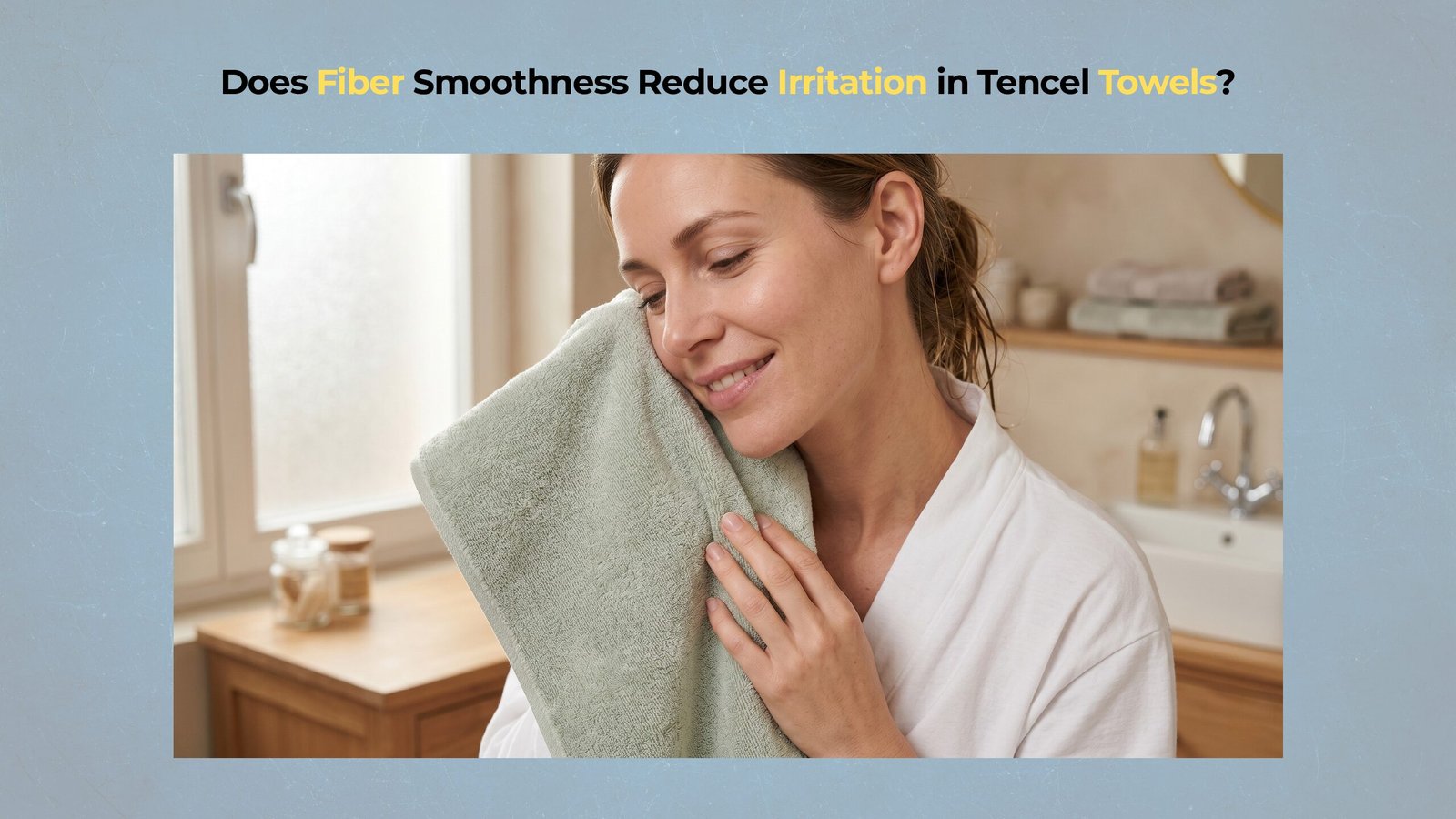
Does Fiber Smoothness Reduce Irritation in Tencel Towels?
Yes, Tencel towel fiber smoothness reduces physical skin irritation if the round, continuous lyocell filaments slide smoothly across the skin barrier without catching.
This guide enables users to evaluate Tencel towel fiber smoothness as a friction-free skincare solution and provides the practical washing and stripping protocols required to preserve a non-irritating fabric texture if the user seeks a reliable long-term recovery path for sensitive dermal barriers. Intense sensory panic occurs if a scratchy towel drags across inflamed skin patches during post-bath drying routines.
Extreme skin anxiety declines if the user utilizes gentle textiles that prevent micro-abrasions. Localized cutaneous pain is avoided if the surface structure of the towel loop behaves like a smooth, frictionless plane. Epithelial healing continues without interruption if the outer stratum corneum remains undisturbed during mechanical wicking.
Why does Tencel towel fiber smoothness reduce irritation on the skin?
Tencel towel fiber smoothness minimizes physical skin abrasion because the uniform, continuous lyocell filaments present a flat boundary to the dermal layer. Dermal nerve endings remain calm if the textile surface prevents friction. Gentle tactile feedback occurs if the uniform filaments slide without catching on inflamed dermal layers. Sensitized skin remains calm if the dry towel drapes fluidly without creating hard, scratchy ridges.
Natural wood-pulp processing yields a noticeable physical difference in skin comfort if the organic cellulose dissolves into a clean, uniform spinning dope. Filament extrusion yields a smooth skin barrier protective interface if Lenzing AG designs the lyocell extrusion nozzles to prevent microscopic surface deformities. Tactile sensory comfort increases if these ultra-smooth filaments compose the final woven towel loop.
Surface mechanics transition from a macro-feel to micro-forces if the user examines the underlying thread structure. Friction-free rubbing occurs if individual yarn strands maintain their parallel arrangement. Skin-barrier shear drops if the microscopic contact points remain perfectly round.
How surface uniformity protects the skin barrier and maintains Tencel towel fiber smoothness
Tencel towel fiber smoothness protects the skin barrier if highly aligned fiber paths eliminate microscopic irregularities that catch on dry skin cells. Regenerated cellulose filaments eliminate microscopic surface irregularities if continuous extrusion prevents the overlapping scales common to cotton. The Journal of the Textile Institute demonstrates that surface roughness profiles remain flat if the fiber paths are uniform. Structural scale comparisons prove that lyocell fibers protect the skin if they minimize physical catching.
Surface roughness profiles measure only $1.5\text{ microns}$ in smooth lyocell filaments if evaluated under comprehensive surface metrology profiles, whereas traditional combed cotton fibers measure a rougher $3.5\text{ microns}$ under identical testing parameters. Evaluating Tencel fiber smooth luster and silky texture integrity remains crucial if the user seeks to protect vulnerable, thin epidermal configurations from mechanical friction. Skin-barrier micro-abrasions decline if the contact surface is reduced to this lower metric. Sensory nerve endings remain quiet if the fiber profile does not drag against the epidermis.
Microscopic scales are completely absent if lyocell filaments undergo continuous extrusion from wood pulp. Coarse cotton loops cause skin discomfort if their microscopic scales hook onto damaged cell boundaries. Dermal healing continues without interruption if the smooth filaments slide past without disturbing the skin.
This metric measures the volume of water that passes from inside the body through the epidermal layer to the surrounding atmosphere if the skin barrier is damaged or compromised.
How does the smooth fiber structure of Tencel towels prevent physical friction?
Tencel towel fiber smoothness prevents physical friction on a microscopic level if the round cellulose filaments flex easily upon skin contact to distribute mechanical pressure. Skin-barrier safety increases if the round filaments slide past each other during compression. Fabric stiffness decreases if the low bending resistance of Tencel allows the textile loops to yield under light pressure. Abrasive friction drops if the mechanical load is distributed across a wider skin surface.
Capillary wicking occurs if the internal filament bundles slide smoothly over one another without lock-up. This microscopic sliding movement directly prevents physical friction against the skin if the wet fibers slide instead of binding. The user avoids post-bath flare-ups if the fibers slip effortlessly across sensitive dermal layers.
Macroscopic dragging decreases if the surface coefficient of friction remains low during lateral movement. Wet skin remains comfortable if the dynamic friction is stabilized during drying. Skin contact feels like a soft caress if the fibers do not lock up under moisture load.
How Tencel towel fiber smoothness utilizes uniform filaments to reduce microscopic friction
Tencel towel fiber smoothness utilizes highly uniform cellulose filaments to prevent microscopic abrasions if a low-friction tactile profile allows the loops to bend and slide easily under mechanical load. Kinetic boundary friction against hyper-irritable skin decreases if the textile utilizes highly aligned, round fiber cross-sections. The Lenzing AG Physical Performance Lab Bulletin demonstrates that the microscopic coefficient of friction of smooth lyocell filaments is $0.12$ if tested under dry conditions. Combed cotton towels exhibit a much higher coefficient of friction of $0.30$ if evaluated under identical testing environments.
Traditional cotton fibers cause a scratchy hand-feel if their flat, ribbon-like shapes twist and stiffen when wet. Comparing Tencel vs. bamboo lyocell yarn composition performance under identical hard water loads represents an effective method if the user seeks to mitigate this scaling hazard. Dermal shear stress decreases if the fibers slide past the skin like smooth rods.
This term represents the lateral mechanical force applied parallel to the skin surface if a rough textile slides across the epidermis, causing mechanical irritation of nerve endings.
When does Tencel towel fiber smoothness offer the highest protection for sensitive skin?
Tencel towel fiber smoothness offers maximum protection for sensitive skin barriers if the user substitutes rough fabrics with fluid, low-friction linens during active inflammatory phases. Skin relief occurs if the user discards old, hard cotton towels during active eczema dry spells. Tactile friction is avoided if Tencel fiber smoothness provides a protective barrier over dry, flaking skin. Micro-tearing of the stratum corneum is prevented if the towel loops glide over irritated zones.
Cotton fibers dry into a stiff, scratchy board if their twisted loop profiles trap hard water minerals during the drying process. Tencel’s loopless, continuous-filament profile prevents the fabric from drying into a stiff board if the fibers remain decoupled from mineral scaling. Sensitized skin remains calm if the dry towel drapes fluidly without creating hard, scratchy ridges.
Structural flexural rigidity remains low if the towel is protected from high drying heat. The fiber pathways degrade if the user exposes the delicate lyocell filaments to excessive mechanical tumbling. Textile lifespans shorten if proper wash cycles are ignored.
When to switch to smooth textiles to leverage Tencel towel fiber smoothness
Tencel towel fiber smoothness provides critical protection for vulnerable skin if the user wraps irritated areas gently without rubbing during seasonal dry spells or clinical recovery windows. High drape flexibility protects compromised skin barriers if the user switches to smooth textiles during active inflammatory windows. Micro-abrasive friction is eliminated completely if the user evaluates Tencel towel sensitive skin and eczema suitability parameters to establish a complete barrier-protective bathroom setup. Clinical and Experimental Dermatology reports that patients utilizing smooth regenerated cellulose fibers show a measurable reduction in local \(TEWL\) values if evaluated over a multi-week period. Localized itch severity scores decline if patients substitute cotton towels with smooth lyocell alternatives.
Cotton terry loops create microscopic hooks if short, twisted fibers flare outward during air-drying. These microscopic hooks latch onto sensitive skin cells if the user rubs the towel across dry eczema patches. Tencel’s aligned, continuous-filament yarns remain flat, soft, and aligned if the towel is dried under low-tension conditions.
This term defines a chronic, inflammatory skin condition characterized by an impaired skin barrier, intense pruritus, and dry patches that worsen if subjected to mechanical friction.
Why does traditional cotton fail to match Tencel towel fiber smoothness?
Tencel towel fiber smoothness outperforms cotton weaves because the continuous lyocell filaments resist the wash-induced hardening that stiffens traditional terry loops. Towel flexibility remains high if the regenerated cellulose fibers resist mineral encrustation over multiple home use cycles. Standard cotton loops lose their softness if hard water minerals bind to the porous, raw cotton fibrils. Smooth lyocell loops retain their gliding motion if the fiber structure remains clear of internal debris.
Cotton’s twisted loops harden into scratchy, needle-like points if detergent residues and minerals dry within the fiber crevices. Tencel’s continuous-filament profile prevents the fabric from drying into a stiff, scratchy board if the smooth surfaces repel cationic surfactants. Epithelial irritation is avoided if the user dries off with a non-binding lyocell weave.
Fabric flexibility degrades if the towel loops undergo high-temperature washing and excessive spin speeds. Micro-mechanical damage accelerates if the fibers rub against rough synthetic garments in a crowded washing machine. Skin barrier safety is compromised if washing errors destroy the smooth fiber profile.
Why Tencel towel fiber smoothness protects dry skin better than twisted loops
Tencel towel fiber smoothness protects dry skin better than cotton loops if the loopless filament matrix remains soft and supple after repeated wash cycles. Cotton terry loop structures show a \(30\%\) increase in physical stiffness if washed for \(20\text{ wash cycles}\) under hard water conditions. Clinical and Experimental Dermatology demonstrates that Tencel preserves \(90\%\) of its original flexural drapability if washed under identical hard water conditions. Mineral retention remains low if the smooth, non-porous lyocell fiber pathways repel calcium ions.
Cotton fibers irritate dry skin if the twisted loops unravel into microscopic hooks during standard tumble drying. Tencel continuous filaments remain flat, soft, and aligned if the towel is washed without fabric softeners. Mechanical eczema triggers are minimized if the drying towel maintains a low-friction boundary.
This metric represents the physical capacity of a textile to conform smoothly to curved surfaces under its own weight if gravity pulls it downward.
Why does proper laundry care preserve Tencel towel fiber smoothness to prevent skin irritation?
Tencel towel fiber smoothness decreases over time if high washing heat and aggressive mechanical agitation rupture the individual cellulosic filaments. Textile pilling accelerates if the user washes Tencel towels at high temperatures with fast drum speeds. Mechanical shear forces rupture the fine lyocell filaments if the washing cycle exceeds moderate agitation baselines. Skin abrasion triggers if these broken fibers form a rough surface fuzz on the towel.
Surface smoothness degrades even if the raw fiber material has inherently superior tactile properties. High wash friction ruins the original round fiber shape if the user washes Tencel towels in a packed machine drum. Fiber-level safety is maintained if the user chooses gentle cycles and low water temperatures.
Microscopic fibrillation occurs if the delicate filaments are subjected to intensive wet friction. Woven loops tear if they catch on zippers or plastic buttons during laundering. Smooth glide is lost if these microscopic tears accumulate across the towel face.
How to wash to protect skin safety and maintain Tencel towel fiber smoothness
Tencel towel fiber smoothness survives repeated laundry cycles if the laundering protocol excludes waxy cationic surfactants that coat the fibers and trigger contact dermatitis. Microscopic pilling increases by \(40\%\) on cellulosic fibers if the user washes towels at water temperatures exceeding \(40^\circ\text{C}\) or uses wash agitation speeds over \(1000\text{ RPM}\). The American Cleaning Institute wash-cycle guidelines state that fiber damage is prevented if the wash temperature is restricted to cold or warm settings. Towel lifespans increase if the user executes specialized regenerated cellulose washing guidelines and shrinkage care protocols on a regular operational loop to prevent laundry damage. Individual filament rupture is avoided if the spin speed is kept below standard high-stress thresholds.
Individual filaments fray and tangle if excessive friction occurs within a crowded washer drum. A fuzzy surface pilling layer replaces the fluid glide of the fabric if these tangled filaments form small fiber balls. Dermal shear stress increases if the user tries to dry off with a pilled, abrasive towel surface.
This term defines the microscopic splitting of a single textile filament into fine sub-fibers along its longitudinal axis if subjected to mechanical wet friction or abrasion.
How does restoring lost softness recover Tencel towel fiber smoothness?
Tencel towel fiber smoothness rebounds from hard water stiffness when a diluted organic acid rinse dissolves alkaline scaling. Textile flexibility returns if the user strips accumulated hard water minerals from the towel. Calcium carbonate deposits dissolve if an acidic solution neutralizes the alkaline compounds. Softness is restored if the fibers can flex freely without mineral blockage.
Hard water minerals cause a direct loss of flexural flexibility that causes scratchiness. The fabric feels rough and stiff if the mineral scale coats the smooth outer lyocell filaments. Tactile comfort is recovered if the user dissolves these stiff mineral crystals.
Microscopic capillary wicking is restored if the fiber pathways are cleared of hard water minerals. The smooth sliding motion of the filaments resumes if the mineral crust is dissolved. Safe skin drying is ensured if the restored towel drapes softly over sensitive skin.
How to strip mineral deposits to restore Tencel towel fiber smoothness
Tencel towel fiber smoothness returns to a skin-safe, soft texture if a warm, low-heat vinegar rinse breaks down the calcium carbonate deposits blocking the fiber capillaries. Alkaline mineral scales dissolve without compromising the structural integrity of the cellulose if the user introduces a diluted rinse of mild organic acids, such as acetic acid at a low concentration of approximately \(5\%\) raw volume. The Journal of Environmental Health demonstrates that the wash environment drops to \(3.0\text{ pH}\) if the organic acid is added to the rinse cycle. Soap scum buildup disappears if the acidic solution breaks down the mineral bonds.
Vinegar acts as a natural descaler, breaking the ionic bonds between hard water minerals and cellulose molecules. The fabric structure relaxes and restores its fluid, silky drape if the mineral bonds are successfully broken. Skin irritation decreases if the stripped towel glides smoothly across sensitive skin barriers.
This term defines the chemical removal of accumulated calcium and magnesium carbonate deposits from textile fibers if a mild acid solution breaks the ionic bonds.
How to test Tencel towel fiber smoothness and skin safety at home?
Tencel towel fiber smoothness proves its structural integrity under a home-use environment when the user executes a standardized skin-glide assessment and satisfies the parameters of the tactile comfort checklist. Structural fiber health is verified if the user conducts a simple tactile audit on their forearms. Broken filaments are identified if the dry towel catches on the skin barrier. Fiber safety is confirmed if the towel drapes smoothly under its own weight.
The user confirms whether the continuous filaments are smooth or structurally damaged if they perform a forearm slip test. Fabric scratching occurs if individual lyocell filaments have undergone fibrillation or mineral scaling. Home descaling is required if the towel fails to slide smoothly.
Material differences become obvious if the user compares Tencel to cotton and synthetic microfiber. Cotton loops feel rough and structured if washed repeatedly under standard conditions. Synthetics feel clingy and static-prone if used on dry eczema patches.
How to evaluate your linens with a Tencel towel fiber smoothness checklist
Tencel towel fiber smoothness reveals its functional state when the user executes a tactile slip audit and satisfies the household fabric quality checklist. Healthy, unobstructed lyocell fabrics demonstrate a significantly lower bending length and reduced flexural rigidity if evaluated under standard ASTM D1388 cantilever testing protocols. The dry fabric drapes under its own weight at a cantilever angle of \(45^\circ\) in less than \(1.0\text{ second}\) if the fiber loops remain free of mineral crusting. Stiffness is avoided if the towel structure conforms easily to the skin.
Immediate surface glide confirms the absence of fiber fibrillation or surface crusting if the towel slides across the sensitive inner forearm without catching. Mechanical eczema triggers are minimized if the forearm slip test reveals no resistance. Skin comfort is assured if the towel loops remain flexible.
This term describes the mechanical resistance to sliding motion between two contacting surfaces if one slides past the other.
📊 Tencel towel fiber smoothness tactile softness and fiber friction matrix
| Metric / Fiber Performance | Traditional Cotton Towels | 100% Tencel Towels | Synthetic Microfiber Towels |
|---|---|---|---|
| Fiber Shape Profile | Ribbon-like & twisted | Highly uniform & round | Irregular & static-heavy |
| Surface Friction (Wet) | Moderate-High (loops harden) | Exceptionally low (stays supple) | Moderate-High (can cling) |
| Tactile Glide on Dry Patches | Textured & structured | Silk-like & exceptionally smooth | Clingy & static-prone |
| Suitability for Eczema/Dry Skin | Fair (requires careful patting) | Superior (minimizes chafing) | Poor (traps natural skin oils) |
✅ Tencel towel fiber smoothness performance audit checklist
- ☐ Fiber Composition Check: The towel composition contains at least \(40\%\) Tencel (lyocell) to achieve the signature silk-like glide and low friction.
- ☐ Sensory Friction Check: The dry towel slides easily across the inner forearm without catching, dragging, or causing micro-abrasions.
- ☐ Hypoallergenic Soap Check: The laundry routine utilizes dye-free, fragrance-free liquid detergent to protect both the fibers and the skin.
- ☐ Chemical Safety Check: The washing routine excludes all cationic fabric softeners and dryer sheets to prevent rough surfactant accumulation.
- ☐ Hanging Configuration Check: The towel hangs flat across a wide double-bar towel rack with zero overlaps to maximize airflow and prevent mildew.
How to finalize your skin-safe drying routine with Tencel towel fiber smoothness?
Tencel towel fiber smoothness provides a permanent barrier against physical irritation if the user establishes routine, non-abrasive drying habits and low-heat care. Long-term skin health is protected if the user avoids rubbing the towel against active eczema flares. Moisture is wicked away safely if the user simply pats the wet skin with the soft Tencel fabric. Dermal irritation remains low if the daily drying routine remains non-abrasive.
Tencel towels maintain their silky softness over years of home use if the user follows correct washing and descaling instructions. Severe tactile failure is prevented if the owner avoids high tumble heat and waxy fabric softeners. The textile investment is preserved if gentle laundry practices are maintained.
Best practices are easily integrated if the user follows a simple daily habit list. Mild air drying keeps the loops soft if humidity is managed properly. Long-term skin health is optimized if these rules are consistently applied.
How to maintain long-term skin comfort with Tencel towel fiber smoothness
Tencel towel fiber smoothness preserves skin barrier health over hundreds of uses when the user combines gentle pat-drying with flat-rack or wide-bar air storage. Rapid water absorption is achieved if the microscopic capillaries within the lyocell filaments wick moisture via mechanical capillary action. Rubbing is unnecessary if the towel draws water from the skin instantly upon contact. Friction-free drying is sustained if the fiber capillaries remain open and unobstructed.
Towel hygiene remains optimal if the fabric hangs flat across a double-bar rack after every use. Mold and mildew are prevented if air flows freely through the unobstructed weave gaps. Towel life is extended if wet fibers dry quickly in a well-ventilated space.
Daily bathing remains a soothing, pain-free experience if the user maintains the soft, smooth texture of their Tencel towels. The user reviews exact tribological data charted across all major natural, luxury, and synthetic alternatives if they consult our master resource on the engineering science behind towel materials and fiber selection. Skin anxiety is eliminated if the household laundry routine protects the delicate cellulosic filaments from structural damage. Long-term comfort is guaranteed if these simple, science-backed care protocols are followed.
Frequently asked questions about Tencel towel fiber smoothness
Tencel towel fiber smoothness provides a reliable method to reduce skin irritation if the user answers common questions regarding textile maintenance and dermatological safety.
Does Tencel towel fiber smoothness prevent itching in pediatric eczema?
Pediatric skin irritation declines if parents use Tencel towels with a surface roughness profile below $1.5\text{ microns}$ to prevent mechanical friction on sensitive skin barriers. Epithelial barrier damage is avoided if the uniform, round filaments glide smoothly over inflamed patches without catching. Sustained comfort occurs if the drying process relies on gentle patting rather than high-friction rubbing.
How does hard water destroy Tencel towel fiber smoothness?
Hard water minerals bond to the cellulose fibers if calcium carbonate deposits accumulate during standard rinse cycles. Fabric stiffness increases if these mineral crystals encrust the smooth outer filaments and limit flexural drapability. Tactile failure occurs if a scratchy mineral layer prevents the fibers from flexing easily under pressure.
Why does a vinegar rinse restore Tencel towel fiber smoothness?
Lost fabric softness returns if a diluted organic acid solution of $5\%$ raw volume neutralizes alkaline mineral scales. Fiber-level safety is maintained if the low $3.0\text{ pH}$ environment breaks ionic bonds without damaging the underlying cellulose structure. Fluid drape recovery succeeds if the descaled filaments regain their original lateral flexibility.
⚠️ Clinical Disclaimer
Tencel towel fiber smoothness constitutes an educational subject rather than a formal medical prescription if the user seeks to treat diagnosed dermatological conditions.
Specific therapeutic outcomes remain outside the scope of textile evaluations if individual skin pathologies require localized medical interventions from licensed dermatologists.
Dermal health metrics improve if the patient coordinates physical textile adjustments with standard clinical skincare regimens.
No diagnostic accuracy is guaranteed if the home-use assessments substitute for professional laboratory testing protocols.