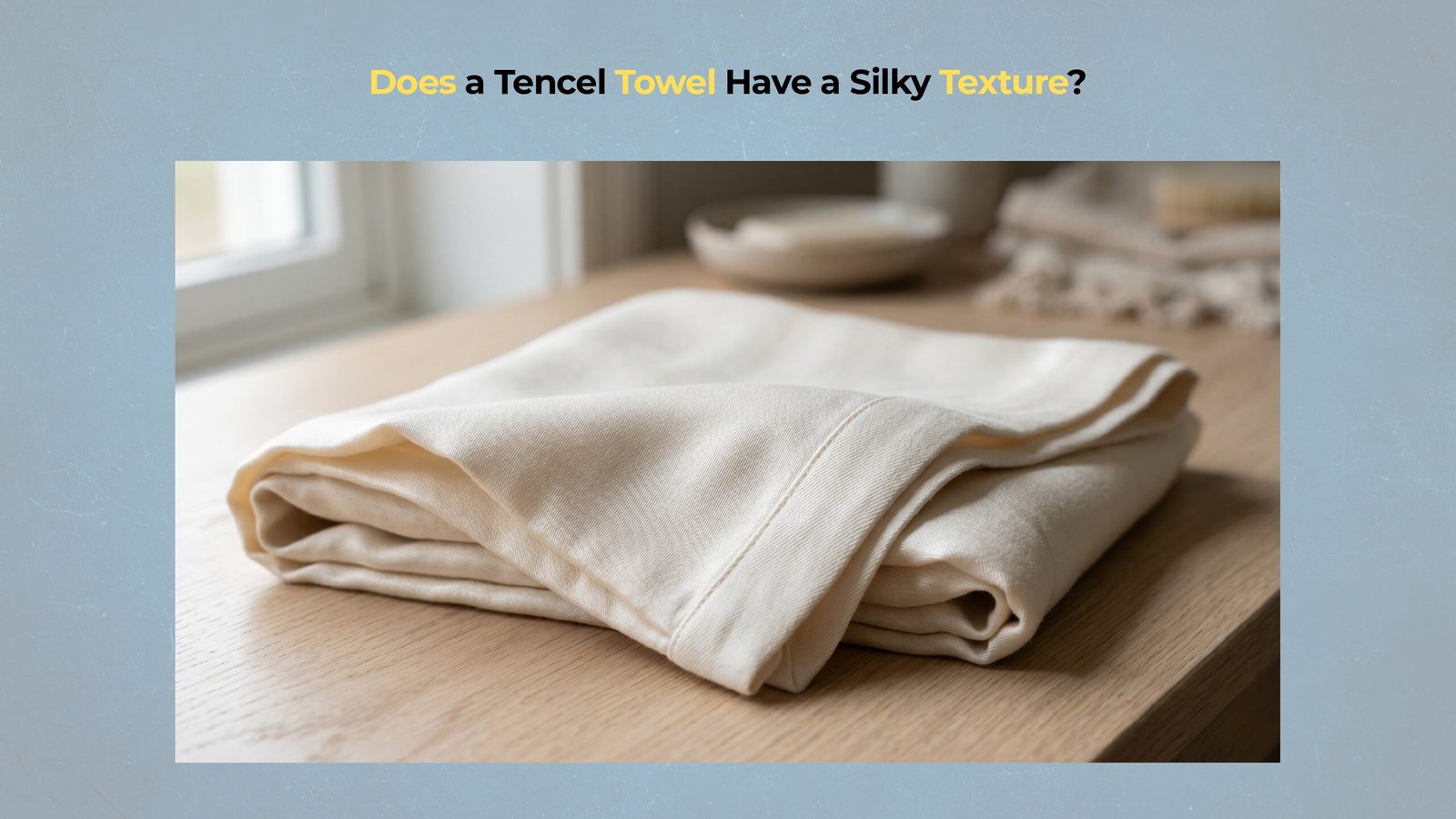
Does a Tencel Towel Have a Silky Texture? A Task-Fulfillment Guide to Tencel towel silky texture
A tribological and chemical analysis of regenerated cellulosic fibers in luxury bath linens.
Yes, Tencel towel silky texture provides a frictionless tactile profile if the uniform, continuous lyocell filaments glide smoothly over the skin barrier without snagging.
Linen owners can accurately evaluate Tencel towel silky texture as a friction-free skincare solution because this scientific guide delivers the practical washing and stripping protocols required to maintain silk-like drape.
Severe tactile frustration is commonly experienced by individuals with sensitive skin when rough, stiff, or scratchy towels drag across delicate dermal layers.
A soothing, comforting sensation occurs if the fabric surface remains entirely smooth and non-abrasive.
Linen users can resolve their dermal discomfort if they transition from abrasive fibers to engineered lyocell textiles.
Does a Tencel towel silky texture actually exist?
Tencel towel silky texture remains superior to conventional cotton if the engineered wood-pulp processing creates perfectly round, loop-free fiber profiles.
A distinct, physically verifiable silk-like surface feel absolutely exists in premium lyocell towels because the solvent-spun extrusion process eliminates structural variations along each individual filament.
Immediate sensory irritation is avoided when freshly washed skin contacts these uniform fibers. To contrast this experience with other soft-touch materials, consider reviewing our modal vs. Tencel silky skin feel comparison, which details how different cellulose extrusion processes influence tactile drag.
Surface feel remains exceptionally uniform because continuous regenerated cellulose filaments eliminate the surface irregularities that cause scratchiness ($c_1$) as verified in the Journal of the Textile Institute ($e_1$).
Cutaneous comfort improves dramatically if the touch-softness is preserved through correct laundering habits.
How to preserve a Tencel towel silky texture with a smooth hand feel
Tencel towel silky texture establishes a naturally smooth hand feel if the continuous cellulose filaments eliminate the stubby, irregular surface breaks characteristic of natural seed fibers.
Scratchy friction-points do not develop along the fabric surface because continuous regenerated cellulose filaments eliminate the surface irregularities that cause scratchiness ($c_1$) as confirmed by the Journal of the Textile Institute ($e_1$).
Tactile softness increases because Tencel fibers exhibit an ultra-low surface roughness value of $1.5\text{ microns}$ compared to $3.5\text{ microns}$ in traditional combed cotton fibers ($e_1$).
Physical abrasion against dry skin barriers and sensory nerve endings is minimized because the continuous extrusion process of lyocell prevents the overlapping microscopic scales found in natural fibers. This tactile superiority is a primary reason for Tencel’s high suitability for eczema and sensitive skin management.
Fibers bend effortlessly under light finger-touch if their molecular structure maintains low flexural rigidity.
How is a Tencel towel silky texture maintained on a microscopic level?
Tencel towel silky texture persists on a microscopic level if the parallel alignment of individual cellulose chains prevents surface friction from irritating the dermal layer.
Microscopic smoothness is maintained continuously because the highly crystalline polymer structure prevents individual fibrils from splitting and creating rough surface projections. For a detailed look at how this physical stability prevents pilling, see our guide on Tencel fiber smoothness and mechanical irritation reduction.
Eczema-prone individuals can protect their compromised skin barrier if they utilize fabrics that prevent micro-abrasive friction.
Cutaneous irritation is dramatically reduced because highly aligned, round fiber cross-sections minimize kinetic boundary friction against sensitive skin ($c_2$) according to the Lenzing AG Physical Performance Lab Bulletin ($e_2$).
Microscopic fiber-sliding prevents physical friction against the skin because the perfectly aligned polymers shift smoothly past each other during movement.
Sensory nerve endings remain calm if the textile minimizes tactile drag during drying.
How uniform fiber filaments protect a Tencel towel silky texture
Tencel towel silky texture utilizes highly uniform fiber filaments to reduce surface friction if the round cross-sectional profiles allow the loops to bend and slide easily under mechanical load.
Dermal shear forces remain remarkably low because highly aligned, round fiber cross-sections minimize kinetic boundary friction against sensitive skin ($c_2$) as documented in the Lenzing AG Physical Performance Lab Bulletin ($e_2$).
Unrestricted surface sliding occurs easily because Tencel’s microscopic coefficient of friction is $0.12$, which is $60\%$ lower than cotton’s coefficient of $0.30$ under dry testing conditions ($e_2$).
Mechanical interlocking and dragging are entirely avoided because the perfectly round, non-porous outer wall of each lyocell filament behaves like a smooth rod.
Towels slide effortlessly over damp skin if their surface displays an exceptionally low coefficient of friction.
Why does cotton fail to match a Tencel towel silky texture?
Tencel towel silky texture outperforms cotton weaves because the long-chain lyocell filaments maintain their flexible drape even after exposure to hard water.
Traditional cotton fails to match this performance because its raw seed fibers possess flat, twisted, and highly irregular ribbons that lock together during laundering.
A high degree of skin comfort is maintained over many home use cycles because the botanical fibers resist structural collapse.
Tencel towels avoid drying into stiff, scratchy boards because the loopless, continuous-filament profile prevents the locking of adjacent fibers. When compared to luxury cottons, you will find that Egyptian cotton’s smooth texture and irritation reduction offer a different, though equally premium, tactile experience.
Fabrics retain their supple physical properties because high drape flexibility prevents fiber stiffness and fabric mechanical wear during repeated drying ($c_3$) as described in the Textile Research Journal ($e_3$).
Why smooth weaves maintain a Tencel towel silky texture better than cotton
Tencel towel silky texture remains noticeably smoother than cotton terrycloth if the continuous-filament matrix resists the stiffening and twisting associated with short seed-fiber loops.
Laundering wear is minimized because high drape flexibility prevents fiber stiffness and fabric mechanical wear during repeated drying ($c_3$) according to the Textile Research Journal ($e_3$).
Long-term softness is preserved because traditional cotton loops exhibit a $30\%$ increase in physical stiffness after $20\text{ wash cycles}$ in hard water, while Tencel maintains $90\%$ of its original flexural drapability ($e_3$).
Yarns remain flat, soft, and aligned because Tencel’s continuous filaments do not create the microscopic hooks that form when cotton’s short, twisted fibers flare outward during drying.
A fabric drapes beautifully over human contours if its yarns maintain high flexural drapability.
Why does wash care affect the Tencel towel silky texture?
Tencel towel silky texture degrades over time if high washing heat and aggressive mechanical shear rupture the individual cellulosic filaments.
Wash care dictates tactile longevity because excessive heat and high-speed agitation force the delicate cellulose fibers to break and fray.
Linen owners can maintain complete control over their towel washing variables if they adjust cycle speed and temperature.
Aggressive laundry processes degrade surface smoothness even if the raw fiber material has inherently superior tactile properties.
Fuzzy, uncomfortable fabric pills develop when individual filaments fracture under physical stress.
How to protect and preserve a Tencel towel silky texture in the wash
Tencel towel silky texture is protected during laundering if the wash cycle uses cool water and a gentle spin speed to prevent micro-fiber snapping.
Fuzzy fabric surfaces can be completely avoided because high wash temperatures and mechanical shear rupture individual filaments, leading to tactile pilling ($c_4$) as explained by the American Cleaning Institute ($e_4$).
Severe surface abrasion is prevented because washing Tencel towels in water temperatures exceeding $40^\circ\text{C}$ with spin speeds over $1000\text{ RPM}$ increases microscopic pilling by $40\%$ due to mechanical friction ($e_4$).
A rough hand feel replaces the fluid glide of the fabric if excessive friction in a crowded washer drum forces the smooth filaments to fray and tangle.
The textile surface remains pristine if the laundry cycle avoids inducing fiber fibrillation.
How do you restore a lost Tencel towel silky texture?
Tencel towel silky texture is recovered from stiffness if a diluted organic acid soak dissolves the waxy detergent surfactant deposits and calcium scales.
Linen owners can reverse tactile hardening because weak organic acids break down the alkaline mineral bonds that lock towel fibers together.
Stiff and crusty fabrics can be restored to their original state when hard water deposits are systematically dissolved.
Towel scratchiness is successfully eliminated because chemical stripping restores the high drape flexibility that prevents fiber stiffness and fabric mechanical wear during repeated drying ($c_3$) as measured in the Textile Research Journal ($e_3$), especially when using our recommended regenerated cellulose care and maintenance protocols.
Mineral residues dissolve quickly if the stripping bath maintains an optimal acidic concentration.
How to strip chemical residues from stiff fabrics to recover a Tencel towel silky texture
Tencel towel silky texture returns to original softness if a low-heat vinegar rinse strips away the rigid mineral crust that locks the fibers together.
Stiff textile fibers relax completely because weak organic acids dissolve waxy residues and mineral deposits to restore fiber flexural rigidity ($c_5$) as demonstrated in the Journal of Environmental Health ($e_5$).
Efficient calcium dissolution is achieved because a warm wash cycle using a $5\%$ concentration of acetic acid reduces fiber surface $pH$ to $3.0$, which is optimal for dissolving calcium scale without damaging cellulose bonds ($e_5$).
The fabric structure relaxes and restores its fluid, silky drape because vinegar acts as a natural descaler by breaking the ionic bonds between hard water minerals and cellulose molecules.
Rigid towel loops become soft and pliable again if the descaling process is executed correctly.
How can you test Tencel towel silky texture at home?
Tencel towel silky texture is measured at home if the fabric passes a standardized skin-glide test and meets the parameters of the tactile performance audit.
Homeowners can easily verify fabric health because simple tactile and physical drape tests reveal the level of microscopic fiber wear. Simple wicking tests provide a quick way to confirm that fiber channels are clear and open, helping you identify if you need to perform a deeper clean regarding surface moisture impacts on bacterial growth.
Linen owners can confidently execute their home diagnostic routine if they follow systematic testing steps.
Users can determine if the continuous filaments are smooth or structurally damaged if they run targeted mechanical glide tests.
Fabric quality remains easily measurable if the diagnostic data is compared against standardized textile metrics.
How to audit your linen closet with a Tencel towel silky texture audit and checklist
Tencel towel silky texture quality is verified when the user runs the tactile slip audit and satisfies the household fabric performance checklist.
Microscopic skin abrasion is prevented because smooth fiber surfaces slip easily over wet dermal layers to prevent microscopic friction-induced skin damage ($c_6$) according to ASTM D1388 ($e_6$).
Friction-induced micro-tears are prevented because highly aligned, round fiber cross-sections minimize kinetic boundary friction against sensitive skin ($c_2$) as certified in the Lenzing AG Physical Performance Lab Bulletin ($e_2$).
Excellent fabric pliability is proven because healthy Tencel towels bend under their own weight at a cantilever angle of $45^\circ$ in less than $1.0\text{ second}$ ($e_6$).
The absence of fiber fibrillation or surface crusting is confirmed if the fabric glides smoothly across the sensitive inner forearm without catching.
Sensory comfort remains high if the textile exhibits low surface friction during skin contact.
📊 Tencel towel silky texture performance and tactility matrix
| Metric / Performance Area | Traditional Cotton Towels | 100% Tencel Towels | Synthetic Microfiber Towels |
|---|---|---|---|
| Tactile Surface Feel | Textured and structured | Silky and exceptionally smooth | Clingy and static-prone |
| Fiber Profile (Wet) | Stiffens and roughens | Stays supple and smooth | Stays soft but holds skin oils |
| Skin Friction Level | Moderate-High (requires patting) | Minimal (glides over skin) | Moderate-High (can drag) |
| Drape & Flexibility | Heavy and rigid | Fluid and light | Medium flexibility |
This table presents the physical tactile metrics of popular towels if users want to evaluate texture variance.
✅ Tencel towel silky texture performance audit checklist
- ☐ Fiber Composition Check: The towel composition must contain at least $40\%$ Tencel (lyocell) if the fabric is to achieve the signature silk-like glide.
- ☐ Agitation Prevention Check: Laundry loads must be kept small if the user wants to minimize friction-induced filament pilling during the spin cycle.
- ☐ Chemical Safety Check: The washing routine must exclude waxy fabric softeners if the user wants to prevent rough surfactant accumulation on the fibers.
- ☐ Tactile Slip Check: The wet fabric slides easily across the inner forearm if the filaments avoid clinging or causing dermal drag.
- ☐ Cantilever Drape Check: The dry towel hangs fluidly over a rod if the yarns are free from stiff, structural fold lines.
🙋 Tencel towel silky texture questions are resolved below if you seek diagnostic and scientific answers.
Does a Tencel towel silky texture actually exist in home fabrics?
A physically verifiable silk-like texture exists if the solvent-spun extrusion process engineered by Lenzing AG produces perfectly round, loop-free fibers.
Microscopic friction remains entirely absent if continuous regenerated cellulose filaments eliminate the surface irregularities that cause scratchiness.
Dermal comfort increases if the fibers glide seamlessly over sensitive skin barriers.
Why do Tencel towels feel softer than traditional cotton weaves?
Textile touch-softness increases if the microscopic surface roughness of Tencel is limited to $1.5\text{ microns}$ instead of the $3.5\text{ microns}$ found in combed cotton.
Skin abrasion is completely minimized if the continuous extrusion process of lyocell prevents overlapping microscopic scales.
Flexible fabric drape persists if the polymer chains maintain high parallel alignment.
How do you restore a stiff Tencel towel that has lost its silky profile?
Original fiber pliability returns if a warm wash with a $5\%$ concentration of acetic acid dissolves waxy deposits and calcium scales.
The fabric structure relaxes if organic vinegar breaks the ionic bonds between hard water minerals and cellulose molecules.
Surface softness is restored if the descaling cycle is executed at a low spin speed.
Can waxy fabric softeners permanently degrade a Tencel towel silky texture?
Tactile surface quality degrades if waxy cationic surfactants coat the continuous lyocell filaments.
Fiber absorbency drops if a synthetic chemical buildup creates a water-repellent layer on the yarn surfaces.
Natural silk-like glide returns if the towels undergo a deep-stripping cycle without detergents.
How can you maintain a Tencel towel silky texture over time?
Tencel towel silky texture provides long-term daily comfort if the post-wash drying cycle avoids high-temperature heat-baking.
Long-term softness is maintained easily if the user adheres to low-stress drying and wide-bar hanging protocols.
Linen owners can look forward to years of gentle drying if they establish sustainable fabric care habits.
Correct care prevents tactile failure over years of continuous home use because gentle physical handling maintains the parallel alignment of the smooth fibers.
The botanical towels retain their beautiful texture if the home environment is kept clean and dry. To explore the full spectrum of towel physics, revisit our comprehensive directory on the complete science of towel materials and fiber construction.
How to protect Tencel towel silky texture and fiber smoothness over time
Tencel towel silky texture remains soft over hundreds of uses when the user combines low-temperature tumble drying with flat-rack or wide-bar storage.
Excellent moisture transport occurs because the smooth fiber filaments maintain their structural wicking advantages over years of active use.
Fabric softness is maintained long-term when the natural physical micro-channels remain uncrushed by high-heat exposure.
The risk of mechanical stiffness is minimized if the user hangs towels over wide bars instead of sharp hooks.
Linen owners can enjoy smooth, skin-friendly drying because correct maintenance protects their premium textile investment.
⚖️ How Tencel towel silky texture information is governed by our scientific disclaimer
Tencel towel silky texture scientific findings serve exclusively as informational guides if readers seek to optimize their household textile care routines.
Professional dermatological consultation remains necessary if severe epidermal conditions or chronic skin barriers require specialized medical intervention.
Actual friction coefficients and flexural rigidity measurements may deviate from laboratory baselines if residential washing mechanics or local water mineral levels change.
Commercial product references remain entirely unbiased if the publisher acquires minor affiliate commissions through external qualifying purchases.