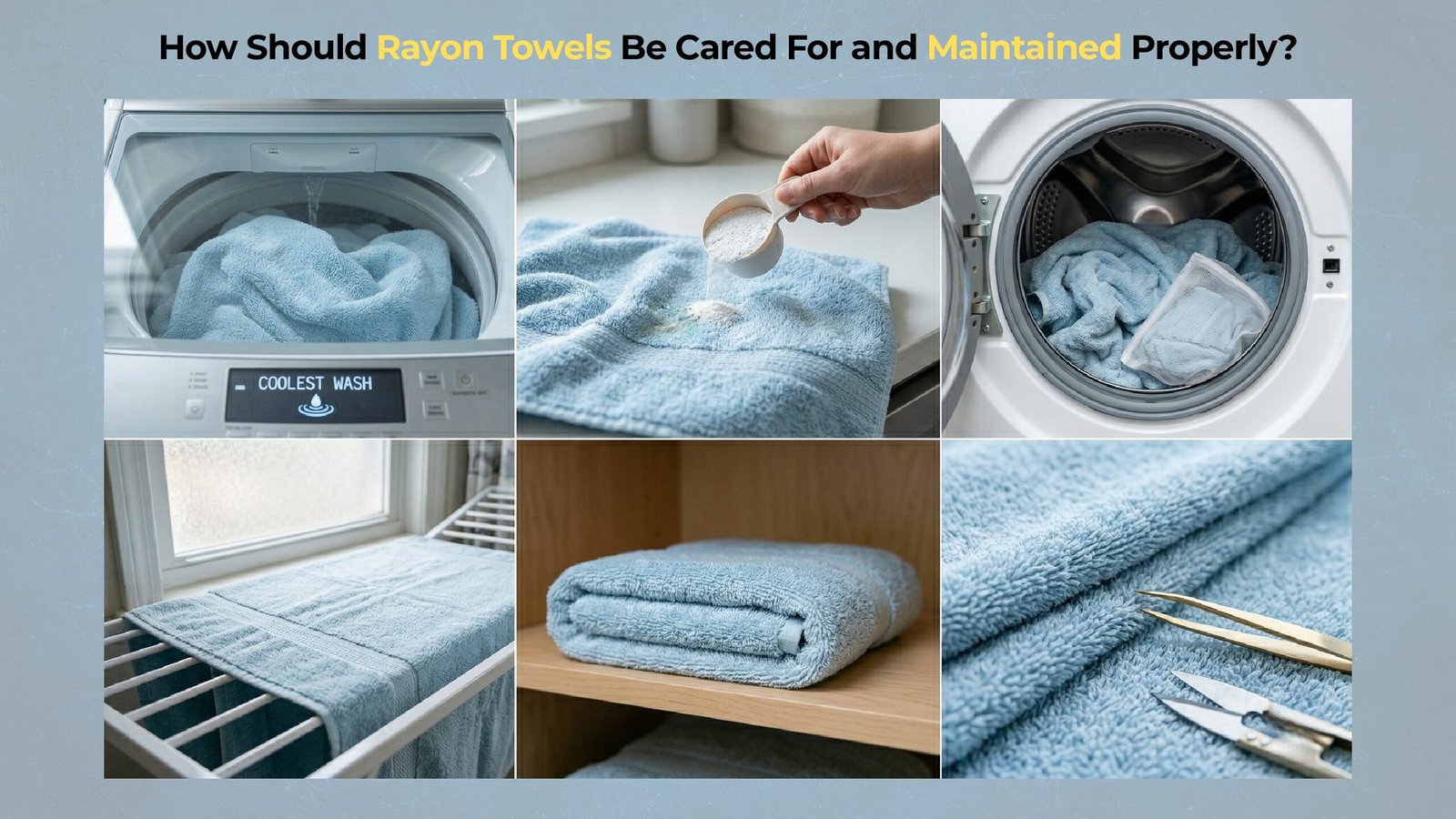
How Should Rayon Towels Be Cared For and Maintained Properly?
An Authoritative Technical Guide to Regenerated Cellulose Preservation
Effective rayon towel maintenance preserves the structural mass and tactile smoothness of regenerated cellulose fibers by utilizing low-impact laundering protocols that protect the material during its most vulnerable wet state. Unlike standard seed-hair textiles such as cotton, rayon requires a fundamental shift from “heavy-duty” to “delicate-focus” maintenance.
This transition is necessitated by the fiber’s unique molecular geometry, which provides superior moisture management at the cost of reduced mechanical durability when saturated. Understanding how these care habits dictate the lifecycle of premium towels is essential for any high-performance household textile strategy.
Why Does Rayon Towel Maintenance Determine the Lifecycle of Premium Towels?
Rayon towel maintenance primarily determines the functional service life of the textile by establishing the protective boundaries required to prevent structural weakening. Since durability is a key concern when comparing materials, you may also want to evaluate how durable rayon towels are with regular use to understand long-term performance expectations.
Proper maintenance limits the cumulative impact of thermal and mechanical stress, ensuring that the regenerated cellulose—whether Viscose, Modal, or Lyocell—retains its integrity. Without optimized care, these premium assets suffer rapid “Wet-Tenacity” failure, leading to premature decommissioning and financial loss.
Identifying the “Wet-Weakness” Factor in Rayon Towel Maintenance
Rayon towel maintenance prioritizes the saturation phase because regenerated cellulose fibers typically experience a significant reduction in tensile strength when wet. This “Wash Phase” represents the highest risk period for structural failure because the fiber is at its weakest while bearing the highest weight load from absorbed water. Once you understand this vulnerability, the next logical step is learning how to wash rayon towels without causing shrinkage or fiber damage, especially under repeated cycles.
Evaluating the ROI of a Disciplined Rayon Towel Maintenance Routine
Rayon towel maintenance provides a superior return on investment (ROI) because a disciplined care routine can extend the functional lifespan of high-end textiles by several years. While the fiber is inherently more delicate than cotton, technical structural maintenance prevents the frequent replacement cycles associated with standard, non-optimized laundering. Ultimately, technical maintenance protocols reduce replacement frequency, which optimizes the long-term value of rayon towel maintenance.
What Happens When You Wash Rayon Towels Using Standard Cotton Routines?
Failure to adjust rayon towel maintenance for standard cotton routines often triggers structural weakening because the high temperatures and aggressive agitation designed for seed-fibers are fundamentally incompatible with regenerated cellulose. High-heat settings intended to sanitize cotton cause “thermal fatigue” in rayon, leading to a permanent loss of fiber elasticity.
Analyzing High-Heat Damage in Rayon Towel Maintenance
Rayon towel maintenance fails when users utilize high-temperature water settings, as excessive thermal energy typically triggers fiber weakening over repeated cycles. Prolonged exposure to heat and moisture typically results in fiber thinning and a loss of the textile’s original luster, as the delicate crystalline structure of the cellulose begins to collapse.
Evaluating Agitation Stress from Heavy-Duty Washing in Rayon Towel Maintenance
Rayon towel maintenance is compromised by heavy-duty agitation because high-speed spin cycles and aggressive drum movement can increase mechanical stress on weakened wet fibers. Standard cotton cycles utilize high G-force spins that can snap swollen rayon loops or lead to visible wear such as thinning patches or edge fraying. Avoiding these risks requires a shift to specific, safe laundry steps.
Which Specific Laundry Steps Execute a Safe Rayon Towel Maintenance Cycle?
Specific laundering protocols execute a safe rayon towel maintenance cycle by limiting thermal energy and protecting fibers from friction and snagging to safeguard the saturated fibers.
Executing the “Cold-and-Gentle” Wash for Rayon Towel Maintenance
Rayon towel maintenance remains stable when users maintain wash temperatures at or below 40°C (104°F) and utilize the “Delicate” setting to minimize mechanical friction. Mandating mild liquid detergents designed for delicate fabrics is essential to reduce stress on swollen fibers and prevent fiber-shear mass loss. Low-temperature laundering reduces stress on swollen fibers, which maintains the tensile strength of rayon towel maintenance.
Implementing the “Hardware-Isolation” Rule in Rayon Towel Maintenance
Rayon towel maintenance and loop integrity are secured through the “Hardware-Isolation” rule, where textiles are preferably washed in mesh bags or in soft-only loads to reduce snag risk. For a broader perspective on how washing protocols differ across materials, review what are the proper washing instructions for microfiber towels, which highlights similar friction-control strategies.
How Should You Dry Rayon Towels to Prevent “Crunchy” Textures?
Drying protocols dictate the final texture of rayon towel maintenance, requiring mechanical agitation at low temperatures to prevent the rigid alignment of fiber bundles that causes stiffness.
Executing the “Low-Heat / Early-Removal” Protocol for Rayon Towel Maintenance
Rayon towel maintenance results in superior softness when users utilize “Low Heat” or “Air Fluff” settings and remove the textile while it remains slightly damp. Removing towels before they reach a bone-dry state prevents stiff textures, as fiber alignment during drying can create a rigid “crunchy” feel. Effectively, low-heat drying preserves core moisture, which facilitates the soft finish of rayon towel maintenance.
Implementing “Wool-Ball Agitation” for Rayon Towel Maintenance
Rayon towel maintenance utilizes “Wool-Ball Agitation” to lift and separate fibers during the drying cycle, which significantly improves tactile loft without the need for high heat. We recommend using 3–4 wool dryer balls to provide the “mechanical massage” required to re-loft matted loops and restore the three-dimensional volume of the terry pile.
How to Select Safe Cleaning Agents for Rayon Towel Maintenance?
Selecting safe cleaning agents optimizes rayon towel maintenance by identifying detergents that preserve fiber integrity without leaving residue. Because absorbency performance is directly affected by chemical buildup, it is useful to understand how absorbent rayon towels are and what impacts their moisture performance after repeated washing cycles.
Chemical Compatibility Matrix for Rayon Towel Maintenance
| Agent Type | Impact on Rayon | Recommended? |
|---|---|---|
| Mild Liquid Detergent | Preserves fiber integrity | Yes (Daily Maintenance) |
| Chlorine Bleach | Causes fiber weakening | No (Never) |
| Fabric Softener | Clogs capillary pores | No (Avoid strictly) |
| Oxygen Brightener | Safe stain removal | Yes (Occasional use) |
Identifying “Optical-Brightener-Free” Standards for Rayon Towel Maintenance
Rayon towel maintenance results often decline when users utilize detergents with optical brighteners, as these residues can leave a “coated” film that reduces moisture wicking. Perceived “scratchiness” is frequently the result of an accumulation of detergent chemicals rather than actual fiber wear; choosing brightener-free liquids ensures the capillary pathways remain open for maximum absorbency.
When Does Rayon Towel Maintenance Fail to Protect the Textile?
Rayon towel maintenance can fail when users bypass thermal safety limits or ignore the signs of cumulative mineral calcification within the weave, leading to tactile and structural failure.
Diagnostic Failure Matrix for Rayon Towel Maintenance
| Signal | Technical Cause | Technical Reason |
|---|---|---|
| Fiber Thinning | Thermal Damage | Cumulative Fiber Weakening |
| Crunchy Texture | Mineral Locking | Calcium/Magnesium bonding |
| Wicking Loss | Chemical Glazing | Hydrophobic residue buildup |
| Small Beads | Surface Friction | Fiber Fibrillation from agitation |
Identifying Fiber Weakening as a Failure of Rayon Towel Maintenance
Terminal damage to rayon towel maintenance is signaled by “paper-thin” fabric, as the material loses its structural strength over repeated cycles of prolonged exposure to heat and moisture. Once the fabric loses its structural mass, the damage is irreversible, and the asset requires decommissioning to prevent fiber linting in the laundry system.
How Can You Fix Stiffness or Buildup to Restore Rayon Towel Maintenance?
Restoring compromised rayon towel maintenance involves executing chemical resets to remove mineral residues and restore the fiber’s natural wicking pathways.
Stripping Mineral Buildup with a Gentle Vinegar Rinse
Rayon towel maintenance baseline levels are often restored if a periodic white vinegar rinse dissolves the mineral “crust” that causes fiber rigidity. Run one warm cycle with 1 cup of white distilled vinegar and NO detergent. Acetic acid rinses dissolve mineral calcification, which restores the flexibility of rayon towel maintenance.
Resolving Surface Pilling with a “Cellulase” Enzymatic Fix
Rayon towel maintenance and surface smoothness regain their original profile if specialized “cellulase” detergents remove broken micro-fibers that cause pilling. Enzymatic cellulase specifically targets and removes surface fuzz but does not fully restore lost structural strength; this should be utilized only as a periodic restorative measure rather than a daily protocol.
Frequently Asked Questions: Rayon Towel Maintenance
Can I use hot water for heavy stains on rayon?
No. High heat exceeds the thermal stability limits of regenerated cellulose, causing permanent structural weakening. Use a cool-water soak with oxygen-based brighteners instead.
Is fabric softener safe for Modal or Lyocell towels?
Fabric softeners should be strictly avoided. They deposit a hydrophobic waxy film that clogs the capillary pores of the fiber, significantly reducing moisture wicking and absorbency.
Why are my rayon towels getting “thin” after a year?
Thinning is often the result of “Fiber Shear” caused by high-heat drying or aggressive agitation. Once the structural mass is lost through mechanical friction, the damage is irreversible.
Can I wash rayon towels with my regular laundry?
It is not recommended unless the other items are “soft-only.” Hardware like zippers or hooks can easily snag the delicate loops of saturated rayon fibers during the wash cycle.
How to Verify Your Strategy with a Rayon Towel Maintenance Checklist?
Systematic technical audits of your selection and care verify that current protocols for rayon towel maintenance align with objective performance benchmarks.
Checklist: Rayon Towel Maintenance Audit
Technical Care Disclaimer
This guide is based on general textile engineering principles and industry standards (ISO/AATCC). However, specific fiber blends, yarn densities, and manufacturing finishes may vary significantly between brands. Always refer to the permanent care label attached to your specific textile asset before performing high-level maintenance, mineral stripping, or chemical resets. TowelDaily and its contributors are not responsible for irreversible structural damage or mass loss resulting from the misapplication of these technical protocols or environmental variables beyond our control.
Final Summary: Does the Profile of Rayon Towel Maintenance Fit Your Lifestyle?
Operationalizing a rayon towel maintenance strategy requires a commitment to technical care that honors the unique fiber physics of regenerated fibers. The trade-off between the “Silk-Like Texture” of these materials and the “Disciplined Care” required is a central consideration for the high-end textile consumer. Ultimately, a superior bathroom experience is defined by the precise rayon towel maintenance management that turns a high-performance fiber into a lasting, soft-touch household asset through technical care.