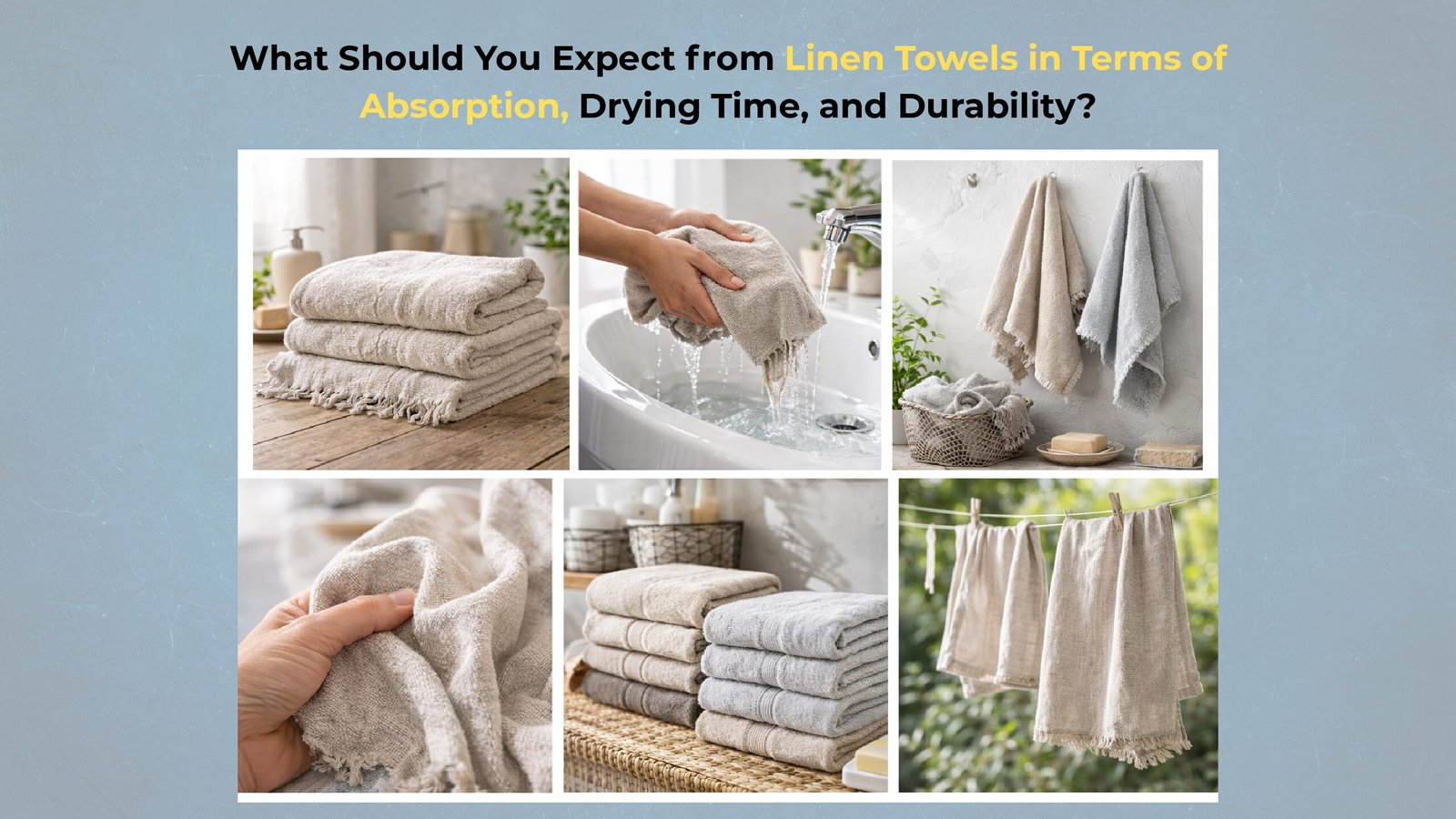
What Should You Expect from Linen Towels in Terms of Absorption, Drying Time, and Durability?
You should expect Linen Towels to provide the best balance of fast drying and natural durability by operating as high-performance bast fiber systems derived from the Linum usitatissimum stem.
These botanical structures possess a superior degree of cellulose polymerization (approximately 18,000 units), which creates a molecular architecture significantly more robust than traditional cotton varieties. Low-density Linen Towels facilitate maximum airflow through their crystalline fiber regions to achieve superior drying speed. This efficiency of moisture management is rooted in the intrinsic mechanical strength of the long-staple flax filament, a hallmark within The 12 Towel Material Categories.
Why are Linen Towels the Standard for Durability and Low-Lint Performance?
Linen Towels are the standard for durability and low-lint performance because the Flax Fibers used in their construction are naturally long (up to 100 cm), tightly structured, and resistant to breaking. Unlike short-staple cotton, which relies on twisting many small fibers together, linen’s continuous filaments prevent the fraying that leads to surface pilling.
How Do Long Flax Fibers Create Linen Towels’ Extreme Durability?
Long Flax Fibers create Linen Towels’ extreme durability by providing a tensile strength of 300 to 400 MPa, which is significantly higher than the 180 to 250 MPa observed in cotton. Our Linen Towels: Full Performance Guide further details how the tensile modulus of industrial-grade flax can reach $80 \text{ GPa}$, ensuring the fabric maintains its shape under heavy mechanical stress.
The Wet-Strength Phenomenon: Unique to bast fibers, hydrogen bonds within the cellulose matrix reinforce when water molecules are present. This prevents wash-cycle tearing and ensures the towel is actually stronger when wet than when dry.
Definition: Lumen – The central hollow core of the fiber cell that facilitates capillary moisture transport.
Why are Linen Towels Naturally Low-Lint and Glassware-Safe?
Linen Towels are naturally low-lint because the multicellular bast structure has a length-to-breadth ratio of up to 15,000:1, which minimizes the number of exposed fiber ends. Testing indicates that high-quality linen can endure 18,000 to 25,000 Martindale abrasion cycles, outlasting cotton’s typical 12,000-cycle threshold.
How Do You Compare Linen Towels’ Absorption Against Cotton and Microfiber?
You compare Linen Towels’ absorption against cotton and microfiber by analyzing the material’s specific surface area ($S_{BET}$), where linen provides $51 \text{ m}^2\text{/g}$ of active wicking area. This analysis helps users understand Why Towel Absorbency Matters Before You Buy, specifically how wicking speed differs from total mass capacity.
Why is the Absorption Mechanism of Linen Towels Unique?
The absorption mechanism of Linen Towels is unique because polar hydroxyl (OH) groups on the cellulose polymers form immediate hydrates, leading to faster moisture uptake. Scientific data indicates a pore volume ($V_{p,w}$ at 95% RH) of $0.19 \text{ cm}^3\text{/g}$ for linen, compared to $0.14 \text{ cm}^3\text{/g}$ for cotton.
Definition: Hygroscopy – The ability of a fiber to attract and hold water molecules within its molecular structure without feeling physically damp or “heavy.”
| Performance Metric | Linen Towels (Flax) | Cotton Towels (Cellulose) | Microfiber (Synthetic) |
|---|---|---|---|
| Surface Area ($S_{BET}$) | $51 \text{ m}^2\text{/g}$ | $8 \text{ m}^2\text{/g}$ | Variable (Low) |
| Tensile Strength | 300 – 400 MPa | 180 – 250 MPa | ~150 – 200 MPa |
| Drying Time (25°C) | 30 – 45 min | 50 – 70 min | 20 – 30 min |
| Wash Lifespan | 300+ Cycles | 100 – 200 Cycles | 200 – 300 Cycles |
While cotton remains the standard for volume, a Cotton Towels: Comfort & Absorption Comparison illustrates that linen’s functional wicking area is vastly superior for humid environments.
When is the Weave of Linen Towels Most Effective?
The weave of Linen Towels is most effective when engineers utilize a waffle or honeycomb pattern to increase functional surface area by up to 40% compared to plain weaves. This structural geometry creates a micro-climate of turbulence that aids in the kinetic release of moisture, surpassing synthetic options like Microfiber Towels: Travel & Gym Drying Speed in natural breathability.
How Do Waffle Weave Linen Towels Accelerate Evaporation?
Waffle weave Linen Towels accelerate evaporation by creating “thirst pockets” that capture moisture and spread it across a grid for maximum air exposure. Studies demonstrate that waffle-weave linen retains only 25% moisture after 30 minutes of air drying, whereas denser terry-loop cotton retains up to 75%.
Why Do Linen Towels Offer Inherent Antimicrobial Properties?
Linen Towels offer inherent antimicrobial properties because residual lignin and phenolic acids in the flax fiber reduce the proliferation of Staphylococcus aureus. Furthermore, the smooth micro-topography of flax prevents the trapping of skin oils and sebum, which are the primary food sources for odor-causing bacteria.
How Can You Preserve the Durability and Softness of Linen Towels?
You can preserve the durability and softness of Linen Towels by maintaining a neutral wash pH between 6.0 and 7.5 to prevent the premature degradation of the pectin binder. Unlike the heavy heat processing required for Polyester Towels: Durability & Wash Lifecycle, linen requires a more nuanced chemical environment to thrive.
Why Does pH-Neutral Washing Extend Linen Towels’ Lifespan?
pH-neutral washing extends Linen Towels’ lifespan by reducing fiber friction by 25% and protecting the heteropolysaccharide pectins in the cell walls. This maintenance of the molecular glue allows the fibers to “relax” and soften over time without losing their structural tenacity.
Definition: Cellulose Polymerization – The process of bonding glucose units into long chains that determine the final fiber tenacity and resistance to chemical wear.
How Do Linen Towels Compare to Cotton in Sustainability Metrics?
Linen Towels compare favorably to cotton in sustainability metrics, requiring only 150 to 400 liters of water per kilogram of fiber compared to up to 29,000 liters for industrial cotton. The carbon footprint of traceable European linen is approximately $2\text{–}3 \text{ kg CO}_2\text{-eq/kg}$, while cotton typically ranges from $4\text{–}5 \text{ kg}$.
How Do You Validate Quality and Authenticity in Linen Towels?
You validate quality and authenticity in Linen Towels by executing a 4-step physical audit focused on detecting the markers of true Flax Fiber. This “Fiber Quality Test” ensures you are not purchasing a synthetic blend marketed as pure linen. To streamline this process, our Towel Material Selector Tool can assist in identifying genuine long-staple flax.
What are the Steps for a 4-Step Linen Towels Audit?
-
1
The Lint Test: Rub the surface vigorously against a dark cloth to ensure near-zero fiber shedding, signifying a high-quality long staple length.
-
2
The Crispness Check: New towels should feel slightly rigid; this indicates the presence of natural Pectin, which will soften into a silk-like texture over 10-20 washes.
-
3
The Shine Test: Observe the fabric under direct light. Authentic high-quality flax possesses a subtle natural sheen from residual waxes and minerals.
-
4
The Price Metric: Verify if the price reflects the 100-day labor-intensive growth and retting process. Cheap linen is often a cotton blend or low-quality “tow” linen.
Frequently Asked Questions About Linen Towels
Why do linen towels feel stiff or scratchy when they are brand new?
The initial stiffness is due to residual **pectin** and natural waxes that bind the flax fibers together. These binders are essential for the fiber’s high tensile strength but require several mechanical wash cycles to break down and reveal the soft, supple cellulose core.
How do linen towels prevent the “musty towel” odor found in cotton?
Linen’s rapid evaporation cycle prevents moisture from sitting in the fibers long enough for anaerobic bacteria to thrive. Additionally, the presence of natural phenolic acids in the flax stem provides a baseline antimicrobial effect that inhibits the growth of *Staphylococcus aureus*.
Is a waffle weave better than a plain weave for drying performance?
Yes, from a thermodynamic perspective. The **waffle weave** increases the active surface area ($S_{BET}$) by up to 40%, creating deep pockets that trap water while simultaneously increasing the contact area with the air for faster kinetic release.
Can linen towels be used for delicate glassware and mirrors?
Absolutely. Because linen is a long-staple bast fiber with a high length-to-breadth ratio, it has fewer “free ends” to shed. This makes it naturally low-lint and safe for non-abrasive polishing of high-clarity surfaces.
Do I need a special detergent for high-quality linen towels?
While not mandatory, a **pH-neutral detergent** (6.0–7.5 pH) is recommended. Highly alkaline detergents (standard grocery brands) can cause chemical degradation of the pectin binder, leading to premature fiber breakage and a loss of the fabric’s natural sheen.