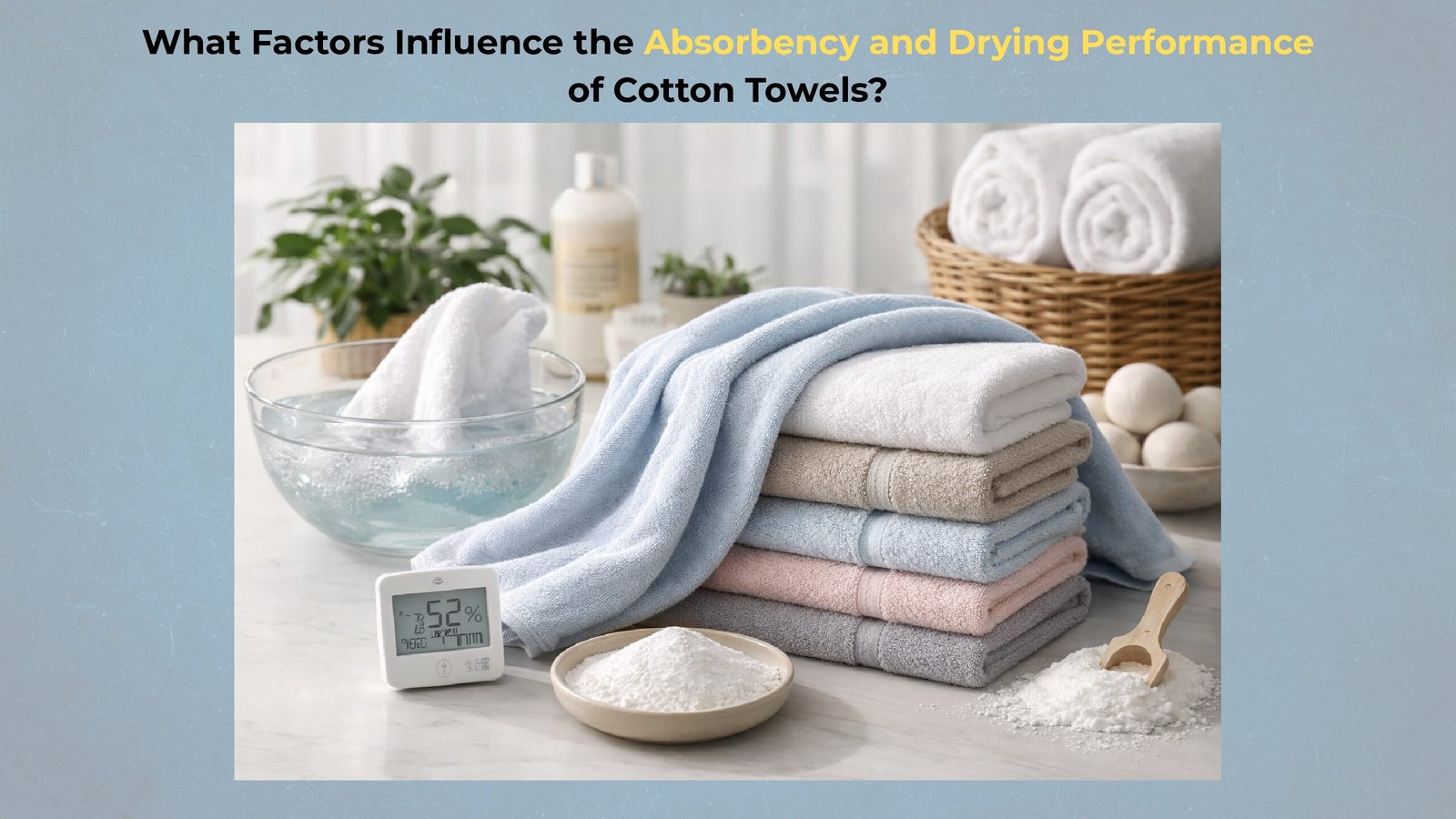
What Factors Influence the Absorbency and Drying Performance of Cotton Towels?
Cotton towel absorbency and drying performance are primarily influenced by fiber type (long-staple like Egyptian/Turkish), yarn twist (low/zero twist), weight (GSM), weave structure (terry loops vs. waffle), and finishing chemicals. High-GSM towels are more absorbent but slower to dry, while lower-GSM or waffle weaves offer faster drying.
Cotton originates as single-cell extensions of the seed epidermis, composed of 99% cellulose once scoured. This botanical foundation establishes the hydrophilic baseline of the textile. Specific moisture kinetics within these fibers dictate hygiene and skin health.
For readers who want a broader baseline before comparing weave geometry and GSM, the main Cotton Towels Comfort & Absorbency guide explains the core hydrophilic behavior that underpins absorbency and drying trade-offs.
Why Does Cotton Towel Performance Impact Hygiene and Skin Health?
Cotton towel performance directly impacts hygiene and skin health because the rate of moisture desiccation determines the duration of the biological window required for microbial colonization.
Rapid moisture release starves anaerobic bacteria of the aqueous environment needed for proliferation. This functional health requirement ensures that drying speed serves as a biological barrier rather than a mere convenience.
The persistence of moisture within textile loops facilitates the metabolic processes of bacteria, leading to the formation of specific volatile odors.
How Does Cotton Towel Performance Prevent Musty Odors?
Cotton towel performance prevents musty odors by maintaining the textile’s moisture content below the 15% threshold required for the formation of odor-producing volatile compounds.
Odor-Producing Volatile Compounds: The chemical byproducts, specifically sulfides and ammonia, released by bacteria in damp textiles.
Successful cotton towel performance yields a 2,000x reduction in bacterial mass compared to stagnant, damp fibers.
Since slow drying directly increases microbial risk in humid spaces, this hygiene section connects well to Cotton Towels Mildew Prevention, where airflow, dampness, and odor formation are analyzed in more detail.
How Do Tactile Benefits Result from Cotton Towel Performance?
Cotton towel performance drives tactile benefits by utilizing high-suction capillaries in the fiber wall that exert pressure to draw liquid water into the cellulose interior.
Fibrils deposited at 70-80 degree angles to the axis create organized capillary systems. The “wipe-dry” experience results from these unobstructed surface capillaries capturing moisture on contact. These tactile results depend on the physical properties and technical factors of the fiber.
When discussing capillary sorption and fiber lumen behavior, readers may also benefit from Cotton Towels Water Absorption for a more focused explanation of how cotton fibers physically pull in and retain liquid.
What Physical Properties Define the Factors of Cotton Towel Performance?
Physical properties define the factors of cotton towel performance by establishing the mechanical limits of fiber density, tensile strength, and internal lumen volume.
Establishing this technical grounding is required for informed procurement and lifecycle management.
How Does GSM Dictate Cotton Towel Performance?
Cotton towel performance depends on Grams per Square Meter (GSM) because this metric quantifies the total fiber mass available for capillary sorption.
Capillary Sorption: The process where water moves into the microscopic spaces between cellulose fibrils.
Every 100 GSM increase adds 15 to 20 minutes to the natural air-drying time. High GSM without proportional pile loft results in “dead mass” that increases energy consumption without improving user wicking.
Why Is Fiber Staple Length a Driver of Cotton Towel Performance?
Cotton towel performance results from fiber staple length because longer cellulose filaments (ELS > 1.25″) provide more continuous surface area and fewer connection points.
Egyptian Giza (Max Absorbency/ELS), Nazilli 84 (Aegean) (Long-Staple/Fast-Drying), and American Pima or Upland (Cost-Efficiency/Short-Staple) varieties offer distinct performance envelopes. Extra-long staple fibers reduce pilling and maximize the available area for water contact.
How Does Yarn Twist and Spinning Methodology Alter Cotton Towel Performance?
Cotton towel performance fluctuates with yarn twist levels because tightly coiled fibers restrict the spatial volume available for moisture penetration.
Ring-spun (continuous twisting/thinning) provides higher tensile strength compared to open-end (chaotic twisting). Zero-twist yarns expose the entire surface area of each fiber to moisture, maximizing absorbency speed while increasing air permeability for faster evaporation. These yarn physics lead to the structural results of weave types.
How Do Weave Types Alter the Structural Results of Cotton Towel Performance?
Weave types alter the structural results of cotton towel performance by manipulating the geometry of the fabric surface to prioritize either wicking surface area or evaporative airflow.
Selecting between volume-focused Terry and speed-focused Waffle weaves depends on primary turnover requirements.
What Is the Terry-Loop Advantage for Cotton Towel Performance?
Cotton towel performance utilizes the Terry-loop advantage where pile height serves as the most significant variable affecting surface water absorption percentages.
Increasing pile height from 6.24 mm to 6.98 mm results in surface absorbency rising from 68% to 78%. However, excessively dense weaves make the structure too compact, which limits water penetration into the fabric interior.
How Does Waffle-Weave Geometry Optimize Cotton Towel Performance?
Cotton towel performance achieves maximum evaporation velocity through Waffle-weave geometry, which utilizes a three-dimensional recessed pattern to facilitate airflow.
Vapor Pressure Differential: The gradient required for evaporation, facilitated by waffle textures that maintain airflow across recessed surfaces.
Waffle weaves achieve high volume with a 40% reduction in base weight compared to standard terry cloth. Weave efficiency remains conditional upon bathroom ventilation and relative humidity.
Since high-GSM performance always creates a trade-off between plushness and evaporation speed, add a comparison to Cotton Towels Plush vs. Drying to help users understand why denser towels dry more slowly in real bathrooms.
How Does Bathroom Ventilation Affect Cotton Towel Performance?
Cotton towel performance depends on bathroom ventilation levels because relative humidity (RH) dictates the thermodynamic capacity of ambient air to hold escaped moisture.
High-GSM towels often fail in poorly ventilated spaces due to the lack of vapor pressure gradient.
Why Does Relative Humidity Limit Cotton Towel Performance?
Cotton towel performance degrades in high ambient humidity because saturated air lowers the vapor pressure differential between the wet textile and the atmosphere.
Evaporation is driven by RH rather than temperature alone; higher air temperatures increase moisture capacity exponentially.
How Do You Compare Metrics to Select Optimal Cotton Towel Performance?
Selecting optimal cotton towel performance requires a multi-variant analysis that weights absolute water mass sequestration against mechanical extraction forces.
Cotton Towel Performance Weights & Weaves Matrix
| Weight Tier | GSM Range | Drying Velocity | Absorbency Volume | Optimal Environment |
|---|---|---|---|---|
| Lightweight | 300–400 | Very Fast | Low | High Humidity / Gym |
| Mid-Weight | 400–600 | Moderate | High | Ventilated Residential |
| Heavyweight | 600–900 | Slow | Very High | Low Humidity / Spa |
How Do You Use Standardized Tests to Verify Cotton Towel Performance?
Utilizing standardized performance tests allows users to verify cotton towel performance benchmarks for wettability and surface water absorption.
AATCC 79 requires < 5 seconds for excellent absorbency, while ASTM D4772, ASTM D3776, and ISO 6330 evaluate turnover efficacy and mass.
Cotton Towel Performance Selection Table
| User Priority | Engineering Combination | Best Technical Choice |
|---|---|---|
| Zero Odor | Low GSM + Waffle Weave | Lightweight Waffle |
| Tactile Softness | High GSM + Zero-Twist | Heavyweight Egyptian ELS |
| Lifecycle Value | Mid-GSM + Ring-Spun | Pima or Aegean Terry |
Which Laundry Steps Maintain Optimal Cotton Towel Performance?
Maintaining optimal cotton towel performance requires technical adherence to surfactant restrictions that prevent the deposition of hydrophobic waxy coatings on fiber surfaces.
Industrial scouring removes hydrophobic pectins; hydrogen peroxide ($H_2O_2$) whitening preserves the cellulose degree of polymerization.
Why Must You Avoid Cationic Softeners for Cotton Towel Performance?
Cotton towel performance suffers catastrophic wicking failure if treated with cationic surfactants because the positively charged nitrogen heads bond to hydroxyl groups to form a waxy film.
Buildup reduces absorbency by as much as 50%.
How Does Mechanical Extraction Force Influence Cotton Towel Performance?
Cotton towel performance in industrial settings depends on extraction G-force because mechanical water removal reduces the energy required for the thermodynamic drying phase.
100G (98% retention) vs 300G (67% retention); diminishing returns occur at 400G. Extraction efficiency precedes absorbency restoration.
How Can You Fix Decreased Absorbency and Hornification in Cotton Towel Performance?
Fixing decreased absorbency in cotton towel performance involves executing a chemical reset to reverse fiber calcification and restore the Water Retention Value (WRV).
When absorbency drops because of waxy buildup, hornification, or poor laundering habits, the Towel Care Diagnosis Engine is a relevant next step for diagnosing the exact maintenance issue and correcting it.
How Does Stripping Deterdup Restore Cotton Towel Performance?
Cotton towel performance recovers its original wicking velocity when laundered with acetic acid (vinegar) followed by sodium bicarbonate (baking soda).
Vinegar dissolves mineral deposits; baking soda deodorizes and breaks down oily residues.
Why Does Hornification Permanently Degrade Cotton Towel Performance?
Cotton towel performance suffers permanent degradation from hornification when drying temperatures exceeding 100°C cause internal fiber pores to collapse and form irreversible chemical bonds.
Hornification: The irreversible loss of cellulose swelling capacity caused by thermal-mechanical pore collapse.
Average molecular mass decreases from 1,320 kDa to 151 kDa over 50 wash cycles. Performance audit checklists serve to detect these integrity drops.
Audit Your Cotton Towel Performance with This Technical Checklist
Inventory integrity for cotton towel performance is verified through technical audits that validate maintenance compliance against industrial benchmarks.
Checklist: Cotton Towel Performance Audit Checklist
- ☐ Staple Check: Does the label confirm “ELS” or “Long-Staple” fibers to ensure high yarn porosity?
- ☐ GSM Calibration: Does the towel GSM (+100 = +20 min dry time) match the facility’s airflow capacity?
- ☐ Absorbency Test: Does a distilled water drop soak into the taut fabric in < 5 seconds per AATCC 79?
- ☐ Residue Audit: Does the dry fiber feel “thirsty” rather than “waxy” from cationic softener buildup?
- ☐ Thermal Audit: Are drying temperatures maintained below 100°C to prevent permanent fiber hornification?
- ☐ Extraction Audit: Are extraction forces maintained near 350G to minimize mechanical moisture retention?
Final Summary
Operationalizing a cotton towel performance strategy requires the synthesis of weight, weave, and wash-cycle protocols to ensure a sustainable and hygienic bathroom environment.
Synthesis of GSM turnover, ELS fiber usage, and avoidance of cationic hornification ensures peak operational longevity.
If users want help choosing the best cotton construction for their climate, turnover needs, and softness preferences, direct them to the Towel Material Selector for a faster match between performance priorities and towel type.
Ultimately, a superior bathroom experience is defined by the precise cotton towel performance engineering that aligns tactile comfort with optimized moisture kinetics.
Frequently Asked Questions
Loss is primarily caused by cationic surfactants creating hydrophobic films or hornification collapsing pores.
300-450 GSM is optimal for rapid moisture desiccation and turnover.
Technical Disclaimer: Individual results depend on real-world variables including local water chemistry and HVAC exchange rates. Toweldaily.com does not guarantee specific percentages for third-party textiles.