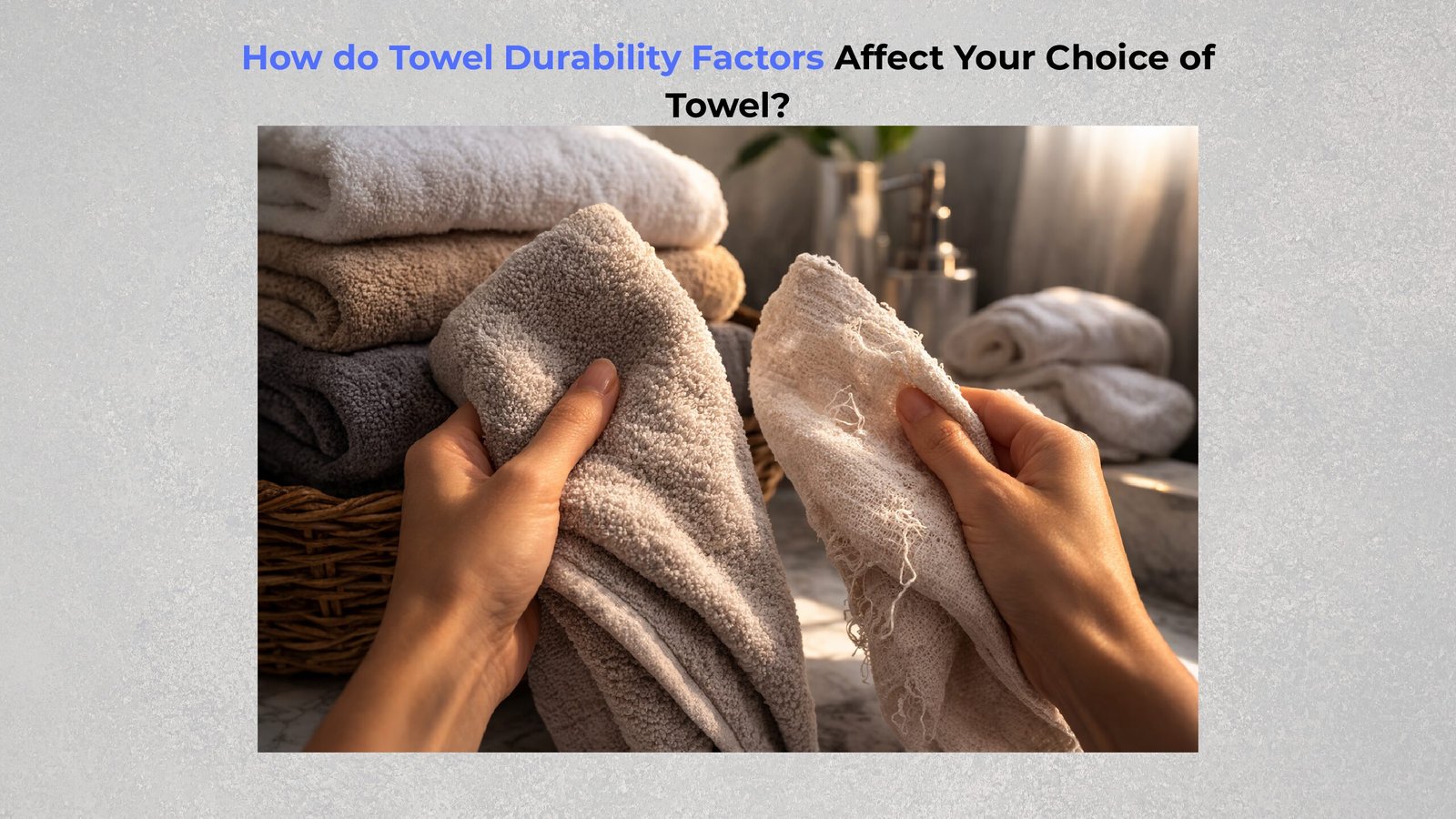
How do Towel Durability Factors Affect Your Choice of Towel?
Evaluating Towel Durability Factors is essential before purchase because the mechanical alignment of the ground weave and the density of the perimeter stitching directly determine the textile’s resilience against wash-cycle agitation and structural fatigue. In institutional settings, durability is an engineering requirement for high-ROI assets, utilizing attributes like SPI 12–14 to establish technical depth. By applying an operational scoring rubric, procurement managers can quantify textile value and efficiency. If you want to keep durability from being evaluated in isolation, anchor it inside the complete set of towel buying factors so performance, upkeep, and cost-per-use are analyzed as one decision system. However, non-optimized specifications lead to increased structural failure and procurement risks.
How Evaluating Towel Durability Factors Mitigates Structural Failure and Procurement Risks
Evaluating Towel Durability Factors mitigates structural failure and procurement risks because objective construction audits identify weak seam interfaces and low-tenacity yarns before they lead to premature inventory decommissioning. Addressing the financial risks of “utility-grade” towels that exhibit edge-fraying within 30 wash cycles is critical for lifecycle management. Since wash-cycle attrition is partially driven by maintenance variables, the next logical step is applying care instructions that protect hems, loops, and cycle-life before you compare brands or price tiers. Specifically, Evaluating Towel Durability Factors identifies double-needle lockstitching, which materially reduces the risk of side-seams unravelling during high-heat agitation.
Table: Towel Durability Factors Failure Risk Matrix
| Risk Variable | Failure Mode | Technical Cause | Operational Impact |
|---|---|---|---|
| Stitch Count | Edge fraying | Low SPI (< 8 Stitches) | Inventory decommissioning |
| Fiber Staple | Pilling / Thinning | Carded short-staple yarn | Loss of tactile comfort |
| Ground Weave | Center bowing | Low warp-thread tension | Dimensional instability |
Mitigating the Risk of Longitudinal Hem Failure via Towel Durability Factors
Towel Durability Factors mitigate the risk of longitudinal hem failure by utilizing double-needle lockstitching to create a redundant mechanical bond that resists high-centrifugal extraction forces. Double-needle lockstitch construction improves seam retention compared to single-thread chain stitching because each stitch is mechanically locked, preventing sequential unraveling during repeated wash and extraction cycles. Lockstitching reduces the probability that a single thread break results in sequential unravelling. Industrial observations suggest that towels utilizing a lockstitch exhibit materially higher seam-retention rates after 100 cycles compared to chain-stitched alternatives. Furthermore, seam “waisting” is a structural symptom of imbalanced thread tension; if the hem thread is tighter than the fabric body, the resulting shrinkage creates a geometric failure that inhibits uniform folding.
Preventing Rapid Fiber Thinning and Mass Loss through Towel Durability Factors
Towel Durability Factors prevent rapid fiber thinning and mass loss by incorporating Extra-Long Staple (ELS) fibers that provide more anchoring points within the yarn core to resist mechanical abrasion. Quantitative observations show that excessive dry-mass loss during early laundering cycles signals low-tenacity yarn construction and reduced long-term durability, as fiber shedding indicates structural instability within the yarn core. Lint is the physical manifestation of an asset dying; every gram of lint captured in a dryer trap is dry-mass sheared from the Towel Durability Factors, potentially leading to a decline in absorbency. Because dry-mass loss eventually reduces functional drying performance, it helps to review why towel absorbency is a key metric to verify before buying—especially once the pile starts thinning.
Towel Durability Factors Structural Audit Checklist
- The “Hem-Tension” Test: Apply manual lateral pressure to side-seams to check for thread “popping” per Towel Durability Factors specifications.
- The Lint-Trap Audit: Measure the volume of fiber loss post-wash to identify deviations in Towel Durability Factors.
- The Translucency Check: Hold the unit to a light source to detect uneven penetration signaling localized failure in construction.
Structural risk metrics necessitate the strict adoption of engineering benchmarks and performance standards.
What Engineering Benchmarks Define High-Performance Towel Durability Factors
Engineering benchmarks define high-performance Towel Durability Factors by establishing measurable load limits for tensile strength and providing standardized metrics for stitch density. High-performance textiles are characterized by breaking loads exceeding 50 lbs-force, as verified through standardized grab testing protocols.
How ASTM D5034 Protocols Validate High-Tensile Towel Durability Factors
ASTM D5034 protocols validate Towel Durability Factors by measuring the fabric’s “grab strength” to ensure the ground weave withstands defined pounds-force loads without structural tearing. The ASTM D5034 test applies tension to a specific width of fabric; high-performance textiles are often verified to sustain loads of over 50 lbs-force in both warp and weft directions. Utilizing ASTM D5034 protocols identifies high tensile performance thresholds and verifies that Towel Durability Factors meet specified industrial load limits.
Why Stitch-Per-Inch (SPI) Metrics Determine the Longevity of Towel Durability Factors
Stitch-Per-Inch (SPI) metrics determine the longevity of Towel Durability Factors because the number of stitch penetrations per linear inch dictates the flexibility and strength of the perimeter reinforcement. An SPI count that is too low (< 8) creates a weak seam, while an SPI count that is too high (> 18) can weaken the fabric by creating excessive perforations. Industry benchmarks for institutional towels frequently specify a 12–14 SPI density to optimize the balance between seam strength and fabric integrity.
Table: Towel Durability Factors Technical Metrics Matrix
| Metric | High-Durability Spec | Utility-Grade Spec | Performance Result |
|---|---|---|---|
| Fiber Type | ELS (Extra-Long Staple) | Carded / Short Staple | Supports extended lifecycle potential |
| Spinning | Ring-Spun | Open-End | Helps prevent rapid surface pilling |
| Hem Type | Double-Needle Lock | Single-Stitch Chain | Verified higher seam retention |
Engineering metrics provide the baseline for calibrating selection to specialized usage environments.
How to Calibrate Towel Durability Factors for Specialized Usage Environments
Calibrating Towel Durability Factors for specialized usage environments ensures that the textile’s physical construction matches the specific mechanical and chemical stressors of its application zone. Gym laundry buyers, for instance, must match durability strategies to use cases such as 60°C wash cycles to ensure hygiene without compromising ground weave integrity. If your environment requires bleach or high-heat sanitation, your next question is usually colorfastness—so compare how towel color and design choices affect fading risk and visual lifespan under institutional laundering.
Selecting Vat-Dyed Textiles to Strengthen Towel Durability Factors in High-Turnover Environments
Selecting vat-dyed textiles strengthens Towel Durability Factors in high-turnover institutional environments because insoluble pigments chemically bond within the cotton polymer chain to resist bleach degradation. Institutional environments often wash towels at temperatures exceeding 60°C; vat-dyeing utilizes insoluble pigments chemically “locked” inside the fiber to enhance resistance to oxidative stress. Selecting vat-dyed Towel Durability Factors enhances pigment resistance to bleach damage and supports visual integrity through high-frequency laundry cycles.
Why Commercial Spas Prioritize Loop-Tension within Towel Durability Factors
Commercial spas prioritize loop-tension within Towel Durability Factors to resist snagging caused by contact with client jewelry or abrasive treatment equipment. High-tension loop construction reduces the likelihood of loop-pull and snagging failures by anchoring the terry loops more securely within the ground weave structure. High-tension ground-warps help lock loops into the base weave more effectively, which helps preserve the aesthetic integrity of the Towel Durability Factors.
Table: Environment-Specific Towel Durability Factors Selection Table
| Environment | Wash Frequency | Primary Stressor | Durability Strategy |
|---|---|---|---|
| Public Gym | Daily / High-Heat | Mechanical abrasion | Synthetic ground / Cotton pile |
| Luxury Hotel | 3–4x Weekly | Chemical sanitization | Vat-dyed ELS Combed Cotton |
| Residential | 1x Weekly | Standard detergent | Balanced Ring-Spun construction |
Environmental selection is only effective when followed by monitoring and preservation protocols.
How to Implement Best Practices for Monitoring and Preserving Towel Durability Factors
Implementing best practices for monitoring and preserving Towel Durability Factors requires the application of pH-balanced laundering chemistry and mechanical agitation limits to inhibit the molecular breakdown of the fibers. After introducing these methods, refer to our [Linen Maintenance SOP] for standard operating procedures.
How to Detect Hidden Structural Decay in Towel Durability Factors
Detecting hidden structural decay in Towel Durability Factors involves monitoring the fiber’s loft-recovery rate after mechanical drying to identify the onset of molecular cellulose breakdown. Over-drying at temperatures exceeding 60°C can lead to the contraction of cellulose fibers, causing them to become brittle and lose elasticity. We define Pilling Profile as the measurable rate at which short fibers entangle on a textile surface.
Why pH-Balanced Laundering Preserves Towel Durability Factors by Preventing Cellulose Chain Scission
pH-balanced laundering preserves Towel Durability Factors by preventing alkaline-induced cellulose chain scission during the mechanical agitation of the wash cycle. Highly alkaline detergents (e.g., pH > 10.5) swell cotton fibers, which leads to accelerated molecular degradation when combined with high thermal energy. pH-balanced laundering preserves fiber integrity by reducing excessive cellulose swelling and chemical stress, thereby supporting longer functional textile lifespan under repeated wash cycles. Calcification from hard water acts like an abrasive inside the yarns, which can grind fibers apart during the mechanical tumbling of the dry cycle.
Table: Passive vs. Active Management of Towel Durability Factors
| Strategy | Maintenance Action | Technical Result | Performance Lift |
|---|---|---|---|
| Passive Audit | Load Balancing | Reduces uneven centrifugal stress | Supports cycle-life stability |
| Active Audit | Acetic Acid Rinse | Inhibits mineral buildup | ~30% Lifecycle Extension |
Monitoring results bridge the gap between maintenance and an operational ROI strategy built on Total Cost of Ownership.
Summary: How to Operationalize a High-ROI Strategy via Towel Durability Factors
Operationalizing a high-ROI strategy via Towel Durability Factors requires synthesizing technical engineering benchmarks with verified wash-cycle lifespans to determine the total cost per use. Ultimately, a superior choice is not defined by retail softness, but by the precise Towel Durability Factors that preserve a textile’s utility through hundreds of rigorous wash cycles.
How Towel Durability Factors Determine the Lifecycle Denominator in TCO Modeling
Towel Durability Factors determine the lifecycle denominator in TCO modeling by establishing a mathematically verified wash-cycle threshold that offsets the initial acquisition price. Premium towels that survive 250 cycles often provide a lower TCO than cheaper towels that fail at 50 cycles. High-durability textiles reduce annual replacement frequency when verified through documented wash-cycle testing relative to utility-grade inventory. Analyzing Towel Durability Factors establishes the verified wash-cycle denominator and calculates the true long-term ROI of the textile asset based on lifecycle utility. Once wash-cycle lifespan is defined, you can convert durability into dollars by linking it to towel cost factors and true total cost of ownership, which is where ROI decisions become objective.
What Final Execution Steps Ensure a Successful Towel Durability Factors plan
Following these final execution steps ensures a successful Towel Durability Factors plan that standardizes inventory performance and supports long-term budget control. Mapping specific weave types to defined usage zones improves inventory aging consistency by reducing uneven stress distribution across textile batches, preventing the premature retirement of mismatched inventory.
Table: Towel Durability Factors Master Technical Benchmarks
| Grade | Tensile Performance (ASTM D5034) | Stitch Count (SPI) | Endurance Classification |
|---|---|---|---|
| Industrial Elite | High (> 50 lbs) | 14 SPI (Lockstitch) | Observed 250+ Wash Cycles |
| Facility Standard | Standard (35–45 lbs) | 12 SPI (Lockstitch) | Observed 150+ Wash Cycles |
| Retail Basic | Low (< 25 lbs) | < 10 SPI (Chain) | Observed failure < 50 cycles |
Implementation and Execution Checklist
- ☐ Source: Prioritize textiles with high breaking-strength ratings and reinforced lockstitched hems.
- ☐ Audit: Track “Lint Mass Loss” across the first five cycles to establish a baseline for Towel Durability Factors.
- ☐ Standardize: Map weave types to facility zones with jewelry or equipment risks to optimize Towel Durability Factors.
- ☐ Verify: Have the Towel Durability Factors been vetted against the specific mechanical RPMs of your extractor?
- ☐ Validate: Ensure the selection provides < 3% shrinkage to maintain original Towel Durability Factors dimensions.
- ☐ Environment Check: Is the Towel Durability Factors compatible with the specific chemical concentrations of your local health code?
Disclaimer: The technical data and benchmarks provided in this guide are based on standardized industrial testing protocols, specifically ASTM D5034. Actual wash-cycle longevity, tensile performance, and fiber retention may vary significantly based on specific laundering chemistry (pH levels), mechanical extraction forces (RPMs), water quality, and environmental stressors unique to individual facilities. This information is intended for professional procurement planning and does not constitute a guarantee of asset lifespan.