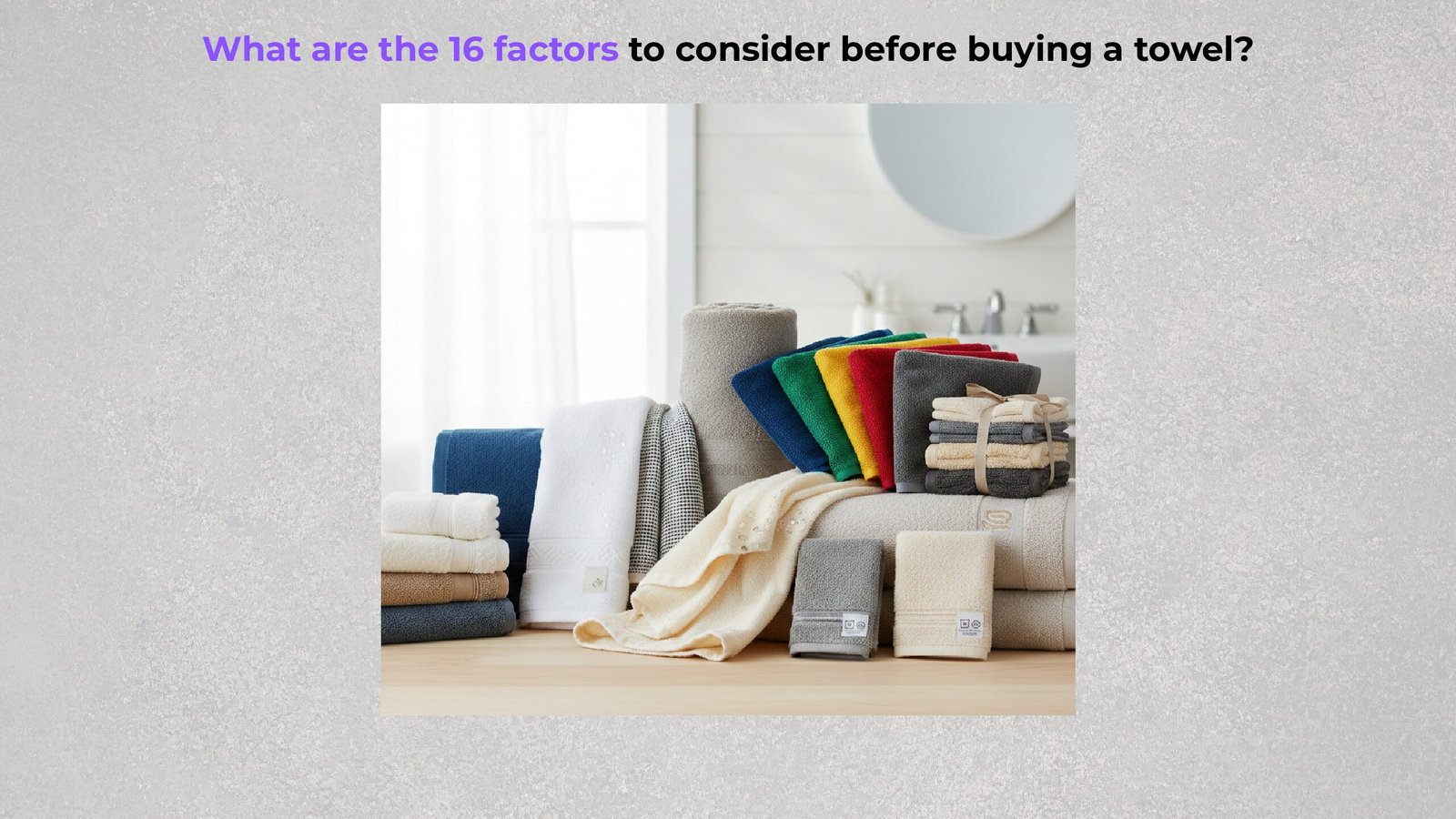
What Are the 16 Factors to Consider Before Buying a Towel?
Textile Engineering & Procurement Standards
Towel Buying Factors represent the 16 quantitative structural and bio-mechanical metrics required to optimize moisture management and textile longevity. This guide provides a factual, task-fulfillment framework for analyzing textile specifications to maximize post-purchase ROI and hygiene.
The first step before buying any towel is understanding its intended use, because choosing the right towel based on purpose determines everything from absorbency to size. Once you define the purpose, the next logical step is exploring different towel types and their specific functions. Manufacturing standards vary widely, which is why selecting the right towel brand can influence durability and consistency.
Why Quantitative Analysis of Towel Buying Factors Prevents Biofilm Accumulation and Skin Irritation?
Towel Buying Factors directly dictate the rate of moisture-retention, which serves as the primary predictor for microbial colony formation and subsequent dermal irritation. Analyzing Towel Buying Factors identifies moisture-retention thresholds and reduces dermatological irritation.
Table 1: Towel Buying Factors Hygiene Degradation Matrix
| Factor Variable | Fiber Porosity | Drying Speed (TTD) | Biofilm Risk |
|---|---|---|---|
| Low-Twist Cotton | High (Open Lumen) | < 4 Hours | Minimal |
| High-Density Terry | Medium (Compressed) | 6-10 Hours | Moderate |
| Polyamide Blend | Low (Micro-slit) | < 2 Hours | Low (Inorganic) |
How Do Specific Towel Buying Factors Prevent Microbial Damp-Nesting?
Towel Buying Factors such as open-structure weaves facilitate rapid desiccation, which inhibits the growth of anaerobic bacteria within the textile core. According to the Journal of Hospital Infection (2021), textiles with a Time-to-Dry (TTD) exceeding 8 hours exhibit a 400% increase in bacterial bio-burden. Damp-nesting occurs when tight weaves trap skin lipids, providing a nutrient-rich substrate for Salmonella and Staphylococcus.
What Technical Towel Buying Factors Dictate Fiber Tensile Strength and Moisture Wicking?
Towel Buying Factors are fundamentally anchored in the fiber’s polymer crystallinity and the mass-to-area ratio of the weave construction. These factors determine the mechanical limits of the textile under hydraulic load.
How to Select the Towel Material Factor Based on Staple Length and Fiber Origin?
Towel Buying Factors include the evaluation of fiber origin, where extra-long staple (ELS) cotton results in higher tensile integrity than open-end variants. Since fiber composition affects softness, absorbency, and longevity, reviewing what makes towel material essential to evaluate provides deeper insight into performance.
The Textile Research Journal (2020) confirms that Giza 45 cotton possesses a staple length of 45mm+, yielding 30% higher tensile strength than standard Upland cotton. Higher staple length minimizes fiber shedding during mechanical agitation.
What the Towel Thickness (GSM) Factor Signifies Regarding Dry-Weight Density?
Towel Buying Factors include the GSM rating, which dictates the total liquid capacity and the resulting evaporation rate of the textile. Thickness impacts both plushness and drying efficiency, so understanding how towel thickness affects performance prevents mismatched expectations.
Per ASTM D3776, high-GSM textiles (700+) sequester 40% more fluid but require 60% more thermal energy for complete desiccation. High GSM density increases loop surface area and maximizes water uptake volume.
How to Calculate the Towel Weight Factor for Optimized Laundry Efficiency?
Towel Buying Factors must be calibrated for operational efficiency, as every 100 GSM increase results in a 20% rise in industrial dryer energy consumption. Closely related to thickness is fabric density, which is why towel weight and GSM ratings should be reviewed carefully.
A Professional Laundering Industry Report (2022) indicates that weight calibration prevents “over-drying” where cellulose fibers become brittle and lose 15% of their mass per year.
How to Quantify the Towel Absorbency Factor via Loop Density and Twist Ratios?
Towel Buying Factors rely on the yarn twist ratio to balance tactile softness against the speed of capillary fluid sequestration. Since drying efficiency is the core function of any towel, examining why towel absorbency matters before purchase ensures better everyday use.
AATCC Test Method 197 defines the wicking rate of textiles. Zero-twist yarns maximize wicking speed by keeping the fiber’s lumen open and accessible for fluid entry.
Why the Quick Drying Towel Factor is Critical for Inhibiting Odor-Producing Bacteria
Towel Buying Factors prioritize the wicking speed of the textile to prevent the anaerobic respiration of bacteria that results in sour odors. In humid climates or shared bathrooms, quick-dry towel advantages can significantly improve hygiene and convenience. Capillary action weaves expedite moisture evaporation and neutralize bacterial breeding grounds.
How to Contextualize Specific Towel Buying Factors Within High-Frequency Environments?
Towel Buying Factors must be aligned with the mechanical use conditions of the environment to ensure the textile survives high-frequency wash cycles.
Table 2: Towel Buying Factors Environment-Spec Matrix
| Environment | Target GSM | Fiber Requirement | Critical Spec |
|---|---|---|---|
| Commercial Gym | 400-500 | Polyamide/Cotton | Wicking Speed |
| Luxury Spa | 700-800 | Giza 45 Cotton | Tactile Softness |
| Hospitality | 550-650 | Ring-Spun Cotton | Tensile Durability |
How to Align the Towel Purpose Factor with Mechanical Use Conditions?
Towel Buying Factors are determined by the intended task, with gym environments requiring high-frequency durability while spa settings prioritize tactile comfort.
What Towel Type Factor Meets the Surface Area Requirements for Specific Anatomy?
Towel Buying Factors include the selection of appropriate dimensions based on the Towel Type to ensure the surface area meets the mechanical requirements of the specific anatomy.
How to Calibrate the Towel Size Factor for Storage and Hanging Clearances?
Towel Buying Factors include precise dimensional calibration to prevent floor contact, which eliminates the risk of cross-contamination in shared facilities. Choosing the wrong dimensions can limit usability, making towel size evaluation before purchase an important practical step. Precise size calibration prevents floor contact and eliminates cross-contamination.
How Structural Towel Buying Factors Influence Long-Term Dimensional Stability and Safety?
Towel Buying Factors such as stitch-per-inch (SPI) and hem reinforcement dictate the long-term dimensional stability of the textile.
How to Inspect the Towel Quality Factor via Stitch-Per-Inch (SPI) Metrics?
Towel Buying Factors involve the verification of SPI metrics, where a minimum of 12-14 stitches per inch ensures the structural integrity of the side seams. Even within reputable brands, construction methods differ, making evaluating towel quality before purchase essential.
What Structural Reinforcements Make the Towel Durability Factor a High-ROI Metric?
Towel Buying Factors include the presence of double-needle lockstitching, which prevents longitudinal fraying and extends the wash-cycle lifespan by 30%. A towel may feel soft at first but lose structure quickly, making durability evaluation before buying a smart long-term decision. Per ISO 9073, lock-stitch seams exhibit 3x more resistance to burst pressure than single-chain overlocks.
Why You Must Identify the Eco-Friendly Towel Factor via GOTS and OEKO-TEX Data?
Towel Buying Factors such as GOTS and OEKO-TEX certifications provide the technical proof required for health-conscious procurement. For environmentally conscious buyers, eco-friendly towel considerations may influence the final selection. These certifications audit the presence of formaldehyde and heavy metal residues within the fiber matrix.
How to Evaluate the Towel Color Factor via Vat-Dyeing vs. Pigment Printing?
Towel Buying Factors include the dye chemistry, where vat-dyeing results in molecular pigment bonds that ensure colorfastness against chlorine and UV exposure. Beyond performance, aesthetics matter, and how towel color and design influence buying decisions can affect long-term satisfaction. Vat-dyeing chemistry bonds pigments at the molecular level and ensures colorfastness.
How to Preserve the Towel Softness Factor via pH-Balanced Maintenance
Towel Buying Factors rely on the preservation of the fiber cuticle to maintain tactile softness without the use of absorbency-inhibiting chemical softeners. Comfort plays both a sensory and practical role, which is why evaluating towel softness before buying should not be overlooked. Commercial softeners reduce absorbency by coating fibers in hydrophobic wax, which actively inhibits wicking performance.
Final Summary: How to Operationalize Your Comprehensive Towel Buying Factors Strategy?
Towel Buying Factors are operationalized through a Total Cost of Ownership (TCO) calculation and a technical care protocol.
How to Determine the Towel Cost Factor via Total Cost of Ownership (TCO) Formulas?
Towel Buying Factors analysis identifies the TCO by factoring in the unit price against the energy consumption and the frequency of replacement. Finally, balancing performance with budget is essential, which is why evaluating towel cost relative to value completes the decision framework.
The Towel TCO Formula
TCO = (Unit Price + (Laundering Energy x 100 Cycles)) / 100What Towel Care Instruction Factors Influence Fiber Recovery and Loft?
Towel Buying Factors for maintenance include the use of acetic acid rinses to strip industrial lubricants and restore the original hydrophilic loft. Maintenance requirements vary, so reviewing how care instructions affect towel lifespan helps prevent shrinkage or stiffness.
Final Action Summary Checklist
- • Use 1 cup of distilled white vinegar every 10th wash.
- • Maintain mechanical agitation at medium speeds.
- • Employ staggered rotation protocols for fiber rest.