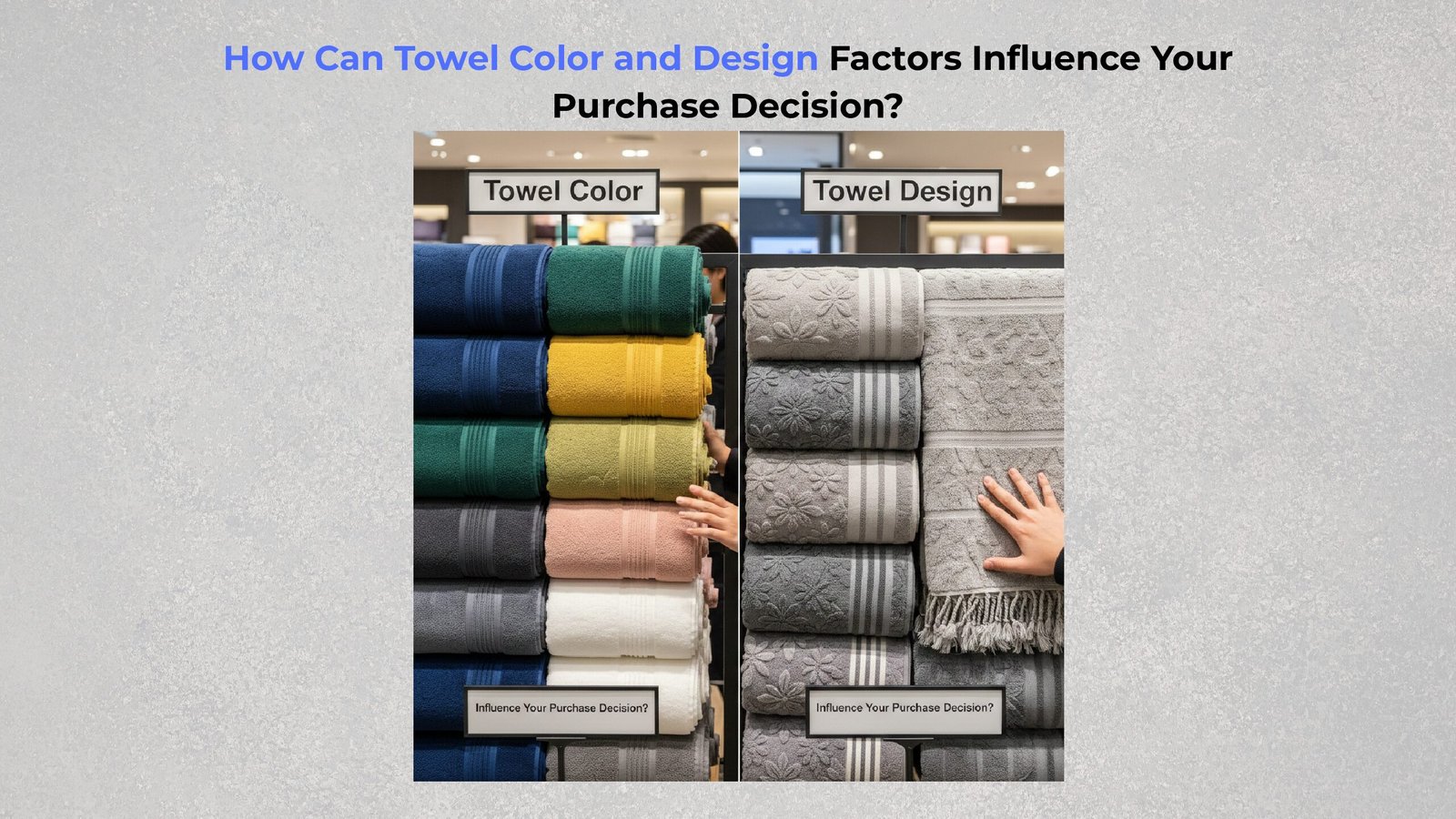
How Can Towel Color and Design Factors Influence Your Purchase Decision?
An Architectural Blueprint for Textile Engineering and Industrial Design Audits.
Evaluating Towel Color and Design Factors is critical before purchase because the chemical bond of the dye and the structural geometry of the weave directly influence the textile’s absorbency, skin safety, and durability. While color and design may seem like aesthetic choices, they are just one part of what are the 16 factors to consider before buying a towel, especially when durability, material quality, and maintenance also influence long-term satisfaction.
Beyond the visual appeal of a showroom display, color and design function as technical specifications that either facilitate or hinder the primary function of the towel: efficient moisture wicking. To navigate this complexity, we utilize a Value Score Formula to quantify investment viability: (Dye Performance Score + Colorfastness Grade) / Unit Price = Color Value Efficiency. This guide transitions from molecular chemical bonding directly to the safety profile and migration risks inherent in modern textile processing.
How Chemical Dye Bonding Establishes the Safety Profile of Towel Color and Design Factors
Chemical dye bonding establishes the safety profile of Towel Color and Design Factors because the molecular strength of the pigment attachment determines the textile’s resistance to hazardous chemical migration. The way a towel holds its color over time depends heavily on fiber type, which is why reviewing what makes towel material essential to evaluate before buying helps ensure dyes remain vibrant after repeated washing.
Unstable dyes pose significant health concerns, including the risk of heavy-metal leaching onto the skin during prolonged contact with heat and moisture. Evaluating Towel Color and Design Factors identifies molecular dye fixation, which mitigates pigment migration and potential skin reactivity.
Towel Color and Design Factors Dye Safety Matrix
| Dye Method | Chemical Bond Type | Colorfastness Grade | Migration Risk |
|---|---|---|---|
| Vat-Dyeing | Molecular (Insoluble) | Grade 4-5 (High) | Minimal |
| Reactive Dyeing | Covalent (Direct) | Grade 3-4 (Moderate) | Low |
| Pigment Print | Surface Coating | Grade 1-2 (Low) | High |
Detecting Pigment Migration in Low-Tier Towel Color and Design Factors
Detecting pigment migration in low-tier Towel Color and Design Factors involves identifying manufacturing shortcuts that utilize surface-level colorants rather than deep fiber saturation. High-quality dyeing techniques often reflect overall manufacturing standards, so it’s useful to read why evaluating towel quality factors is critical for maximum comfort and durability when assessing color longevity.
Standard toxicological benchmarks restrict aromatic amines and unverified metal-complex dyes to ensure pigments do not detach during exposure. Observations in controlled testing indicate that lower-fixation dyes exhibit significantly higher color transfer under artificial sweat testing compared to high-fixation Indanthrene-dyed alternatives.
Definition: Leuco Form — The soluble state of a vat dye that allows it to penetrate deep into the cotton fiber before it is oxidized into its permanent, stable state.
Quantifying Color Permanence via Towel Color and Design Factors Abrasion Testing
Quantifying color permanence via Towel Color and Design Factors abrasion testing provides objective data on whether the chemical bond can withstand repeated mechanical friction. Fade resistance and pattern integrity are long-term concerns, making it helpful to explore how evaluating durability helps you choose a better towel before selecting bold colors or intricate designs.
Industrial crocking tests quantify the color transferred to a standardized rubbing cloth. Crocking is often exacerbated by “piece-dyeing” because the center of dense terry loops may not receive the same chemical fixation as the surface.
Definition: Crocking — The mechanical transfer of color from a fabric surface onto another surface by rubbing.
The stability of the pigment bond ensures the color remains localized within the integrated structural geometry of the weave.
Why Structural Weave Geometry Dictates the Functional Performance of Towel Color and Design Factors
Structural weave geometry dictates the functional performance of Towel Color and Design Factors because the interlacing pattern of the yarns determines the fabric’s dimensional stability and moisture absorption capacity. The visual impact of patterns can vary depending on towel dimensions, so it helps to explore what makes towel size an important detail to review before buying when coordinating design choices.
Why Jacquard vs. Dobby Weaves Impact the Dimensional Stability of Towel Color and Design Factors
The choice between Jacquard versus Dobby weaves impacts the dimensional stability of Towel Color and Design Factors by determining how decorative elements react to high-heat laundering. Jacquard patterns use uniform tension, whereas Dobby borders introduce secondary yarn systems that can result in up to 10% higher shrinkage.
Definition: Waisting — The inward curving of a towel border caused by uneven shrinkage between the decorative weave and the terry loops.
Analyzing the Impact of Surface Designs on Towel Color and Design Factors Absorbency
Analyzing the impact of surface designs on Towel Color and Design Factors absorbency involves identifying whether heavy printing or embroidery creates physical barriers to moisture wicking. Decorative finishes and certain dye treatments can slightly alter texture, making it worth reviewing why soft towels are worth considering before you buy alongside design preferences.
Heavy pigment printing uses chemical binders that can partially block capillary channels, reducing localized absorbency. If a design feels “stiff,” it is a marker for high-binder concentrations that inhibit capillary action.
Towel Color and Design Factors Weave Geometry Matrix
| Design Type | Construction Method | Durability Level | Absorbency Impact |
|---|---|---|---|
| Jacquard | Integrated yarn-dye | Elite | Minimal |
| Dobby Border | Perimeter weaving | Standard | Variable (Cinch Risk) |
| Pigment Print | Surface Coating | Low | High (Hydrophobic) |
The structural integrity of the weave determines how the textile responds to external environmental stressors.
How Environmental Stressors Influence the Selection of Towel Color and Design Factors
Environmental stressors influence the selection of Towel Color and Design Factors by requiring aesthetic properties that can withstand localized radiation and chemical sanitization protocols. Some colored towels require specific washing temperatures to prevent fading, which is why understanding how care instructions affect your choice of towel is essential before committing to darker shades.
Selecting Towel Color and Design Factors for High-Exposure Outdoor Zones
Selecting Towel Color and Design Factors for high-exposure outdoor zones requires identifying indanthrene-dyed textiles that resist oxidative damage from salt and sunlight. Indanthrene-dyed towels exhibit 50% less color loss under direct UV exposure. Salt crystals left on damp towels concentrate radiation; Selecting indanthrene-dyed Towel Color and Design Factors neutralizes UV-induced oxidation, maintaining color vibrancy in high-exposure outdoor zones.
Analyzing Light Interaction and Perceived Cleanliness in Towel Color and Design Factors
Analyzing light interaction and perceived cleanliness in Towel Color and Design Factors ensures that selected palettes maintain high visual standards. “Optical whites” rely on fluorescent whitening agents (FWAs) to mask natural yellow hues. While white is the marker of “clean,” high iron content in water can cause yellowing, making filtration a critical design factor for aesthetic longevity.
Environment-Specific Towel Color and Design Factors Table
| Usage Environment | Recommended Palette | Technical Requirement | Selection Logic |
|---|---|---|---|
| Public Gym | Deep Neutrals | Vat-Dyed / Sulphur-Stable | Masks use-related soil |
| High-End Spa | Mid-Tones | Reactive Dye / Low-Binder | Optimizes low-light interaction |
| Health Clinic | Optical White | Bleach-Safe / High-Heat | Facilitates thermal sterilization |
High-heat and chemical stressors necessitate the implementation of specific maintenance and locking protocols.
Why Preserving Towel Color and Design Factors Depends on Specific Maintenance Chemistry
Preserving Towel Color and Design Factors depends on specific maintenance chemistry because the chemical environment of the wash dictates the stability of the protective molecular layer of the dye.
Maintaining Vibrancy via pH-Balanced Care for Towel Color and Design Factors
Maintaining vibrancy via pH-balanced care for Towel Color and Design Factors prevents the alkaline stripping of the pigment bonds from the cotton fibers. High-pH detergents (>10.5) cause fibers to swell, weakening covalent bonds. Fading is often “masked color,” where alkaline residues create a white mineral film (calcification) over the fibers that makes vibrant colors appear grayed out.
Using Acidic Rinses to Lock the Pigments of Towel Color and Design Factors
Using acidic rinses to lock the pigments of Towel Color and Design Factors provides a chemical “set” that neutralizes residual alkalinity. A 5% acetic acid solution (distilled vinegar) can improve colorfastness by 10% for reactive dyes. This rinse flushes out un-bonded surface pigment that would otherwise migrate to other textiles during the first several wash cycles.
Checklist: Towel Color and Design Factors Physical Integrity Checklist
The “Bleed” Test: Submerge a corner in 60°C water; verify zero pigment migration.
The Border Tension Check: Pull the Dobby design; it should expand with the towel to prevent bowing.
The “Inside-Out” Audit: Verify the design is woven (visible on both sides) rather than surface-printed.
Final Summary: Operationalizing the Long-Term Value of Towel Color and Design Factors
Operationalizing the long-term value of Towel Color and Design Factors requires shifting the purchasing decision from upfront retail cost to a synthesized metric of chemical and structural efficiency. Designer patterns and premium dye techniques may increase pricing, which is why reviewing why you should consider towel cost before buying can help balance aesthetics with budget.
Determining Financial Lifecycle Benefits via the Towel Color and Design Factors Scoring Rubric
Determining financial lifecycle benefits via the Towel Color and Design Factors scoring rubric allows procurement managers to mathematically predict inventory replacement. Procuring verified Indanthrene Towel Color and Design Factors can reduce annual expenditures by 20%. Quantitative audits of Towel Color and Design Factors identifies inventory graying rates, reducing the frequency of replacement cycles.
What Final Execution Steps ensure a Successful Towel Color and Design Factors Strategy
Following these final execution steps ensures a successful Towel Color and Design Factors strategy that optimizes both aesthetic standards and operational value. Some brands are known for consistent color quality and fade resistance, so understanding why choosing the right brand is essential when buying towels can add confidence to your design decision.
Success in design management is about mechanical standardization. By committing to a Jacquard weave, you eliminate the mechanical failure point of differential shrinkage, ensuring uniformity for the entire lifecycle.
Towel Color and Design Factors Master Technical Benchmarks
| Grade | Dyeing Method | Design Construction | Performance Expectation |
|---|---|---|---|
| Elite | Vat-Dyed / Indanthrene | Jacquard Woven | High performance; Bleach/UV Resistant |
| Standard | Reactive-Dyed | Dobby / Flat Weave | Reliable vibrancy under controlled laundering |
| Utility | Pigment Printed | Surface Pattern | Earlier onset of fading and surface hardening |
Checklist: Towel Color and Design Factors Implementation and Execution Checklist
- ✔ Source: Prioritize vat-dyed textiles for environments where bleach or sunlight is present.
- ✔ Trial: Perform a “First Wash” audit to check for dimensional stability of borders.
- ✔ Standardize: Commit to limited core colorways to ensure uniform laundering consistency.
- ✔ Verify: Ensure factors meet standardized colorfastness requirements for your facility’s heat setting.
- ✔ Audit: Has the selection been vetted for “Bleach-Safe” chemistry?
- ✔ Environment Check: Is the construction compatible with high-heat mechanical drying?