Does High Heat Cause Egyptian Cotton Towel Heat Damage?
A Material Science Analysis of Thermal Degradation in ELS Fibers
High temperatures cause Egyptian cotton towel heat damage. Egyptian cotton towel heat damage occurs if excessive heat accelerates fiber relaxation shrinkage. Cellulose structural integrity fails if the dryer maintains temperatures above the safe operating range.
Fiber relaxation shrinkage represents the primary physical mechanism of material degradation. This process results in the permanent contraction of the extra-long staple (ELS) yarns. Tensile strength loss triggers if the thermal energy disrupts the molecular bonds within the Giza 88 or Giza 45 cotton strands.
How does thermal exposure trigger Egyptian cotton towel heat damage?
Thermal exposure triggers Egyptian cotton towel heat damage by inducing an over-dry state. This over-dry state occurs if the dryer evaporates the moisture necessary for cellulose flexibility, which serves as a precursor to permanent high heat damage to Egyptian cotton towels. Brittle fibers develop when the yarn loses its hygroscopic equilibrium.
Technical Definition: Hygroscopic Equilibrium
Hygroscopic equilibrium is the specific moisture content at which a textile fiber neither gains nor loses water to the surrounding atmosphere, essential for maintaining the elastic properties of Giza cotton.
How do water-to-elasticity ratios influence Egyptian cotton towel heat damage?
Water-to-elasticity ratios influence Egyptian cotton towel heat damage because cellulose flexibility depends on specific moisture levels. Egyptian cotton towel heat damage increases if the dryer exceeds moisture-removal thresholds. Following strict protocols for washing Egyptian cotton towels ensures that fibers maintain their baseline integrity before thermal exposure.
Which visible markers identify Egyptian cotton towel heat damage?
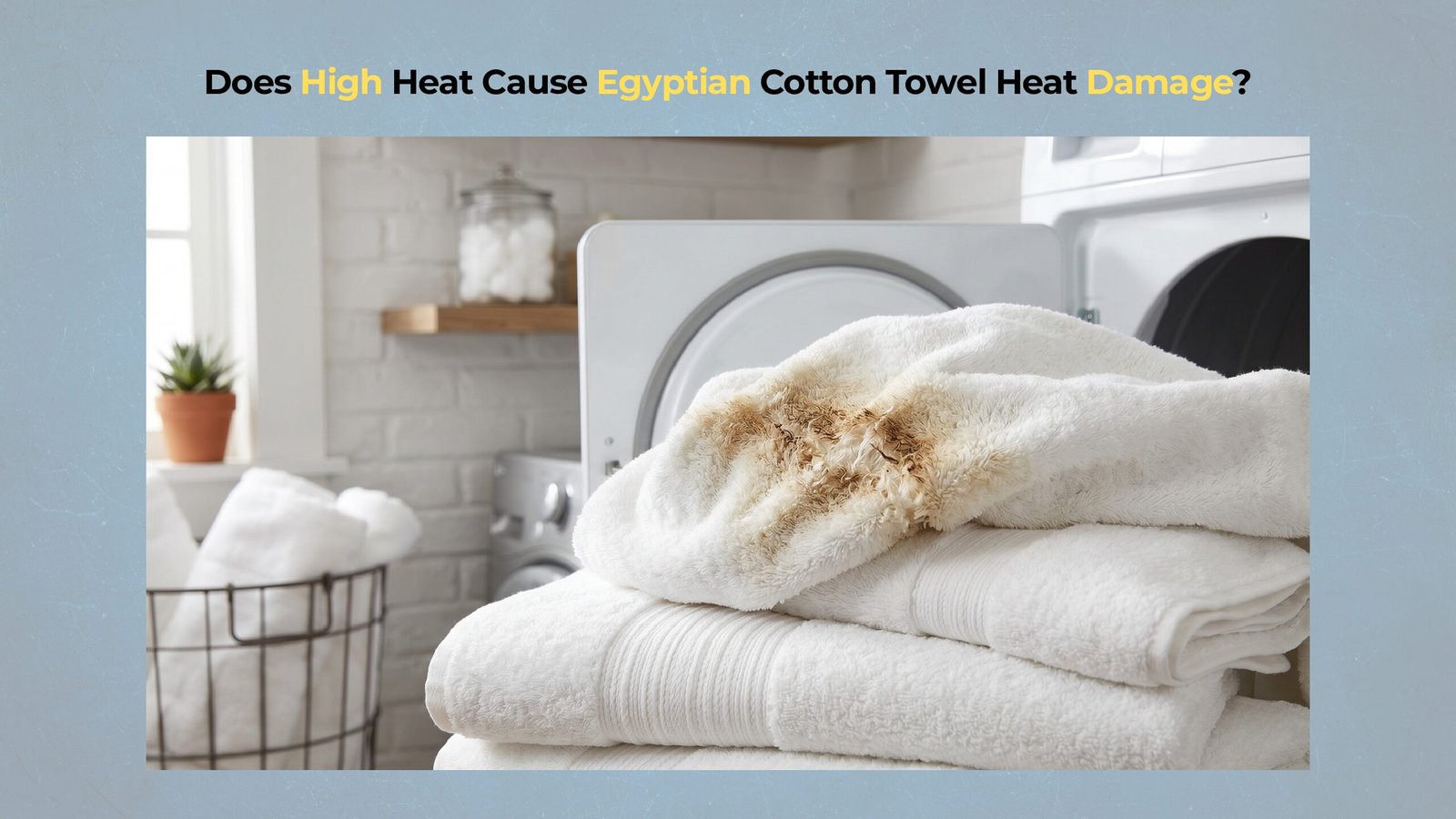
Identifying Egyptian cotton towel heat damage involves observing increased lint volume and loop stiffness. These markers of Egyptian cotton towel heat damage appear if the fibers reach the over-dry state and snap. Surface texture changes when thermal wear compromises the yarn loops, which can sometimes be confused with detergent residue stiffness in Egyptian cotton towels.
Technical Definition: Fiber Relaxation Shrinkage
Fiber relaxation shrinkage is the irreversible contraction of processed yarns returning to their natural, unstretched state when exposed to temperatures exceeding their thermal stability threshold.
Why is lint production a symptom of Egyptian cotton towel heat damage?
Lint production serves as a primary symptom of Egyptian cotton towel heat damage. Egyptian cotton towel heat damage manifests as high lint volume when brittle fibers break away from the base weave. Users should regularly perform mineral buildup removal for Egyptian cotton towels to distinguish between inorganic calcification and actual thermal fiber breakage.
Which drying methods protect against Egyptian cotton towel heat damage?
Low-heat tumble cycles or ambient air drying protect against Egyptian cotton towel heat damage. Egyptian cotton towel heat damage ceases when ambient drying provides zero thermal stress. Consistently choosing low heat drying for Egyptian cotton towels maintains the mechanical loft without triggering fiber wear.
| Drying Setting | Impact on Structure | Longevity Rating | Risk Level |
|---|---|---|---|
| High / Heavy Duty | Accelerated fiber snapped | 1-2 Years | CRITICAL |
| Medium / Normal | Gradual structural thinning | 2-4 Years | MODERATE |
| Low / Delicate | Maintains capacity | 5-10 Years | MINIMAL |
| Air Dry (Shade) | Zero degradation | 10+ Years | ZERO |
How do you set dryer controls to avoid Egyptian cotton towel heat damage?
Avoiding Egyptian cotton towel heat damage requires selecting “Delicate” or “Low” heat presets. Egyptian cotton towel heat damage stops when moisture sensors terminate the over-dry state. This moisture-sensing technology is a foundational element in softness restoration for Egyptian cotton towels that have been slightly over-processed.
Technical Definition: Thermal Fiber Stress
Thermal fiber stress is the mechanical strain exerted on individual cellulose strands when localized heat exceeds the material’s glass transition temperature, leading to microscopic fractures.
Which habits aggravate Egyptian cotton towel heat damage?
Specific laundry habits aggravate Egyptian cotton towel heat damage. Egyptian cotton towel heat damage worsens if silicone-based softeners create flammable coatings. Examining the fabric softener absorbency impact on Egyptian cotton towels reveals how these chemical layers act as thermal traps.
Frequently Asked Questions
Can Egyptian cotton towel heat damage be reversed?
Egyptian cotton towel heat damage is irreversible once fiber relaxation shrinkage occurs. Thermal degradation permanently alters the cellulose molecular structure, rendering the loops brittle and non-absorbent.
What temperature prevents Egyptian cotton towel heat damage?
Maintaining dryer temperatures below 120°F prevents Egyptian cotton towel heat damage. Delicate or low-heat presets protect the tensile strength of ELS fibers by avoiding the glass transition threshold of cotton cellulose.
Is air drying better for avoiding Egyptian cotton towel heat damage?
Ambient air drying eliminates Egyptian cotton towel heat damage by removing thermal stress entirely. Shade drying prevents additional UV-induced fiber weakening while maintaining the towel’s natural hydrophilic capacity.
How does heat damage affect towel absorbency?
Egyptian cotton towel heat damage reduces hydrophilic capacity by crushing the terry loops. Brittle fibers inhibit the capillary action necessary for water wicking, which can be further hindered by incorrect liquid detergent use for Egyptian cotton towels.
Final Thermal Safety Checklist
Validation Protocol for Egyptian Cotton Towel Heat Damage
The user deselects the “Towels” or “Sanitize” high-heat preset to prevent Egyptian cotton towel heat damage.
The appliance dial remains set to the “Delicate” or “Low Heat” threshold.
The user excludes chemical dryer sheets to prevent loop suffocation.
The drum load allows for even airflow through restricted volume.
The user removes towels while 10% damp to prevent reaching the over-dry state.
Disclaimer: Material Science and Laundering Protocols
Laundering outcomes vary based on appliance calibration, regional water chemistry, and specific textile manufacturing techniques. Toweldaily.com provides this material science analysis for educational purposes. Users assume full responsibility for applying these protocols to specific high-end textile assets. Implementing these thermal safety measures constitutes a voluntary action by the reader to secure their luxury linen investment.