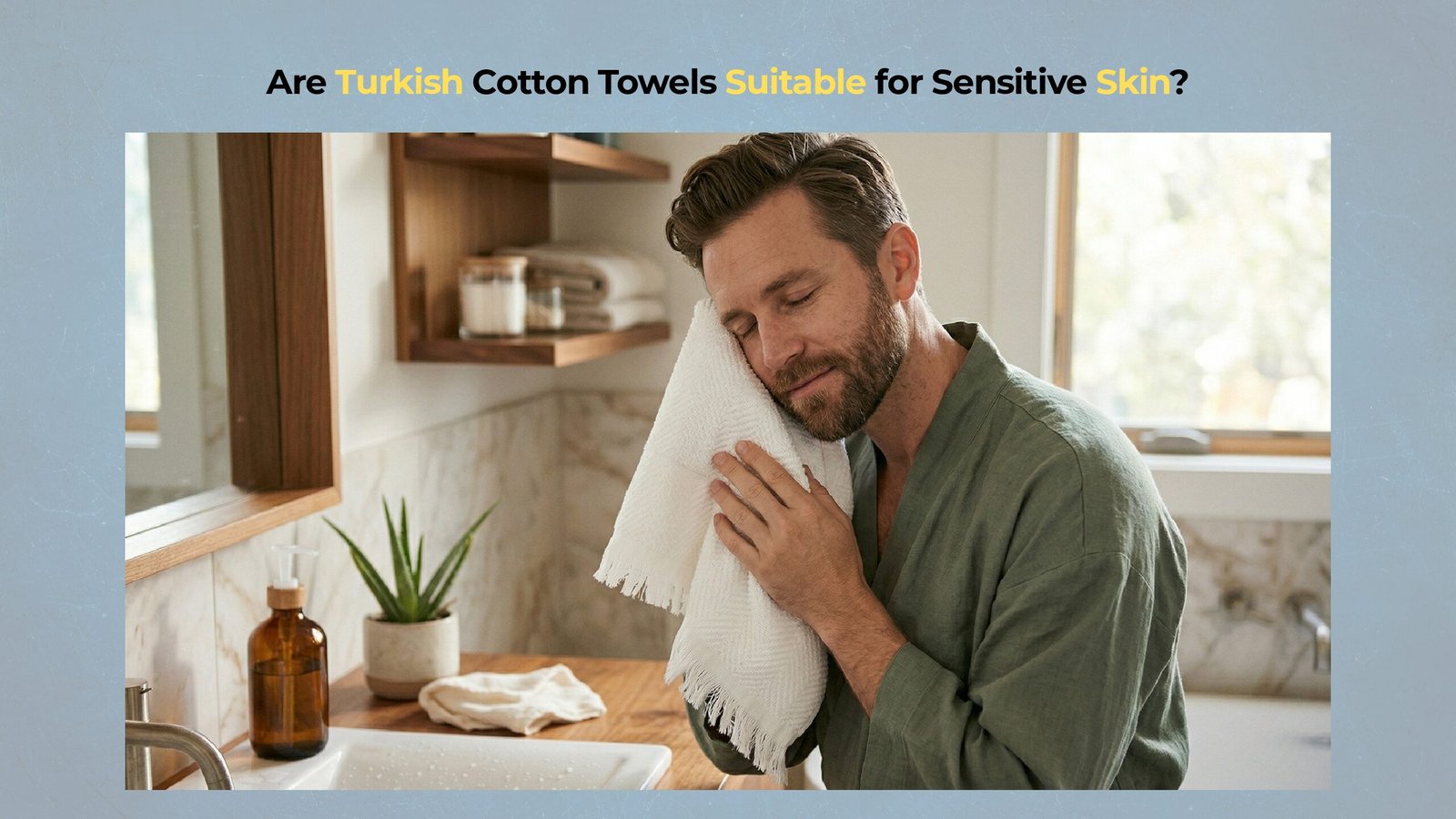
Are Turkish Cotton Towels Suitable for Sensitive Skin?
Turkish Cotton Towel Sensitive Skin Suitability: A Technical Ergonomic Audit
Yes, superior dermatological compatibility typically results from Turkish cotton towel sensitive skin suitability, as the utilization of long-staple Aegean fibers facilitates a low-friction interface that typically minimizes mechanical and chemical irritation risk.
These long-staple Aegean fibers (measuring between $28.5\text{–}32\text{ mm}$) possess a high degree of uniformity, which translates into a yarn surface with fewer protruding ends. This structural integrity ensures that the textile maintains a smooth profile even after repeated laundering, directly supporting the preservation of the stratum corneum during the drying process.
This activation phase describes how unwashed Gossypium hirsutum fibers may require multiple washes to remove finishing agents and reach their intended softness. During manufacturing, natural waxes and industrial sizing are applied to protect the threads; removing these via professional laundering “opens” the fiber, allowing the characteristic Aegean bloom to emerge.
Technical Objective:
This guide audits the friction coefficients, pH balance, and fiber morphology of Aegean cotton to verify Turkish cotton towel sensitive skin suitability and provide technical benchmarks for reactive skin care.
Establishing this baseline for dermal safety confirms that effective irritation prevention is the primary driver of textile performance.
Why Can Irritation Prevention Support Turkish Cotton Towel Sensitive Skin Suitability?
Turkish cotton towel sensitive skin suitability is strongly influenced by how fibers interact with the skin surface during drying. To understand how moisture is absorbed without aggressive friction, it is useful to explore how absorbent Turkish cotton towels are and how they manage moisture transfer. Structural smoothness typically minimizes the micro-abrasions associated with short-staple linens, preventing inflammatory responses in reactive skin types.
This wicking efficiency ultimately results in a low-abrasion tactile outcome that defines the high-performance user experience.
Identifying the Low-Abrasion Outcome for Turkish Cotton Towel Sensitive Skin Suitability
Mechanical skin stress is typically reduced by Turkish cotton towel sensitive skin suitability because Aegean long-staple fibers can exhibit lower friction compared to short-staple cotton, as longer strands create fewer “exposed ends” that may scratch the epidermal layer. Since this advantage is driven by fiber length, you may want to explore what staple length Turkish cotton towels typically have and why it matters for softness.
Dermatological friction studies published in the Journal of Dermatological Science indicate that the use of uniform filaments results in a measurable reduction in kinetic friction. Fewer “Join-Points” in the yarn core result in a surface profile that glides rather than scrubs.
[Long-staple fiber alignment] → [reduces exposed fiber ends] → [optimizes Turkish cotton towel sensitive skin suitability softness].
Determining Why Wicking Speed Supports Turkish Cotton Towel Sensitive Skin Suitability
Turkish cotton towel sensitive skin suitability typically supports dermal comfort by utilizing high-speed wicking to dry the skin surface without aggressive rubbing. The ability to dry skin gently depends on how quickly moisture is released from the textile rather than retained in the fiber core. Since this directly affects comfort for reactive skin, a natural next step is to review how fast Turkish cotton towels dry and why this reduces irritation risk.
The American Academy of Dermatology (AAD) guidelines for drying sensitive skin emphasize the importance of minimizing friction. Observation shows that high-wicking Aegean cotton supports the “Pat-Dry” technique, which helps preserve the natural lipid barrier of the stratum corneum by relying on capillary action rather than shear force.
[Rapid capillary wicking] → [enables the pat-dry method] → [supports dermal comfort in Turkish cotton towel sensitive skin suitability].
How Do Molecular Physics and Fiber Geometry Support Turkish Cotton Towel Sensitive Skin Suitability?
Skin barrier preservation typically results from Turkish cotton towel sensitive skin suitability by leveraging the low friction coefficients and parallel fiber alignment of the Aegean cotton strand. Because this behavior is rooted in fiber morphology, it is helpful to understand what the fiber structure of Turkish cotton towels looks like and how it affects skin contact. At a microscopic level, the “Parallel-Track” nature of ring-spun Turkish yarn prevents the transverse snagging of skin cells.
Identifying How Friction Coefficients Facilitate Turkish Cotton Towel Sensitive Skin Suitability
Turkish cotton towel sensitive skin suitability is enhanced by the parallel fiber alignment of ring-spun yarns, which typically minimizes the “grab-and-pull” effect on inflamed skin areas.
According to ASTM D1894 (Standard Test Method for Static and Kinetic Coefficients of Friction), high-tenacity yarns facilitate reduced kinetic friction against the skin. A unique insight into this material science is that low static friction identifies Aegean cotton as beneficial for sensitive skin conditions, as it can reduce the risk of mechanical scale disruption during initial contact.
Analyzing Why the Bloom Mechanism Supports Turkish Cotton Towel Sensitive Skin Suitability
Volumetric expansion typically improves Turkish cotton towel sensitive skin suitability over the textile’s lifecycle as the fibers can increase thickness after initial washes to create a soft, upright pile. Over time, proper washing and activation cycles allow fibers to relax and achieve their optimal low-friction profile. To follow that progression, it helps to explore how Turkish cotton towels become softer and more skin-friendly after repeated washing.
Data from the Textile Research Journal regarding fiber relaxation indicates that fabric thickness increases as manufacturing tensions release. The “Bloom” is a structural re-inflation that typically increases the air-trap volume, providing a gentler skin-contact zone that cushions the epidermal layer against the base weave of the towel.
Which Certifications Validate Turkish Cotton Towel Sensitive Skin Suitability?
Identification of third-party safety labels verifies Turkish cotton towel sensitive skin suitability by highlighting low-residue, skin-compatible materials that lack dermatological triggers.
| Certification | Primary Benefit for Sensitive Skin | Toxicological Screen | Recommendation |
|---|---|---|---|
| GOTS Organic | Zero synthetic pesticide exposure | Heavy Metals / Toxins | 1 (Highest) |
| OEKO-TEX Std 100 | Screens for 100+ harmful allergens | Azo Dyes / Formaldehyde | 2 (Class I/II) |
| Hypoallergenic | Marketing designation | None | 3 (Unverified) |
| Untreated Raw | Potentially high in industrial sizing | Waxes / Starches | 4 (Requires Fix) |
Evaluating the Safety Tiers of Turkish Cotton Towel Sensitive Skin Suitability
Turkish cotton towel sensitive skin suitability reaches the peak “Low-Residue” tier when adherence to GOTS organic benchmarks supports a supply chain that strictly excludes the allergenic dyes often responsible for contact dermatitis. Sensitive skin compatibility can decline when residues or chemical coatings remain on the fiber surface after washing. Because these substances directly affect skin contact, it is useful to review how chemical residues affect Turkish cotton towel performance and dermatological safety.
Which Laundry Protocols Preserve Turkish Cotton Towel Sensitive Skin Suitability?
Preservation of a low-irritant profile results from maintenance protocols that support Turkish cotton towel sensitive skin suitability by excluding chemical additives and alkaline detergent salts. Improper laundering can lead to “Cellulose Hornification,” where fibers become brittle and sharp.
Why the “No-Softener” Rule Secures Turkish Cotton Towel Sensitive Skin Suitability
Turkish cotton towel sensitive skin suitability can be compromised if liquid fabric softeners are utilized, as these cationic surfactants coat fibers in synthetic fragrances that can trigger contact dermatitis. Mechanical stress and repeated laundering can alter fiber smoothness and increase friction over time. Since this defines long-term usability, it is helpful to explore how durable Turkish cotton towels are and how they maintain softness with use.
Environmental Working Group (EWG) data on “Quats” (Quaternary ammonium compounds) suggests that these chemicals are potent skin irritants. Furthermore, the silicone “glazing” created by softeners doesn’t just block water; it creates a hydrophobic film that may trap skin oils and bacteria against the skin surface during use.
Executing the “Double-Rinse” Protocol for Turkish Cotton Towel Sensitive Skin Suitability
Turkish cotton towel sensitive skin suitability improves when users execute a second rinse cycle to help maintain a near-neutral pH surface by reducing trapped alkaline salts.
How Can You Restore Flexibility to Maintain Turkish Cotton Towel Sensitive Skin Suitability?
Restoration of original loop flexibility typically results from executing chemical resets to revitalize Turkish cotton towel sensitive skin suitability before fibers reach a state of mineral-based stiffness.
Resolving Mineral-Based Stiffness to Restore Turkish Cotton Towel Sensitive Skin Suitability
Turkish cotton towel sensitive skin suitability regains its original pliability when a warm vinegar rinse successfully dissolves the calcium deposits that can improve fiber flexibility and reduce roughness. Improper drying conditions can stiffen fibers and increase surface roughness, which may aggravate sensitive skin. Because drying methods influence fiber flexibility, you may want to review how drying methods affect Turkish cotton towel softness and performance.
How to Audit Your Experience with the Turkish Cotton Towel Sensitive Skin Suitability Checklist?
Checklist: Turkish Cotton Towel Sensitive Skin Suitability Audit
- Certification Check: Does the label display the official Oeko-Tex Standard 100 or GOTS logo?
- Activation Audit: Has the towel undergone enough washes to ensure total sizing removal?
- Chemistry Audit: Is the laundry routine 100% free of cationic fabric softeners and scented dryer sheets?
- Tactile Check: Does the wet textile provide a “glide” rather than a “grab” sensation?
- Irritation Audit: Does the towel ensure it should not cause noticeable irritation for most users after a 5-second firm rub?
Frequently Asked Questions: Turkish Cotton Towel Sensitive Skin Suitability
For most Aegean textiles, 3 to 5 full wash-and-dry cycles are required to completely strip industrial sizing and allow the fibers to relax into their maximum loft. Users with hypersensitive skin should avoid using the towel until it has reached this “bloom” state.
While bamboo is soft, it often requires heavy chemical processing (rayon/viscose method) which can leave trace resins. Turkish cotton is a natural mechanical solution; its long-staple geometry provides softness through fiber physics rather than chemical additives, making it a safer profile for many eczema sufferers.
A pH-neutral, liquid detergent free of dyes, enzymes (proteases), and synthetic fragrances is recommended. Powdered detergents can sometimes leave alkaline mineral deposits within the high-density loops, increasing friction.
Yes, medium-heat tumble drying is actually beneficial as the mechanical action helps “fluff” the fibers and prevent the stiffness associated with line-drying in hard water. However, ensure the dryer is free of dryer sheets which contain the same irritating surfactants as liquid softeners.
Dermatological Disclaimer
The technical analysis provided in this guide is for informational purposes regarding textile engineering and material science only. It does not constitute medical advice, diagnosis, or treatment for clinical dermatological conditions such as eczema, psoriasis, or contact dermatitis. While Turkish cotton towels exhibit low-abrasion properties, performance is conditional upon the complete removal of industrial sizing and the exclusion of harsh chemical surfactants. Individuals with highly reactive skin should consult a clinical dermatologist before altering their household textile or laundry hygiene protocols.