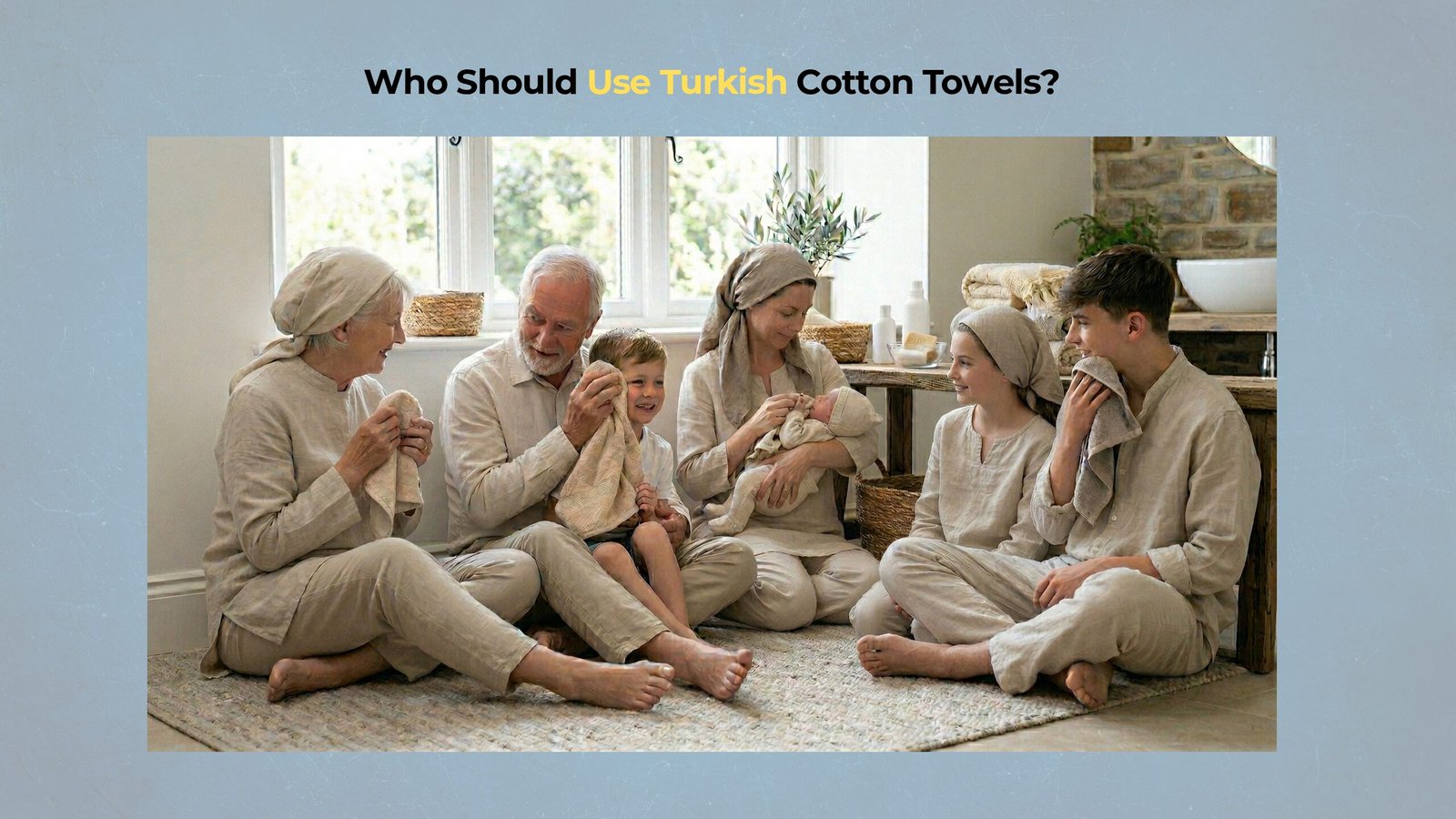
Who Should Use Turkish Cotton Towels?
Optimal results for daily hygiene typically result from Turkish cotton towel suitability when the user requires a balance between plush tactile comfort and a rapid evaporation window that inhibits microbial colonization.
The technical superiority of the Aegean fiber is rooted in its structural geometry. The specific 28.5–32 mm fibers facilitate a porous architecture that prevents moisture from being trapped deep within the cellulose core.
This guide audits the moisture-transport dynamics, atmospheric ventilation, and textile lifecycle ROI of Aegean cotton to verify Turkish cotton towel suitability for specific residential and high-activity environments.
Why is Turkish Cotton Towel Suitability Defined by Balanced Performance?
Turkish cotton towel suitability is defined by a balanced performance profile where the textile pulls moisture off the skin while refusing to sequester it stubbornly in the fiber core. Long-staple Aegean fibers also contribute to balanced performance by reducing friction and maintaining structural stability over time. To better understand this advantage, it is useful to review what staple length Turkish cotton towels typically have and why it matters.
Technical Summary This performance profile utilizes medium-staple length to optimize “Turnover Speed.” Unlike Extra-Long Staple (ELS) varieties that prioritize absolute capacity, Turkish cotton balances wicking volume with release velocity, preventing the “heavy-wet” sensation typical of saturated high-GSM linens.
As a consequence of this niche, wicking efficiency becomes the primary metric for user satisfaction. Optimal Turkish cotton towel suitability depends on how efficiently moisture is absorbed and released during daily use. To understand how this moisture interaction works at the fiber level, it is useful to explore how absorbent Turkish cotton towels are and how they manage moisture.
Does the “Wick-and-Dry” Niche Drive Turkish Cotton Towel Suitability?
Turkish cotton towel suitability reaches peak efficiency in the “Wick-and-Dry” niche because the fiber structure facilitates atmospheric moisture release significantly faster than high-saturation Egyptian or Pima alternatives. The defining advantage of Aegean cotton lies in its ability to release moisture quickly rather than trapping it inside the fiber core. Since this directly relates to drying efficiency, a natural next step is to review how fast Turkish cotton towels dry under real conditions.
According to AATCC 199 (Drying Time of Textiles), Aegean linens often reach moisture equilibrium up to 40% faster than Giza varieties of identical GSM. Selecting for speed rather than absolute capacity ensures the towel is dry for its next use, essentially eliminating “towel fatigue” or the accumulation of residual dampness.
Why is Climate-Dependency a Factor for Turkish Cotton Towel Suitability?
Turkish cotton towel suitability remains conditional upon localized environmental conditions, providing a functional requirement for high-humidity or coastal regions where heavier textiles often fail to dry between daily uses.
In environments exceeding 70% Relative Humidity (RH), towels above 700 GSM can foster musty odors within 24 hours due to sustained water retention. Turkish cotton serves as a “Hygiene Guard” in humid climates by keeping the damp-window shorter than the bacterial incubation period, ensuring a sanitized drying surface.
How Does Molecular Physics Support Turkish Cotton Towel Suitability?
Cellular-level vapor transit and the management of “Void Volume” support Turkish cotton towel suitability, leveraging the natural plumbing of the Aegean cotton strand.
The Aegean cotton strand acts as a biological capillary network. This rapid evaporation is enabled by the internal structure of long-staple fibers that create open pathways for vapor movement. Because this behavior originates at the microscopic level, it is helpful to understand what the fiber structure of Turkish cotton towels looks like and how it supports airflow.
Does “Vapor-Path” Geometry Facilitate Turkish Cotton Towel Suitability?
Turkish cotton towel suitability for active lifestyles is supported by “Vapor-Path” geometry, where the inter-fiber spacing in low-twist yarns creates a conduit for convective airflow. Air permeability further enhances suitability in humid environments by allowing continuous moisture escape between uses. Since this performance is influenced by textile construction, you may want to explore how weave structure affects airflow and drying efficiency.
Referencing ISO 9237 (Air Permeability of Fabrics), Turkish-style weaves can exhibit 20–30% higher air permeability than closed-loop Upland cotton terry. This high airflow prevents the “Steamy Microclimate” that often develops between the skin and non-breathable textiles, making it the technical standard for athletic recovery.
How Does the “Bloom” Mechanism Optimize Turkish Cotton Towel Suitability?
Tactile satisfaction results from this Aegean utility through the “Bloom” mechanism, where the first several laundering cycles cause the long-staple fibers to re-inflate and untwist for peak loft.
Under ISO 6330 standardized laundering, controlled tests show that fabric thickness can increase by approximately 15% as initial manufacturing tensions release. Repeated laundering cycles can also impact how well the towel maintains its original performance characteristics. Since this defines long-term usability, you may want to review how durable Turkish cotton towels are over time with regular use.
Which Lifestyle Scenarios Align with Turkish Cotton Towel Suitability?
Selection of the ideal inventory results from matching Turkish cotton towel suitability against a performance matrix that weights moisture-release speed against specific mechanical stressors.
| Environment / Activity | Suitability Rank | Primary Technical Benefit |
|---|---|---|
| High-Humidity Bathroom | 1 (ELITE) | Prevents musty odors via fast wicking |
| Gym / Athletic Bag | 1 (ELITE) | Low-bulk wicking; dries during storage |
| Luxury Guest Bath | 2 | High aesthetic “Bloom”; manageable care |
| Ultra-Arid Desert Spa | 3 | Functional; ELS may offer higher soak |
Which Laundry Protocols Preserve Turkish Cotton Towel Suitability?
Preservation of wicking velocity results from maintenance protocols that support Turkish cotton towel suitability by excluding hydrophobic residues and maximizing mechanical moisture extraction. Suitability can decline when residues or improper washing conditions interfere with fiber performance and moisture transport. Because maintenance plays a critical role here, it is helpful to explore how chemical residues affect Turkish cotton towel performance and usability.
Maintenance must focus specifically on the total absence of softeners to protect the natural “thirsty” state of the fiber.
Why Must Softeners be Excluded to Protect Turkish Cotton Towel Suitability?
Turkish cotton towel suitability typically experiences a catastrophic wicking failure if treated with liquid fabric softeners, as cationic surfactants coat the fibers in a hydrophobic silicone film. Over time, proper washing and drying allow the towel to reach peak performance through fiber relaxation and expansion. To follow that natural progression, it helps to explore how Turkish cotton towels become softer and more effective after repeated washing.
Per AATCC 79 (Wettability), softener deposition can extend wetting times from less than 1.0s to greater than 10.0s, essentially waterproofing the towel. These siliconized residues seal the Lumen (central canal), which neutralizes the wicking capacity of the Aegean strand.
How Do Thermal Settings Stabilize Turkish Cotton Towel Suitability?
Turkish cotton towel suitability results from maintaining mechanical drying temperatures on “Medium” or “Low” to help prevent the pore collapse that renders fibers brittle.
Temperatures exceeding 60°C trigger Cellulose Hornification, permanently reducing moisture regain capacity. Utilizing three wool dryer balls on a lower heat setting provides the “mechanical massage” needed for the bloom without scorched fiber tips.
How to Fix Performance Drops to Restore Turkish Cotton Towel Suitability?
Restoring compromised Turkish cotton towel suitability results from executing chemical resets to strip away oleophilic lipids and mineral calcification.
Does a Vinegar Rinse Restore the Flexibility of Turkish Cotton Towel Suitability?
Turkish cotton towel suitability regains its original visual luster and tactile softness if a warm vinegar rinse successfully dissolves the mineral “crust” masking the fibers.
Note: Acetic acid dissolves calcium carbonate at pH levels below 5.0, restoring wicking velocity.
Can Baking Soda Resets Resolve Odors in Turkish Cotton Towel Suitability?
Turkish cotton towel suitability typically improves if a separate hot wash with sodium bicarbonate (baking soda) strips the bacterial biofilms that cause “damp-towel smell.”
How to Audit Your Routine with the Turkish Cotton Towel Suitability Checklist?
Systematic technical audits verify Turkish cotton towel suitability by ensuring maintenance protocols align with objective structural and environmental benchmarks.
Technical Suitability Audit
- Humidity Check: Lack of bathroom ventilation indicates higher fiber suitability requirements.
- Weight Audit: 500–650 GSM represents the operational turnover sweet spot.
- Wicking Test: Droplet absorption must occur in < 1.0s per AATCC 79.
- Chemistry Audit: Laundry routine must be 100% free of liquid cationic softeners.
- Sensory Check: Fibers must exhibit “springy” resistance rather than a waxy coating.
Frequently Asked Questions
Why is Turkish cotton better for humid climates?
Turkish cotton is ideal for humid climates due to its faster moisture-release window compared to Egyptian varieties. Its fiber geometry allows for rapid wicking without deep saturation, preventing the microbial incubation that causes musty odors in high-RH environments.
How long does it take for a Turkish towel to dry?
Typical drying times for a 600 GSM Turkish cotton towel range from 4 to 6 hours in standard ventilated conditions. This turnover speed facilitates multiple uses per day, making it an ideal technical requirement for active households and travelers.
Do Turkish towels become more absorbent after washing?
Peak absorbency typically results from the “Bloom” mechanism after the first 3–5 laundering cycles. This process allows manufacturing tensions to release, enabling the cellulose capillaries to expand and untwist, maximizing the wicking surface area.
What happens if I accidentally use fabric softener?
Occasional softener use typically results in a temporary wicking drop due to cationic surfactant buildup. Restoring performance requires a chemical reset (warm vinegar rinse) to dissolve the hydrophobic film and re-open the fiber capillaries.
Are Turkish towels suitable for gym and travel use?
Optimal results for gym use typically result from Turkish cotton’s low-bulk “Vapor-Path” architecture. These towels offer high moisture-transport efficiency while being thin enough to dry quickly inside a gym bag, unlike thicker ELS towels that sequester moisture.
Disclaimer: The technical data and performance metrics cited in this report (including drying rates and wicking velocities) represent controlled laboratory outcomes. Actual performance in residential settings may vary depending on local relative humidity, ambient temperature, water hardness, and specific mechanical airflow within individual laundry environments. This guide is for educational purposes and does not constitute a performance guarantee for specific retail products.