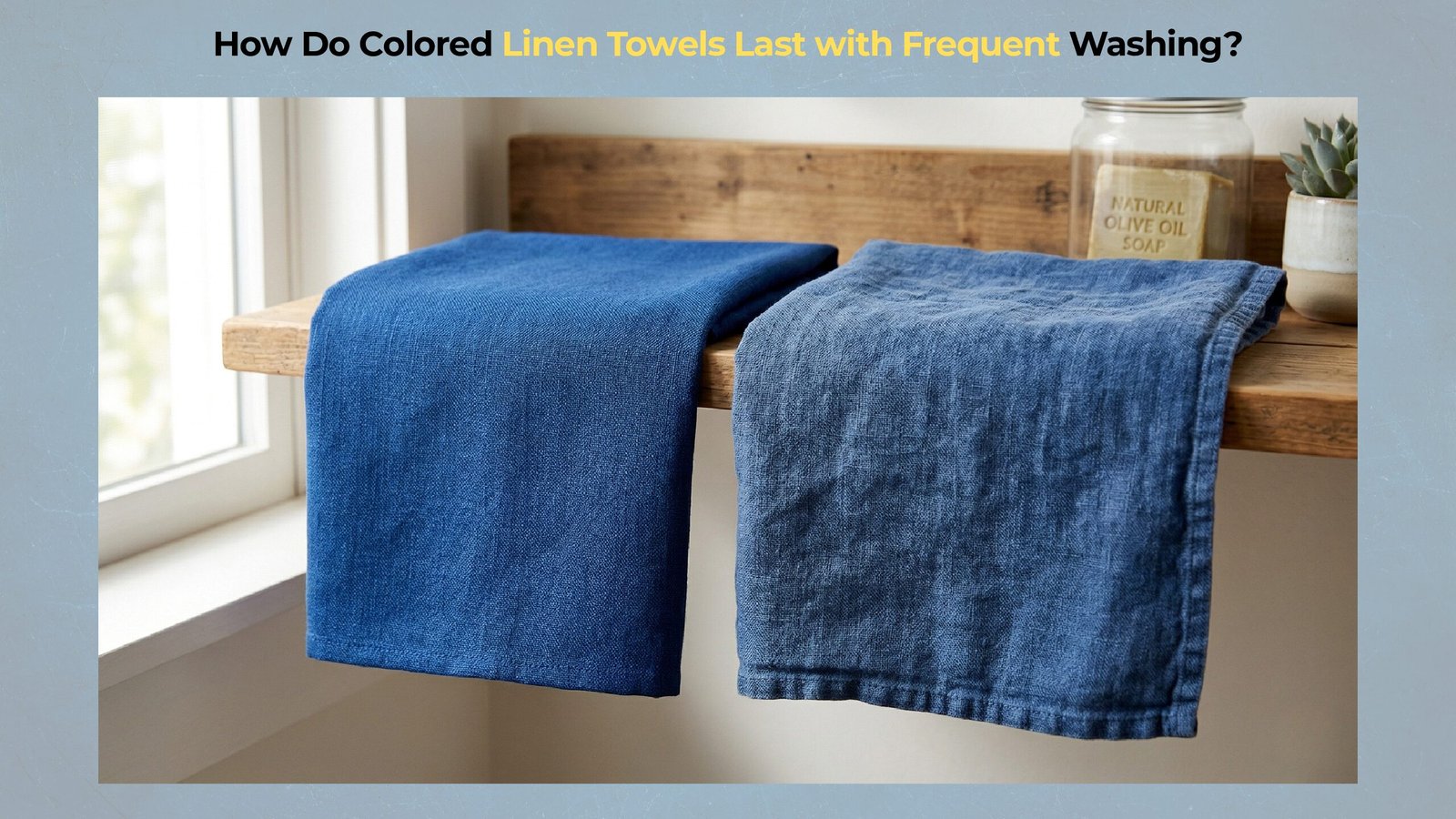
How Do Colored Linen Towels Last with Frequent Washing?
Authoritative Technical Guide to Dyed Bast Fiber Preservation
Colored linen towels can maintain acceptable color integrity for many years when users implement temperature-controlled laundering and mechanical preservation protocols, though gradual fading is expected over time.
Detailing how maintaining vibrancy is a matter of managing the “visual age” of the textile, we must shift perspective from basic laundry habits to objective dye chemistry. Every wash cycle introduces kinetic energy that tests the bond between pigment and cellulose. Concluding this analysis, we find that desiccation and friction are the primary determinants of long-term aesthetic value.
Why Does Colored Linen Towel Durability Matter for Long-Term Aesthetic Value?
Colored linen towels represent a significant household investment where linen durability primarily determines the “cost-per-use” by extending the period before mechanical wear or dye loss necessitates replacement. In premium interior design, the color of a linen textile is an intentional design choice; therefore, the premature degradation of that color undermines the entire aesthetic ecosystem. Visual aging requires identifying the specific link between color retention and perceived age to maintain the asset’s original value proposition.
How Does the Link Between Color Retention and Perceived Age Affect Colored Linen Towels?
Colored linen towels may exhibit a “frosty” or faded appearance because fading results from both mechanical fibrillation and the gradual chemical loss of dye molecules over time. While most users interpret a lighter shade as “lost dye,” the reality is often more structural.
Technical Fact: Fibrillation results from mechanical abrasion during the wash cycle, which shears the surface of the bast fiber bundles to scatter light. Unique Insight: “Fading” is a dual-mechanism process where structural fiber fatigue and pigment depletion occur simultaneously.
Is There a Fading-to-Softness Trade-off in Colored Linen Towels?
Colored linen towels undergo a natural evolution where the fiber fibrillation (‘blooming’) process that increases tactile softness simultaneously facilitates a gradual lightening of the textile’s hue. This is the central paradox of linen care: the breaking of rigid lignin bonds facilitates loft but increases the surface area for light reflection.
How Do Dye Molecules Bond to the Fibers of Colored Linen Towels?
Molecular bonding in colored linen towels is primarily dictated by the interaction between pigment surfactants and the crystalline cellulose regions of the flax fiber bundles. Unlike cotton, which has a more amorphous structure, flax presents a dense, crystalline architecture that acts as a barrier to simple immersion dyeing. We must focus specifically on crystalline structure and dye penetration to understand longevity.
How Does the Crystalline Structure of Flax Influence Colored Linen Towels?
Colored linen towels possess a highly crystalline cellulose framework that partially limits dye penetration compared to more amorphous fibers, which can necessitate specialized industrial processes to secure colorfastness. Technical Nuance: While flax is dyeable with reactive dyes, its crystallinity requires specific moisture-transport pathways for effective delivery. The density of the crystalline regions is a key factor in why high-quality dyed flax often requires more specialized industrial processing than seed-based textiles, which often prioritize protocols like cotton mildew prevention over molecular dye stability.
Why Is Yarn-Dyed Construction a Standard for High-Quality Colored Linen Towels?
Colored linen towels can achieve superior color depth and wash-durability when utilizing yarn-dyed construction, where individual fiber bundles receive pigment saturation prior to the weaving process. This differs significantly from piece-dyed towels, which may exhibit “center-core” paleness in dense loops. We reference ISO 105-C06 (Colorfastness to domestic and commercial laundering) as the primary benchmark for this construction standard.
Which Laundry Steps Maximize the Color Lifespan of Colored Linen Towels?
Colored linen towels require technical adherence to temperature controls and UV-safe drying to significantly reduce the chemical oxidation and mechanical shearing of the pigment layer. High-heat environments act as a catalyst for dye-fiber bond hydrolysis, leading to accelerated leaching. Proper temperature management is also essential to manage linen drying time effectively without compromising the pigment layer during the dehydration phase.
How Does the “Cold-Wash” Protocol Protect Colored Linen Towels?
Colored linen towels maintain their original saturation levels longer when washed at or below 30°C (86°F) because lower thermal energy significantly reduces dye migration from the fiber. Instruction: Mandate pH-neutral detergents free of optical brighteners. Evidence Mention: Reference industrial colorfastness data (e.g., AATCC 61) showing that high thermal energy facilitates the kinetic diffusion of reactive dyes.
Why Does the Shaded-Air Rule Prevent UV Damage in Colored Linen Towels?
Colored linen towels can suffer from gradual to rapid hue degradation if exposed to direct sunlight because UV radiation initiates an oxidative process that breaks chemical dye bonds. Instruction: Restrict air-drying linen towels to shaded zones with active cross-ventilation. Technical Fact: Sun-bleaching rates depend on exposure duration and dye type, but the chemical change results in permanent loss of color intensity.
How to Select High-Quality Colored Linen Towels Using a Performance Matrix?
Selection of colored linen towels involves an analysis of dye saturation levels and industrial certifications to ensure the textile aligns with high-frequency laundering demands, outperforming the synthetic microfiber drying speed in terms of aesthetic longevity. Use the matrix below for structured procurement evaluation.
| Color Category | Fade Risk | Technical Reason | Maintenance Tier |
|---|---|---|---|
| Natural / Flax | Very Low | No added dye, but natural oxidation occurs | Lowest (Utility) |
| Pastels | Low | Low pigment density | Moderate (Residential) |
| Deep Tones | Moderate–High | Higher contrast visible during fading | High (Cold wash only) |
| Vibrants | Highest | Maximum pigment saturation load | Expert (Acetic Reset) |
Do Industry Standards Secure the Safety of Colored Linen Towels?
Colored linen towels often carry Oeko-Tex Standard 100 or Masters of Linen certifications to verify safety and production standards associated with high-quality textiles. Unique Insight: Certifications verify the absence of harmful arylamines and the legitimacy of fiber origin, signaling a baseline of manufacturing quality.
How Can You Restore the Vibrancy of Dull or Faded Colored Linen Towels?
Restoring colored linen towels that appear “ashy” or grayed involves chemical resets that restore clarity by removing the residue that masks the original color. This process addresses the “residue mask” rather than replacing lost pigment.
Does Mineral Stripping Restore Clarity in Colored Linen Towels?
Colored linen towels can regain their visual luster if a periodic acetic acid (vinegar) rinse dissolves the calcium “crust” that typically grays the appearance of dyed fibers. Instruction: Run one cycle with 1 cup of white distilled vinegar and no detergent to remove residue masking the original pigment. ⚠️ Factual Directive: Vinegar and baking soda must be used in separate cycles to avoid neutralization.
How Does Oxygen-Based Brightening Support Colored Linen Towels?
Colored linen towels in light shades may benefit from a sodium percarbonate (oxygen bleach) soak to lift organic stains without inducing the fiber scission caused by chlorine. Defensibility Test: Oxygen bleach is safe for many colorfast linens but requires a patch test for “Expert Tier” vibrant dyes to ensure pigment stability.
How to Verify Your Strategy with a Colored Linen Towel Checklist?
Systematic technical audits of your maintenance habits verify that current protocols for colored linen towels align with objective performance benchmarks.
Checklist: Colored Linen Towel Durability Audit Checklist
- Chemistry Audit: Is the detergent verified as pH-neutral and free of optical brighteners?
- Thermal Check: Is the wash water temperature maintained at or below 30°C (86°F)?
- UV Audit: Is the drying location strictly isolated from direct solar radiation?
- Sorting Check: Are towels washed in monochromatic loads to prevent cross-pigment transfer?
- Texture Test: Does the dry textile feel “springy” rather than brittle or “crunchy”?
Frequently Asked Questions
This is likely due to “fibrillation”—the splitting of surface fibers that scatters light and creates a frosty appearance. It can also be caused by mineral buildup from hard water, which can be resolved using an acetic acid (vinegar) reset cycle.
Yarn-dyed construction is superior for longevity. Because the individual yarns are dyed before weaving, the pigment penetrates the core of the fiber bundle, whereas piece-dyed towels often only have surface saturation that wears away faster.
No. Fabric softeners leave a waxy residue that masks the original pigment and can chemically interact with reactive dyes. To maintain softness, rely on the natural “blooming” process of the fiber through regular, proper laundering.
For residential use, a chemical reset every 4–6 months is sufficient. If you live in a hard-water area or notice the colors becoming “ashy” sooner, you can increase frequency to every 3 months.
Yes. UV radiation causes irreversible oxidative damage to dye-fiber bonds. Shaded air-drying preserves the molecular integrity of the pigment layer, whereas direct sunlight can cause rapid hue degradation within just a few exposure cycles.
Technical Disclaimer
The information provided in this guide is for educational and technical reference purposes only. Outcomes regarding color retention and fiber longevity are conditional upon a variety of factors, including specific textile manufacturing processes, local water pH and mineral content, detergent formulation, and individual machine mechanics. While these protocols align with industrial benchmarks such as AATCC 61 and ISO 105-C06, Toweldaily.com cannot guarantee universal results. Always perform a patch test in an inconspicuous area before applying chemical reset protocols to vibrant or delicate dyed inventory.
Final Summary: Do Colored Linen Towels Align With Your Aesthetic Goals?
Operationalizing a strategy for colored linen towels requires a shift from convenience-centric washing to a preservation-centric model that honors the unique chemistry of the dyed flax fiber.
Value Summary
- Dye Integrity: Managed via low thermal energy and pH-neutral surfactants.
- Structural Clarity: Maintained by minimizing mechanical fibrillation and UV oxidation.
- Asset Restoration: Achieved through mineral stripping resets rather than abrasive bleaching.
“Ultimately, a superior linen experience is defined by the precise colored linen towel maintenance that turns a functional textile into a lasting aesthetic asset through technical care.”